
저자: PeterSchiff · 외국인
요약 보기
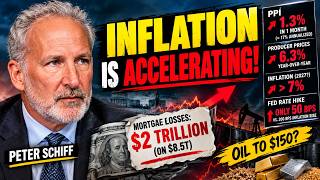
결론: 인플레이션 폭탄이 임박했으며 유가·원자재 급등과 주택시장 붕괴 우려가 겹쳐 생활비 위기가 더 악화될 것이라는 경고. [최근 물가 데이터] 9월 PPI 전월 대비 1.3%로 연환산 약 17%, 수출물가는 한 달 2.2%로 연환산 약 30%라는 수치를 근거로 듬. [유가·원자재] 유가가 5개월 신고가인 배럴당 110달러를 기록했다고 언급하며 150달러 이상으로 더 오를 것으로 전망. 에너지뿐 아니라 모든 원자재 가격이 오를 것이라고 주장. [주택시장] 주택 지표가 매우 나쁘다며 2007년 금융위기 직전과 유사하다고 평가. 2008년과 같은 주택시장 위기가 진행 중이라고 주장. [연준 정책 비판] 연준이 물가 상승을 반기며 2% 평균 목표제로 정책 긴축을 피했다고 비판. 2020~2021년 과도한 통화·재정 부양이 인플레이션을 촉발했다고 설명. [팬데믹 정책 비판] 실업 수당이 임금보다 많아 근로 유인이 약해졌고, 임대료·학자금 상환 유예와 PPP 대출 부정 수급 등으로 소비 여력이 커졌다고 주장. [출연자 입장] 당시 자신만이 인플레이션을 경고했다고 강조하며, 현재 생활비 위기가 더 나빠질 것이라고 결론. [종목·자산 언급] 대상 종목 중 직접적인 매수·매도 언급은 없음. 금 관련 언급은 있으나 구체 방향 예측은 없음. [리스크] 인플레이션 가속과 주택 침체가 동시에 일어날 수 있다는 위험 강조.
다듬은 글
There is an inflation bomb that is going to be going off. The September PPI was up 1.3% in one month. That annualizes out to 17%. That is a huge number. But look at the export prices up 2.2%. That's more than the entire 2% one-year inflation target in a single month. That annualizes to 30% inflation.
Oil prices hit a new 5month high today. We hit $110 a barrel. So oil prices are going to go up towards 150 and then higher. And it's not just oil. It's going to be everything energy related, all commodity prices. The housing data is so bad. It reminds me of 2007 before we had a financial crisis. So you've got something similar to 2008 happening in the housing market.
Something similar to 2021 happening with inflation, except they're happening at the same time. If you think the cost of living crisis is bad now, wait, do you see how much worse it's about to get? The Peter Shiff Show. As I've been looking at all of the recent data that's been coming out, both on inflation and housing, I'm reminded of two times in the past where we had what should have been warnings of a problem, but where the mainstream was very complacent in the face of what should have been some very, very problematic evidence that showed that there was a real problem.
This relates to both inflation and housing. And I'm going to start with inflation. That's kind of where I left off on my last podcast. We talked about the CPI numbers on the podcast. We hadn't gotten the PPI numbers or the import export prices. They came out the following two days. I did discuss those on my Friday shift gold market rap, but I never got a chance to discuss it on the main podcast.
So, I'm going to do that again today. But what this time period reminds me of is late 2020s, early 2021 as the CPI and PPI numbers and the import export prices really began to move up. And it was pretty much similar to what's happening now in that the producer prices were making bigger moves than the CPI and so were import export prices.
And I remember on my podcast specifically talking about these numbers, the import export prices, how they were more reliable, how they were more valid because of the lack of subjective manipulation. no substitution, no hydonics. But I also talked about the fact that these numbers were leading indicators of the consumer price increases.
And the rise started in late 2020. And again, Donald Trump was president. And initially, nobody really cared about it. Nobody thought it was of any concern. In fact, that's when the Fed initially adopted its inflation averaging target because inflation rose above 2%. Even as measured by the CPI, but instead of reacting to that by tightening policy, the Fed said, you know, we need to go a little bit above 2%.
we we need to make up for all of the years where we were below it. Which at the time I pointed out that that was a bunch of nonsense. There was no reason to make up for the fact that inflation was below 2% as if we got jipped or something like, "Hey, you know, I know you guys were really hoping for 2% inflation, but you didn't quite get it.
Your cost of living only went up by 1.8%. So don't worry, we're going to make it up to you. I know you missed out on that extra 2% increase in the cost of living, so we're going to let inflation run a little hot so you can catch up because we don't want to feel that you got jipped out of all the inflation that you're entitled to.
So, we're going to make sure. I mean, it was nonsense. And again, one of the other reasons that I remember was a bogus justification for targeting 2% inflation is the Fed said, "We want to make sure that we don't have deflation." So if you know if we try to have inflation that's too low, we could slip into deflation.
And so in order to make sure that prices don't go down because we all know what a disaster that would be. If the cost of living actually went down, all hell would break loose. So we need to save the public from the pain of the cost of living going down. We want to make sure it goes up, but we have to make sure it goes up by 2% because we don't want to get too close to zero because we might slip into the negative.
Well, if we avoided deflation for prior years, if we didn't get a negative number, if we got 1% or 1.5% or 1.8%, there's no reason to try to make up for that because we dodged that that bullet. So why go back and say, "Hey, now we want to make sure it's 2%." Because lower inflation is better than higher inflation.
So 1% is better than 2%. But the Fed wanted to come up with an excuse not to tighten policy. And so they came up with that BS inflation averaging. We're not trying to get 2%. We're trying to have inflation average 2% over time. And again, at the time I said that eventually they're going to give up on that because inflation is going to be so high they're not going to talk about averaging it back down.
And that's exactly what happened. But I don't want to get into that particular aspect in today's podcast. The point that I'm making now is that the Fed wasn't worried that inflation was rising. In fact, it welcomed it. It acted as if it was good news because it was helping to average up the too low inflation of the past.
And this should not have been a surprise that the numbers started to move up because we unleashed the most inflationary monetary and fiscal policy in US history during the COVID years during the pandemic. And I was talking about this. I called this out. Remember most of the mainstream economists and strategists when they looked at the pandemic, they thought it was deflationary.
They thought, "Oh no, the economy is tanking. People are losing their jobs. GDP is going down and this is going to be deflation." And you know, initially interest rates went way down. As if you know that was going to happen. The stock market went down. And so everybody was saying, "Hey, we need stimulus.
We need stimulus to fight off this deflation. And I was on my podcast at the time saying the opposite, that it was highly inflationary. Yes, people were losing their jobs, but they weren't losing their paychecks. In fact, their paychecks were bigger. Remember, a lot of people who lost their jobs, the government replaced their paycheck with unemployment benefits that exceeded what they were earning.
This was for the first time ever where it was better to lose your job than have your job because you actually got more money being unemployed than you got working. And for most Americans, you know, that's a great deal because they don't really like their jobs. They're happy not to go to work, especially if they get a bigger paycheck not working than working.
You know, I remember there were a few Republicans at the time that wanted to have a limit where they adjusted these benefits so that you couldn't get more. The most you could get was 100% of what you were earning. And even that was an incentive not to work. Because if you can get paid the same amount not to work as if you work, well then why work?
Especially since you don't have to commute back and forth. That costs money. That takes time. You got to get ready for work. Women, you know, they spend a long time getting their hair done, getting their makeup done. They don't get paid for that, but they got to do that. So, that's takes time out of their day.
And if you don't have to do any of that, if you can just lie in bed and sleep in and get the same amount of money. But even that, that was shot down in a bipartisan way. They said, "No, no, no. This is too big an emergency. We don't have the time to do that. We just have to send out these checks. Everybody gets the same check no matter what they're earning.
It's too important. And how could you be heartless? You know, during a pandemic, people are dying. People are quarantined. Yet, you want to restrict some of this money. No, everybody has to get this money. And so, people were at home and they were shopping. They were buying stuff. They were spending money.
They weren't producing stuff. They weren't working. They weren't productive, but they were buying. That was highly inflationary. What should have happened to the extent that we even did this asinine policy of quarantine and nobody goes to work, we should have said, okay, well then everybody has to stop spending.
If you're not working and you're not earning money, well, you know, you can't spend. And in fact, what the government did, even though the government was flooding consumers with money, they said, "You don't have to pay your rent. You don't have to pay interest on your student loans." So, people were actually earning more money than they did when they had jobs, and they didn't even have to pay their rent.
They didn't even have to pay back their student loans. So, it freed up massive amounts of money for spending. And you know, it wasn't just the workers that got all this free money. Remember the PPP where if you had a small business, you know, you could just apply for a PPP loan. And they weren't even loans.
They were gifts because you didn't have to pay the money back. So, you know, if somebody loans you money, but you don't have to pay it back, how do you even call that a loan? That that's a gift. And I remember at the time when they were doing this, there was a couple of Republicans that said, "Hey, I think that people should have to validate or verify that the information is accurate.
There should have to be some kind of proof that they actually have a business here." And also there were some Republicans that wanted to have a a contingency that you actually had to prove that your business suffered a decline in its revenue because of CO because a lot of businesses actually made more money during CO.
It it wasn't like everybody's business suffered. A lot of people had higher sales during CO. I mean my bank tanked during CO. I mean, all of our transactions went down and so my bank had a tough year, but my asset management company, we had a great year. I I had a record year at Shift Gold. Lots of people were buying gold in 2020.
I had record sales. So, that business didn't suffer during co It actually did well. But I could have just applied for a PPP loan and I would have got it. Jeff Gold would have got one. I could have lied like everybody else. My asset management company. I could have applied for a PPP loan there. I would have got one, but there was some Republicans that said, "Yeah, let's make people prove that they actually need the money and verify." And that was shot down.
Congress said, "No, we can't do that. That's not fair. That's heartless. We can't ask anybody. Let's just do the honor system. Let's just trust Americans to be honest with their PPP loans." Yeah, what a ridiculous idea that was. Cuz I pointed it out. You know, I did Monday morning quarterback. There are a lot of people years later that came back and said, "Yeah, this was not a really good idea.
There was a lot of fraud. There was a lot of abuse." Well, I said that that was going to happen as they were passing these bills that it was going to be fraught uh with fraud and abuse. It was going to be the most abused government program ever conceived. And that's exactly what happened. And sure, there have been a few people that have been prosecuted for fraudulently applying for these loans, but the vast majority of fraudulent loans were never repaid and the borrowers were never prosecuted.
But the point is that all of these people, whether they were business owners or pretend business owners or employees, the government gave them money. All this money, you know, the Fed's balance sheet exploded. It went from 4 trillion to 8 trillion as we dropped interest rates to zero. We lit an inflationary fire during co.
Now most people again don't understand what inflation is. So they didn't care that we were creating all this inflation. But then when the sparks, you know, became obvious, when you started to see the consequence of the inflation in the PPI, in the import export prices, in the CPI, nobody cared. Nobody was worried but me. I was out there screaming on my podcast, "Hey, we got a big inflation problem


Comments 0