저자: PeterSchiff · 외국인
요약 보기
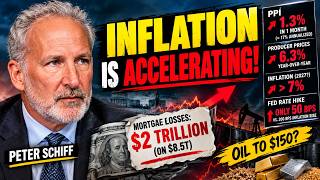
결론: Peter Schiff은 인플레이션이 급격히 심화되고 주택시장과 미국 모기지 대출 기관이 구조적 위기에 처해 있으며, 이에 따라 금·은 등 귀금속 매수가 계속 유리하다고 주장한다. [유가·물가 전망] - 국제유가는 최근 5개월 고점인 배럴당 110달러까지 올랐으며, 중간선거 이후 전략비축유(SPR) 방출이 중단되면 150달러 이상으로 상승할 것이라고 전망했다. - 에너지 외 원자재 전반으로 가격 상승이 확산될 것이라고 보았다. 본인의 9월 전기요금이 전년 동월 대비 26% 올랐다고 언급했다. - 스트리밍 서비스 등 구독료는 매년 8~10%씩 인상되고 있다고 주장했다. [생산자물가(PPI)·수입물가·수출물가] - 9월 PPI는 전월 대비 1.3% 상승(연율 약 17%), 전년 대비 6.3%이다. - 근원 PPI는 전월 대비 0.6%(연율 약 9%)이다. - 수입물가는 전월 대비 1.1%(연율 약 14%), 전년 대비 8.1%이다. - 수출물가는 전월 대비 2.2%, 전년 대비 11.6%로, 수출품 가격 상승은 미국 내 소비자 물가에도 전가될 것이라고 주장했다. [연준·금리 전망] - 케빈 워시(Warsh) 연준 의장 취임 후 5개월간 125bp 인상이 있었으나 충분하지 않다고 평가했다. - 시장은 12월 이전 추가 25bp 인상을 기대하지 않는다고 언급했으며, 이에 따라 귀금속 매도는 잘못된 판단이라고 주장했다. - 2026년 CPI가 7% 이상 오를 것으로 예상하며, 트럼프 행정부 4년간 누적 물가 상승이 바이든 4년보다 클 것이라고 주장했다. [주택시장 전망] - 9월 기존주택 계약건수 지수는 66으로 2001년 지수 작성 이후 최저 수준이며, 전월 대비 7.3% 하락했다. - 주택건설업체 신뢰지수는 29로 2012년 이후 최저, 건설업체의 43%가 가격을 인하 중이다. - 신축 주택이 중고 주택보다 저렴해지고 있어 기존 주택 가격도 하락할 선행 신호라고 주장했다. - 모기지 금리 7.5%가 8.5~9%까지 오를 수 있으며, 이 경우 같은 소득으로 살 수 있는 주택 가격은 절반으로 떨어져야 한다고 보았다. 주택 가격은 2008년 수준인 최소 30% 이상 하락할 것으로 예측했다. - 이민 정책과 관세로 건설 비용이 상승하고 건설 고용이 줄어들 것이라고 언급했다. [모기지·금융 시스템 리스크] - 미국 고정금리 모기지 약 8.5조 달러(평균 잔존 만기 25년, 평균 쿠폰 4.6%)의 미실현 손실이 약 2조 달러에 달한다고 주장했다. 금리가 8.5%로 오르면 손실은 약 3조 달러로 확대된다고 했다. - 2008년 금융위기 때 실현 손실이 약 4,500억 달러였던 것과 비교해, 현재 미실현 손실은 그 4배 수준이라고 강조했다. - 시그니처밸리은행(실버게이트 등 사례 언급) 파산을 예로 들며, 예금 인출 압박 시 손실 매각이 불가피해 금융 시스템 전체가 지급불능 상태에 있다고 주장했다. - 주택 가격 하락 시 연체·깡통주택이 늘어나 실제 손실로 이어질 것이라고 보았다. [투자 관련 발언] - 연준 긴축이 부족하고 물가가 계속 오르므로 금과 은은 12월 이후에도 매수 대상이며, 현재의 귀금속 시장 반응은 둔감하다고 평가했다. - 리스크: 자막상 발언은 예측 성격이 강하며, 일부 시나리오(2027년 CPI 7% 이상 등)는 조건부 전망이다. [출연자 전망 요약] - 인플레이션 가속, 연준 대응 부족, 주택시장 급락, 모기지 금융기관 손실 확대가 맞물려 있으며, 이로 인해 귀금속 강세가 지속될 것이라는 입장이다.
다듬은 글
The unrealized losses right now on 8 and 1/2 trillion in mortgages is about $2 trillion. If the lenders had a mark to market, if you had to sell your book of mortgages today, and you had a book of mortgages with a 4.6% coupon and 25 years left, you would have huge losses. Collectively, the losses are about $2 trillion on 8 and 1/2 trillion.
Now, the lenders will say, "Well, you know, they're not real losses because, you know, all we have to do is hold on to these mortgages for the next 25 years, and we're golden." Yeah, the problem is you may not be able to do that. That's why, you know, Signature Valley Bank failed. Because oil prices hit a new 5-month high today.
We hit $110 a barrel. But, I think oil prices are going to soar after the midterms. Because that they're going to have to turn off the spigots on the Strategic Petroleum Reserve. So, oil prices are going to go up towards 150, and then higher. And it's not just oil. It's going to be everything energy related.
All commodity prices. This is a huge inflation problem. You know, I mentioned on on X yesterday I got my electric bill for I think it was September, and it was 26% higher than it was for the same month in the prior year. The same house, same appliances. That's a big increase in my electric bill. And, you know, this is happening I'm sure across the country.
And insurance is going way up. All all kinds of I'm looking at these streaming services. You know, I subscribe to quite a few of them. You know, the Netflix earnings route today. But, all these streaming services, every year, there's never been a year that they don't jack up the price. And the price increases are way way above 2%.
They're usually like 8%, 10% every year, like like clockwork. Everybody keeps raising their prices. So, when Trump is talking about how prices are coming down everywhere, again, that's the same nonsense he said in December when he got me kicked off of Fox News. It's almost going to be a year now. It's about, I guess, 10 months since I was banned from Fox News because I said that prices were going up.
And what did I say on that interview in December? I said that oil prices were going to keep rising. The administration was saying they expect oil prices to go down. I said, "No, they're going to keep rising." And I said that the cost of living was going to keep going up, that the president's policies were not working.
They were not lowering inflation. And he went ballistic cuz he said, "I'm a jerk cuz I don't realize that prices are coming way down. Everything is getting cheaper." Nothing is getting cheaper. Everything is getting more expensive. But, the point I'm making here is this should be an alarm. Cuz look at these other numbers, right?
So, look at the PPI numbers that came out after we got the CPI. And nobody really talked about these because, you know, they talk about the CPI. They don't bother to look at the PPI even though the PPI is a glimpse into the CPI. Because before consumer prices go up producer prices go up because that's that's the chain.
I run a business. My costs are going up. All this stuff I'm buying is more expensive. Now I got to raise my prices. I got to recover that. I got to maintain a profit margin. So, there's a step of how prices go up. And so, you can't just ignore what's happening to producers and just wait until, you know, it trickles down to the consumer.
But the September PPI was up 1.3% in 1 month. That annualizes out to 17%. That is a huge number. What are the producers going to do with these higher prices? They're going to pass them on. But even now, year-over-year, the annualized increase in producer prices is 6.3%. That is a big number. People should be alarmed like, "Oh my gosh, we got a problem here." You know, the Fed is is too loose.
We need some serious hikes. No. In fact, the odds of a rate hike this month crashed because of some comments from Warsh. So, the markets don't even expect another quarter point rate hike until December. Warsh has been Fed chair for 5 months. All he's done is 125 basis point hike. And maybe we'll get a second one 7 months in.
Meanwhile, look at what's happened to inflation. Inflation has risen so much more than rates. If we end up, let's say, with just 5% inflation this year versus about 3% last year, that's 200 basis point rise in inflation. And maybe we'll get a 50 basis point rise in rates. That's not tight money. That means that interest rates have come down.
The Fed has eased policy because in the face of a 200 basis point increase in inflation, the Fed only raised interest rates by 50 basis points. That's 25% of the increase in the inflation rate. You're not going to bend the curve when you're that far behind the curve. But the numbers are suggesting that next year, it's going to be a lot higher.
In fact, I would not be surprised if inflation in 2027, in fact, I would forecast this, for the whole year the CPI will go up by more than 7%. That will be more than the highest year, 2021, under Biden. And I've already said this from the beginning, that the cumulative increase in consumer prices during the four years that Trump is president will be bigger than the four years when Biden was president.
And what makes it worse is that the huge increase in the cost of living under Trump is on top of the huge increase in the cost of living under Biden. That's what makes it so much worse because it already was so bad. And instead of solving the problem, which is what Trump promised, he promised that prices would be coming way down on day one, he made the problem even worse.
And Producer price data can offer clues about future consumer inflation. Businesses facing higher costs for imported materials, energy, transport, or labor may eventually raise prices to protect their margins. But pass-through is neither immediate nor guaranteed. Companies can absorb some costs, improve efficiency, or accept lower profits if customers resist increases.
Import prices may provide an earlier signal, while export prices reflect changes in goods sold abroad and can also influence domestic markets. A single monthly jump can be volatile, so economists compare monthly readings with annual trends and measures. The key is to assess a pattern, not one number alone.
The core PPI that we got last week was up 0.6. That's the core. Annualize that, that's 9%. But the worst numbers were the import-export prices. And that's exactly what was happening in 2021. Go back and listen to my own podcast. When everybody was talking about the CPI, I was talking about import-export prices.
I'll say, "Hey, wake up. Look at what's happening to prices. Import prices were up 1.1% in September. In 1 month. That annualizes to 14%. The year-over-year increase in import prices, 8.1%. There is a lot of inflation in the pipeline because the import prices even come before the producer prices. They're they're the earliest indicators of what's going on.
But look at the export prices, up 2.2%. Now I look I know a lot of there's energy in there, but still 2.2%. That's 1 month. That's more than the entire 2% 1-year inflation target in a single month. That annualizes to 30% inflation. But even the year-over-year increase in export prices is 11.6%. And again, people may think why should we care about export prices cuz we don't pay those?
Well, the stuff that we export, we don't export it at all. We we produce it, we consume some, and we export the rest. So that means the cost of the stuff that we're producing here is going way up. So Americans are going to pay higher prices, too. It's not just the Europeans or the Canadians or the Mexicans or whoever is buying this stuff from us, Americans are, you know, looking at the same increase in prices.
So there is a inflation bomb that is going to be going off. And everybody is so complacent, nobody cares. They're talking about, well, we might have another 25 basis points or, you know, that is nothing. That is nothing. And again, if Warsh really was a tough inflation fighter, we would have had a lot more than 125 basis point rate hike in the face of all this horrible data on inflation and consumer prices.
And of course, you know, the precious metals market still is not reacting. They're still looking at oh, the Fed's going to hike rates by another 25 basis points in December. We better sell gold. We better sell silver. These rate hikes mean nothing cuz again, by then the inflation numbers are going to be a lot worse.
So, the Fed is going to be even further behind the curve when it hikes rates by 25 basis points in December than it is right now. So, there's going to be even more reasons why people should be buying gold and silver in December than they're doing right now. Now, the other numbers that are reminding me of a prior period are the housing numbers.
The housing data is so bad. It reminds me of 2007 before we had a financial crisis that was the result of a collapse in home prices. It was falling home prices that ultimately caused the problem. It wasn't just that we had adjustable rate mortgages that were resetting. Because had real estate prices not go down, even if borrowers couldn't afford to make those higher payments, they could have sold their houses.
Or even if the bank had to foreclose, if the home prices held up they wouldn't have had the losses. The problem was that the lenders lost money on defaulted mortgages. That's where all the losses came from in the financial sense. But, central banks try to control inflation by adjusting interest rates and influencing financial conditions.
If prices rise faster than borrowing costs, real interest rates may fall, leaving policy less restrictive than rate suggest. Still, monetary policy works with delays, and officials weigh employment, credit conditions, and economic growth alongside inflation. Raising rates too aggressively can weaken demand and strain borrowers.
Moving too slowly can allow inflation expectations to become entrenched. Investors therefore watch central bank statements, inflation reports, wage growth, and energy markets together. Forecasts of exceptionally high inflation should be treated as scenarios, not certainties, until evidence confirms the trend.
I was talking, you know, going on television, I was writing articles, pointing out all of this data related to the housing market. I was talking about all the inventory of homes that couldn't sell. You can go back and look at the Peter Schiff Was Right video when I'm talking about how real estate prices are going to collapse and I say, "Aren't you looking at all the inventory, all these homes that are on the market that aren't selling?" And people are saying, "Yeah, and so what?
Nothing is happening." Nobody could look forward to see what was obvious. And one of the reasons is because people kept saying, "Well, real estate prices never fall. They've never fallen in the past, so you're crazy, Peter. They're not going to fall." And I would say, "Well, wait a minute. But, real estate prices never went way up like this before.
So, if we had an unprecedented rise, why can't we have an unprecedented fall? It doesn't make any sense that real estate prices are going to go way up and then just never go down because they haven't gone down in the past." Well, they've never been this elevated and I knew why they were so high. The Fed slashed interest rates to 1% in 2001 and it raised rates very slowly and it allowed Wall Street to create these securitized mortgages and the subprime market and you had Fannie and Freddie and buying subprime and and doing all this stuff.
So, I knew that there was a bubble in the housing market and when I started to see all the evidence in 2006, 2007, go look at my mortgage bankers speech from 2006 on YouTube. The evidence was already there. You could see the data that there was going to be a big drop in home prices and that was going to create a problem and no one cared.
Complete complacency until after the fact, until after Bear Stearns went bankrupt, Lehman went bankrupt, Fannie and Freddie went bankrupt. We're in full-blown crisis and now all of a sudden, oh, I guess there was there was a problem there. Same thing is happening again in the housing market. Look at some of the data that we just got.
So, today pending home sales This is an index of pending home sales dropped by 7.3% in September. This is the biggest drop since December last year, but more importantly is the level of the index. It's at 66. That [snorts] is the lowest in the history of this index, which started in 2001. So, in the last 25 26 years this is the lowest the pending home sale index has ever been.
Of course, it's headed a lot lower than this, but it's already the lowest. But if it's the lowest right now that means it's lower than it was at any point during any of the years associated with the 2008 financial crisis. So, you have fewer homes being sold than in 2007, 2008, 2009. Home builder confidence is collapsing.
September housing market index fell to 29. That's the lowest since 2012. 43% of the builders are slashing their prices and in fact, if you go and look now in a lot of the markets around the country, the new homes are selling for substantially lower prices to the existing homes. Think about that. A brand new home can be bought for less money than a used home.
It should be the other way around. The new homes should be more expensive. But the reason they're not is because the developers need to get rid of them. So they are marking them down. See, right now the existing home market, the homeowners are not motivated yet. They're sitting there with a 3 4% mortgage.
They're in no hurry to reduce their prices. And you know, you just own one home. So you know, you can sit there and pay your mortgage and you can wait until you think you're going to get the price that you believe your house is worth. But if you're a home builder and you've just got all this inventory, you have to have a more realistic outlook.
You know, you need to move the product. You need to sell. So they're slashing their prices. But housing markets can weaken when home prices and mortgage payments outpace household incomes. Falling pending sales, builders, and growing discounts on new homes may signal that buyers are struggling with affordability.
Builders can cut prices faster than existing homeowners who may have low fixed rate mortgages and little incentive to sell. If new properties become cheaper than comparable older homes, sellers may eventually face pressure to adjust expectations. However, local markets differ and one indicator cannot establish that a crash is imminent.
Analysts also examine inventory, construction permits, credit standards, employment, and household finances to judge the depth of housing stress. What builders are also realizing is, you know what? We really can't sell these homes. Because nobody can afford to buy them. Mortgage rates are at 7 1/2% and construction costs are soaring.
Inflation is pushing up construction costs, tariffs are pushing up construction costs, the immigration policy, you know, Trump has succeeded. Yes, we don't have as many illegals in the country. Well, a lot of those illegals were building homes. And if they're not there, well, now they got to hire illegals and they want a lot more money.
And so home builders are in a very difficult spot. They really can't build a home that an American can afford. So, now they got to get rid of the homes they've already built, but they can't do that unless they slash their prices. So, this is going to lead to a lot of unemployment in in the housing sector.
I think this is going to be the weakest housing market as far as construction and sales that we've ever had until the bottom drops out. But you're going to see like it's going to completely freeze over, right? Activity is going to keep shrinking because of where the prices are relative to affordability.
But the fact that the new homes are being marked down, you know that the existing homes are going to have to follow. Because why would anybody buy a used home when I could buy a brand new one for less? Because the problem with a used home is there's a lot of problems there. You buy a new home, you get a warranty, you know it's brand new.
But home is 10, 15, 20 years old, there could be a lot of problems there. You may have to spend a lot of money on maintenance, on repairs. I mean, probably a lot of the the appliances are going to start going. Your air conditioners are going to start going. Your roof, if you buy a brand new home, all that stuff is brand new.
So, it's obvious that the new homes are a leading indicator. Real estate prices are going to fall. But they're not just going to fall by a little because a little's not going to help. They're going to have to fall by a lot, at least as much as they did in the 2008 financial crisis, which was a 30% drop.
And even then, I think it would be hard, especially if mortgage rates keep rising, because they're at 7.5% now. They can easily be at 8.5% early next year, and then 9% You know, at 9% if a mortgage is 9% in order for the payments to be the same as when mortgage rates were 3% the house price has to be cut in half.
So, if you can afford to buy a $500,000 house when you can borrow at a 3% mortgage the same income will only afford a $250,000 house at 9%. So, prices are going to have to collapse. And again I think incomes are already stretched, so most people don't even have as much money to buy a house as they did you know, back when mortgage rates were 3%, because food is a lot more expensive.
Electricity, the cost of living. So, they don't have as much money left over to even qualify for a mortgage. So, this is going to be a huge problem for the lenders. But, there's another reason that this mortgage crisis could be a lot worse than 2008. And nobody is talking about this. And I talked about it 10 years ago.
I knew that this was going to happen the minute I saw banks selling 30-year mortgages you know, at 3%, 4%. I knew this was going to come back to bite the lenders eventually. Nobody else seemed to care, because all they focused on was how great it was for the borrower that they could keep refinancing their mortgages.
Meanwhile, the banks that had 8% mortgages on their books, then 7%, then 6%, then 5%. People kept refinancing, and every time they refinanced, they went back to a new 30-year mortgage. They reset the clock. So, the banks kept getting stuck with brand new 30-year fixed-rate mortgages at ever lower rates.
Now, when the Fed was sitting back at 0%, they were making money, and as mortgage rates kept falling, yes, the mortgages until they got refinanced, they were gaining in value. But, today, it is a completely different story because now the interest rates have risen. Now, mortgage rates are 7.5% and now the banks are stuck.
There is about 8 and 1/2 trillion dollars of fixed-rate mortgages outstanding with an average maturity left of 25 years. 25 years. And the average coupon, the average rate on that 8 and 1/2 trillion is 4.6. Now, of course, there are some that are a lot lower. I mean, I've got one myself. I'm at 3 and 3/8 on on the one mortgage I still got.
But, I I've talked to people that that are actually under three. That's great for the borrower because, you know, you're paying these low rates, but it's lousy for the lender because you're sitting on a huge liability. Long-term fixed-rate mortgages protect borrowers when market interest rates rise, but they can lose market value for lenders holding them.
A loan paying 4% looks less attractive when new loans yield 7%, especially if decades remain before repayment. These valuation losses may remain unrealized if borrowers continue paying and institutions can hold the assets. Yet liquidity pressures can force a lender to sell investments at unfavorable prices.
Banks manage this risk through capital, deposits, hedging, and asset-liability strategies with varying degrees of success. Mortgage exposure alone does not prove insolvency, but concentrated interest rate risk deserves careful scrutiny closely. The unrealized losses right now on 8 and 1/2 trillion in mortgages is about $2 trillion.
If the lenders had a mark-to-market, if you had to sell your book of mortgages today, and you had a book of mortgages with a 4.6% coupon and 25 years left, you would have huge losses. Collectively, the losses are about $2 trillion on 8 and 1/2 trillion. Now, the lenders will say, "Well, you know, they're not real losses because, you know, all we have to do is hold on to these mortgages for the next 25 years and we're golden." Yeah, the problem is you may not be able to do that.
That's why, you know, Signature Valley Bank failed because their customers wanted their money. And so, they had to sell. They had to realize losses on their underwater portfolio of Treasuries or whatever they had. I mean, the the entire financial system is insolvent because it has collateral that it can't sell, assets that can't be liquidated.
If there's a run on the bank, if depositors want their money back, the lenders, if they own these mortgages, they can't give the depositors their money back because they lost it. You know, they can't say, "Well, you know, yeah, we got your money and we can give it back to you over the next 25 years as we get the money back from our mortgages, but, you know, we can't just give it to you today because, you know, we lost it because the mortgage is worth 80 cents on the dollar." But, it's going to get worse when mortgage rates hit 8 and 1/2% it's a $3 trillion unrealized loss.
This is on the mortgages that that aren't going bad. All the mortgages. Remember that we had the financial crisis in 2008 because there was about $450 billion of realized losses on defaulted mortgages. We have $2 trillion in unrealized losses right now. That's four times the actual losses during the years of the financial crisis, but another thing nobody talks about.
Only 10% of the mortgages went bad. So 90% of the people paid and those mortgages gained in value cuz the Fed slashed interest rates to zero, mortgage rates collapsed. So if you had a book of mortgage loans it appreciated. I think the unrealized gains initially on the mortgages that were outstanding was about $1.3 trillion.
So the unrealized gains exceeded the realized losses. So in general the lenders were were in good shape. Yeah, they lost some money, but the the value of their portfolio went up by more than the losses that they had to cover. This is the opposite. The banks are losing money on 100% of their mortgages even if none of them go bad.
The losses are worse because they were dumb enough to make these loans and I was saying this at the time how stupid it was to loan somebody money especially that last round of refinancing during COVID when interest rates were zero and the banks were dumb enough to issue brand new 30-year mortgages with a three handle.
Did they really think that interest rates were going to stay that low for that long? No, they didn't give a damn. They just wanted to do the refi's and generate the fees. They didn't care. All of those mortgages are huge money losers. That the lenders would have been better off had they just denied all these loans.
But they were dumb enough to do it. Yeah, it was great. I said on my podcast, I encouraged all my listeners, go out and borrow for 30 years, get the biggest mortgage you can and lock in this rate. I said it was going to be the best thing that you could do. As you're not going to make money as a homeowner, I said, you're going to make money as a debtor.
You're going to make money because you got all this cheap money locked up. Well, the reason the borrower makes money is because the lender loses it, right? It's a negative sum game. Normally, the lender makes money because, you know, he gets interest. But in this case, the lender loses money because he's not getting enough interest.
It's the borrower who's got all this cheap money. I mean, you could just take the money that you got from your mortgage. If you've got a 3% mortgage, you could just take the money and put it in the bank and get four you know, not in the bank, but in money market. The banks still don't pay anything. But you can get over 4% out of money market and just arbitrage the difference.
But what happens when those rates go to 5%, 6%, 7%? The banks are screwed. You're locked in for another 25 years. So, the banks have lost all this money before anybody defaults. But there are going to be defaults once real estate prices fall. Even if you've got a fixed-rate mortgage, you're not going to struggle to make the payments if you're upside down and have negative equity.
The 2008 crisis combined falling home prices, risky lending, defaults, and losses that spread through the financial system. Today's risks must be assessed on their own evidence, not assumed to repeat that history. Higher mortgage rates can reduce affordability, weaken home sales, and pressure borrowers already stretched by living costs.
Meanwhile, banks holding low-yield, long-duration assets may face losses if funding becomes expensive or depositors withdraw money. But outcomes depend on underwriting standards, capital buffers, regulation, and market conditions. Watch delinquency rates, bank disclosures, home inventories, and credit availability.
These indicators offer a clearer picture than dramatic predictions alone. Carefully.


Comments 0