저자: KimMun-hwa · 한국인
요약 보기
작가는 2013년 국내주식으로 투자를 시작해 2016년부터 미국주식에 투자했다고 소개한다. QQQ 등 지수에 매달 100만원씩 20년 정기 적립하면 복리로 자산이 크게 불어나며, 역사 데이터상 20년 투자 시 손실 확률이 0에 가깝다고 주장한다. 시장 폭락 시 매도 유혹을 피하고 소액으로 꾸준히 투자할 것, 과도한 레버리지와 욕심을 경계할 것을 강조한다. 은퇴자에게는 QQQ 기반 커버드콜 상품으로 현금흐름을 만들 것을 제안한다. 구체적 종목 가격 전망은 없다.
다듬은 글
Retirement is just around the corner. For those in their mid-50s, those who are now 60, or those who have already retired, if we invest about 1 million won every month using a regular investment method, it can grow much larger than we expected due to the compounding effect. I would like to suggest making an investment that moves stably with a zero chance of loss and generates the amount of cash flow I need .
I think your anxiety about the low will be largely relieved. [Bell sound] Yes. hello. I am Tax Accountant Du-kkeobi. The person I have invited today is, well , you are the book. First investment in U.S. growth stocks. Uh, recently the Korean stock market has faced a major crisis with the KOSPI plummeting, causing money to shift back to US stocks.
Just at that opportune moment, our author Kim Mun-hwa has written a book. So, writer Kim Mun-hwa is here today. First, could you please say a few words to our subscribers? hello. It is nice to meet you all . I am Kim Mun-hwa, the author of the book "Investing in US Growth Stocks for the First Time," which you just introduced .
I worked as an ordinary working mom for nearly 20 years before quitting in 2021, and now I’ve earned the nickname "FIRE Tribe ." So, actually, I did n't invest with the intention of pursuing FIRE, but I ended up becoming part of the FIRE community. Now, I write books, give lectures, and whenever I am invited, I come out and appear on shows like this.
I am so envious. Buyers? yes . Thank you so much. Actually, I think I was really lucky. And uh. Oh, everyone who did well always said it was luck. No, seriously, I don't think you can ignore crying . But I know that as so many people invest, there are really a lot of them setting their goals on FIRE .
It is good to set your goals on FIRE, but trying too hard does n't necessarily mean things will go well. I always believe that if you live diligently, there will eventually be a time when luck is on your side. I'm looking for [clearing my throat] by his side. I can't help but ask about U.S.-related stocks right from the very first question, and you have written about it in the book.
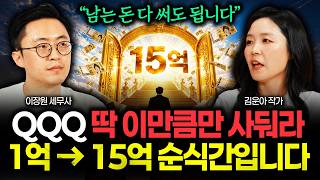
QQQ estimating the Nasdaq 100 example. A roadmap to build 1.5 billion won in assets by purchasing QQ . First, I am curious about what this part entails . Could you please explain it to me? yes . I didn't only invest in US stocks; I started my first investments with domestic stocks . [Laughs] In which year?
Back in 2013, there was no one around me who invested in US stocks. Naturally, I started my first stock investment with domestic stocks. There was a boom in Chinese stocks once in the middle. Oh, right, right, right. So, if you buy Chinese stocks now—if you invest just 10 million won—you can buy a Gangnam apartment in 10 years .
I think I heard that it goes up 100 times. yes. So, I had my first experience with overseas stocks through Chinese stocks . Then, emerging markets are also interested in investment, so yes, yes. I tried buying a very small amount of Vietnamese stocks, but then around 2016, I started investing in US stocks.
So, I didn't go into U.S. stocks knowing anything about them from the start, but as I continued investing, I became interested in various investments, and information started coming in little by little . While doing things like this, I started investing in US stocks in 2016 . That was already 10 years ago.
Ah, I see. yes . When I first started investing, I did n't know anything about the S&P 500 or QQQ either. I had absolutely no idea about the NASDAQ or anything like that. I just blurted out, "Apple, ah, individual stocks, yes, Microsoft, you know, those famous companies." Wow, that's still amazing. I always start with a gambler's temperament, you know, those penny stocks .
[Laughs] Hey, I bought something saying it would go up 100 times because of hydrogen, but now I'm stuck with it, MICE is at 98%, and stuff. Hey, I should have bought something like Apple. But back then, you needed to know something to buy even penny stocks, and since I did n't know any companies, there was n't much information available.
Nowadays, brokerage firms provide various stock recommendations and allow you to obtain all kinds of information, but back in 2016, investing in US stocks was still in its very early stages. So, there weren't many people who knew about this kind of information or indices, so I had no choice but to just buy a company I knew .
But what was really funny was that all the companies I use, like McDonald's, Domino's Pizza, and Starbucks, are located in the U.S. So, oh, this is really fun. Ah, I started with individual stocks because of that life . [Sigh] That is why I actually don't feel any pressure investing in individual stocks.
But many people feel a huge burden about starting with specific stocks, you know . And these days, investing in indices is so well-known that those starting out feel a bit less burdened, so I wrote about this in the book. If we consistently invest about 1 million won every month in QQQ using a fixed-rate method for about 20 years, our assets can grow much larger than we expected due to the compounding effect.
The average rate of return was calculated based on the average rate of return over the past 10 years . So, while there is no guarantee that future returns will match past returns, if you extend the investment period, stock investing is... If you analyze the historical data for US stocks, especially the SMP 500, you can see that data from 1928 to the present, 2024, is available.
If you run through all the results based on that data, they say that no matter which year you start investing, if the investment period is 20 years, the probability of incurring a loss is zero. Ah, so that's why it's been 20 years. So, even in Peter Lynch's book, there is a sentence stating that the appropriate investment period is 20 years .
It is a book I really like, so investing for about 10 years is not easy, but there is a slight chance of incurring a loss during that time . We talk about the Dacombubble a lot, you know. That's right . That's right. There is indeed a bubble. In particular, if you invest at the peak, there is a possibility that your investment will not recover for about 10 years .
But if you extend this further and invest for about 20 years, the probability of losing money goes to zero. Ah, then whether you invest in QQ or SP 500, if you invest your money consistently over a long period of time with peace of mind and without feeling burdened, I think you will be able to alleviate a lot of anxiety about your retirement.
Actually, the people who need to look at this are in their 30s and 40s, since it is a 20-year long-term investment. But I really understand why it’s not easy for people in their 30s and 40s. Because there are so many things to spend money on. They have to buy a house, get married, and if they are married, have children to raise and educate.
Since they have so many things to do, long-term investment doesn't go as well as they'd like . It's not easy. If you just consistently do this, it is practically an undefeated investment, isn't it? There is almost a 100% chance of success, but realistically, investing 1 million won every month for 20 years is difficult.
We need to acknowledge that and invest, but people have very ambitious plans when they invest. [Laughs] But I think the biggest potential risk is that life doesn't go according to plan. I believe it is very important to fully recognize that risk, coolly analyze our potential, and invest small. You need to let go of some of your greed.
You have to be consistent, because if you drop out halfway, you lose motivation, and there are people who don't do it for a few months. I think it's so obvious. Because I'm putting in 1 million won every month, and you know how once a bear market starts, it tends to last for about a year? But if you miss a whole year straight, you're bound to get exhausted .
If the money in my bank account keeps shrinking, all the reward for my hard work disappears. If I go home feeling self-conscious and can't even treat my family to a proper meal out while investing, only to find the money just sitting in my account, I ca n't help but feel discouraged. It seems so obvious, so what I'm saying is that it is extremely important to try investing small enough so that you can avoid selling despite everything.
Well, a person has to succeed at least once to gain the strength to wage another institutional battle. But as luck would have it, I started right at the peak, and then I encountered a bear market that kept dropping for a year straight. The trauma of feeling like a failure as an investor became so deep that I decided never to set foot in that spot again.
However, the characteristic of those people is that they end up entering again right at the peak. [Laughs] You'd forgotten about it for a while, but then the topic of stocks just started coming up again . Yes. It was just all over the news, and I heard it went up by a few percent when I woke up. If this happens, FOMO comes again and you end up hitting the peak again, and this cycle repeats .
yes . So there are people who keep repeating failures, but we need to keep repeating successes . So, absolutely do not be greedy at first. Although I wrote that in the book, there are almost no people who invest 1 million won little by little over 20 years, so yes. The important thing is to completely reduce your greed and start with the mindset that you will succeed just a little bit, or that you can succeed at this level .
Since the focus is on growth stocks, I think there might be some people who are just starting their retirement planning who think, "I need some liquidity right now, so the dividends are a bit lacking." that's right. Do you tend to adjust that balance ? Please mix in some dividends as well. How is it?
But generally speaking, office workers already have a cash flow in the form of a monthly salary, you know . So, I don't think there is any need to receive dividends in the form of stocks . Since I am the one generating the dividends through my own hard work, I am somewhat against going all-in on dividend stocks.
Because growth stocks rise much faster in terms of returns, they are much more advantageous than receiving dividends and reinvesting . In terms of return on investment. So now, I'm going to continue working for another 10 or 20 years. In that case, I would advise you to go with growth stocks rather than dividends, but as you mentioned, retirement is not far off.
If you are in your mid-50s, are now 60, or have already retired, and you invest everything in growth stocks, your livelihood could become difficult. So, for these people, since there are many products these days that use QQ as an underlying asset and pay monthly dividends, I suggest investing in covered calls.
Because QQ is an index, its underlying asset moves relatively more stably up and down compared to other products, allowing it to generate the amount of cash flow you need . hmm. You're already running a YouTube channel now, aren't you? I watched a few videos of Petit Richiuna, a place where everyday life becomes financial management, and I saw people really asking questions in the comments like, " How do I set up a portfolio?" and "How old are you?" I think people will ask a lot of questions like that.
I went to the lecture too. yes. You were curious, so I actually wrote about it in my book. About the portfolio. yes. yes. But I was told that there is no such thing as a permanent portfolio. I could show you that fact, but since my mind could change today or a situation could arise where I have to sell something tomorrow, many people are very curious about the portfolios of those who claim to have made money or lost assets in stocks, but I think it is very dangerous to blindly trust and follow them.
Right ? And there is that trend. For example, if you watch a video from a year ago and see things like Hansam Electronics and Nix rising, things can change. It's completely different right now. yes . yes. that's right. That line about portfolios not lasting forever really resonates with me . In the book's table of contents title.
yes . yes. that's right. But to give you a hint, there are, in any case, industries that are growing. So, when it comes to growing industries right now, it is, of course, AI, which everyone knows. hmm. I think it is necessary to include these things in your portfolio. However, younger people tend to invest a larger amount, while those nearing or already retired invest less because they do n't want their investment to be cut in half.
I think some adjustment in the investment proportion is necessary. I think there is definitely a sense of realization as you keep doing it, and I believe there is. This seems like fishing. I’ve never fished myself so I don’t know, but you know how people who fish know where to go to catch fish well—they have these kinds of "spots." that's right.
Even if we run the same way, it’s like a ghost that I only bite that person. You know that's true . But it's a kind of feeling like that. In my case, I hold too much of a certain stock. Then I get a little anxious. I feel anxious whether someone goes up or down. So, if it bothers you too much and you keep looking at it, that is a bit excessive.
Ah, it feels just like that. So, I guess I end up looking at it often because I'm so anxious. Then I reduce the weight a bit. Ah, [sigh] I tend to keep it reduced just enough so that I don't have to worry about how much it drops . And now that other things have risen a lot, it does n't matter if you buy more of it once your assets have increased a bit more.
However, there are people who hold large amounts of those risky, challenging stocks—as you mentioned earlier—while having limited assets . You watch it every three minutes, right? [Laughs] Refresh. yes . When the market is really good, those kinds of things tend to rise even more. So, there are people who went all-in on it, but when the market corrects, those investors often fall even more and fail to recover properly .
It's the same with US stocks. But if I have too many of those things and can't sleep, I think it's right to reduce their weight a bit. If it drops by about 60%, I won't watch it again. [Laughs] Because that's what I did. Ah, but he changed completely, and it might be hard to believe, but he went up to 700% .
that's right. I have n't seen it for about three or two years now. If you wait, there is a possibility that it will turn out that way, but mine was originally inherited stock, so I did n't wait, and uh, but uh, it ended up like this . That's really true. Since you really never know what the future holds with stocks, I believe the most desirable approach is to remember that we invest for our own happiness, to make our families happy, and because money is absolutely necessary to protect the people we need to protect.
However, if investing leads to becoming overly sensitive, stressed, family breakdown, daily life disruption, arguments between spouses, and the inability to send children to tutoring classes, it should n't happen. It is a case where the priorities have been reversed. So, I think investing just enough to make your daily life a little more comfortable is the first principle for us to be proper investors and to engage in long-term investing.
That's right. Because it looks like I've been shackled by money . In a way. That's right . I become too obsessed with money. You are taking risks to invest because you desire financial freedom, but before you can enjoy it, you become slaves to money and unable to break free from the shackles of investment.
And sometimes, those of you who use leverage become slaves to dopamine. please . [Laughs] Yes. But I often find it a bit unfortunate because those things seem to be going in a direction that is so different from the fundamental reasons or goals for wanting to invest . Ah, so that kind of philosophy or something caught my eye is the next title: "Investment for the Whole Family." Ah, is it something like that ?
Uh, there is that kind of feeling, and I also included some content related to leverage. We work hard at the company to get a salary, you know. But the thing is, the salary comes in at double the speed. As much as you worked. But I hope my money [clears throat] doubles or triples . I work half the amount, but you expect me to work two or three times as hard for money.
That's too greedy. So, there are people who invest with excessive leverage, borrowing money, or investing in leveraged ETFs, but in most cases, the outcome isn't good . And we don't not know that . However, there are often cases where people make such choices out of impatience, even though they know better .
And then you can't sleep again, and if you fail, you feel regret. So, you must not lose sight of why you are making these investments, what your goals are, and what you are trying to protect. Please make sure to remember this. Since the essential thing you seek in investing is freedom, it is correct that you are free right now .
If you want to enjoy freedom, you must enjoy the freedom you are entitled to to the fullest right now so that you can obtain freedom in the future as well . Can a person who is not happy right now be happy later? I think it won't work. [Clears throat] yes . So, we need to be happy and joyful right from the start of the investment process so that you can be free from money even after you become rich .
Ah, I imagine you meet a lot of wealthy people, but are n't there many among them who aren't free? Ah, there is one thing that actually stung me more than I thought: the reason why an 8 billion won building owner cannot resign. yes. Right. As soon as I saw this, it just came to mind; literally, it seems like it's about [a certain amount].
The story is a bit... yes. that's right. That's right . So, this person has a lot of assets, but is n't happy, right? There are people who are going through a very hard time because of taxes, and there are also people around me who have a lot of money but still consider themselves poor. that's right.
Even he cannot fill the vessel of greed . yes . So, there are people who are stingy even in situations where they should be giving, because they feel they still need to save more money and become richer, and are still poor. In that case, I don't think that person is rich even if they have tens of billions of won in their lifetime .
You will keep feeling thirsty, but it wo n't be satisfied. So yes. You all need to be happy right now, even if you have 10 million won, so that you can be happy later, even if you have tens of billions .


Comments 0