원문 보기
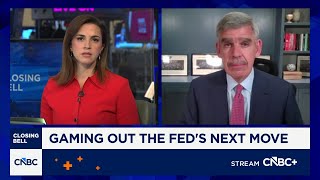
With us is Allianz Chief Economic Advisor Mohamed El- Erian to share his reaction. Nice to see you. Do you agree with Gundlach? Should they have raised the rate by 50 basis points? I don't think so. If they were in control of the situation, and they were n't, because the market had backed them into a corner with a 92 percent probability of a 25 basis point hike, then I think the arguments in favor were very balanced, and I personally would have preferred that they not raise it.
Do you think a 25 basis point increase solves the inflation problem? Or was it perhaps simply a confidence test to see if the Fed would remain independent and how they would act under pressure from Washington and the administration demanding lower rates? This is certainly a signal that the central bank is independent, and the 12-to- zero vote only reinforces that message.
Listen, for all the talk about the confidence test or inflation concerns, if you look at the 10-year bond and inflation expectations, they've barely moved in the last few days. They are in a fairly narrow range, and the reason for that is what you discussed earlier. Neither confidence in the Fed nor inflation fears were the reason for the jump in yields.
The jump in profitability is due to an imbalance between the growing demand for bond financing, especially from hyperscalers, and the decrease in the number of reliable buyers due to the situation in China, Japan, the Gulf countries, and Norway. Yes, deglobalization also extends to the demand for Treasury bonds.
You recently wrote in the New York Times that powerful forces are allowing the U.S. economy to bend but not break, and this confirms the conventional wisdom that investors should be fully invested in the market. But do you see anything on the horizon that could break this trend? I see three different characteristics of the economy.
The first is consensus. She is incredibly resilient. It will constantly retrace to the mean, so stay invested and buy on every dip. And it worked well. Second thought: " Wait a minute, this equilibrium is becoming increasingly unstable." We are running out of oil reserves. We are depleting consumers' balance sheets.
Be careful. And there is a third element—the transformational transition that you just talked about, particularly in AI, but also in geoeconomics. So the main conclusion is that we have to get used to living in uncertainty, and this is our reality for a while. There is no dominant scenario, so investors should expect a much wider range of possible outcomes .
Does this mean you expect more volatility? Yes. I expect more volatility and dispersion, as we see structural uncertainty. So, yes, more volatility, more dispersion. Given all of this and what you heard from Chairman Walsh yesterday, do you think financial conditions are tightening? I know he said that he's essentially removing some stimulus with a 25 basis point hike, but how would you assess financial conditions right now?
Talk to anyone in the housing industry and they will tell you that financial conditions are not just tightening, they are already tight. Chairman Powell noted that there are certain areas where financial conditions are tight, and there are others—he points to markets—where conditions remain soft. And this is a problem for monetary policy.
This is a very crude tool. My concern is that if the Fed confirms market expectations for further hikes, at least three by the middle of next year, that would be very bad news for the economy.




Comments 0