
원문 보기
Look, Nvidia's down here since GTC. I mean, GTC was an amazing event. I was there. I couldn't believe it. It just didn't matter what they said. That's That's preposterous. It's a major American company that is ruling the world when it comes to the most important thing, which is AI, and the stock cannot The stock is was knife through butter yesterday.
After what period of time after what period of time do you start to defer to the wisdom of the market when it comes to the way it's valued in the Oh, hey professor, this market knows more than I do. It's It's very wise. that we we I mean, we just heard from Warren Buffett, of course, who's always said there are times when it's when it's when the market is completely wrong and there's a period of time and it's misvaluing the companies.
Well, this is at 13 times next year. You see that? At 13 times next year. 13. That's my point, Jim. 13 times would seem to be an absurdly low multiple for a company with this kind of growth rate and this kind of business. Unless you're in a bear market. and free cash flow Unless you're in a bear market.
conversion and everything else you want to go through. But, it's been doing nothing for quite some period of time other than maybe go down a bit. Well, At some point do you just defer to the fact that well, I guess I'm not seeing things that are being more broadly spoken for by the broader decision being made here?
The biggest customers went from being the greatest customers of all time to being customers that could be constrained because they're uh using up all their cash flow. Okay. At the same time, I think if you don't lose your You don't lose your cash flow, you don't play. Then you're left left behind and you're never going to catch up.
Right. Marvell Technology, you can see right there uh rallying off the highs, but still up over 6%. This on news of a new partnership with Nvidia. It does include an investment by Nvidia of some $2 billion into Marvell. Nvidia's CEO, Jensen Huang, joined us earlier on Squawk on the Street. He discussed the company's push to expand these kinds of partnerships.
Every one of these announcements, as you as you see, is an expansion of our ecosystem. Our partnership with CoreWeave is obviously extremely unique. They're basically 100% top to bottom, end to end Nvidia, and they're expanding our ecosystem. In the case of Marvell, our partnership is to expand the Nvidia AI ecosystem in the data center as it pertains to semi-custom ASICs.
Whenever they do a semi-custom ASIC, we now we now connect it to NVLink. It connects to the entire Nvidia ecosystem as a result of that. We are also expanding our partnership to extend the AI infrastructure out of the cloud data centers and out into the world's telecommunications AI base station network.
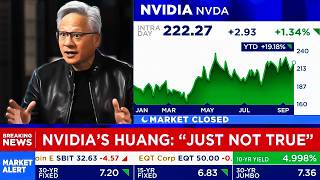
Uh Jim also asked Jensen Huang about what the market may be missing. Of course, Nvidia stock down about 9% so far this year, rebounding ever so slightly today, but certainly confounding many investors given its low multiple versus a growth rate that that many still applaud. Take a listen. The market misses several things about about Nvidia.
I think they Of course, because we are such a large company and we have such a large position of AI computing and all the AI infrastructure, you know, a lot of people might think that all of our growth is all priced in. However, uh what is very clear is several things happened this last several months, in fact, maybe the last 6 months.
We gained share. How is it possible that we're gaining share at a position that we're so large? We didn't have Anthropic exposure uh previously to this year, and now we're scaling with Anthropic. Our growth in AWS is accelerating. We just announced they're going to buy a million GPUs from Nvidia in just a, you know, about a year and a half or so.
And so, that's an enormous number of new GPUs. The number of customers outside of the clouds, the top five cloud service providers, has now grown to 40% of our company's business. Most people think that most of our business is in the cloud, but in fact, the fast one of the fastest growing segments is outside of the enterprise, the industrial.
You know, he went on Carl, obviously we we we conducted the interview to talk about the total addressable market and enterprise software in particular. Said a lot of I thought interesting things in terms of how he sees that evolving in the I mean, trillions in TAM, but the fact that margins for some of these enterprise software companies may come down as they really rely on AI for almost everything.
So, their cost of compute, in other words, for tokens will uh comprise a lot of the value proposition for them. So, he was talking about 50% margins versus higher margins now, but a much larger potential market for all of these kinds of companies. Right. And of course, at 170, that's a price we first crossed last July.
Jim this morning mentioned the 13 multiple. He's talking about a fiscal year that doesn't start for a while, not the current one at around 20. Around 20 times right now, but that is still confounding to many out there who sort of wondering you heard Jensen address the question. You say, how can how can Nvidia, one of the greatest companies of all time, given its growth rate, given its margin profile, be trading at only 20 years worth of earnings?
Down 9% this year. I mean, it has really been a down year. I think also just the partnerships are so interesting because companies that you that you would have typically thought as competitors. I mean, maybe it's not head to head with the with the products, but just the fact that the that the ecosystem is becoming so intertwined and Nvidia is just spreading its bets across friends and foes alike.
I mean, you almost lose track. I was, you know, quoting to him some of the public company They file a 13F. I mean, they own, you know, of Synopsys and Nokia, obviously Intel, CoreWeave, now Marvell, and then significant amount of OpenAI. And I believe in my Do they Do Do they own any Anthropic? I'm not even sure anymore, but But he did mention that as a catalyst for the business, the fact that they are working with Anthropic this year.
the the positions are large in sense of their many billions, but for the company, obviously it has a, you know, a market cap of some $4.1 trillion, they're not that large. Right. But it just gets to this whole circular question as well. You know, if if if if it if it does if if there is a rethink of the bubble and just how much is being spent, just how interconnected this trade has become um with another $2 billion deal here.
Yep. Nvidia 25 to 20. I mean, Nvidia is like the cheapest it's been to the S&P in like 10 years. Apple was 32, now it's 29, Josh. Well, so the point that I wanted to make is if you think the earnings power of these companies just vanishes or falls off a cliff, then these lower valuations aren't going to help you.
They're They're not They're not going to They're not going to do much to protect you. I don't think that most people think that. So, if you think this will be a a decent year for overall earnings growth and that these companies have preserved their earnings power through similar market moments and they will again now, um they're screaming buys.
So, uh Nvidia at a 15 forward earnings, they're supposed to do 74% earnings growth in 2026, um and then another 34% next year. Once again, 15 times. I understand all of the competitive threats and is the China business back? I get it. Still, uh you mentioned Meta, 27% earnings growth this year, 16 next year.
Microsoft, 21% earnings growth, 15 next year. And by the way, all those next year numbers, the weird thing that's been going on over the last few years is we keep having to raise them as we get to the halfway point of the preceding year. So, unless you think it's a complete mirage and the 75 sell-side analysts covering those three names are have have their their their heads in the sand, um these stocks are probably buys, and they're way easier buys than sells.
And there are more I'm we're just using those three, but it's not just the valuation reset, it's the valuation reset relative to the future earnings growth um that that the street is looking at. So, Nvidia is is a a really great example of this. By the way, we're at 170, remember? Remember Kristina Partsinevelos came on the other day and and made the point that 170 was this line in the sand for the stock.
It hadn't been able to see that for a minute, and here we are with this gain today. It's still around an 8-month low coming into today. It's down 9% year-to-date. Well, Jensen Huang was on CNBC earlier today. He said the market's been just getting it wrong. Listen. The market misses several things about about Nvidia.
I think they Of course, because we are such a large company and we have such a large position of AI computing and all the AI infrastructure, you know, a lot of people might think that all of our growth is all priced in. However, uh what is very clear is several things happened this last several months, in fact, maybe the last 6 months.
We gained share. How is it possible that we're gaining share at a position that we're so large? We didn't have Anthropic exposure uh previously to this year, and now we're scaling with Anthropic. Our growth in AWS is accelerating. We just announced they're going to buy a million GPUs from Nvidia in just a, you know, about a year and a half or so.
And so, that's an enormous number of new GPUs. The number of customers outside of the clouds, the top five cloud service providers, has now grown to 40% of our company's business. Most people think that most of our business is in the cloud, but in fact, the fast one of the fastest growing segments is outside of the enterprise, the industrial.
I mean, he Joe, by the way, that gentleman they he they invested $2 billion in Marvell and they launched an AI partnership, in case you're wondering, who's that other guy sitting there? Why is he sitting there? That's what that was about. But, nonetheless Jensen has had an incredible ability to refocus people on what they do and what they do better than everybody else, right?
He did it when he and I sat down ahead of the Super Bowl. Remember, the stock had been down like almost 10% in in like a week to date. He came on, he sort of retold part of the story, refocused people, and the stock went up from there. And I feel like this is another one of those moments. Well, Whether it's lasting, who knows, but it certainly calmed people and got people to refocus on what this company is doing and where they're investing and how they believe it's going to continue to pay off for the investors who continue to believe in it.
He he has an ability to communicate very eloquently, very elegantly, and simplistically in a way that individuals are able to understand, however they might um be trained in the financial services industry. What he did with you was he defeated the premise that was out there that competition was coming.
He showed everyone that, no, they still had the control of market share. Look, I I I've spoken about this all year and and people have kind of questioned me on it. I don't see what the issue is with Nvidia. The stock is basically, from my perspective, running in place. It's outperforming the rest of its Mag 7 peers.
It hasn't been below 160 since last July. And really, all you're seeing is what you should have expected, moderation in the triple-digit revenue growth. You can't expect that this company was going to continue to grow at that pace. So, it's it's been a core holding. It ranks as number one for the ETF strategy.
We own that along with Alphabet. I I agree that uh things have are lining up, including the biggest company in the world deciding it wanted to come on and goose the stock back to 170, Nvidia, with some news today and it's actually getting traction. So, that's Oh, it is, you know. That's That's important when the market actually responds to it.
I I was going to go there next time and I'm glad you did. Let's look at Nvidia on an intraday basis. It's at the highs of the session. So, they they make this $2 billion investment today into Marvell. They have an AI partnership and then Jensen Huang comes on the network this morning and essentially says the market's been getting it wrong.
And what happens? Well, you see right from this morning's appearance, the stock is steadily uh moved higher. This is an area that just so desperately needs some level of stability. Sure. And look, I think, Joe, you know, coming into this week, what was the What was the textbook play? It was the trends have been damaged.
The burden of proof on rallies is high and we might be in a sell rallies mode, right? And so, it isn't just Iran and oil because it seems like the market has been consumed with other issues for 6 months. Now, sometimes when the market has been struggling with these underlying issues and then you have this kind of focal point crisis.
I think of Brexit in 2016. That came after almost a year of Chinese devaluation, of energy credit concerns, of an industrial recession. Earnings took a hit and then by the end of it, it was actually Brexit, which was kind of a bad news thing, kind of released the market higher. And then, of course, you had the election after that.
My point is, sometimes it can be that, the clearing event, and sometimes it can be actually the problem was actually a festering rolling over of of, you know, the leading group in the market, which is AI. Yeah. Just checking out, of course, Nvidia. We talked so much about Nvidia and Marvell, but just the fact that the word photonics is back up again and look at the bid, what we're seeing in the Nasdaq with it up nearly 3% today.
Some of your thoughts on Nvidia here. Yeah, finally getting uh catching a bid back above that 170 level, uh up about 4% today. Um was up over 5% earlier, but still down about uh 7% uh so far this year and off about 17% from those all-time highs that we saw last October. It's been in consolidation phase between about 170 and 195 over the last several months here, but uh now trying to bounce off of those multi-month lows that we saw uh just uh at the end of last week and into yesterday's close.
Uh so, some positive news today, the $2 billion investment into Marvell Technologies uh as they're trying to continue to leverage um this roundabout type of cycling of investing in different companies uh so, they can sell more of their GPUs and more of their technology. Everybody wants to be in this Nvidia ecosystem moving forward and I think that's why Nvidia, who has a lot of free cash flow, uh is putting that out there and today was uh Marvell's turn uh and that stock's doing well.
Everybody has questions around the valuation, which if you think about it on a forward PE prior to today, Nicole, the forward PE on Nvidia, which has 70% revenue growth year-over-year, uh was about the same as the S&P 500 as a whole, uh which doesn't grow at 70% year-over-year. Uh so, a lot of people expecting uh better things uh after the GTC conference and positive commentary out of CEO Jensen Huang also.
Uh so, we'll continue to see if this uh rally can hold. Um I think that 170 level is going to become a big area of support, but we did see some bullish activity and this was really early before we saw the massive pop in the stock. Uh on the April 17th monthly options that expire in 17 days, traders bought 10,000 of uh the 180 190 strike call spread here.
Uh they paid an average debit of about a buck 05 on this $10 wide bullish call vertical. Uh that takes the break even up to 18105 over the next 2 and 1/2 weeks. That's only about 5% above the current share price in Nvidia. So, buying a cheap vertical, you know, you you cap some of your gains on this one, but is uh Nvidia really going to go above 190 over the next 2 and 1/2 weeks?
Most likely not. The probabilities are against that, but uh yeah, bought a cheap uh call spread here for some upside exposure over the next 2 and 1/2 weeks. Marvell and the addition of Marvell to the Nvidia ecosystem through NVLink Fusion. There are three main components to this announcement. Nvidia is investing $2 billion in Marvell.
Marvell is joining the Nvidia AI factory and AI RAN ecosystem via NVLink Fusion. And the two companies will collaborate on telecommunications and silicon photonic technologies. You may remember that Jensen unveiled NVLink Fusion back at Computex in May of 2025. Back then, I made the point that I thought NVLink Fusion would actually help strengthen Nvidia's mode because it would help keep customers within the Nvidia ecosystem.
Now, with NVLink Fusion, even if another company develops an accelerator that is better than Nvidia's on a per-chip basis, they can simply integrate those custom accelerators with Nvidia's technology and remain a customer within the Nvidia ecosystem. Nvidia is no longer a chip company. They're an AI infrastructure company.
If some customers want to use custom accelerators, that's fine. Nvidia can still sell them other parts of the system and keep them within the Nvidia ecosystem. We clearly see this at play in today's announcement from Nvidia and Marvell. Under the partnership, Marvell will provide custom XPUs and NVLink Fusion-compatible scale-up networking.
And Nvidia will provide the supporting technologies, including the Vera CPU, ConnectX NICs, BlueField DPUs, NVLink interconnect, and SpectrumX switches in the Rackscale AI compute. I'll also briefly mention Amazon because I know that many people associate Marvell with Amazon's custom chip efforts. AWS and Nvidia already announced back in December that Amazon's Trainium 4 will integrate Nvidia's NVLink Fusion.
So, we already knew about that. But, today's announcement is another positive proof point that Nvidia's NVLink Fusion is being adopted throughout the industry. And it's a reminder that Nvidia is an AI infrastructure company addressing the entire AI stack. They're so much more than just a chip company.
Also, under the partnership, Nvidia and Marvell are partnering to transform the world's telecommunications network with AI infrastructure with Nvidia Aerial AI RAN for 5G and 6G. You may remember that back at GTC in October, Jensen announced the new Nvidia Aerial Radio Network computer and a partnership with Nokia.
This business segment doesn't get much attention because it is relatively small compared to some of Nvidia's other opportunities and business segments. But, it's another great reminder that Nvidia is actively working to establish themselves as the underlying AI infrastructure within every industry. Also, in today's press release, Jensen writes, quote, "The inference inflection has arrived.
Token generation demand is surging and the world is racing to build AI factories." Jensen's comments about token demand surging and the inference inflection brings me back to what I've been saying in recent videos. I'm once again going to talk about agentic AI and the inflection and inference demand because it is very important to Nvidia's growth over the next couple years.
And most people have no idea that this inference inflection is even happening. For many months, I've said that throughout this year. And now, we are at a major inflection. There's a reason why GPU spot pricing has recently started moving higher. Agentic AI . With agentic AI, we're no longer talking about an AI model that simply responds to your prompts.
We're now talking about agentic systems consisting of many . This will cause many people to have another ChatGPT type of moment wherein they realize that this technology is both very useful and productive. In other words, many people will soon start to realize that there's going to be a clear ROI on the massive AI investments we've seen in recent years.
There's a reason why Open Claw skyrocketed in popularity early this year. There's a reason why Jensen recently called Open Claw, quote, "Definitely the next ChatGPT." There's a reason why Jensen recently called Open Claw, quote, "the iPhone of tokens." Open Claw essentially allows people to create their own AI agents.
For a while, enterprises were hesitant to adopt Open Claw due to the security risk. Then at GTC, worked with leading security . Implementing large agentic systems at scale throughout their businesses to drive productivity and enhance their workforces. These enterprises are going to consume a mind-boggling large .
Please hear me well. I do not want to come across as being hyperbolic when I say this because I'm being completely serious. Most people have no idea that this inference inflection is even happening and they have no idea of the implications it has for Nvidia's growth over the next couple years. Now, with that context in mind, consider what we're currently seeing in the market.
this year's earnings. And Nvidia is trading well below a market multiple on next year's earnings even though Nvidia's earnings growth will be . And even as we are witnessing a major . And even as GPU spot pricing is moving notably higher. I view Nvidia's cheap valuation a. Again, I don't know when the situation in Middle East will be resolved and I don't know where the bottom is for stocks.
But from a long-term perspective, Nvidia is one of the clearest fundamental setups in the entire market right now. I think at some point in future years, we will look back on this moment as a screaming buying opportunity in Nvidia. I'm not saying to go all in. That's not at all what I'm saying. I am saying that I think it is reasonable for long-term investors to consider responsibly dollar cost averaging into this stock in small amounts over a long period of time because the fundamental setup is extremely clear despite market participants hesitancy.
I'll mention one more thing on the inference inflection we're seeing. Recently on the Lex Fridman podcast, Jensen was very seriously raising the possibility of Nvidia becoming a $3 revenue company in the near future. For context, Nvidia's full year fiscal 2026 revenue was $215.9 billion. Jensen is usually somewhat conservative in the future projections he provides.
And Jensen is very seriously talking about the possibility of Nvidia becoming a $3 revenue company. If that happens, this stock will definitely go higher in the future, much higher. I'm not saying that it's going to happen immediately. These things take time after all. But I'm saying that I expect Nvidia to be worth notably more in future years than it is today.
Right now, we need to focus on the fundamentals, ignore the short-term noise, and remember that we are only at .



Comments 0