
저자: JensenHuang,MattMurphy/인터뷰출연자,진행자Jim/David/Carl제외 · 외국인
요약 보기
NVIDIA가 Marvell에 $20억 투자 및 NVLink Fusion 파트너십 발표. 황젠슨은 AI 추론 변곡점과 에이전트 AI로 토큰 수요가 급증해 엔터프라이즈 소프트웨어 TAM이 수조 달러로 확대된다고 주장. Marvell은 2025년 44% 성장, 데이터센터 40%+ 성장 가이던스 제시. FinVid 해설자는 NVIDIA 밸류에이션이 내년 실적 기준 시장 멀티플 이하로 저평가라며 장기 분할매수 고려 가능, 2030년까지 3~4조 달러 AI 팩토리 투자 전망 인용.
다듬은 글
Got your some treat. Shares in Marvell Technology rallying sharply on news of a new partnership with none other than NVIDIA this morning, which includes an investment by NVIDIA of $2 billion into the company. And joining us now exclusively NVIDIA's founder and CEO Jensen Huang and Marvell chairman CEO Matt Murphy.
Gentlemen, thank you for coming on the show. I'm going to start with you, Jensen, because this is a remarkable deal. I'm trying to understand, if I get this right, the customers will have a lot of choice that are current is currently not available, which could mean great things for your network portion of your business.
Yeah. You know, first of all, you know that AI inflection point has arrived. We got a big echo on our side. Can somebody stop that? Oh, fantastic. Okay, so anyways, you know the AI inflection point has arrived. We're going through a platform transition. All of the world's data centers are going to be replaced with this new form of doing computing, we call accelerated computing.
Of course, the vast majority of the data centers will be powered by NVIDIA CUDA GPUs. However, for customers who would like to also have specialized versions that they built themselves, we're extending our architecture starting with the networking architecture. Basically, the entire chassis of our Grace Blackwell and Vera Rubin systems, and we're going to extend that through NVLink and connect it to Marvell.
And uh together, we'll be able to address the customers whether they would like to use all NVIDIA gear or they would like to augment their art NVIDIA gear with their specialized processors, and together, uh we'll be be able to uh address a much, much larger town. Okay, so Matt, congratulations. I know this is a really big deal and you know, I followed your company for many, many years and you did uh tell me over and over again, look, you would be part of the future of AI, which is now obviously is coordinated.
I want to know whether you have customers and you've got some big hyperscaler customers that will be thrilled that they get a chance to be able to kind of get away from who they've they necessarily been trapped with. Well, I wouldn't call it trapped. I think customers are going to be very excited about this.
I mean, what customers are looking for Jim is flexibility. They're looking for technology innovation. They're looking for their partners to actually work together to drive a very robust ecosystem and I think that's really what we see from the Marvell side is we have key strengths and interconnect technology, silicon photonics, custom custom silicon.
But then Nvidia and as Jensen mentioned, they're not just a GPU company. This is an asset rich company, right? With key networking IP, Nicks, DPU's, CPU's, interconnect, rack scale. So these are all things that now Marvell together with Nvidia can provide. We can drive interoperability. We can drive complete solutions and we can enable customer choice.
So I think it's going to be a win for everybody. And you know Jim, there's really a couple of major specialized semi-custom chip players out there and both of them have a large installation of Nvidia architecture now. And so both of them have large installations of NVLink. They use the standard chassis that Nvidia provides, the Grace Blackwell chassis.
And so all of this can be extended. In the future, these data centers will have, you know, GPUs and they have some specialized XPU's on their side, but they have the benefit of connecting all of it with NVLink, connecting all of it with Spectrum X. They could add Nvidia Vera uh to their racks. They can add Nvidia's storage processors BlueField 4 to their rack, and they could even add Nvidia LP LPXs, the Groq chips, uh to their racks.
And so, all of this will be system architecture compatible. The you'll be ecosystem compatible, and it expands the opportunity, makes it easier for them to interoperate, and makes it fantastic for us as we expand our TAM. Let's talk about the TAM and and how big it is. Uh Matt, one of the things that you taught me is you know, everybody there's room for everybody.
And in some ways, people might say, "Well, you're now competing with Nvidia." I I obviously I when you get $2 billion, I don't think it's much of a competition, but can you talk about the size of the market? Cuz I think people right now it especially with the stocks really getting hurt. I don't have to say stock too much, but maybe people are thinking that maybe the TAM isn't as big, and maybe the whole thing is just kind of a a wonder that is not necessarily going to be economic long term.
Yeah. Let me give you some thoughts on that, and I'll let Jensen chime in as well, but I'm going to bring up a story, okay? When when Jensen and I started collaborating, which goes back probably 5 or 6 years, maybe longer, okay? The two companies have been working together for some time. We had a discussion once, and it was about how people typically look at the semiconductor market.
People typically look at it as a zero-sum game. One's here, one's here, one wins, one loses, and it's just all nets to zero. That's And that happens in part of the semiconductor market. Company And what what you actually said to me was, "Companies like Nvidia and Marvell, we create the market. We create the TAM.
Okay?" And so, if you look at over the last 5, 6 years, look at the explosion in the AI TAM. That's come That's been led by Nvidia, and also followed up by companies like Marvell and others. But this partnership is again a move that we're making to keep increasing the overall TAM and then letting both companies actually participate more richly in there.
And I mean, you can comment on it, but the the the the the TAM, you know, per per gigawatt is just in in the deca-billion dollar range at this point. Yeah, the part that most people miss is the whole nature of AI. The processing of the software is all done in real time. Basically, it's a generative form of computing.
The way we used to do computing in the past, you would retrieve pre-recorded information from, you know, typed in by humans. But now AI generates content and generates information in real time. This inflection point, this platform shift, where all enterprise software in the future, every single character you see on your display, every piece of information that is produced has to be generated generated in real time.
And so all future enterprise software will come along with it what we call tokens. These tokens are going to be manufactured, produced, processed by the infrastructure that we create. And so the multiple trillions of dollars of enterprise software is now in transition into a token-enhanced enterprise software world.
In the future, the the multiple trillions of dollars of enterprise spend will all be token-enhanced. And so this is what everybody is chasing. Now the moment of now is really important because 2 years ago, we had the chat GPT moment where consumers had the benefit of enjoying AI for the first time. But now with Claude Code and OpenAI Codex, we're now seeing the agentic moment of that enterprise software.
We now have the killer app of enterprise computing, finally, and it's being adopted here, of course, inside NVIDIA. The adoption is incredible. It's you're hearing news, of course, of Anthropic growing some incredible number of billions of dollars in just a month. This is now the inflection point of enterprise AI arriving, and all of that computing has to be done in real time, and that's what this infrastructure is designed to do.
So, uh Jensen, it's David. So, listening to you then, I mean, are we even able to calculate what the what the TAM may be? I mean, you mentioned Anthropic's exponential increase in revenues. Um what we're seeing is sort of something we've never seen. Does it Is it just endless? I don't know. I'm just curious having listened to what you just said, trying to understand what that means.
The simple logic is this. Um in the today, most enterprise software is 90% gross margin. It's basically software licensing. In the future, enterprise software will be larger than it is now, much larger, and it's very likely that their gross margins will be lower because it will be enhanced with tokens.
And so, if you look at Anthropic's gross margins as a software company, call it 50% gross margins, but it's much, much larger as a company because their opportunity is substantially larger than a software company. And so, the enterprise IT industry in the future will likely be, you know, pick your favorite number, but several trillion dollars at 50% gross margins instead of $1 trillion at 90% gross margin.
And so, this is a great inflection point for the enterprise world. If you look at all of the enterprise software companies today, you know, pick your favorite ones, they're all going to be agentic. Every single one of them is working on agents at the moment. They're all going to be agentic. Their gross margins will be lower, but their TAM's going to be much, much higher.
Um Jensen, if I could just follow up on, you know, when I your decision to invest $2 million in Marvell um follows uh significant stakes that you hold in companies such as Intel and CoreWeave and Nebius, and I could go on. It's a small, small overall number in terms of the size of your company, but nonetheless, I'm curious as to why you choose to make an investment along with every one of these announcements.
Every one of these announcements as you as you see is an expansion of our ecosystem. Our partnership with CoreWeave is obviously extremely unique. They're basically 100% top to bottom, end to end in video, and they're expanding our ecosystem. In the case of Marvell, our partnership is to expand the Nvidia AI ecosystem in the data center as it pertains to semi-custom ASICs.
Whenever they do a semi-custom ASIC, we now we now connect it to the NVLink. It connects to the entire Nvidia ecosystem as a result of that. We are also expanding our partnership to extend the AI infrastructure out of the cloud data centers and out into the world's telecommunications AI base station network.
The the future telecommunication network, today's telecommunication network, is essentially a dumb pipe, dumb wireless pipe. In the future, just like we did with cloud computing, we're going to turn the AI base stations into a part of the into the AI infrastructure. And so, we're going to be able to run AI models right inside the base stations in the future.
Telecommunications and base stations is a core part of the business that um Marvell and and Matt has built over the years. We're now going to connect NVLink to that so that we extend the Nvidia ecosystem all the way out into the base stations. Really exciting future growth opportunity. And that's why you wanted to own $2 billion worth of stock?
Well, Marvell is a marvelous investment. You know, I've been dying to say that. And so and so [clears throat] this but this partnership is is about extending NVIDIA's AI ecosystem and NVIDIA's AI architecture. And so this investment is really a fantastic investment for us. We're going to of course we're also smart investors.
We've expanded the TAM for both of us as a result of of this partnership and we want to be a investor in that. We want to have a stake in that future. Hey Matt, can you help contextualize the news given just the news of the day this commodity price shock we're living with the geopolitical tensions in the Middle East and whether or not that's going to interrupt any kind of demand or or whether some of these commodity shortages will inhibit production around the world somehow.
Yeah, thanks Carl. Good to see you. Yeah, demand continues to be very strong. We we had you know our best quarterly earnings ever last quarter. Strong momentum coming out of that. We've guided our data center business to keep growing like 40 plus percent a year for the next couple years. I don't see that changing at all.
I think certainly there's there's a wall of worry out there with a lot of things going on in the world. I heard you guys talking earlier about multiples compressing and things like that. But from our standpoint, we are not slowing down at all on the R&D investment. [clears throat] We don't see any slowdown from our customers on their intent to deploy.
So that all looks extremely positive and um you know, I really appreciate the the the vote of confidence from Jensen and the team. This you know, Marvell was already growing very strongly. I mean we grew like 44% last year with another big year ahead of us this year. This just helps turbocharge our growth and our opportunity, and gives us an infusion of capital that actually allows us to go do that.
So, we were doing great on our own, but this is a way for Marvell to actually just really take a leap forward. And as Jensen mentioned, I totally agree this inflection on what you're seeing in the enterprise, and and really the accelerated buildout of the AI factories, that gets Marvell into that in a much bigger way, and really at the rack scale level now.
Not just selling individual components, but how do we go in together with a broader solution. And we don't have all the pieces. We can do that with NVIDIA. And in some cases, NVIDIA doesn't have all the pieces. So, that's how we can get it together. Okay. Okay, so one of the reasons why I like these deals that Jensen does is because it immediately actually ends up raising the earnings per share estimates.
People looking for 5:30 for the calendar year 2027. That seems ridiculously low after what we've just heard, Matt. Why not take those numbers up right now? This is a This is a method of distribution on our network that you can do it. Hey Jim, you know how I run this company. I've been doing this for 10 years now.
Consistent, methodical, okay? One quarter at a time, and show consistent results. So, All right, so I think you're going to have to take those up. like we we signaled for the year we would be up at But yes, I I think I think it it it certainly is a great setup for next year, Jim. Perfect. And Jensen, how I mean, GTC, obviously one of the most important events, so many great things.
Are you not surprised to some degree that the marketplace doesn't seem to see what you and I see? Yeah, I think I think the market misses several things about about NVIDIA. I think they Of course, because we are such a large company, and we have such a large position of AI computing and all the AI infrastructure, you know, a lot of people might think that all of our growth is all priced in.
However, uh what is very clear is several things happened this last several months, in fact, maybe the last 6 months. We gained share. How is it possible that we're gaining share at a position that we're so large? We didn't have Anthropic exposure uh previously to this year, and now we're scaling with Anthropic.
Our growth in AWS is accelerating. We just announced they're going to buy a million GPUs from Nvidia in just a, you know, about a year and a half or so. And so, that's an enormous number of new GPUs. The number of customers outside of the clouds, the top five cloud service providers, has now grown to 40% of our company's business.
Most people think that most of our business is in the cloud, but in fact, the fast one of the fastest growing segments is outside of the enterprise, the industrial. Uh the announcements we made with Lilly, our autonomous vehicle uh uh uh work, um all of the physical AI robotics systems, the number of those applications is growing incredibly because AI is diffusing into all of the world's enterprise, industrials, every single industry, and every single country.
And none of that is covered because we spend so much time thinking about the Mag 7, the Mag 6, that, you know, because it it consumes so much of the attention, people forget the rest of the world is incredibly large. And so, that segment is growing incredibly large for us, now represents about 40% of our total business.
And so, so I think a lot of people don't see the bigger picture of what's happening because of the attention we put into the the the top sevens. Um but the fact of the matter is we're we're only we're taking share, uh we're growing into new segments. Okay. Uh congratulations to both you gentlemen. Great to see you again, Jensen.
$2 billion and much more earnings and a much larger team. Thank you. Marvell and the addition of Marvell to the Nvidia ecosystem through NVLink Fusion. There are three main components to this announcement. Nvidia is investing $2 billion in Marvell. Marvell is joining the Nvidia AI factory and AI radio ecosystem via NVLink Fusion.
And the two companies will collaborate on telecommunications and silicon photonics technologies. You may remember that Jensen unveiled NVLink Fusion back at Computex in May of 2025. Back then, I made the point that I thought NVLink Fusion would actually help strengthen Nvidia's moat because it would help keep customers within the Nvidia ecosystem.
Now, with NVLink Fusion, even if another company develops an accelerator that is better than Nvidia's on a per chip basis, they can simply integrate those custom accelerators with Nvidia's technology and remain a customer within the Nvidia ecosystem. Nvidia is no longer a chip company. They're an AI infrastructure company.
If some customers want to use custom accelerators, that's fine. Nvidia can still sell them other parts of the system and keep them within the Nvidia ecosystem. We clearly see this at play in today's announcement from Nvidia and Marvell. Under the partnership, Marvell will provide custom XPUs and NVLink Fusion-compatible scale-up networking.
And Nvidia will provide [clears throat] the supporting technologies, including the Vera CPU, ConnectX NICs, BlueField DPUs, NVLink interconnect, and Spectrum-X switches, and the Rackscale AI compute. I'll also briefly mention Amazon because I know that many people associate Marvell with Amazon's custom chip efforts.
AWS and Nvidia already announced back in December that Amazon's Tranium 4 will integrate Nvidia's NVLink Fusion. So, we already knew about that. But today's announcement is another positive proof point that Nvidia's NVLink Fusion is being adopted throughout the industry. And it's a reminder that Nvidia is an AI infrastructure company addressing the entire AI stack.
They're so much more than just a chip company. Also, under the partnership, Nvidia and Marvell are partnering to transform the world's telecommunications network with AI infrastructure with Nvidia Aerial AI RAN for 5G and 6G. You may remember that back at GTC in In Jensen announced the new Nvidia Aerial Radio Network computer in a partnership with Nokia.
This business segment doesn't get much attention because it is relatively small compared to some of NVIDIA's other opportunities and business segments. But, it's another great reminder that NVIDIA is actively working to establish themselves as the underlying AI infrastructure within every industry. Also, in today's press release, Jensen writes, quote, "The inference inflection has arrived.
Token generation demand is surging, and the world is racing to build AI factories." Jensen's comments about token demand surging and the inference inflection brings me back to what I've been saying in recent videos. I'm once again going to talk about agentic AI and the inflection and inference demand because it is very important to NVIDIA's growth over the next couple years, and most people have no idea that this inference inflection is even happening.
For many months, I've said that throughout this year. And now, we are at a major inflection. There's a reason why GPU spot pricing has recently started moving higher. Agentic AI . With agentic AI, we're no longer talking about an AI model that simply responds to your prompts. We're now talking about agentic systems consisting of many .
This will cause many people to have another ChatGPT type of moment wherein they realize that this technology is both very useful and productive. In other words, many people will soon start to realize that there's going to be a clear ROI on the massive AI investments we've seen in recent years. There's a reason why Open Claw skyrocketed in popularity early this year.
There's a reason why Jensen recently called Open Claw, quote, "Definitely the next ChatGPT." There's a reason why Jensen recently called Open Claw, quote, "The iPhone of tokens." Open Claw essentially allows people to create their own AI agents. For a while, enterprises were hesitant to adopt Open Claw due to the security risk.
Then, at GTC, worked with leading security . Implementing large agentic systems at scale throughout their businesses to drive productivity and enhance their workforces. These enterprises are going to consume a mind-boggling large . Please hear me well. I do not want to come across as being hyperbolic when I say this because I'm being completely serious.
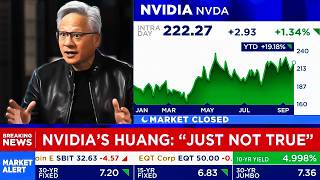
Most people have no idea that this inference inflection is even happening and they have no idea of the implications it has for Nvidia's growth over the next couple of years. Now, with that context in mind, consider what we're currently seeing in the market. this year's earnings. And Nvidia is trading well below a market multiple on next year's earnings even though Nvidia's earnings growth will be .
And even as we are witnessing a major and even as GPU spot pricing is moving notably higher. I view Nvidia's cheap valuation a. Again, I don't know when the situation in Middle East will be resolved and I don't know where the bottom is for stocks. But from a long-term perspective, Nvidia is one of the clearest fundamental setups in the entire market right now.
I think at some point in future years, we will look back on this moment as a screaming buying opportunity in Nvidia. I'm not saying to go all in. That's not at all what I'm saying. I am saying that I think it is reasonable for long-term investors to consider responsibly dollar-cost averaging into this stock in small amounts over a long period of time because the fundamental setup is extremely clear despite market participants hesitancy.
I'll mention one more thing on the inference inflection we're seeing. Recently on the Lex Fridman podcast, Jensen was very seriously raising the possibility of Nvidia becoming a $3 trillion revenue company in the near future. For context, Nvidia's full year fiscal 2026 revenue was $215.9 billion. Jensen is usually somewhat conservative in the future projections he provides.
And Jensen is very seriously talking about the possibility of Nvidia becoming a $3 trillion revenue company. If that happens, this stock will definitely go higher in the future, much higher. I'm not saying that it's going to happen immediately. These things take time after all. But I'm saying that I expect Nvidia to be worth notably more in future years than it is today.
Right now, we need to focus on the fundamentals. Ignore the short-term noise and remember that we are only at .



Comments 0