저자: JoelGreenblatt · 외국인
요약 보기
그린블라트의 껌 장사 비유로 가치투자 핵심을 설명: 사업 가치를 계산해 싸게 살 것. 미스터 마켓의 변덕을 이용하고, 가치 평가 4가지 방법(DCF·상대가치·청산가치·인수가치)을 소개. 매직포뮬라(자본수익률+이익수익률)는 17년간 연평균 30.8% 수익률을 보였다고 주장. 마지막으로 전략을 지속할 인내와 심리적 규율이 어렵다고 강조.
다듬은 글
Have you ever wished you could get a seat in one of the most legendary value investing classes of all time? Well, today we're doing just that. We're diving deep into the wisdom of Joel Greenblat. Basically distilling his entire Columbia University course into one powerful explainer. Let's get into it.
So, here's the game plan. We're going to start with a really simple story about selling gum that's actually the key to his whole philosophy. Then, we'll meet this crazy character called Mr. Market and figure out how his mood swings are our biggest advantage. After that, we'll get into the toolkit, four ways to value a business.
And then we'll unpack his famous magic formula. And finally, we'll tackle the biggest question of all. If this stuff is so simple, why is it so darn hard to pull off? All right, first up, you know Greenblat's entire complex multi-million dollar philosophy, it really just boils down to one single powerful idea.
And it didn't start on a Wall Street trading floor. Nope. It started with a business so simple a kid could run it. See, when Greenblat wanted to explain investing to his son, he didn't pull up a stock chart or a bunch of confusing jargon. He talked about something his son could actually understand. His friend Jason's little business selling packs of gum at school.
And the math here is just beautifully simple. Jason sells five packs a day. He makes a 25cent profit on each one. You do the math over a whole school year, and that little side hustle is pulling in about $4,000 in profit. It's a real business with real, understandable earnings. So, here's where it gets really interesting.
Greenblat puts the question to his son. What if Jason came to you and offered to sell you half of his entire business for a onetime payment of 1,500 bucks? I mean, think about it for a second. You pay 1,500 bucks once, and you get half the profits, about $2,000, every single year. It's a complete no-brainer, right?
Of course, you take that deal. You're thinking like a business owner. And boom, right there. That is the entire philosophy. That's the whole game. Investing isn't about trying to guess which way a stock chart is going to wiggle tomorrow. It's about figuring out what a business like that gum business is actually worth and then waiting patiently for the chance to buy it for way, way less.
Okay, so if the name of the game is buying businesses at a discount, that begs a pretty obvious question. Where do these amazing discounts even come from? Well, this is where we need to introduce a very important character in the world of value investing. He's the one who makes it all possible. Everyone, meet Mr.
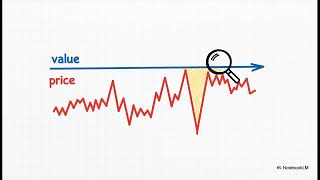
Market. Imagine he's your business partner for every single stock you own. And uh he's a little unstable. Some days he's euphoric. He's on top of the world and he'll offer to buy your shares for some ridiculously high price. But other days, he's in a full-blown panic, convinced the world is ending, and he'll offer to sell you his shares for pennies on the dollar.
In the short term, the guy is just completely driven by emotion. But here's the secret. Here's the kicker. While Mr. Market is an emotional wreck from day to day, over the long haul, he actually gets it right. His prices eventually line up with the real value of the business. The trick is to just completely ignore his daily temper tantrums and trust that long-term reality.
And this is your advantage. The price is what Mr. market is screaming at you every day. The value is what that gun business is actually earning year in and year out. Your job as an investor is to plug your ears to all the screaming and just step in and buy when the price he's offering is way below the real underlying value.
Okay, great. So, we know we need to figure out what a business is worth, but how how do we actually do that? Well, Greenblat doesn't just leave you hanging. He gives you a practical toolkit with four different ways to look at it. These are the four big ones. First, you've got your classic discounted cash flow or DCF where you're basically trying to predict all the future cash it'll generate.
Second, there's relative value. How does this company stack up against its competitors? Third is breakup value. You know, if you shut the company down and sold off all the pieces, what would they be worth? And fourth is acquisition value. What would another smarter company be willing to pay for this whole business?
Each one gives you a slightly different angle on that one core question. what's this thing really worth? But you know, this might be the single best piece of advice he gives. You do not have to be a math wizard. You don't need a perfect precise calculation for every single company. If you look at a business and it's just too hard to figure out what it's worth, don't don't waste your time.
Just move on to the next one. You're looking for the easy ones, the obvious home runs. So Greenblat took all of these ideas, you know, finding good businesses, buying them when they're cheap, and he boiled it all down into a simple, systematic approach that pretty much anyone can use. He calls it the magic formula.
And this really shows you the difference in his thinking. You know, academic finance is full of these theories about efficient markets and trying to predict the future with super complex models. Greenplat's world is a lot simpler. He says, "Mr. Market is moody. You can't predict the future, so just use simple concepts.
The one thing they both agree on, you got to do the work yourself. So, what is this magic formula? Honestly, it's almost laughably simple. It just looks for two things. First, is it a good company? It measures this with return on capital, which is just a fancy way of asking how good the company is at turning a dollar of investment into profit.
High number, great business. Second, is it a cheap stock? It measures this with earnings yield. This tells you how much profit you're getting for the price you pay. So, the formula just finds companies that are both good and cheap. That's it. That's the whole thing. Simple, maybe, but powerful. Oh, yeah.
When he tested this strategy over a 17-year period, a portfolio built with a magic formula delivered an average annual return of 30.8%. I mean, that's not just beating the market, that is absolutely crushing it. The numbers don't lie. Over the long run, this simple idea works. And that brings us to our final and honestly the most critical part of this whole discussion.
If there's a simple formula with clear data showing it produces these incredible results, why isn't every single person on Earth using it? While the answer has nothing to do with spreadsheets or math, it has everything to do with being human. Let me tell you about a value investor named Richard Pisna.
During the dot bubble in the late '90s, his fund was down while the rest of the market was going completely bonkers. Can you imagine the pressure? For 3 years straight, he looked like an idiot. And his clients couldn't take it. He lost 70% of his investors who all bailed out right at the absolute bottom just before his strategy came roaring back.
Sticking with it can be unbelievably painful. And it's not just the clients who crack under the pressure. It's the experts, too. James Oshanosy literally wrote the book on this stuff. It's called What Works on Wall Street. But after a few years of his own strategy underperforming, he gave up on it. He abandoned his own system right before it was about to go on an incredible run.
Even the guy who invented the system couldn't handle the psychological pain of being wrong for a few years. You know, Charlie Mer really just nails it with this quote. He said that great investing records aren't built on being busy all the time. They're built on incredible patience, sticking to what you know works, even when it's not working.
So that when those rare, perfect opportunities finally show up, you're ready to pounce. And that really is the final exam of this master class. The logic is simple. The data is clear. It works. So the real question isn't about your intelligence. It's about your temperament. Do you have the discipline, the psychological strength to stick with a winning strategy even when it feels like a losing one for months or even years at a time? Because that is the real secret.

Comments 0