원문 보기
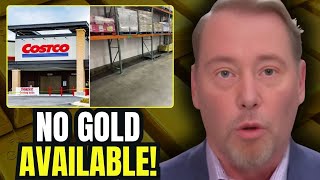
Gold suddenly is the flight to quality asset. People uh I think is Costco is selling gold retail and they can't keep it in stock. Well, certainly uh behaving differently than it was for the last four decades. I mean, what we've seen is uh in the last uh 15 years, there's been a number of corrections on the S&P 500.
And in every single one of them, when the S&P goes down more than 10%, the dollar index, the trade weighted dollar index goes up. This time, the dollar went down when the S&P 500 went down almost 20%. That's that's strange. Things are behaving differently. Usually, when the Fed starts cutting interest rates, rates across the yield curve go down.
The 10-year Treasury almost always goes up immediately following the first Fed rate cut and then it keeps rallying for a while. This time, the dollar, the 10-year yield went up and the yield curve is steepening. Uh so I think what we have is a recognition that the interest expense for the United States is untenable if we continue running a $2.1 trillion budget deficit and we continue to have sticky interest rates.
One thing that people fail to appreciate is how much the average Treasury payment has gone up. The average yield, the average coupon on on treasuries was below 2%. the entire treasury market, all 30 odd billion of it, you average all together. Some of them are old, you know, they're issued with higher interest rates, but it was below 2%.
Now it's pushing 4%. And as long as bonds are maturing, and there's trillions and trillions of dollars of them maturing, a lot of them were issued back in, you know, 2009, 2008, these other time periods. Even if you just issued them in 2019, some of these are starting to come due. and they were issued with coupons of a quarter of a percent.
And now it's four and a quarter percent. So it's 400 basis points higher. So So this problem continues to to build and there's an awareness now that the long-term Treasury bond is not a legitimate flight to quality asset. It's not responding to lower interest rates. It's not about it's not really responding to an inflation rate which is now 2 and a.5%.
Probably going to go higher on the inflation rate because the ones that are rolling off from a year ago. I mean the cumulative I think headline CPI that what came out today it was8 but the one that was rolling off I think was was.1 and and if you do the the next two months those three months together that quarter the cumulative rise from a year ago was 0.1.
So, we're likely seeing the low point in near-term inflation. So, yeah, I think there's the reckoning is is coming is that we have to somehow figure out how we're going to deal with 37 trillion. I mean, we're actually going to hit the 37 trillion number for real. It's still 36.95 trillion, but it's going up quickly.
So, yeah, there's going to have to be some pretty creative thinking, and the market's starting to to believe that. So the private previous uh group talked about capital flows and one of the reasons that the US is is underperforming at this point is so much money came into United States uh since say 2015 or so uh or 2005 and it's it's there was a net investment position foreigners were investing more in the US than the US was investing outside the country to the tune of $3 trillion that is about 15 17 years ago.
It's now over $25 trillion is the net investment position and the dollar is falling. So it's not inconceivable that some of that $25 trillion that came in over just a couple of not even two decades could go out. And so this is a moment where finally you have the setup where non US investment, even if you're a dollar-based investor, you should be thinking about increasing your allocations to non-doll investments.
And it's already working. It's already working. And I've come to the idea that as the Fed eases or and and when the economy really does weaken more, the Treasury will continue to go up at the long end. And so for now, we're very uninvolved in the long-term Treasury bond, but there will come a moment where you have to pivot because there's going to be a response.
And I've got many ideas of what that response might be. But one of the leading candidates would be quantitative easing. So you get to a point where the rate is so uncomfortably high. What is that number? I'm I'm going to guess 6%. where they say this is going to be something that we're going to have be running a $5 trillion budget deficit with all this bond issuance when we go into a recession.
And so they'll pivot. I believe this is a sensible idea. There's other ideas too, but the leading candidate is they will announce quantitative easing on buying long-term treasuries. And when they do, you have to you you have to very quickly and hopefully you do it the day before they announce it. But uh we don't have access to the day before stuff.
That's that's for the that's for the the primary broker dealers. But we we we um you you you would need to buy long-term treasuries as much as you possibly could because when that gets denounced, it'll be just like when they announced buying corporate bonds in CO where all of a sudden the corporate bond market went from down, you know, 20 points to right back to where it started in just a matter of a few days.
You could get a 20 point rally on the long bond if they announced that they're buying the long bond. That would be a 100 basis point drop. I mean that's it's a paradigm shift. We have we have we have a a tremendous paradigm shift that's going on where money is not coming into the United States where the long bond is not a flight to quality asset.
Gold suddenly is the flight to quality asset. people. Uh I think Costco is selling gold retail and they can't keep it in stock, you know, and and gold has gone from uh it was living at $1,800 an ounce not very long ago. And once it broke above 2,000, it was just straight up and now it's basically a third of 10,000 300 3,333 and 333 cents.
It was actually when I looked at it yesterday. So it's I think I think gold is um is a real asset class. It's no longer for lunatic survivalists and and wild speculators. It's viewed as an asset class and central banks have been accumulating gold. Gold was so was stuck in the mud because for a a decade or more central banks were selling it down.
They've bought it all back. So, you buy gold? I've owned gold since it was $300 and I also own some some gold miners personally, but they bought it all back. It's it's amazing. They sold it at like $300, $400 and they're buying it back at $3,000. See, central banks are not very good long-term investors.
We manage a lot of other people's money and a lot of it is in the the fixed income market. We're just protecting and waiting for much better opportunities. I think about it, you know, markets take the stairs up and the elevator down, which means they go up faster than they go they go down faster than they go up.
And so when it really when it really breaks, it's not down a couple of points. Even what we saw in April, that's not a real break of the credit market. The real break of the credit market is bonds drop 30 points. And and everyone thinks they're cheap, but they they have to sell. So you have an opportunity at some point to buy bonds down, I don't know, let's just say let's just say it's uh 25 points.
High yield bonds yield about two two and a half% more than treasury bonds. So if it takes 10 years for that 25 point opportunity, you're going to break even. And it's not going to take 10 years. It's not going to take 5 years. I I believe I but the other uh the panel before me said I think is true. I think 2728 are going to be are likely to be a window of tremendous opportunity because I think by then the the Treasury problem will be even more in focus than it is to is today and I think that it'll weigh it'll weigh upon uh market behavior.
We need we need to restructure a lot of things uh in in our system. We need to restructure we need to structure institutions. We need to restructure political parties. We need to re restructure our finances. All these things are have been in place. It's it's the it's the it's the waves of history. You know, Neil Howell calls it the fourth turning.
He wrote a book called the fourth turning in the mid '90s predicting the credit crisis around 2006 using demography. Pretty good. And uh I I I know him pretty well and we talk about it and we have the same concepts and that is that societies start with a a pact there. They have an economic system that produces things and then they have so that's the means of production and then they have the property relations that split up the rewards.
And when it starts out, and this would be say right after World War II or after the Civil War, it starts out that everybody's kind of buys into how the system works. But there's a there's a fundamental problem with this kind of duality of property relations and uh the means of production. Means of production change in revolutionary ways.
Steam engine, radio, television, telephone, internet, AI, they're just explosions of innovation. But the property relations, they don't change very quickly. In fact, they're barely evolutionary in the way they change because over time there's becomes an a wealth inequality which we which of course we're in an extreme where the people that benefit from the the the the property relations, they don't want them to change because they're winning.
So when you have tremendous concentration of wealth and power, the the property relations become calcified and meanwhile the means of production are causing all kinds of disruption and make and intensifying the the wealth inequality and then suddenly the whole thing says this doesn't work. We have to get the property relations to a right place where this isn't a a a feudal system where there's the the the lords and the surfs.
But that's what we have. And so we need to rejigger all of this stuff. So and the Treasury debt problem, the interest expense unaffordability is another offshoot of all. It's all the same thing. It's that we need institutions that people believe


Comments 0