
원문 보기
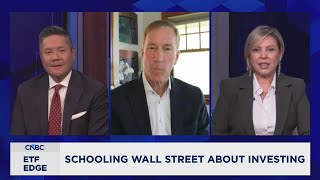
BlackRock, the world's largest money manager, released its quarterly results a short while ago, reporting earnings of $6.61 per share. This beat the estimate of $6.13 . Revenue was in line with Wall Street expectations , and BlackRock raised its quarterly dividend by 5% to $ 3.30 per share. Larry Fink is with us, the chairman and CEO, and he's joining us now specifically .
The stock didn't seem to move much in the pre-market on the news, but given the challenges of 2018, 2019 looks better. Yes, you're right, Andrew. Global equities fell 13% last year . Global equities recovered about 11%. The conditions were completely different throughout the quarter . We increased our total asset base by 9% .
That means we have grown assets of more than $525 billion . Of this, 65 billion was organic growth, the rest came from market movements. So we're back to the $6.5 trillion level again . However, the AUM mix is quite unusual . We received 80 billion inflows in fixed income. You've seen many people investing in fixed income .
But global equities saw huge industry-wide outflows. So there hasn't been much change in trends. But in our case , as I said, there are net inflows of 65 billion . We have seen extraordinary new successes in our technology business. We raised a record $6 billion in illiquid alternatives this quarter .
So we noticed the investments. But I wouldn't say investors have completely jumped on the market rally. I can clearly say that at the moment, many investors are holding back by not investing enough. Does that mean you think they invested less ? Okay, two questions. One, where are you bringing in the new money ?
What I can say is that , I can say publicly about our iShares franchise , there have been 32 billion inflows , which are mainly concentrated in the US and Europe : about 17 billion in the US and 15 billion in Europe; Very little came from Asia in the first quarter. But, we have seen investments from Asia and the Middle East in our institutional business, so we are seeing some investment coming in .
Money is shifting from cash to fixed income . We are not seeing a large amount of money coming into equities. What are the investment trends coming into Core iShares and Mutual Funds? Can you explain to us something about your fees and the pressure on them? This quarter, our fees actually increased 0.2 basis points .
That is, we went from an average of 18 basis points to 18.2 . Overall, I'm talking about the entire franchise . Part of it is that we are now more and more successful in the alternative space . That is definitely helping and we have seen a different change in the high- yield segment compared to the situation in 2018 .
In the iShares business, a combination of low-fee core and non-core ETFs for institutional needs or liquid markets is good. So, we didn't see any pressure that was heavily diverted towards just the core. So we're seeing a good mix of both core and non-core. Before answering that question you mentioned that people are underinvesting, globally .
Yes. Worldwide . Yes. But explain why you think that , are you saying it in terms of the equity market or just in general ? Usually . And some people consider this a market call . Yes, that is a market call. Yes. Is that what you are asking? Yes. I think there is more risk of a meltup here than a market crash .
Am. Wherever the equity markets are , we haven't seen money become an investment. We have a record amount of cash on hand . Retail investors are withdrawing money from equities . Institutional investors are also withdrawing money . I am talking about the industry now . So, when there's something unique in our infrastructure business or otherwise , the demand for those assets is extraordinary .
In fact, our clients are arguing for us to give them a bigger share . They want more allocation . But explain why you are bullish , because you have been bearish or neutral when you have come to this event many times in the past. I think so, especially in the current circumstances, as central banks are adopting a more dovish stance than in the past .
They are not changing their behavior regarding QE now . There is a shortage of good assets . In recent weeks, people like Katie Stockton, as well as others, have noted that there has been little enthusiasm among investors about this huge move from January to March. And if you look at it, you know, you know these things very well in managing trillions of dollars, there's not as much excitement now as there was when the market peaked in the past, right?
Yes. In fact, there seems to be huge excitement in fixed income. Many people thought interest rates would rise , but that didn't happen. Yes. We didn't see that and people rushed to invest in fixed income , but we didn't see that in equities, what I'm saying is, I didn't see a situation there where I would run and say I missed the opportunity.
Can I ask you something about this? I consider this a kind of enthusiasm gap . We're talking about Lyft, as well as the series of IPOs like Pinterest that came out this week , and Uber is coming soon. How do you think investors view this ? How do you view these IPOs in light of this lack of enthusiasm ?
Hmm, I think everyone is looking for some new story , so when these IPOs come out it will be a new story ; For those who have not invested in private equity markets, venture capital, or angel investing, this is their first opportunity to see these stocks . Some of them even include big retail names like Uber.
So, what is Larry Frink's opinion about these IPOs ? It depends entirely on their business models . We've been big investors in Uber since its early days , so we're watching how it trades with interest . Are you concerned about the way Lyft is trading ? No, not at all . That means I'm not focusing on just one stock.
No, I didn't . We shouldn't focus on just one company . No, I'm asking if Lyft is considered a counterpart to Uber . Some say they are completely different businesses because of the work they do , and the way Uber is trying to expand internationally, compared to Lyft . But I think to myself , if you look at where Lyft is today , but you can tell me why those companies are important and translate that to asset managers , because we just finished a leadership meeting where I talked to all of our leaders about the macro trends that are impacting our clients .
Our clients. So our clients, well, everyone wants more transparency , right? Everyone is looking for a company that offers them more convenience. Well, these are two macro trends that will impact anything you talk about financial services, from taxis to buying on the internet . Many companies are not providing transparency and certainly not providing convenience.
So I believe these are the two key elements that are changing asset management in the investing market, and that is leading to lower fees . That's still leading to great demand for high returns , if you can get them. But most importantly, this is leading you to want to focus on my outcome , right? So I asked all of BlackRock's leaders about those five trends, how are they going to impact your business ?
And I truly believe that we are going to see huge changes in our industry, in financial services, just like we have seen in the taxi business or retailing . People need more transparency and they expect it . Society is expecting more of it and people want more convenience and we need to translate that.
Reference. He is worried . He kept watch. He is careful . But to you, when was the last time you were worried? Maybe when you start the block . You haven't had anxiety in years . Right? You are not worried. I am not a person who worries. You are not worried. You have trillions of dollars . That's not it , okay, no, that's not my money, Joe, as you know .
So, you're worried about other people . OPM mentioned . I am worried . Anxiety, caution, vigilance. I also call you, I mean, you are more than calm. I would also say that I am calm. You have a presence. You have a peaceful presence. Moreover, over time, I would say that you are one of those people who voice their opinions about Wall Street and capitalism and the conscience of businesses in America.
And I thought it was interesting when you came last time, when we were talking about that situation with Khashoggi and Saudi Arabia . I asked you directly, will you end doing business with Saudi Arabia? You said no, absolutely not . And you're very honest about this , here we are with a bond offering , where I think everyone has come to your perspective , I haven't seen anyone say they won't take these fees for the bond business or participate in the offering .
So once again, common sense, this is the real world, right? That means we have to endure some things and move forward . I wouldn't even call it tolerating it. As I said , when we talk about Saudi Arabia , you know we have a lot of work to do there . We manage the money for the Social Security Fund .
We manage money for very good people in Saudi Arabia . We still do not know the end of that terrible tragedy. We know there's a lot of criticism, but when I write in my CEO letters , I say you have to be local in every community you work in. You know that no society in the world is perfect. There are many extremes in every community , but in every community you have to work with the local community to be a part of that community .
That's why we decided to continue doing business there . We didn't go to that one conference . I have been to Saudi Arabia , and will be going there again soon, along with many other countries I am traveling to . So, you know you have to be intentional. You have to be open . You have to be straightforward.
But I believe that what we are doing in Saudi is not contrary to what we talk about corporate purpose . No, I agree . You will be very popular in China too . That means things aren't that good in China and they're not perfect in many countries . There are extremes in many countries and it is our job to try to overcome them, but we also need to have a sense of awareness.
So I'm not here to say that we're not evolving or changing, because I believe that society now expects more . But there is a question here about companies being a coercive mechanism on these issues . How does Black Rock think of itself in places like Saudi Arabia or China ? Is it just about overcoming these problems or is it about acting as a coercive mechanism in places like Saudi Arabia ?
When doing business there , how much sense does it make to use your voice to tell them that we will do business with you , but on these terms or we will do something? In every community where we work, whether it's Saudi Arabia, China, America, Mexico or Europe, we have to stand by our clients in those communities and work with them .
If you truly want to be an international company and do business globally, you should not forcefully impose the practices of America or other countries, but rather work together in those communities and find ways to help them change. There are some universal principles that we cannot change . One of the global principles we are working towards is to have at least 50% women .
Therefore, there should be gender neutrality and equal pay for women and men worldwide . It doesn't matter where we work. So we are trying to grow, change and move forward as an organization , and we want to be a principled organization that works with all communities . We are also in countries with problems.
I don't want to name any one company . I have personally spoken to them about what we think they need to do moving forward, they may or may not listen, but we will voice our concerns . But the fundamental problem is that society is changing, as I wrote in my last letter: Millennials expect more from the companies they do business with .
Millennials are paying attention to where they work, so if you want to be a company that attracts top talent and expands in the community , you need to be more careful . And I believe we are in a very deep political debate now . I believe that the role of public companies will grow , and that leaders of public companies or their boards will need to have a stronger voice , and that a stronger voice will lead to better profits .
Does that mean you take a stance or do you vote with your shares and take a stance? It could be anything , but Black Rock is standing strong, you know, I represent Black Rock employees, clients, shareholders , we have a voice now. We are also asking other CEOs, chairpersons , and boards to speak up .
I believe we need to be careful , you hear from Jamie Diamond, Ray Dalio and many others , that we need a more conscious capitalism now. A more inclusive capitalism is needed and, as I mentioned in my last two letters , society is impatient with the government doing less. I'll ask you a question on that , because Jamie Diamond was asked about wages at the bank hearings last week.
Last week you saw Jeff Bezos come in and challenge Walmart on wages . If all these companies cut their profits and raised wages, at least in the short term , how would BlackRock view this? It might be good for society, but it might be bad for the stock . Look, if in the long run you can attract better employees and be more productive , I do n't have full information, but I think they can attract better employees by raising wages or if those same employees are willing to work harder, they'll be more motivated .
If the output is better productivity, it may not reduce their profits . But once again, if you do that and raise awareness among your clients, which creates more demand for your products , then everything might be fine . So the question is, if you think that simply increasing wages will have no impact on your employees, that is not correct.
These are being done by private companies. If the minimum wage were to be raised to $20 by law, as it is in Seattle, businesses could suddenly go out of business , which could be bad for society. This is not always good for society. It happens. That could be bad for the company. Even to the society they are in.
What's bad for companies is n't always good for society, Andrew. And if the minimum wage nationwide were $20, that could also be bad for society . But I would strongly argue that in the long run, having more enthusiastic employees and stronger clients is more important. She is a private company. Thank you very much for coming here. Thank you.



Comments 0