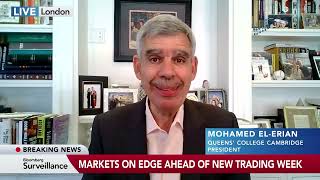
저자: MohamedEl-Erian · 외국인
요약 보기
관세 정책의 단기 방향이 불확실하고 시장은 마진콜·기술적 매도 등으로 무질서한 하락 위험에 노출돼 있다. 연준 풋(Fed put)은 인플레이션 우려로 사실상 멀어졌고, JP모건은 연말 인플레이션을 4.4%로 전망한다. 기업들은 채용 동결·비용 절감·가격 인상에 나서고 있으며, 이는 개별 기업으로는 합리적이나 경제 전체로는 부정적이다. 시장 바닥을 확신하기 어려운 상황이다.
다듬은 글
Mohammed, welcome to the program, sir. We don't usually get to talk on a Sunday evening, and when we do, it's probably not a good thing. So let's get straight into it. Do you believe these are the start of a set of negotiations or do you believe these are the new rules? We don't know, John, because as much as there was uniformity when it came to statements on where we're going to end up, which is this notion of a golden age in which tariffs play a critical role in getting us there.
We've heard at least three different messages about the short term message, number one, from the second Treasury. There's nothing to worry about. There's this rush by Wall Street and others to price it lower growth, recession. We had Jp morgan over the weekend with significant revisions. In the secretary's view, that is excessive.
There's no need to do that. So he's saying everything is fine in the short term. You have a second view that, yes, it's going to be tough in the short term, but it's worth it because these tariffs will hold and what you're going to get is higher revenue. What you're going to get is protection. What you're going to get is people moving back to the US with the production facilities.
Then you had a third view expressed that you have 50 plus countries negotiating, and we may go into a world where tariffs are uniformly low across the world. So I think the hardest thing for the markets right now is not only to try to evaluate where the destination is, but how bumpy will the journey be.
And I'm saying that because we have technicals playing in margin calls, are there people are in fact reducing winners and losers across the board to waste cash. Fund managers are worried about actual and expected outflows. So the thing that Lisa rightly said is there is no circuit breaker on the horizon.
And the question for the marketplace is with this confusion about what's happening in the short term, will bad technicals take over? That's the big question right now. Mohammed, let's follow up on that and separate two issues. The next phase for markets and the next phase for business, corporate America and corporations across the planet.
The next phase for the markets. So far, we've repriced the cycle. Repriced the economy lower. Got that? And we've done it in quite an orderly way so far. Do you see reason to believe this enters a more disorderly phase in the days to come? It could go wrong. On the one hand, this sell off has been quite indiscriminate.
Correlations across asset classes have gone to one. Whether it's equities or gold, the correlations have gone positive and high positive, and therefore value is being created in certain pockets of the market. On the other hand, people are worried about catching a falling knife and worried about more deleveraging.
They're worried about the margin calls forcing people to raise cash. So, you know, you've got to be really brave to go in and pick up the pockets of value because there's still a very big cloud, a techno cloud over your head. Who do you think is more likely to blink first? I mean, this was sort of the downdraft that we saw further on Friday was when Fed Chair Jay Powell came out and clearly said it wasn't going to be him because right now inflation was a serious concern.
How much is that fuelling this additional round of potential sell offs that we may see? It is because we first priced out that Trump put. And then what we heard from Powell on Friday is that the Fed put it well out of the money. And if you look at the latest revisions in in inflation, J.P. Morgan this weekend has been inflation at 4.4% by the end of the year, 4.4%, more than twice the Fed's inflation target.
So I think to go back to what you said when you looked at what happened in 2020, you need a malfunctioning of markets. In order for the Fed put to back into money, you need markets to malfunction. You need Treasuries not to be the safe haven, but to start showing technical breakdown. And we haven't seen that.
So unless there's a malfunctioning of market, the Fed is forcibly sidelined by the inflation side of its mandate. In the meantime, Mohamed. Companies have to take action. They don't have the luxury, as John was mentioning, of just sitting there and watching and hanging tough. If they have a payroll to meet and they aren't sure exactly how much they have to charge and when they can pass along the prices.
I know you set up boards and you have discussions with people. I know that you are in the corporate world as much as anything else. What are you hearing in terms of how they are preparing and whether we are getting closer to that point where they have to make really hard decisions about what they keep and what they don't?
And Lisa, you know, I listened very carefully to business leaders because I think you get a good sense when there's a paradigm shift as to what's likely to come next. The best that you can say for the economy is that there's a set of business leaders who are willing to wait and see and take the hit on profit margins.
What hit are they taking? Higher cost and anticipation of lower revenue due to demand destruction. So there's a group that's saying wait and see, We know it's going to impact profits, but we're willing to do that because we don't know how these tariffs are going to work out. Then there's a second group that says we can't wait.
We have to take action now. So you're starting to have soft freezes on hiring. You starting to have rounds of let's see what we can cut in terms of expenditure. And you're starting to talk about price increases, trying to pass on the higher cost to. The end consumer. That second set of reaction, which makes sense at the level of each company, does not make sense for the economy as a whole.
So it's going to be the balance between the two. And I must say that second set is larger. The people I talk to, of course, it is a small sample, but it's larger than the first set.



Comments 0