원문 보기
Gold and silver also fell for the week. Silver prices appear to have closed at 55.83. Oil prices have now risen 22% since July. Remember, precisely because gold is cheaper now than it was at the start of the war , this is the new narrative that war is hurting gold. So this is a huge scam that creates a great opportunity for people who missed out on the huge growth to buy both metals and mining companies.
That's what, as you know, has led to some declines in bond yields , as the probability of a Fed rate hike has decreased a little bit based on those numbers. The yield is still very high compared to where we were. Import prices increased by 7.1%. Export prices increased by 10.2%. But then again , the reason the government wants to misdefine inflation by claiming that inflation is price increases, not money expansion , is precisely so they can pretend they are not the cause.
So they can try to blame whoever is raising prices and not take responsibility for the inflation they created. But gold and silver also fell over the week. Gold fell 1%. Gold traded below 4,000 for several days, but did not fall below 4,000 for a week. We closed at $401,730. Today, the week ended with an increase of just over $40.
Silver, ahem, performed much worse , down 4% for the week. Silver closed at 55.83, I believe. This is about the lowest weekly close I've seen for silver in a while. And mining stocks performed even worse, or about the same as silver. GDX fell by 3.9%, and GDXJ by almost 5%–4.8%. Again, markets are wrong.
Markets are reacting, ahem, to rising bond yields, ahem, to the Fed. And I'm going to look at, um, the second part of Warsh's testimony, um, a little later in this podcast, but it's the idea that he's now this hawk who's going to be tough on inflation, but also this was a real escalation of the war.
You know, uh, the war has been in the spotlight again this week, especially in terms of oil prices. Oil prices closed down about 11.5% for the week. Closed at around $82.50. Now in July, the price of oil has increased by 22%. Remember, we went down 30% in June. In July, we already grew by 22%. So that also, uh, lowered the price of gold, because again traders are assuming that the war is bad for gold just because gold is cheaper now than it was at the start of the war .
This is the new narrative that war is bad for gold. Peter Schiff notes that rising oil prices and geopolitical tensions have historically supported gold, increasing inflationary risks. However, gold remains under pressure, suggesting that short-term market sentiment is trumping long-term fundamentals.
Instead of focusing on daily price fluctuations, Schiff believes investors should keep an eye on institutional buying and broader economic trends. What appears to be weakness today may actually be part of a larger accumulation phase before the next big move. No, that's not true. This has always been good for gold.
This will always be good for gold . The only reason the price of gold fell with the start of this war was because it had risen so much before the war, and this was partly due to the expectation of war. So this is a huge scam that creates a great opportunity for people who missed out on the huge growth to buy both metals and mining products.
And so, silver is far from its high of $1.25 , falling to 55.83. But I'm focusing on the fact that we went over 50. We had a powerful breakthrough. You know, there was huge resistance just below 50 starting in 1980 and then again in 2011. So the silver chart looks phenomenal and I think in a couple of years you will barely notice the drop from 125 to 55 where we are now.
Uh , this is a great buying opportunity. Bond yields fell slightly during the week, driven by better THANEX inflation expectations . And I talked about the CPI in my last podcast, it's better than expected. The same happened with the Producer Price Index (PPI), which came in better than expected. Actually, I got these numbers right here: June producer prices fell 0.3% month-on-month, up only 5.5% year-on-year from the previous month, up 6.5%, and the core index rose 0.2%, er , better than expected, 4%, and year-on-year, excluding food and energy, producer prices rose 4.7%, better than 4.9%.
Peter Schiff argues that the recent decline in silver prices may be a normal reset after a significant structural breakout , rather than the end of a bull market. Short-term inflation data may temporarily calm markets, but it does not necessarily change long-term monetary and supply-demand indicators .
For long-term investors, the key is to separate temporary market sentiment from the underlying fundamentals that can continue to support precious metals. So, that's what, as you know, led to a slight decline in bond yields , as the probability of a Fed rate hike decreased a little bit based on those numbers.
But the yield is still very high compared to where we were. The 10- year Treasury yield closed the week at 4.54, and the 30-year at 506. So that's still a high yield compared to where we've been, not compared to where we're going and where we've been, you know, since the 90s, the 80s, or the 70s. They are low compared to this, but in recent memory, after the 2008 financial crisis, this yield is about the highest we have seen, and it will be much higher.
Meanwhile, the news on inflation is actually not very good. What caused the fall in producer prices? The same thing that caused consumer prices to fall . This was a 30% drop in oil prices in June. Well, they already grew by 22% in July. So why are we celebrating the great oil price crash that has now largely been overcome?
And there is a high probability that it will be completely overcome. But even more important are the figures released today regarding import and export prices. I've mentioned this many times on the podcast. These are much more honest numbers than the CPI or PPI because there is no substitute. There are no hedonic adjustments.
Numbers are numbers. And compared to last year, import prices increased by 7.1 %. Export prices increased by 10.2%. Compare that to a CPI increase of 3% and 12% compared to last year or slightly higher, as I just said, with producer prices. These numbers are a much better reflection of the price increases that Americans are actually paying.
Obviously, if imports grew by 7.1 %, we are buying a lot of imports. We pay these higher prices. The CPI may not reflect this, but we pay. Peter Schiff points to rising import and export prices as a sign that inflationary forces remain active beneath the surface. While headline inflation may appear subdued, higher commodity prices could ultimately have a negative impact on the economy as a whole.
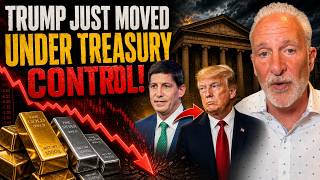
Investors should focus on long-term trends rather than short-term data, as purchasing power may continue to come under pressure even as inflation appears to be easing. I want to talk a little bit about what I heard from our Treasury Secretary Scott Bessette on Fox News. He was interviewing Jesse Waters, and he was giving him a tour, I guess, of, you know, and on the wall were, um, framed old Federal Reserve notes from before 1968 or before 1933, which were silver and gold certificates that I used as legal tender that could be exchanged for gold or silver coins on demand.
And so Scott Bessette walks down the hall, points it out to Jesse Waters and explains to him, you know, how our currency has changed , how it used to be backed by gold and silver, and now it's just fiat currency, right? What is true? Of course, this is all unconstitutional. Um, he didn't resort to that.
But the reason I bring this up is because he then told Jesse Waters that if any of these old notes were still around , whether they were silver certificates or gold certificates, he said, "If you have one of them, you can bring it to Fort Knox and you can get your gold, you can get your silver." He actually thought those silver certificates were still good.
This is not true. How could he not know this? Now, I guess I can forgive the average guy or girl on the street who might not know this, right? That the government abandoned these banknotes many years ago. That was Roosevelt in 1933. Roosevelt said that if you have a gold certificate, you can't get any more gold.
Peter Schiff argues that mistakes about the history of the monetary system can raise broader questions about how politicians understand the currency they control. He believes that trust in financial leadership depends on trust and informed decision-making, not just public statements. For investors, the key takeaway is to verify official statements, stay informed, and focus on long-term economic fundamentals, not just headlines.
You cannot get gold for your gold certificates. Silver certificates remained valid until 1968. But after 1968 they were also not suitable. You couldn't buy them out. So yeah, you know, maybe the typical person, especially someone who went to public school, knows , what the hell are they learning there?
So they may know nothing about the monetary history of the United States or the Federal Reserve System. But if there's anyone in Trump's cabinet who you think might know this, it's the Treasury Secretary. So, he's the one who actually signs the banknotes, right? He must know the history of our money, and he thinks he does, because he explains it to Jesse Waters as if he does .
However, he is absolutely wrong about something so obvious. I mean, I don't even remember when I first learned about it, but I've known it for almost my entire adult life. I'm sure when I was still in high school I knew that these notes were not redeemable. In fact, you know, when Scott Bessant said that if any of this was around, there would be a lot of it.
There are many such certificates. I went on eBay and saw one set framed, right? So it could be bought with a frame, and there were three silver certificates, two $2 bills, and one $1 bill . That means in the past you could get five silver dollars, right? You could go to the government, give them a $2 bill, and they would give you two silver dollars , and you would get either a Morgan silver dollar or a peace dollar, right?
You were getting real silver. You could have bought these three bills. They sold them in a set. It was something like $31, $31.95 or something, which includes the frame and everything else. According to Scott Bessett, you can take that $5 to Fort Knox , and they'll give you five silver dollars , which are worth about $60 apiece.
$300 in silver, according to Scott Bessett. You could do it. It would be funny if someone had this video, downloaded it onto their phone, drove to Fort Knox with some of these old certificates and said, "Hey, I'm here to collect my silver." Scott Besson said, "I just need to bring him in and you'd give me my silver." Of course, a lot of people, when I pointed this out to X, said, “Oh, come on , Peter.
He didn't actually say that." He really said that. That's exactly what he said. Come to my feed X. I reposted the clip . Um, you know, the person who posted it didn't even pay attention to it. I reposted someone else because in the same video he said, “Hey, he was at Fort Knox and all the gold is there, so don’t worry.
It's all there. Well, I won't believe anything he says. If he doesn't even realize that gold certificates are no longer valid and you can't redeem them or get silver certificates, you know why I should believe him about what's in Fort Knox? Like, comment and share. . Stay tuned and stay connected."


Comments 0