
저자: National Libertarian · 외국인
다듬은 글
시장 거품과 미국 주식에 대한 우려
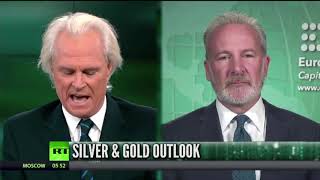
or at the stock market retreating from record highs, let's get some reaction now from Peter Schiff, CEO of Euro Pacific Capital.
Peter, it's been an incredible record run, and even with this slight pullback, we were at record highs not too long ago. So what do you say?
Well, the bubble keeps getting bigger. Donald Trump called it himself as a candidate. He said it was a big, fat, ugly bubble, and he was right then. Now he's wrong, because he denies it's a bubble now that he's president, and so it's his bubble. He'd rather it be a bull market. But the valuations here really are extreme, and the complacency is also extreme. Investors are willing to pay very high prices and have very little worry that the stock market is going to go down. People have very short memories. We've had two major 50% declines in the stock market this century, since 2000. So the market has been cut in half twice, and it could easily happen again, yet nobody seems concerned.
연준의 구제금융과 투자자 심리
I think one of the reasons is that the last two times the market went down, the Fed was able to bail out investors who bet on one bubble by inflating a bigger one. A lot of investors may have been conditioned to believe that even if the market implodes, if they hold on they'll get their money back. But the third time may not be the charm. It's possible the Fed can't blow a bubble big enough to bail out investors this time.
기술주 실적은 정말 좋은가?
But Peter, you must acknowledge how well some of these companies are doing. Look at how well Apple is doing. They have a pretty modest valuation. Other stocks like Amazon and Microsoft are doing so great, and Roku. Companies are benefiting from these technology trends, right?
Well, I think they're really benefiting from all the cheap money that's been coming out of the Federal Reserve. So yes, it's very easy for companies to do well when interest rates are at historic lows. Let's see how well these companies perform when interest rates normalize. That is the key. They're doing well on life support, but let's unplug all those gadgets and see how they do. Warren Buffett used to say that when the tide goes out, we see who's swimming naked. I think there are a lot of people swimming naked, and you just don't know it because of all the water the Fed has been sprinkling into the markets. But eventually the tide is going to go out, and it's not going to be pretty.
금리 정상화와 달러 약세 전망
So do you think that tide turns in the next year?
Hey, I don't know. There's no way to know. I think Donald Trump has nominated somebody who will try to do his best to keep the air in the bubble. But at some point, market forces will overwhelm the Fed. The market will go down, and if it doesn't go down, the dollar will collapse instead. Either way, you're going to see the real value of US stocks come way down, whether it happens nominally or not. I have a feeling that if the Fed prints enough money to prevent the market from going down dramatically, then the real losses will be even bigger because of the implosion of the US dollar.
투자자를 위한 조언: 해외 투자
Okay, so any advice for investors in terms of where to put their money right now, if they're worried about US stocks?
Yeah, look, I've been putting my money outside the US market for years. It was a great trade up until 2008. From 2001 to 2008, the returns were spectacular internationally, in commodities and emerging markets. Then we had good years from 2009 through 2012. 2013, 2014, and 2015 were bad years for global investors. We had a big rise in the dollar, a drop in gold, and dropping commodities. But the tide has turned since January of last year, and I think we're riding a big wave here. People who are in the US market are overlooking much better returns from much better valuation levels that are happening overseas. So I think people should take advantage of the overpriced US stock market and the overpriced US dollar, sell, and move money abroad. Get into the international developed and emerging markets, and get into the commodity space. Look at oil hitting a new two-year high again today. This is going on in commodities across the board. We are coming off major bear markets, at the infancy of new bull markets. I think the dollar is about to get killed. This is the first year in many years that the dollar is down, but I think it's the first of many. I think the dollar could fall for the next five to ten years in a major bear market, taking the dollar to all-time record lows. That will enable enormous profits for people invested outside the US in the right currencies, the right assets, and the right companies. That's what I think we're doing with our clients at Euro Pacific Capital, and that's certainly what I'm doing with my own money.
미국 법무부의 CNN 분리 매각 요구에 대한 견해
All right, Peter, I want to ask you about a specific market situation. There are reports that the Justice Department is asking for CNN to be spun off in order for AT&T's acquisition of Time Warner to close. Of course, Time Warner owns CNN. What's your reaction to something like this?
Well, I don't think it really matters much, but I really wish the government would stay out. I really don't like all this antitrust legislation. It all started with a populist movement early in the last century, and over the years it has done far more harm than good. Consumers are best served not by government regulators but by the free market. Let companies compete, let companies merge. At the end of the day, I think the consumer is going to win. I am not worried about monopolies unless they exist by way of a government grant or a government regulation that stifles competition. The free market and competition are the best things consumers have, and we don't need the government to make the market free. The market does a very good job on its own. When regulators try to substitute their own judgment and determine that things are anti-competitive, they make more errors in judgment, and they end up stifling innovation and growth. Because of all this antitrust regulation, I think consumers end up paying higher prices than they otherwise would if the government just minded its own business.
Even though, if AT&T owns Time Warner and CNN, they'd have more pricing power, so the consumer could potentially lose?
There is so much competition for content. It's crazy to say there's not going to be a competitive market. Look, I remember when the government broke up the merger between Blockbuster and Hollywood Video because they said they would dominate the VCR rental market. That market doesn't even exist anymore. In a few years it was gone anyway, and they were desperately trying to survive. Yet the government blocked the merger because they wanted to make sure there was still competition to rent movies. Look at all the competition that exists even without any rental companies. This is nonsense. There's plenty of content, there are plenty of alternatives, and consumers have more options now than ever before. This is ridiculous. These companies need to merge to remain competitive in a hyper-competitive environment.
트럼프의 CNN 비판과 정치적 동기 의혹
The thinking is that Trump has criticized CNN's coverage of him. Is that the ultimate reason he or the administration wants CNN sold?
Look, I have no idea if it's that kind of petty vendetta, or if the president has anything to do with it. This is the type of stuff that's been happening. If Trump was going to drain the swamp, I'd like to see some swamp draining over there. Stop nitpicking. If private businesses want to get together, and the shareholders of these companies decide it's in their economic interest to merge, let them merge.
비트코인 급등과 그 가치에 대한 평가
Peter, what do you make of the latest surge in Bitcoin in recent days? It hit seven thousand eight hundred dollars at one point. How high can this go?
Well, I don't know. I guess there's no limit, because there's no real value. I don't believe in Bitcoin. So if it can go to 8,000, it can go to 80,000. I suppose the odds are lower the higher you get, because the prices become absolutely ridiculous. And of course, people who are holding these things will at some point want to sell, because they're going to want to buy stuff. So at some point the market is going to go down. But what I've seen recently is more people looking at Bitcoin not as a fiat currency, not as an alternative medium of exchange. A lot of people are acknowledging it's not going to be an alternative for typical people around the world to go out and buy a cup of coffee. They're not going to be paying for it with Bitcoin. Now the story is that it's an alternative to gold. It's not really a digital currency, it's digital gold, and people could use it the way most people use gold. Most people are not using gold as money, even though we used gold as money in the past. Today investors use gold as an inflation hedge, a store of value, a safe haven. Now they're trying to market Bitcoin as an alternative to gold. They're even calling it digital gold, and they're trying to get investors, hedge funds, and larger buyers to come in. To some extent, I think this marketing campaign is working. Of course, the returns on Bitcoin have been spectacular. People who bought in three, four, five, six years ago have made returns we've never seen, even in the dot-com bubble or any other bubble. The amount of money on paper is enormous. For some people, they've actually cashed out. Those spectacular gains create hope. People want to get in, and they're hoping the same thing can happen again, that it can go up another 50 or 100 times. But it probably isn't going to do that. At some point it's going to implode, but I have no idea when.
비트코인은 금의 대안인가?
Do you think Bitcoin is a legitimate alternative to gold?
No, I don't think it is. It is an asset, a digital asset. What its actual value is remains to be seen, but it has nothing in common with gold. There are certain things you could say it has in common with gold, but you can't do anything with it. None of the real-world uses of gold apply. Gold is used in jewelry, and you can't make jewelry out of Bitcoin. Gold is used in consumer electronics, in medicine, and in aerospace. There's no use for Bitcoin other than storing it as an asset, and that depends on other people valuing that asset. It's all based on trust and confidence. That's the same flaw people who were initially buying Bitcoin saw in the dollar, the euro, or the yen. All these fiat currencies are created by governments, have no real backing, and have no real value. Their value comes from confidence, trust, and faith. But that's the exact same way Bitcoin derives its value. Yes, Bitcoin is limited in supply, unlike dollars or euros, which are unlimited. But there is an unlimited supply of other cryptocurrencies that can be created that are as good as, or a tentacle to, Bitcoin, or may even be better. So there you have an unlimited supply as well. I don't think these currencies are going to work, but they have made a lot of people a lot of money. Certainly the people who have cashed out have made money, and a lot of other people have big paper profits, whether or not they actually realize those profits. Most of the paper profits are going to vanish, but some of them will be realized. At the end of the day, I think it becomes a zero-sum game. The gains of people who make money on Bitcoin come at the expense of the people who lose money. Just like any pyramid or Ponzi scheme, somebody gets caught holding the bag, and the bag holders end up providing all the profits for the people who got in early and cashed out. It could be a hot potato situation. I don't want to get caught with it when the music stops.
Peter Schiff, always a pleasure chatting with you. Thanks so much.





Comments 0