저자: KenGriffin · 외국인
요약 보기
켄 그리핀은 하버드 기숙사에서 위성 데이터 링크와 전환사채 차익거래로 시작해 Citadel을 세웠다. 1987년 블랙먼데이에도 수익을 냈고, 1998년 락업 조항으로 LTCM 사태 때 자본을 지켰다. 2008년에는 55% 손실과 대규모 자금 이탈 위기를 락업으로 버텨 2009년 62% 수익을 냈다. 2022년 Wellington 펀드는 160억 달러 수익으로 역대 최대 연간 이익을 기록했다. 핵심은 예측이 아닌 인프라와 구조적 방어에 기반한 시스템 운용이다.
다듬은 글
Inside the headquarters of Citadel, a phrase is engraved near the elevators identifying the firm as the most profitable hedge fund manager of all time. The foundation of that record began in 1987, not on a trading floor, but on the slate roof of a Harvard dormitory. In the late '80s, real-time market prices were assets locked behind the proprietary systems of major investment banks.
For a 19-year-old student, the lag between a price change on Wall Street and the information reaching a dorm room made high-frequency trading impossible. To bridge that gap, Griffin convinced university administrators to let him install a satellite dish on the roof of Cabot House. He ran a coaxial cable from the roof, down the side of the historic brick exterior, and through his dorm room window.
That cable fed live stock quotes directly into a computer terminal sitting next to his bed, giving him the same data stream used by professional desks in Manhattan. While his peers relied on the morning papers, Griffin had built a private physical link to the heart of the market. Griffin had spent his teens as the president of his high school math club in Florida.
He was known for taking complex equations apart and rebuilding them into more efficient proofs. He applied that same structural logic to a strategy called convertible bond arbitrage. This chart represents the relationship between a company's stock and its convertible bonds. Usually, they move in parallel, but micro inefficiencies in the market can cause the two prices to briefly drift apart.
By buying the underpriced security and simultaneously shorting the overpriced one, a trader can lock in the difference as profit. Because the positions offset one another, the profit is insulated from broader market swings. Whether the Dow climbs or falls, the margin between the two prices remains the focus.
The math provided the safety, but it required the satellite feed to catch those price gaps before the rest of the market could react. With the data link established and the math verified, Griffin needed the capital to move the needle. He raised $265,000 by pitching his grandmother to his dentist and a few family friends.
Griffin spent his days in lecture halls and his nights managing a quarter-million-dollar portfolio from a desk cluttered with textbooks. By his sophomore year, he was operating a professional-grade arbitrage fund without ever leaving the campus gates. In October 1987, less than 3 weeks after his fund went live, the strategy faced a systemic collapse.
October 19th became known as Black Monday. The Dow Jones Industrial Average dropped 22.6% in a single session, the largest one-day percentage decrease in the history of the index. On the floor of the New York Stock Exchange, the day ended with the sound of shouting and the sight of millions of discarded trade tickets covering the floor.
Newspaper headlines reflected a sudden, widespread fear that the mechanics of the global economy had fundamentally broken. Inside his dorm room, Griffin watched the same plummeting numbers on his terminal. Because his arbitrage positions included heavy short exposure, the crash didn't trigger a loss.
While major firms were crippled by the volatility, Griffin's model performed exactly as the math suggested it would. Griffin ended his first year with a return of roughly 70% navigating the worst market crash in a generation. It was a performance that would have been notable for a veteran manager, let alone a student trading between classes.
That dorm room operation would eventually scale into Citadel, a firm that now manages over $60 billion in assets. Griffin's success didn't come from predicting the crash, it came from building a machine that remained indifferent to it. In the late 1980s, the stock exchange floor was governed by adrenaline and ego.
Traders navigated markets through shouting matches, relying on gut instinct to make split-second decisions with millions of dollars. When prices dropped, this reliance on human emotion became a massive vulnerability. Fear would spread across the floor, turning a routine dip into an uncontrollable chain reaction of selling.
Far removed from those noisy trading pits, a recent Harvard graduate named Ken Griffin was quietly taking a different approach. By 1989, he was managing roughly a million dollars of family money from a modest office in Chicago. Instead of guessing market directions, Griffin used a strategy called convertible arbitrage.
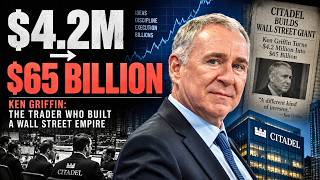
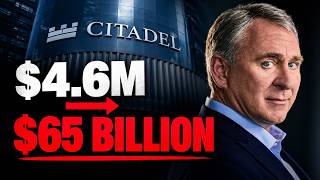
He looked for slight pricing discrepancies between related securities, relying entirely on strict mathematical formulas to generate returns, while largely ignoring the daily noise of the market. That steady, numbers-driven performance caught the attention of Chicago investor Frank Meyer. In late 1990, Meyer backed Griffin with 4.6 million dollars of actual institutional capital.
Griffin used the capital to launch a new firm. He named it Citadel, a deliberate choice meant to evoke a physical fortress capable of surviving a sustained siege. He intended to construct a trading operation entirely devoid of human panic, systematically engineered to weather the crashes that regularly wiped out traditional firms.
To staff this operation, Griffin bypassed the veteran traders looking for work on Wall Street. Instead, he went straight to top academic institutions, recruiting physicists, statisticians, and software engineers. He assembled teams of mathematically inclined specialists years before the industry regularly used the term quantitative analyst or quant to describe them.
This team built proprietary computer systems to to price relationships and hedge ratios across markets simultaneously, finding hidden connections humans could never spot. Those algorithms allowed the firm to scale rapidly, expanding from convertible bonds to apply the same mathematical rigor to equities, fixed income, commodities, and emerging markets.
By replacing intuition with code, Citadel created an arsenal of algorithmic trading strategies that operated with cold precision. That precision would be tested almost immediately. The early 1990s brought a wave of economic recession and global turbulence that sent standard investors scrambling to protect their portfolios.
The outbreak of the Gulf War injected massive geopolitical instability directly into global supply chains. At the same time, the Federal Reserve was rapidly shifting domestic interest rates, creating violent, unpredictable swings across domestic markets. While the rest of the financial sector retreated from the chaos, Griffin's automated systems processed the turbulence as raw material.
The firm's relative value models were specifically calibrated to find pricing dislocations during moments of high volatility. As markets fluctuated wildly, Citadel capitalized on those price gaps, generating returns that steadily compounded well beyond standard market benchmarks. The algorithmic architecture of the firm meant it did not need stable markets to survive.
It was built to consume and profit from severe instability. Despite having removed human emotion from the trading floor, a massive vulnerability remained inside the firm's structure, the clients supplying the capital. In the years leading up to 1998, Citadel placed very few restrictions on its outside investors, allowing them to withdraw their money on short notice.
If a severe market panic frightened those investors, they could theoretically all demand their cash back simultaneously, draining the firm's operating capital overnight. Recognizing this risk, Griffin made a highly unpopular demand. He rewrote the firm's terms, forcing every client into a rigid new framework.
He instituted a policy known as the lockup. Investors had to commit their capital for a minimum of 2 years or face steep financial penalties for pulling their money out early. The timing of that decision was extraordinarily precise. Weeks after the new terms were finalized, the global financial system cracked.
Long-Term Capital Management, a massive hedge fund staffed by Nobel laureates, imploded under the weight of its own leverage trades, bringing Wall Street to the brink of a systemic freeze. The resulting panic triggered a massive wave of volatility, disrupting nearly every asset class and global market that Citadel traded in.
Because his investors were contractually locked in, Griffin's algorithms could continue executing their trades. Insulated from the threat of a sudden bank run, the firm navigated the crisis intact. By securing the capital base behind a contractual wall, Griffin completed his design. He combined algorithmic trading with rigid capital controls to establish a highly resilient framework that countless hedge funds would eventually copy.
Wall Street mythology usually follows a predictable arc: a lone genius, a market crash, and a single high-stakes gamble that pays out in billions. For 15 years, the ceiling for that performance was John Paulson. In 2007, he shorted the subprime mortgage market and walked away with 15 billion dollars in profit.
That record stood for over a decade. Then, in 2022, Citadel quietly erased it. Citadel's flagship Wellington fund generated 16 billion dollars in a single year, the largest annual gain in the history of the industry. Many assumed Ken Griffin must have spotted a black swan event and made an even riskier bet than Paulson.
But these returns were the product of a different philosophy. Griffin treated his fund as a piece of industrial machinery, an engineered system designed to function under extreme pressure. In September 2008, that system faced its first true stress test. The global financial architecture began to fail.
When Lehman Brothers collapsed, liquidity vanished and markets across the world seized up. Citadel was weighted down by heavy exposure to convertible bonds, amplified by massive leverage. When the market for those bonds froze, the leveraged positions entered a vertical drop, dragging the firm's valuation with them.
By year's end, Citadel's flagship funds had lost 55% of their value. Panicked investors launched a capital run, attempting to pull 1 and 1/2 billion dollars out of the firm simultaneously. Rumors spread that Citadel would be forced to close. Griffin later described this as the low point of his career, a moment where the firm stood on the edge of total dissolution.
The very aggression that built Citadel's early wealth had now pushed it to the brink of bankruptcy. Usually, a loss of that scale followed by a billion-dollar bank run ends in a fire sale. Citadel, however, remained standing. They were saved by a specific defensive feature known as lockup provisions.
These provisions acted as a structural floodgate installed a decade earlier to survive a capital run. The floodgate held. Barred from pulling capital simultaneously, Citadel avoided liquidating at the bottom. This bought time. In 2009, Citadel generated a 62% net return, converting chaos into a historic recovery.
This survival wasn't the result of a lucky trade in 2008. It was the result of a structural mechanism designed in 1998 to ensure the firm outlasted the panic. The 2008 survival illustrates a broader pattern in Griffin's career. He views market dominance as a problem of engineering, Whether it's capital stability or data speed, the solution is always infrastructure.
This philosophy traces back to his early days as an undergraduate in Cambridge. Griffin realized that a mathematically sound strategy is useless if you lack the hardware required to execute it faster than the rest of the market. He solved that problem by installing a satellite dish on the roof of his Harvard dormitory, ensuring he received real-time pricing data before his competitors.
That rooftop dish and the 2008 lockup provisions were both part of the same mindset. Griffin builds systems to solve for the variables, like data lag or investor panic, that eventually destroy other firms. In this model, long-term gains are the byproduct of superior plumbing. Citadel sits on two pillars: technological infrastructure for the attack and structural legal protections for the defense.
Over 35 years, those systems have generated an estimated $90 billion in net gains for investors. The record-breaking $16 billion profit in 2022 is the natural conclusion of that engineering, a scale of success that only becomes possible when you no longer need to gamble on the market's direction. Ken Griffin built the most profitable fund in history by acknowledging that while trades can fail, a well-engineered fortress can survive almost anything.



Comments 0