
원문 보기
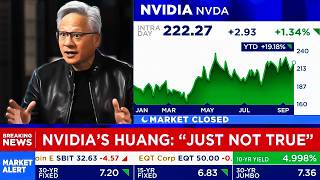
Chip giant Nvidia reporting better than expected fourth-quarter results. It was driven by revenue growth of 75% in its core data center business. That's a business that's very important to Nvidia. They control about 95% of that market. They see profit margins or gross margins of 75%. They are the 800-pound gorilla and then some when it comes to all of this.
And we spoke with Nvidia CEO Jensen Huang about that revenue growth and AI chip demand first on CNBC. The demand is really strong and it's diverse. It's coming from all over the place. At the core of it, Becky, what's happening is that AI just went through its third inflection. The first one was 2 years ago with ChatGPT.
And then the second one was about a year ago when the reasoning AI agents came out, reasoning AI systems came out. And the number of tokens, the amount of computing demand that it needed to be able to reason and produce all the excellent answers that these chatbots were doing was really sky-high. And then now with these agentic systems, we're now having these agents able to reason, take task, and actually do work.
And so the agentic systems are doing incredibly well all over the world. Of course, you've heard how Cloud Cloud Code and Open AI's Codex are doing incredibly well in companies all over the world in software programming, but it's starting to spread out into all these different type different other types of tasks.
And so at the core it's because AI has gone through a new inflection point and the amount of computing demand is off the charts. Let's talk a little bit about your customers, too, because you did say that the the big companies, the big hyperscalers, actually increased the amount of spending. And I think they make up about half of the spending that went into the data center segment in particular.
But you said the other customers were growing really quickly, and that's where so much of the growth came from. Who Who those other customers? You know, most people see AI as a chatbot. And the it's understandable because OpenAI is so popular and they're doing so well. And we hear a lot about cloud code.
But remember, AI is about a new way of doing software. It affects every single industry. Nvidia is really fortunate in the sense that we are the computing platform, the accelerated computing platform for every cloud, for any model, as well as every different domains of science. And so, we're seeing success whether it's in small cloud service providers regionally around the world.
It could be an enterprise. Our big partnership with Lilly. We have many others. Car companies that are building autonomous vehicles. The robo-taxi era is coming. And so, there's a whole bunch of computing being built for that. Scientific computing is being completely revolutionized by artificial intelligence.
And so, you know, the number of industries that are affected by AI because AI is fundamentally a new way of doing software, is going to be very broad-based. And that's one of the reasons why I say AI is a new industrial revolution because every single company is affected, every industry will be transformed, and every country will power it.
And so, it's a very it's broad-based. But CEO Jensen Huang says that the markets have miscalculated the AI threat to software companies. I spoke with Huang after his quarterly his quarterly conference call about the rise of AI functionality across industries and the SaaS apocalypse that those fears that have spooked investors.
I think there's a deep misunderstanding. What cloud cloud is definitely revolutionary and it's an inflection point for AI. It's the first time that AI can perceive, it can reason, but it can also do work. It actually performs tasks. Like for example, it can, you know, write software. It could create a website for you.
It could arrange a vacation for you. And so, it can actually perform tasks. And that's what That's the reason why we call them agents. They're agentic in their nature. Um what software companies the reason why it's it's so exciting, of course, is because it could write software. What's going to happen are the tools companies, the platform that ISVs, the SaaS companies, the tools companies, they will use agentic systems to develop their software.
But enterprises are not going to go develop software. They're going to use agents to use those tools. And so, what's likely going to happen is that agents won't replace the tools, but agents will use tools. That's the reason why we also say agents are tool users. Why write your own Why write or rewrite the browser when the browser exists and just use it?
Why rewrite Excel when Excel exists, just use it? And so, all of these tools that we use today, whether it's Cadence or Synopsys or ServiceNow or SAP, these tools exist for a fundamentally good reason. And AIs these agentic AIs will be intelligent software that uses these tools on our behalf and help us be more productive.
And so, I what's likely to happen, and this is this is very counterintuitive, it's very likely that because we have so many agents in our company now, the tool use will actually go up. And so, and you could see you could see it all over the place. The number of C compilers that we use, the number of Python programmers that we Python programs that we have, the number of instances are growing very, very fast because the number of agents we have that use these tools are going up.
And so, I I have 42,000 biological employees, and I'm going to have hundreds of thousands of digital employees, and and together we're going to use a lot more tools. But that means that you think that they're not going to disintermediate these companies like a Salesforce or so many of the others along the way.
You think they'll still be using those tools coming from those companies that are being sold off right now by the markets? I think so. I think the markets got it wrong. I think it's very likely that these companies that we're talking about are going to introduce agents that run on their platforms. You know, these agents of course they have to be experts in what they do and nobody's going to understand customer service better than ServiceNow and they're going to come up with agents that are really fine-tuned and optimized for the type of work that uses the tools that they have.
In the end also, um we need the tools to finish their work and put the information back in a way that we can understand. And that we call them system of records. And so each one of these tools have their own system of records. They those system of records exist because we put them there and we use it so that we understand the information that's finally complete.
And so those system of records will still be ground truth and will continue to be ground truth and now the agents will, you know, help they will use it and they will populate the system of records. They will use the tools that are available on these platform. I think the a thought experiment that that could be helpful is imagine one of these days when we have robots and these robots are in our homes, it's very unlikely that the robot will come up with a new Cuisinart.
The robot will just read the manual for the Cuisinart and just use the Cuisinart. It's more likely that instead of coming up with another way of doing microwaving that the robot will just use the microwave. These tools exist for a good reason. And so I'm I'm fairly certain future robots will use screwdrivers and wrenches and, you know, pliers and things like that and and and these tools are essentially in their digital form from the companies that you're talking about.
So they're not going to replace the tools, they're just going to replace us, the humans that use all these tools to begin with. Um that's It's interesting thought experiment that I like. help us. And and the reason for that is because as it turns out that for most of our software engineers coding is what they do just as for a CEO typing is what I do.
But the purpose of the typing, the purpose of the coding is solving problems and solving problems that we haven't even thought of solving. That's called innovation. And so the purpose of the work won't change and so we're going to need lots and lots of software engineers. But maybe they don't just they just don't have to code like they used to code.
They'll code in a new way. They'll code in a um uh they'll describe to the soft the the agents what their intentions are, what kind of ideas they have, and the agents will write the actual software. And so, you know, we'll work at a different level of abstraction. We'll be a lot more productive, you know, hopefully you know, create a create a lot of new things and solve a lot of new problems.
Nvidia dominates some 95% of the data center market, but it has a price-to-earnings ratio that is consistently below other chip companies. I spoke to CEO Jensen Huang after the quarterly release and asked him if he was concerned about how the street values Nvidia. I think part of it is just imagination.
Imagination of how large a company can be and imagination of how large this computing industry can be. Um I would say starting from from the from the punchline uh the market can't hold us back forever. And the reason for that is because we're going to keep on growing. And the reason why we're going to keep on growing is because software has fundamentally changed.
The way software was done in the past, in these classical computers, the amount of computation necessary was not very high. But because AI is contextually aware, meaning every single time you use AI, it's generating the tokens. It's generating the response to you, generating the answer to you for the very first time.
And so it has to compute and has to do necessary for the future of software is enormous. And so, people are kind of wondering, is this $700 billion in the top five CSPs? Is that sustainable? And I'll just tell you, absolutely. This is the way computing will be done in the future. Every single query, every single way we interact with every time we interact with the computer, artificial intelligence will be involved, and the amount of tokens that will be generated will continue to grow.
And so, I think the sustainability question should people have to understand from first principles what's happening to the software. We understand it better than most, and and they have to understand what's the direction of AI. The second the other thing is, you know, will AI that people have questions about will AI ever be useful?
Right. And and one of Of course, when ChatGPT came out, everybody was inspired by that, and then it was hallucinating too much, and then all of a sudden reasoning came out, and people were inspired by that, and all of a sudden computing demand continued to shoot up, and then now the question is, you know, will AI ever be useful for enterprise?
And here we are at a new inflection point where AI's now agents being used in enterprises all over the world. The demand for these agent AIs are now skyrocketing, and their revenues are skyrocketing. And so, I think I think these are things that people will understand, and they won't be able to hold back the stock much longer.
The the one question though is people look at your competitors. Let's say an AMD who just signed this deal with Meta earlier this week, and they think, okay, maybe some of these other companies could make some inroads into market share at some point. Again, you guys are 90 to 95% of the market as it is right now.
You are the 800-lb gorilla, but do you worry about losing market share to any of those chip companies? Well, this is this is the largest computing industry the world's ever seen. Um the largest opportunity that the world's ever seen. And so it's understandable that we have a lot of competition. But obviously our position in the marketplace is because it's really really hard to do what we do.
And the pace that we do it, the scale at which we do it, uh has never been seen before. Our R&D budget is already $20 growing growing and focused on just one thing and one thing only. You know, of course other people are building chips here and there, but Nvidia's building the entire AI infrastructure.
And these AI infrastructures, these AI factories, are incredibly hard to build. The technology is complicated, the software stack is complicated, and the pace at which we're doing it is incredible. And so, you know, no matter how you look at it, Nvidia's leadership is pulling ahead every single day.
And and the type of deals that people are doing kind of tells you how hard it is the work that we do. And then the last thought I that that I'll share is because AI um requires compute, and because AI is now tokenized and tokens have revenues associated with it, compute is a company's revenues now. Mhm.
I call it an AI factory for a good reason because a company's factory is the source of its revenues. It's the source of its growth. And so the choice of the architecture is vitally important because it directly affects your revenues. It directly affects your company's growth. And so, if you look at our architecture, our performance per dollar, our performance, our tokens per dollar, our tokens per watt, per amount of energy used, is completely off the charts better than anybody else's in the world.
And when the world is power limited, and when your factory is power limited, then our architecture translates to the highest revenues for our customers. And you know, revenue growth matters. We mentioned Anthropic before and the Secretary of Defense, Pete Hegseth, has given Anthropic until Friday to give the Defense Department more access to Claude or he says they could actually risk invoking the Defense Production Act or maybe even labeling the company a supply chain risk.
You're a strategic partner of Anthropic's. Do you see anything wrong with what the Defense Department is doing? Well, the Defense Department depart department has the right to use the technology and use the products that they they procure in the way that serves their needs. And obviously their needs are you know, the it's the depend of war.
In the case of Anthropic, of course, they have the right to decide how they would like to to market their products and and what kind of use cases that could be used for. And so I think they they both have their their reasonable perspective and however it gets worked out this this won't be the Anthropic is not the only AI company in the world and and of course United States is not the only customer for for any company in the world and and so I think they both have their their proper positions.
I hope that they could work it out, but if if it doesn't get worked out it's also not the end of the worl. I'm going to recap what I said about Nvidia earnings in last night's video in case you missed it because we learn a lot of new details reported fantastic earnings and even better guidance. Let's quickly go over the results.
Nvidia reported quarterly revenue of $68.1 billion versus the $66.1 billion expected. Data center revenue was $62.3 billion versus $60.2 billion expected. GAAP EPS was $1.76 versus $1.53 expected. And non-GAAP gross margins were 75.2% versus roughly 75% expected. Nvidia's networking revenue came in at $10.98 billion dollars the quarter, up 263% year-over-year.
And Nvidia is now the largest networking business in the world. Moving on to the outlook, Nvidia's next quarter guidance is what caused the stock to have an initial positive reaction when the earnings report was released. Nvidia is guiding Q1 revenue at $78 billion versus the $72.6 billion that was expected.
And Nvidia is projecting that gross margins will hold at 75%. That is fantastic. Then we got the Nvidia earnings call. A wide variety of topics were covered on the earnings call. And so . Nvidia saw no China revenue during the quarter, and their Q1 forecast includes zero China revenue. Nvidia's sovereign AI business more than tripled year-over-year, and Nvidia expects their sovereign business to grow at least in line with the AI infrastructure market.
Nvidia shipped the first samples of Vera Rubin to customers earlier this week. Vera Rubin is still on track to start shipping in volume starting in the second half of 2026. There are no delays. Nvidia's inventory grew 8% quarter-over-quarter, and Nvidia has strategically secured inventory and capacity to meet demand beyond the next several quarters.
This reflects the longer demand visibility Nvidia has, and they expect the tightness in supply for their advanced systems to persist. In other words, demand is extremely strong. There is not enough supply to meet that demand, and Nvidia expects this to continue. That bodes very well for gross margins, by the way.
Jensen told us that Nvidia continues to work with OpenAI toward a partnership agreement, and Jensen believes they are close to an agreement. Jensen said he will share more about how Nvidia is integrating Grok's technology at GTC in March. Jensen said that they will extend the Nvidia architecture with Grok as an accelerator.
briefly mention that Nvidia knows that low latency inference demand is about to skyrocket, and Nvidia licensing Grok's low latency technology is not a coincidence. They're preparing for the massive low latency inference demand that they see on the horizon. When asked about the hyperscalers' ability to continue raising their CapEx spending, Jensen said that he's confident in the hyperscalers' cash flows growing.
Compute is directly tied to these companies' revenues, and he believes the hyperscalers will be able to continue spending big on CapEx. Jensen says that we are now generating profitable tokens, and that includes profitable tokens being generated by the hyperscalers. Leadership told us that gaming will be under pressure for at least a couple of quarters due to memory supply constraints.
It's important to remember that gaming makes up a relatively small portion of Nvidia's business compared to their massive data center business. This next point is important. Nvidia's CFO told us in her commentary that during the quarter, hyperscalers represented slightly more than 50% of Nvidia's data center revenue.
But data center revenue growth was led by the rest of Nvidia's data center customers as revenue diversified. That means that nearly 50% of Nvidia's data center revenue is now coming from customers that are not hyperscalers. This is very important because it shows that Nvidia's customer base is growing strong even outside of the major hyperscalers.
That substantially reduces Nvidia's risk of include large enterprises, sovereign customers, and so on. Jensen told us that the amount of compute demand in the past for software is a tiny fraction of what is necessary in the future. He also told us that the amount of token generation capability that the world needs is a lot more than $700 billion.
As a reminder, $700 billion is the amount of money that the major hyperscalers are expected to spend on capex this year. Jensen told us that agenic AI made a major inflection within just the past two or three months, and that the next major inflection is physical AI, which Jensen called, quote, "a giant opportunity ahead." This lines up with what I've been saying for a long time.
fter that, I think the next major surge in compute demand is likely to be fueled by physical AI. Jensen appears to agree. Looking ahead, Jensen is scheduled to participate in a fireside chat at the Morgan Stanley TMT conference on March 4th. And then after that, we have Nvidia GTC in Marc. Now, please hear me well.
This was a really solid earnings report with fantastic next quarter guidance. $78 billion in revenue next quarter is well above what analysts were expecting. And Nvidia is usually conservative in the guidance they provide. So, we're probably looking at something closer to 79 or $80 billion in Q1 revenue.
Blackwell Ultra has ramped swiftly leading to the inflection we're seeing in revenue growth. And Vera Rubin is on track to launch later this year. As I said in Wednesday night's video, I didn't know how the market would react to this earnings report in the short term, and it's not unusual for the market to act irrational.
It happens frequently. But let's not lose sight of what's happening here. Nvidia's revenue growth is accelerating. Nvidia's networking business more than tripled in one year. Nvidia's . Vera Rubin is on track without any delays. And gross margins are holding steady in the mid-70% range. e broader market.
And so, while I don't know how the market will react in the days ahead, and the market is often times irrational in the short term, I continue to be bullish on Nvidia long term, and even more so after this earnings report. The only slight negative on this report, and I emphasize slight, is that the gaming business will face some short-term headwinds due to memory supply constraints.
But again, gaming is a relatively small segment of the business. Data center, which makes up the vast majority of Nvidia's business, is growing very strong. I've also seen many Nvidia price target upgrades from multiple analysts following Nvidia's earnings, which is another testament to the fact that this was a really good earnings report with fantastic guidance.
Don't let the short-term gyrations in the stock price distract you from this fact. Short-term fluctuations in a company's stock price do not change . When considering how much runway Nvidia has ahead of it, we have to consider that we are just starting to see the adoption of agentic AI systems at scale.
This should lead to a substantial increase in compute demand. And then after that, we have to .



Comments 0