저자: VijayKedia · 외국인
요약 보기
Kedia는 신생기업·프로모터 실적이 없는 회사, 부채가 과도하고 지배구조가 나쁜 회사, 오퍼레이터 주도 페니스톡을 피한다고 말한다. 부채는 이자 지급 여력 범위 내에서 성장과 맞물려야 한다고 본다. 기업 선택은 15~20년 이상 경력과 일시적 부진 후 회복 가능성을 중시하며, 장기 보유와 경영진 교체 시 이탈(비비샤나 비유)을 강조한다. 특정 자산에 대한 단기 가격 예측은 없다.
다듬은 글
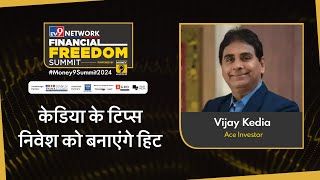
Today, let's understand from veteran investor Vijay Kedia ji what he does when he faces such a situation in the toughest elections. The name of this session itself is the toughest elections. So let me please welcome Vijay Kedia ji on stage. Sir, please come on stage. And also, I am Mani Nine's editor Aman Tiwari ji.
I thank you very much for coming to this program. Even before you came, we have received so many requests. Usually, people don't expect to hear songs from investment gurus, but you have your own unique talent and a unique identity. You have just written a new song, so let's start from there. First, let's listen to your song for investment, which you wrote before the budget and sent to the government.
Although this time it was an interim budget, then we move on to the questions. Whatever you sent to the government, I send it to the government every year, but the government does n't listen. So, I have decided that I had sent it to Nirmala ji. Perhaps you might be talking about that. It has been two years since I sent it, but Madam has not heard it, but now the budget is coming back.
Okay, this was an interim budget. I will send it back to him and if he doesn't listen to it this time too, then it is certain that I will send it back to him next year. So let's listen to this song first, then after that, two lines of it are like this - I have to tell you, today for the first time madam, you take tax on dividend, madam, why, repeatedly, so a little bit of tune, a little bit of thank you, a little bit of tune, people want to hear you sing it in a tuneful manner, a lot of people are waiting to listen to you online, I have to tell you, I have to tell you, today for the first time madam, you take tax on dividend, madam, why, thanks repeatedly, now we will listen to one or two more lines from Vijay ji because Vijay ji understands or explains stock investing as beautifully as he sings it beautifully, and this is a special thing, let's come to our main topic, elections are ahead and as Gaurav said, the theme of this session was the most difficult choice, you as an investor, you are a very successful investor and you consider yourself an investor and you also tell investors three things which you never do.
There are such stocks which I do not like to touch or recommend to you while choosing a stock. What could be the three things that make the selection easier? According to you, there could be three such things. Firstly, I invest in new companies or those whose promoter does not have any previous track record.
I do not invest in such companies. So, I invest in such companies which have at least 15-20 years of experience, that is, it has been seasoned because experience is worth the money here. So, firstly, I do not invest in such companies which are completely raw investors, that is, promoters or founders.
And secondly, I invest in penny stocks. People think that the small stocks that I buy are small caps, but there is a difference between penny stocks and small caps. So, I do not invest in such companies which have a bad past track record and which have a lot of debt. That is, the company which has so much debt that it may have service problems.
So, I also invest in such companies. And thirdly, I invest in such companies which People feel that somewhere they are operator driven or you can say they get into the bull market and get wiped out in the bear market, in which the promoter's name is also sometimes involved in making the market go up and down or if they are operator driven then they are manipulated, I do not invest in such a company, all these points are very important for those who are watching this program because it is going to be especially important for investors who want to learn and start investing in the stock market, A Kidiya ji said three important things, do not invest in new companies, there are many questions in our mind regarding this, which we will ask, do not invest in new companies, do not invest in companies which have debt and whose promoters have a bad track record, this question is valid, but it is said that if there is no investment in new companies then how will the entire primary market of equity grow because we say that the primary market will grow only when the company comes, presents its plan and gives confidence to the people, people will invest in IPO, so listen to you, then people will not invest in IPO at all, so an IPO There is a difference between me and the new management.
There can be IPO companies too, they keep a 10-20 year old management and after that they come for IPO, that can also happen, so I am not talking about them, by the way I do not invest in IPOs either because the value is already squeezed out first, mostly by saying this, but IPOs also have 20 years and the second thing is see sir, there are a lot of investors here, I have not taken any contract of the primary market, I have so many investors, 14 crore accounts, demat accounts, understand, there will be two, three, four crore active investors, so it is suitable for every person, there will be many people who will say that I want to invest in a new company because there is an opportunity in that, so the market is big, everything is being sold here, tea is available in 0, tea is available in 00 and tea is available in 00 and all three are running, so there are all kinds of customers in that, second question sir Many questions arise in people's minds regarding debt, and we're asking this question because our audience also invests in the stock market and indirectly invests in mutual funds through stocks, because ultimately, mutual fund funds are invested in those stocks.
In our programs, we constantly tell our viewers to check their mutual fund portfolio and its holdings. There's a lot of confusion regarding debt and corporate debt. There are many different formulas and parameters for investing in the market. It's said that debt-loaded companies are not good. The rule is, those with a lot of debt.
But it's also said that if there's a capital shortage, if companies have a good growth plan and debt, only then will they be able to grow. How will capitalists who don't have capital grow? So, how do you choose companies based on debt? Which companies do you choose that have zero debt, or do you like to see the quality of performance of those companies?
Zero debt is not necessary, it is good to have zero debt, but you are absolutely right that if the company does not raise money through debt, then how will it grow, how will it expand, so there should be a matching within the company, for example, suppose the turnover of the company is Rs. 2000 crores and suppose the company has taken debt of Rs.
500 crores or Rs. 100 crores, then we will have to pay Rs. 10050 crores as debt every year, if we have taken Rs. 1000 crores and Rs. 100 crores as debt interest, so if the interest payment of Rs. 2000 crores is to be made, then if its revenue is going to be Rs. 500 crores, then what will the company earn and what interest will it pay and when will it pay its principal, when will it pay its principal, so there should be a coordination within this, so I prefer generally that the minimum debt should be such that even if the company goes into losses for two-three years.
Even then, the company should not have any problem in paying minimum interest, it should not have to sell any asset, so if there is over-ambition, there should be ambition but it should be in sync with your growth, so wherever that balancing of growth, profit and interest payment happens, I can invest there.
Sir, a question that arises again and again in India is regarding the corporate governance of companies and we have seen many cases in front of us in the last five-six years, seven years and even before that, where very good and top-notch companies have ended due to poor corporate governance and there has been huge wealth destruction in them.
How do you apply filters, how do you understand that this is a good and clean company for investment because thousands of companies are listed in the market, it is difficult for the common investor to check their records, check the workings of their promoters and know about them. What advice would you give in this matter, what would you tell that if you have to choose a clean company from among 5000-6000 companies, the clean company So what things should be looked at, no sir, I have a quote that late are large caps late are mid caps and late are small caps and there are scrap caps also yes what is bangar cap, please tell them also, so this scrap cap of 6000 which you are naming, in this 45000 companies of scrap cap come in the category of scrap cap which come in every bull market like a chess rooster and they go back, they come in the bull market and go back, then their performance is weak, so saying this, the ones which remain in my notice are 500000 companies and I watch them for 10-10 years, 5-15 years, 15-15 years, I give them and I give an example, I have given examples at many places as to what I do, so consider any such athlete who has a very good track record in the past, it means any company which in the past when the cycle of the economy The boom cycle came, in which the company set some big records and did very well, but after that, when there was a downturn in the economy and the athlete who set the record fell ill, he had some health issues or went out of form.
For example, many times we see a cricketer batting or bowling brilliantly, but suddenly he goes out of form for a year, two, three years. So, the company which goes out of form but has not lost its skills, I keep waiting for it to come back in form. Sometimes the wait for such companies is 5 years, even 101 years, when I feel that the sector of this company has improved and this company, even after 10 years of recession, that is, after the economic downward cycle, the company is still surviving and the strength of the company has not ended or will be destroyed and when good days come back, it will run fast and strong.
I identify the company like this, out of the selected 5000 companies, you keep an eye on 100 or 500 and out of that 500 you select 50 or 40, our viewers would like to know what is the level of returns on those stocks, what is your average return on those stocks, the sum on that investment on the stocks that you have selected, out of the 500 stocks that you have selected 100, how many are the stocks that give the best returns, well not the ones that give the best returns, there are all types of stocks in it, there are also those which have not given very good returns and I have one stock which gave me 16000 times return, understand it gave me 16 16000 times return in 16, 17, 18 years, so I was lucky that I held on to those shares for 18 years, for 18 years, yes 17, 18 years, in 18 years So companies exit the Sensex, India changes for 25 years, companies don't stay at the top, so we invest in companies, we understand that we are shareholders of the company, we are called equity shareholders, we are called owners, shareholders, so you have to have that patience, if this company is doing well and there are many ups and downs in between, such ups and downs, such ups and downs that two-thirds of the company's value got wiped out, yet it remained in it, I have that last question for you, the biggest question that comes in the mind of investors is when to exit the market, exit strategy is more difficult, before investing in the stock market, everyone sees the entry, whether the valuation is visible or the growth is visible, how to exit, how do you plan your exit, what is your exit strategy, see, I had given an example of exit strategy at one place, I will tell you here that you can learn the exit strategy from Vibhishana in Ramayana, so what did Vibhishana do, he invested in a triple A company There was Ravana and his golden Lanka, so you can understand what kind of governance and company it would be.
His management was Triple A, but when that management lost its focus and became unfocused, what did it do? It left him and exited him. Another Triple A company which was in crisis, as I told you, is an athlete, but now he is ill, but his skills and abilities have not diminished. He joined another Triple A company which was Ram.
So this is a perfect example of when the focus of the management is lost, then one should leave it and then enter a new management. Kedia ji told you through the story of Ram that like Vibhishana, and do not speak ill of Vibhishana because Vibhishana's exit strategy was right. He left a sinking company and started investing in a rising company.
So we always take Vibhishana in a negative tone. Thank you very much Kedia ji for coming to this program of Money Nine and telling us in a very interesting way what mistakes we make. And how to choose stocks, thank you very much Sir, Barun Sir, to come on stage and you know, just what token for you and I will request you Sir to give me token once, loud applause thank you Vijay ji, thank you sir, thank you sir




Comments 0