
저자: FinnWidom · 외국인
요약 보기
AI 수요가 공급을 여전히 초과하며 엔비디아 중장기 전망은 긍정적이라는 주장. 엔비디아의 코어위브 20억달러 투자는 순환금융이 아니라 기술 파트너십이라는 입장. 하이퍼스케일러(MS·메타·알파벳·아마존) 실적에서 자본지출 가이던스가 강할 것으로 예상. 엔비디아 2월 25일 실적도 긍정적으로 전망. 중국 매출은 가이던스에서 제외해야 한다는 젠슨 황 발언을 언급. 마이크로소프트 자체 AI칩 마이아 200 출시도 엔비디아 수요에 큰 위협이 아니라고 평가.
다듬은 글
Meanwhile, NVIDIA CEO Jensen Hong is in China as the chipmaker faces stiff competition from local rivals and scrutiny from Chinese authorities. Reuters reports that Hang visited a company partner in Shanghai this week before visiting Beijing, Shenzhen and then Taiwan. Keep in mind that there were also reports on Friday that Chinese tech companies could potentially start buying H200 chips.
The most important event this week will be earnings from technology companies. And I think that will really be in the spotlight, given the return of capitalization and the AI revolution after Davos. You can compare what happened there. There is a geopolitical Trump in Greenland. But what was the real focus?
This was the first artificial intelligence revolution in the US in 30 years, overtaking China. To what extent will memory prices take this history into account, considering things like capital expenditures? Listen, I think Jimmy and Ryan raise important issues early in the week, but, you know, when you think about everything we're seeing, DRAM prices, shortages, this is going to play a key role in terms of reporting season.
Look, and I think what's even more important is that this is an artificial intelligence arms race. You know, you see some losses on rare earths, and you see this kind of battle with China, but it all comes down to demand, and right now demand is 12 to 1 in terms of the AI revolution. This is what investors are really focused on , but obviously the issue will be supply and constraints.
I think it all comes down to demand now. That's why I think we're wrapping up this week. This is going to be a bullish week for tech, despite, you know, obviously some geopolitical jitters and jitters about the shutdown, with some breaking news from Ed Lew of Nvidia. Hello, Ede. Yes, good morning, John.
Nvidia is set to invest an additional $2 billion in Coreweave by purchasing common stock at a price of $87.20 per share right now, and it's fluctuating before going public . I think there may be some algorithmic steps going on in this. You know, when we spoke to Nvidia CEO Jensen Wong last night in an interview with Bloomberg, he said, "It's just a matter of confidence in Coreweave, Corewave's plan, Corewave's leadership on capacity building, accelerating data center capacity building." But we asked him, isn't this circular financing?
And his answer to that was very simple: this is not circular finance. It would be ridiculous to call it that, because it's a tiny fraction of what we know Callweave will have to bring in if they can build data centers to a level where, uh, they can meet the demand that's already there. He also said that this is basically in line with the investments they have made across the entire AI stack at the same level, and is quite strongly against it.
But it's no surprise that Coreweave, uh, in response, had a big jump in the pre-market stage. What do the investors you talk to every day call non- circular financing? Doesn't this look and smell like circular finance? You know how they said, "Well, you need to distinguish between different agreements." In some of the investments that Nvidia makes, they clearly state that it's not a service for a service.
In other words, the startup they invest in can take Nvidia's money, but they are not obligated to use Nvidia chips. In this case, Core Weave shares rose more than 9% on the market. There is also a technology deal here. So, another big news that you see, like putting pressure on AMD and Intel in the market, is that Nvidia is going to start offering its CPU, not the GPU, but the CPU as a separate offering, and Coreweave is going to be the first to roll that out.
Um, you know, it's hard, when it comes to both a technological and a financial deal, to get outside the vicious circle. A big step from Cool Weave, which grew by 9-10% on the domestic market. Ed, do you see other chip manufacturers taking a similar approach to other NeoCloud manufacturers? Yeah, you know, I do too, cloud technology manufacturers, you know that AMD, which is second only to Nvidia in the AI accelerator market, is doing the same thing with advanced labs, right?
Going directly to AI, saying, "We're collaborating, we're going to negotiate a power deal where the power will be based specifically on AMD chips." Hmm, in honor of Core, users keep saying , Core Weave customers want Nvidia. So even though there are other products on the market, they keep asking for Nvidia.
And it's not just the latest generation of Nvidia accelerators. Hmm , I should have prepared that terminal diagram. Sorry. But if you look at the older generations, we have it, for example, at the terminal bunker. These aging older generations are now seeing rental prices increase significantly. The usage is really high.
It's still history, whether AMD likes it or not. Ed, good to see you. I look forward to the program and coverage of this story a little later on Bloomberg Technology. Street Core Weave shares appear on the news. Nvidia is investing another $2 billion in the company to accelerate the creation of more than 5 gigawatts of artificial intelligence computing power by 2030.
As part of the collaboration, Coreeave will be one of the first to deploy new Nvidia products, ranging from processors to storage systems. The CEOs of both companies joined us exclusively last hour to discuss the news. This is Mike Intrader from Core Weeav about the deal. When you think about what our company is doing, when you think about the partnership that we're expanding with Nvidia, it's really about how we're going to accelerate the creation of this infrastructure to meet this demand, right?
This comes from the entire economy. This comes from governments. This comes from all over the world. And this is, uh , a significant and sustained, uh , push to be able to bring the infrastructure to market as quickly as possible. Jensen Wong from Nvidia joins us from China. We also asked for clarity on the company's business there.
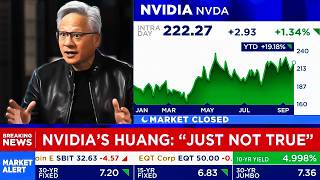
All Chinese business and future potential business is not included in our forecast, is not included in our guidance. So I wish everyone would just not include this in our guidance, and that will be a great bonus when things get sorted out, and I have some confidence that things will get sorted out .
But until then, uh, we should just not include it in our guidance, and that would be a great bonus for everyone. In fact, the conversation with David went far beyond Coreweave, discussing open AI, anthropogenic, and all these sources of demand. Yes, and demand is a key point. I think they both wanted to make a confidence, uh, in Sarah Jensen Wong, who, uh, has no shortage of performances or words, so to speak.
He talks a lot, uh, but we always want to hear from him. Uh, again, someone is talking about the insatiable demand and the fact that we are in the early stages. I asked for some clarification, as Carl said, on the investments in open AI, so to speak, which were talked about a lot, uh, last September .
Karl I can't say I fully understand it. It's kind of a gradual investment over time as they build up the capacity , essentially, as it's described in this world, in gigawatts, where , you know, it all depends on the power that the computations that you're creating are consuming. Yes. I mean, that's where Jensen was at Davos last week, and I know you asked him about it, and he said, "It's interesting to hear members of the administration say that this is our national champion for artificial intelligence." You know that China has Huawei, and we have Nvidia.
So seeing him in China is just interesting. And also this Morgan Stanley research note that came out this morning regarding the deal. I find this remarkable. They said, “So this processor is the first time the company has offered such a chip separately, and it means they will challenge Intel and AMD processors in the data center.
So it's a kind of competitive positioning. Interesting. Nvidia is falling. Coreweave gets a nice 13% boost from this. At the same time, Nvidia has at least some direct competition. We often talk about Alphabet's GPUs, Amazon's Tranium. These chips are designed to replace their reliance on Nvidia GPUs to some extent.
Coreweave obviously won't be one of them. They are not going to develop their own chip. Although Sam Waltman from OpenAI, when he joined us a while ago, also mentioned developing a chip they're working on, I think he's developing it with Broadcom. Yes. It was interesting to hear him say, whether it's energy, or financing, or now the memory side , there's always something right, there's always something getting in the way, and it's a process that tries to overcome those challenges as development continues.
What did he say about cyclicality? Another thing this deal reminds us of is that Nvidia is at the center of many companies and aspects of AI development, and they have a significant stake in this endeavor. They...uh, Jen, I asked Jensen about that . We also asked him, Trader. He's essentially saying that this is such a tiny fraction of the total amount of money that CoreWeave has to spend on building their computing systems and everything else that you can't really ...it's useful in terms of what they're trying to achieve overall, but it has very little to do with funding actual demand.
Right. But they are all connected. They are all connected, no doubt. And it will be an ongoing issue of the cyclicality of their funding of their clients, which is essentially what they do. It's like a whole new meaning for artificial intelligence trading. Yes. We have a deal, and it is for Nvidia to invest an additional $2 billion in Corewave.
They are going to buy Core Weave common stock at a price of $...87.20 per share. There is some of this that is about technology sharing, but the bigger picture is about accelerating capacity building. Bloomberg spoke by phone with the CEOs of both companies last night. Bloomberg's Ian King , who led this conversation, joins us on set now .
First, I will move on to circular finance. We asked him if this is circular finance for him, as Jensen Wong, CEO of Nvidia, said. His answer was pretty simple: he says it's a very small fraction of what Corewave will need to continually raise to build capacity, and it's in line with what they're investing in many other companies.
Let's start with this. Yeah, I mean, he said, look, is it Coreweave, is it XAI, is it any other one that he's discovered artificial intelligence for, obviously, that he's agreed to give a lot of money for. He said that was only a small part. It's just me helping them out a little bit and showing faith in what they're trying to do.
They'll have to go and collect this...money themselves. The market will, in essence, resolve this issue. This is not cyclical financing, was his argument. And it was like Core Weave CEO Michael Entra came back and said, “Look, this is a drop in the ocean compared to the amount of infrastructure spending we have to do, but where does it align strategically?
Why are they digging even deeper into their pockets to give money to Core at this time? Yeah, I mean, Jensen said that this is really a technology partnership, that CoreWeave is a very early adopter of Nvidia systems, inclined to do them the way Nvidia thinks they should be done, and it's kind of a reference platform.
So they like it , and Ease also thinks there's a lot of demand. So the faster we can move, the better, the better things get. There are also processors that have pushed GPUs aside. What Jensen Hang really wanted to emphasize, as far as I can tell from reading the transcript of your conversation, is that the Vera Vera processor will now be a separate infrastructure product.
Hmm, CoreWeave is appropriate here. Just explain what he told you on the phone. Yeah, I mean, as you know. Jensen never says anything without thinking it through carefully. So he really wanted to get the message across that this is a standalone product as well as part of the infrastructure. Remember, previous versions were integrated into one of the six Nvidia computer chips right now.
Hey, you can use it on its own if you want, and that makes it a direct competitor to some, you know, big and very fast cars. AMD is under pressure. Intel is also under pressure. Ian, is this a surprise? It shouldn't be. No. Of course. Ian King, we thank you very much for revealing a truly important story to us.
And look , there's another story in the world of artificial intelligence semiconductors. Microsoft is releasing the second generation of its own artificial intelligence chip. You see, the stock is up about one percent. Not very moving with the news that is just coming out . And Bloomberg's Matt Day, the man who covers Microsoft for us, reports this news.
How important is it that yet another company is building its own artificial intelligence chips? Well, for Microsoft, it's, uh, really important. They've gotten a little ahead of their biggest competitors Amazon and Google in creating their own, uh. silicon. They see this as an important way to reduce costs to find another source of availability.
So this is going to be a really big test for their chip division and for their cloud business. We write in our Bloomberg article that this could eventually become an alternative to Nvidia hardware, but the reality is that, as with all other hyperscale solutions, Microsoft is still dependent on Nvidia.
Just explain the scale of your computing and why it relies on Nvidia. So Nvidia is the workhorse that powers the vast majority of AI workloads in Microsoft's data centers. You know, if you're using OpenAI as a Chat GPT consumer, chances are you're checking out an NVIDIA chip running in some Microsoft data center.
You know, like everyone in the industry, Microsoft would like to have other options. So, this effort with Maya is about trying to create a better mousetrap that is more suitable for their data centers and that could ideally reduce some of their costs in the long run. Tell us how it's rolling out, where it's rolling out first, and ultimately when customers ...are going to use it.
So, it's unclear when customers will get their hands on this. The first devices are already on sale today. Microsoft tells us about it in data centers near Des Moines, Iowa. More devices are coming to the Phoenix area. But we don't have a date yet for what the broader rollout will look like, or, you know, what the availability will be.
Will this be a global rollout? Is this more of a kind of step in research and development? And future chips will, as it were, carry the mail for them. So it remains to be seen how widely they will embrace it. Okay, I hope you're doing well today and keeping calm in this market. Today, Nvidia and Coree announced that they are deepening their collaboration, with Nvidia investing $2 billion in Core Weave Class A shares at a price of $87.20 per share.
Coreeave plans to implement Nvidia processors and storage platforms across multiple Nvidia generations. And as part of this expanded partnership, Nvidia will offer Coreweee software to global cloud service providers and enterprises. This expanded Partnership should help accelerate Core Weave’s buildout of over 5 gigawatts of AI factories by 2030.
You may recall that Nvidia entered into an agreement with Coreeave in September to acquire any unsold capacity from Core Weave through April 2032. I mentioned at the time that I was curious about what Nvidia was working on behind the scenes, because it seemed like they needed a lot of power. Then, -source models, making it clear that Nvidia wants to be a leader in open- source models.
And Jensen later confirmed this during his CES keynote in early January, saying that Nvidia has created a huge amount of DGF capacity to develop open-source models that are driving the entire industry forward. And today is another reminder of that, because today Nvidia introduced the Earth 2 Open Model Family, the world's first fully open accelerated set of weather AI models and tools.
As I've mentioned in previous videos, I do n't think most people realize the full implications of Nvidia being the leader in open source models. Jensen described AI. like a five-layer cake, each layer of which is supported by all the layers below it. At the very top of the stack, we have the application layer.
And notice that immediately below the application layer is the model layer. The AI applications that are being created are built on AI models. So, by being a leader in open source models, Nvidia ensures that their models are used throughout the AI ecosystem and developers build applications based on these models.
This could lead to a very advantageous position for Nvidia in the future, with many popular AI applications being built on Nvidia models. Also today, Microsoft introduced Maya 200, a new AI rendering accelerator design to improve token processing efficiency. Maya 200 is built on TSMC's 3nm process with high-speed HBM3e and large onboard SRAM to support large models.
Microsoft claims it is the highest-performing self-developed silicon processor of any hyperscaler, with better performance than Amazon's Tranium 3 and Google's TPUv7 in certain inference metrics. The way to think about this chip is that it's designed for cost- effective output, not for...beating Nvidia in peak performance.
Overall, this news does n't bother me when it comes to Nvidia. And I see it as another reminder of two things. The world simply cannot get enough supply to meet current demand. Second, the demand for logical inference is about to explode as the models are finally good enough to be paid for. And the demand for logical inference is about to skyrocket as companies begin to monetize AI on a large scale.
It's no coincidence that Nvidia recently struck a deal with Grock and licensed their low- latency inference technology. The demand for logical inference will increase significantly in the near future, especially with AI systems. Looking ahead, we will be releasing Nvidia's earnings report on February 25th, and I am optimistic for several reasons.
Rapid production ramp-up of Blackwell Ultra, Vera Rubin is already in full swing, and several large-scale sovereign AI projects are scheduled to launch this year, including some scheduled for early this year. All of these factors together point to positive earnings, a positive outlook for the next quarter, and to the earnings, but I'm optimistic and expect Nvidia's earnings to confirm that the long-term thesis is still firmly in place.
But before Nvidia's earnings, we'll have Hyperscaler earnings starting this week, and Microsoft and Meta earnings will be released on Wednesday, January 28th. Then we have Alphabet earnings next week, their capital expenditure outlook and their expect Meta to report a strong capital expenditure outlook, given Zuckerberg's recent comments about building significantly more capacity.
I also expect Alphabet's capital expenditure guidance to be strong, given Gemini's recent success. We've already heard the CEO of AWS talk about Amazon bringing in several gigawatts of capacity by 2026. So I expect Amazon's capital expenditure guidance to be strong as well . As for Microsoft, we'll have to listen to the earnings report to get the full picture of what's going on.
At the latest earnings call, Microsoft's CFO talked about how the company is still constrained in supply. Let's see if we get... similar comments on this earnings report. Additionally, Microsoft leases a lot of capacity from other companies, and this should be part of Microsoft's operating expenses, not capital expenditures.
So, there are some important nuances to Microsoft's AI strategy, and we'll need to listen to the earnings report to get the full picture. Overall, I expect another earnings season with strong capital expenditure projections from hyperscalers, given all their recent comments and the increasing competition we are seeing in the AI ecosystem .
Additionally, Iron is scheduled to report earnings on February 5. have realistic expectations ahead of this particular earnings report. 2026 is the year we should start to see Iron meaningfully deliver on its AI predictions. That said, I don't expect any noticeable changes in Iron's actual cloud AI revenue in this particular earnings report.
In this particular earnings report on February 5th, I will be focusing on updates on the progress of the Iron data center construction and the transition to cloud-based AI technologies. I will also pay attention to whether they increase their AI predictions or announce any changes in the timeline. patterns I've seen in a while.
This is not hype. I'm sure I'll have more to say about Iron as we get closer to earnings reporting. I continue to be optimistic about Nvidia's long-term prospects and think the company still has a lot of opportunity ahead . If you're wondering how much potential Nvidia has ahead of it, consider that we're only in the very early stages of physical AI today.
This industry will fundamentally change society in the coming years, and Nvidia is positioning itself to benefit enormously. NVIDIA's CFO called the physical AI market stage of growth for Nvidia. Nvidia sells equipment for data centers wher models are trained and tested. And Nvidia also sells hardware that enables real-time inference on devices via NVIDIA AGX, allowing robots to intelligently interact e that Nvidia...
building in as the underlying foundation that supports it all. it's not getting enough attention. I continue to believe that most analysts' long-term valuations for Nvidia are too low, given what lies ahead. In terms of ramping up production, Blackwell Ultra is currently ramping up production very quickly, which is leading to accelerated revenue growth.
Reuben is scheduled to launch in 2026. Then we expect Reuben CPX in late 2026. Later, we expect that extends to 2028. And Jensen believes that three to four trillion global AI factories will be built by 2030. This means that Jensen expects the demand for AI to grow and the overall addressable market to expand, which is what underlies it all.
I don't think we're anywhere close to a bubble-bursting event. With all of this in mind, I seriously believe that Nvidia still has a lot of potential ignificantly more in the future than it is today. At least, that's my opinion on the situation. A small note before I conclude. All Widom with original structure and commentary.
From time to time, Weed. I appreciate your support. Remember the calm in this market. Keep the long term in mind and don' that in mind, I wish you all a good day. And I'm interested to hear your thoughts on Nvidia in the comments below. Please like this video so more people can see it . And while you're see you next time.



Comments 0