저자: JensenHuang,MichaelIntrator · 외국인
요약 보기
엔비디아가 CoreWeave에 20억달러 투자하며 2030년까지 5GW+ AI 컴퓨팅 확장 협력. 수요는 폭발적이며 AI 네이티브 기업 투자가 역대 최대. 중국 H200 라이선스 진행 중이나 가이던스에서 중국 매출은 제외. 공급 부족(CPU·메모리 등) 지속 언급. 영상 진행자는 블랙웰 울트라 램프, 하이퍼스케일러 capex 강세, 엔비디아 실적(2/25) 긍정 전망을 제시.
다듬은 글
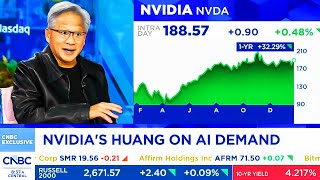
Shares of Core Weeb are jumping today uh as Nvidia invests an additional $2 billion to help speed up an effort to add more than 5 gawatts of AI computing capacity by 2030. Joining us now exclusively to discuss the expanded partnership, Nvidia CEO Jensen Wong, he's currently in China and Corio Mike in Trader who joins us at Post 9.
Thank you so much gentlemen for being here. Uh Jensen, go to you. Oh, it's great to see you Jensen. I wanted to just go to you first. There are people who think wait a second there are nip people nipping at your heels. We've got Amazon has a chip. We've got Google has a chip. So the question should be as always please give me the demand story.
How much demand is there right now for your complete line of product software hardware? The demand is incredible and it's driven by a couple of things. The first is that everyone, the AI makers, AI labs are racing to the next frontier. They're racing and to build out pre-training capability, post-training capability, as well as inference capability.
And so we're seeing extraordinary demand from them. But one of the big events that happened in the last year is the significant investments into the next layer of AI which ultimately is the most important AI applications. This is AI applications for healthcare, for manufacturing, for entertainment, for media, so many financial services, software, engineering, so many different applications are being started.
And the last year, last couple of years, the funding into AI native companies are the largest in venture capital history. And these need infrastructure and which leads us to the incredible partner that we have with coreweave. We're making a significant investment in them. Incredibly happy that they're going to sign up and dedicate themselves to our architecture for the next 5 gawatt and you know many years to come.
And the thing that is happening here is that as you know coreweave has used Nvidia's architecture for GPU computing as well as networking since their founding. But they're also now going to add Nvidia CPU as well as our storage platform based on Bluefield. So our CPU is Vera. It's completely revolutionary.
We're going to tell everybody more about it. So many companies are now signing up to use Vera all by itself because it's such an incredible CPU. And then also our new blue field storage platform which is going to be really important for a aentic AI so that it can have memory and large context and so this is a really significant partnership and I'm really excited to support coreweave.
All right I'm thrilled that Michael's here too and we talk about that. Just one other thing, Jensen. You are uh in East Asia, you're in China. Uh and I wanted to know uh what are the possibilities that you can talk about the big orders that you might have in China, whether they should be included in the models of analysts and what is the overall sense of the idea that your chips can be used by Bite Dance, by Alibaba, by Tik Tok.
All of which, as we understand, need them, want them, and want to partner with you. Well, I'm here to celebrate Chinese New Year with my employees. I'm visiting four different sites. And while here, I have the opportunity to meet with uh the some members of the Chinese government and of course uh our our customers and partners here.
Um we're looking forward to the H200 licenses being finalized and we're looking forward to the Chinese government uh contemplating how they would like to allow us back into this market. And uh but the thing that is consistent is that the demand for H200's and the demand for Nvidia uh stacks are really really significant here.
And the reason for that is the same as what we're experiencing in you know in the west which is uh these AI systems are trying to are racing towards the frontier and also uh the number of applications that are being built on top of these AI models is really going through the roof. So demand is really strong.
All right. So, Michael, it's great to have you on. And you asked a question and Mike, excuse me, Mike, excuse me about, sorry about that, Jim. You asked a question. It's really important. All of China's business and future potential business are not in our forecast, not in our guidance. And so, I would love for everybody just to keep it off our guidance, and it'll just be a great bonus uh when things get sorted out.
And uh I've I've got a fair amount of confidence that that things will sort out, but until then uh we ought to just take it keep it off our keep it off our guidance and it'll just be a great bonus for everybody to enjoy. Excellent. Thank you. I'm so glad to have Michael here too. Michael, there's a very big deal.
I know that you already had the terrific relationship including a nice owner's mistake by by Nvidia which also got in on the on the terrific IPO. Now already the first thing people said and I I go back and forth with you all the time. Oh, you know what? This is one of those circular deals. Okay, I know it's not, but you know what?
I need to hear from you. Yeah. So um let let's start with uh you know Jensen really did a great job describing where the demand is coming from in this market the breadth of the demand the depth of the demand and uh you know when when when you think about what our company is doing when you think about the partnership that we're extending with Nvidia here it really is about how are we going to accelerate the build of this infrastructure to meet that demand right it's coming from uh across the economy it's coming from governments it's coming from across the globe.
And that is a uh uh a significant and sustained uh uh push to be able to ensure that we can move as quickly as we can to be able to do to uh deliver the infrastructure to the market. And this deal right here does really uh three things, right? It does an alignment around the physical infrastructure so that we're able to uh build uh an additional uh 5 gawatt or more as we go forward.
uh it gives us uh a a wonderful alignment with um uh Nvidia on the software side. You know, I've come in here again and again and kept telling you that Core Weave does something different on the software and execution side and this is just a tremendous validation for us that that is in fact uh uh how it works in terms of delivering uh the best solution to the market.
You bring together uh the best uh infrastructure, you bring with the best software and the best operations and you deliver the best uh uh product to the consumers of this and that's what this uh partnership really represents. Will this be something where uh any customer other than a hyperscaler can say you know what I got to get these chips the hyperscalers would take them all otherwise.
Is this a place for people to go who want very much Nvidia and don't know what to do? Yeah, look, this is this is a uh uh this kind of drives our business uh in a lot of ways and it allows us to touch a lot of infrastructure uh on prem infrastructure that that that companies want to build um uh sovereign cloud uh and it allows us to deliver our software solution to those consumers.
And that is a market that we haven't really been able to uh open up. You know, ordinarily we build within our own data center. Now we're going to be able to build within our own data center. And we're also adding the ability to deliver software so other people can use our solution for their builds and that's a huge market for us and it will be very important to us over time
and it's your feeling that that is going to differentiate you in the marketplace in terms of the offerings that are out there. Yeah. So, so why uh so we have our own infrastructure, we build it, we deliver it to the market and we do the best job and and in terms of building that solution. Um we will be able to license our software to others who want to deliver really high quality infrastructure and we believe that that's a great business for us to be in.
uh in parallel with our uh um infrastructure builds that are going to occur within the additional 5 gawatts that we're adding to the backlog of 2.9 that we talked about at our last earnings. The the gating issues that we talk about sometimes, the friction, uh the financing, the permitting, the labor, the energy.
Has there been any evolution of those things? As has one rocketed to the top, for example? So you know the way that this market works is that you kind of move through uh the critical path of resistance and so you know the market has identified again and again hey you know uh right now access to the the the GPUs is the limiting factor and then that clears and access to energy is the factor and then you know we work through that issue and then we kind of you know access to memory is going to be an issue as we go forward.
All of those things occur. That debate will continue uh for the foreseeable future uh as the world tries to scale into this global computing infrastructure that's required. Um Jensen, I'd love to come to you. It's David. Jim asked uh uh Mike about the circularity question, but I'd love to come to you on it as well.
This idea that you basically are financing your own demand. Uh how do you respond to that potential criticism? Well, we're trying to build the AI ecosystem. AI is a five layer cake. Starts with engine uh energy on the on the lowest level, then chips, then infrastructure. This is where Coreweave is. And then the AI models, there's open- source models.
There's of course all of the premium uh AI labs models. And then the layer on top of that are the AI applications that are associated with the different industries and and applications. And uh uh you could see us investing across that entire five layer five layer cake of AI. And the reason for that is of course we're uh really enthusiastic about the companies there.
They're once in a generation companies being built and we want to support and be deeply engaged with every single layer of that ecosystem. Now, the thing that that um to remember is we we've invested two $2 billion in the core weave, but recognize that the amount of funding that needs to be raised yet to support that 5 gawatts uh is really quite significant.
We're investing a small percentage of the amount that ultimately has to go and uh be provided in order to be raised in order to provide this infrastructure. This goes along this is exactly the same with XAI and we're delighted to invest in in them invest delight to invest in anthropic delighted to invest in open AI.
Um but whatever we decide to invest is a small percentage very small percentage of the overall amount of infrastructure capital they're going to have to raise. Yeah. And we talk about that all the time. The numbers are truly just staggering. Almost hard to imagine. Not to mention the power that's got to be built.
You mentioned Open AI Jensen. We were talking on on set prior to your coming joining us. You know, it was I think it was back in late September when there were the first reports about a hundred billion potential NVIDIA investment in OpenAI. Um, we haven't seen it finalized yet. Is that something that is still going to happen?
Well, we said that we would invest a billion dollar, $10 billion for each gigawatt that they would have to go raise. So, they have to raise a significant amount in addition to what we decide to invest in them. Now, as you know, we invest in in exchange for equity. I think it's a once in a generation company.
It's a fantastic investment. I wish we would invested earlier and and more significantly. Uh the the the work that they're doing is is incredible. This is going to be a consequential company and a very large company and so we're delighted to invest in them. But whatever we decide to invest in them in the small percentage of what they ultimately raise, you know, we're we're in the largest infrastructure buildout in human history.
And this is AI is revolutionary technology but because of the nature of AI it needs infrastructure to process and generate a intelligence in real time. You can't do this in advance. You can't pre-record intelligence. You can't pre-record it like a book. You have to pre you have to generate the intelligence in real time.
So you need computational infrastructure for this. And because it's intelligence is fundamentally necessary for every application in every industry, we're seeing this buildout across every country as Mike was saying earlier. And so so this is going to be a s substantial infrastructure buildout. We're just in the beginning part of that.
Yeah. No, no doubt. I just to come back to open AAI so your investment takes place over a long period of time given they meet certain thresholds in terms of the buildout that they've committed to. Is that correct? That's right. That's right. Yeah, they're they're giving us the opportunity. They're giving us the opportunity to invest um as they build out and for each one of the each one of the buildout will we'll consider the investment and um and I expect that it's going to be a great opportunity and and I look forward to invest.
I see. So, Michael, couple things are concerning to me. You would best person to be able to answer it. There's this tremendous CPU shortage is developing and memory shortage and something that Jensen said to me this summer was going to happen but it seems like everyone including Lip Bhutan who's a very very smart man at Intel missed.
Uh could that be something that uh foralls the growth here of an industry that we all thought would just be uh leaps and bound growing? Well, I don't know if we have the capacity. So, you know, this is just another example of the size and scale of the buildout that you're seeing and the demand signals that are moving through the market.
They're overwhelming parts of the market that there was an assumption would be okay and have enough supply to handle. And um you know when when I when I think about that I kind of come back to our core business which is being driven and informed by the demand signals that the largest consumers of this infrastructure are are driving through us.
They come to us to buy massive quantities of infrastructure. And so um I look at this and I think that you're you're in a super cycle. Um you're going to be buying and building uh across the computing space. uh there are going to be opportunities to scale this business uh uh broadly the the the the AI infrastructure business uh um you know within the domestic US around the world all of which are going to consume uh GPUs they're going to consume networking they're going to consume optics they're going to consume CPU they're going to consume memory and that is the what is you know that is a consequence of as Jensen says the largest buildout in human history Michael when when your company went public I can remember us having a conversation around customer concentration Microsoft I believe was the name that the preponderance of sales were there where do you guys stand now and how does a deal like this if in any way help you sort of increase the mix so to speak
yeah so so two things right one is is uh at my last earnings I said that uh you know there is no uh customer that represents uh more than I think 32% of our backlog and so um we have made it a priority. It was a stated priority and we have done an excellent job as a company executing on diversifying our uh backlog as we onboard new great clients like Meta um you know like Nvidia like OpenAI you know right across the board and and so that's that's been uh uh wonderful.
The other thing that I've always said is that when you're dealing with contracts and infrastructure at this size and scale, the way that you diversify is through growth, right? You need to get larger because you need to bring on new clients that are huge consumers of compute in order to bring down concentration.
And this deal allows us to accelerate our build which will lead to uh continued diversification uh and uh reducing dependency on any particular client as we scale into this uh additional uh um data center capacity. Okay, Jensen, I wanted to ask you, we've got GTC coming up. It's going to be so exciting as it always is.
And I was hoping I saw that you said the this weekend that anthropic I hope people are using it to develop software. I'm developing software. you're developing, we can all do it. Can you give us a sense of what's going to happen to just make it so that Ver Rubin takes maybe a a step function when you combine it with anthropic that people just are going to be blown away?
I don't think people understand what lays ahead. Yeah. I think the um the last year uh the models made gigantic progress and and that all of the labs made incredible progress with agentic AI systems. And these AIs could now reason um they could plan and they could use tools. They have memory and the capabilities are extraordinary which is the reason why the layer above them is really taken off.
You know these are application companies that ultimately are going to bring productivity and new capability to the different verticals and different industries and this is ultimately the layer that has to take off and it's taken off. In the last couple years, we've seen the largest venture funding into the application layer of AI and it's also the the largest VC funding years in history.
And so, it's great to see everybody's so excited about the capability of these AI models. One of Jim that I'm I'm going to mention is that um you know Nvidia's supply chain is the largest in the world with respect to AI and we've had the benefit of ramping and scaling and planning our supply chain for the last couple years and and we've been looking forward to the gigantic buildout of this year and the next several years and so we've had the benefit of planning and support and great support from the entire ecosystem from TSMC's wafers and co-ass and packaging from Amcor and Spill and and all of our memory vendors.
Uh we we're the only AI company in the world that works with every single vendor, every single memory maker in the world. And so we have incredible support from all of them. So we're looking forward to a giant scale out this year. Jensen, that kind of leads me to to my question. You know, coming out of Davos, I'm sure you know you were there.
Uh we're hearing all these conversations about sea changes in uh global alliances and trade relationships. The buildout as you think of it is it immune from any volatility that comes as a result of that? Well, we're in the beginning of the AI infrastructure buildout and the demand is just extraordinary.
You know, as I mentioned earlier, the first part of the demand is the race to the next frontier. And these agentic systems are learning how to reason and solve problems and use tools and uh you're going to see some extraordinary capabilities this coming year. In the next several months, the models that are going to be released are going to be extraordinary.
But the thing that is really amazing are the all of the startups that are being built on top of these these AI model companies. These applications ultimately takes advantage of the AI models that are being built in addition to proprietary models that they're creating or open models that are being fine-tuned.
And so we're seeing just a just a large number of AI native companies that are being founded. And all of these companies, whether it's the Frontier AI labs or the AI native startups, they all need infrastructure, which is the reason why we're working so closely with Coreweave, so that we can align our engineering, align our operations, and enable them to scale as quickly as possible so we can go after that demand.
Yeah, the demand is just extraordinary. Well, thank you, Jensen. Thank you, Michael, for coming on the show. I think it's a just still one more sign that we're so early in this thing. It's really kind of to doubt it, to question it, and to talk about circular. I don't know. I'll take I'll take Nvidia's money any day.
Then it just doesn't matter. That's Willipuchian in thinking. That's my wor, Nvidia and Coree announced that they're deepening their collaboration with Nvidia, investing $2 billion in core class a shares at a price of $87.20 per share. Coreweave is to adopt Nvidia CPU and storage platforms in multiple NVIDIA generations.
And as part of this expanded partnership, Nvidia is to offer Coreeave software to global cloud service providers and enterprises. This expansion of the partnership is to help accelerate Core Weeav's buildout of more than 5 gawatts of AI factories by 2030. You may remember that Nvidia struck a deal with Coree back in September to purchase any unsold capacity from Coreeave through April of 2032.
I made the point back then that I was wondering what Nvidia was working on behind the scenes because it appeared that they needed a lot of capacity. Then , making it abundantly clear that Jensen later confirmed this during his CES keynote in early January, saying that Nvidia has built up a massive amount of DGF .
And today is another reminder of that because today Nvidia unveiled the Earth 2 family of open models, the world's first fully open accelerated set of models and tools for AI weather. As I've mentioned in previous videos, I don't think most people realize the full implications of Nvidia being the leader in open- source models.
Jensen has described AI as a five layer cake with each layer being supported by all of the layers under it. At the very top of the stack, we have the application layer. And notice that right below the application layer is the model layer. The AI applications that are being built are being built upon the AI models.
And so by being the leader in open source models, Nvidia is making sure that their models are used throughout the AI ecosystem with developers building applications on top of those models. This could lead to a very advantageous position for Nvidia in the future wherein many popular AI applications are built upon Nvidia's models.
Also today, Microsoft introduced Maya 200, a new AI inference accelerator design to improve the economics of token processing. Maya 200 is built on TSMC's 3 nanometer process with high-speed HBM3e and large onchip SRAMM to support large models. Microsoft claims this is the most performant firstparty silicon from any hyperscaler with better performance than both Amazon's Tranium 3 and Google's TPU V7 in certain inference metrics.
The way to think about this chip is that is designed for cost-effective inference, not for beating Nvidia on peak performance. Overall, this news does not concern me when it comes to Nvidia. And I view it as another reminder of two things. the world simply cannot get enough supply to satisfy the current demand.
And second, inference demand is about to explode as the models are finally good enough to be paid for and inference demand is about to skyrocket as companies start monetizing AI at massive scale. It's not a coincidence that Nvidia did a recent deal with Grock and licensed their low latency inference technology.
Inference demand is going to increase substantially in the near future, especially with aai systems. I'm optimistic for multiple reasons. the swift production ramp of Blackwell Ultra, Vera Rubin ese factors put together bode well for positive earnings, positive next quarter guidance, and also to earnings, but I'm optimistic and I expect Nvidia's earnings to reinforce that the long-term thesis is still firmly intact.
But before Nvidia earnings, we have hyperscaler earnings starting this week with Microsoft and Meta earnings on Wednesday, January 28th. Then we have Alphabet earnings next week on capex guidance and their 'm expecting Meta to report strong capex guidance given Zuckerberg's recent comments about building substantially more capacity.
I'm also expecting Alphabet's capex guide to be strong given all the recent success of Gemini. We've already heard the CEO of AWS talk about Amazon bringing on multiple gigawatts of capacity in 2026. So, I expect Amazon's capex guide to be strong as well. As for Microsoft, we're going to have to listen into the earnings call to get the full picture of what's going on.
On the last earnings call, Microsoft CFO spoke about how the company was still supply constrained. . Also, Microsoft is leasing a lot of capacity from other companies, and that should be part of Microsoft's OPEX, not Capex. So, there's some important nuance in Microsoft's AI strategy, and we'll need to listen in to the earnings call to get the full picture.
Overall, I'm expecting another earnings season of strong capex guidance from the hyperscalers given all of their recent comments and the rising competition we're seeing across the AI ecosystem. Also, Iron is scheduled to report have realistic expectations ahead of s in a meaningful way. That said, I'm not expecting any notable change in Iron's actual AI cloud revenue on February 5th, I'll be paying attention to updates on the progress of Iron's data center buildout and the transition to AI cloud.
I'll also be paying attention to whether they increase their AI forecasts or announce . This is not hype. I'm sure I'll have more to say about Iron as we get closer to earnings. e



Comments 0