
저자: BradGerstner · 외국인
요약 보기
CES 2026 젠슨 황 기조연설 이후 엔비디아 실적·성장 전망을 낙관. 베라 루빈 full production, 추론 토큰 수요 폭증, 에이전틱 AI·피지컬 AI 확대 강조. 2026 AI 인프라 비중 확대 중이며 엔비디아 밸류에이션(PER 25~26배)은 부담 낮다고 주장. 소프트웨어 저평가 및 AI 인프라 수요 지속 전망.
다듬은 글
We have to make sure that every single generation we increase it tremendously. In the case of Reuben, the token throughput of an AI factory increases by a factor of 10 times. And so the value is unquestionably incredible. And the reason why we're able to do that even though the number of transistors we used was only 1.7 times.
This is where Nvidia's ability to integrate and innovate across the CPU, GPU, the GPU, the networking, the networking, the switches, the scale up switch, the scale out switch and the data processing engine. We literally innovated across every single chip at the data center. This and Vera Rubin this generation, every single chip changed.
six brand new chips, every one of them revolutionary, and it's by co-designing it. It's called co-designing. It's basically innovating across everything at one time. Bernstein today, uh, Reuben looks like a monster, they say. Uh, Piper, we continue to be astounded by the level of involvement of Nvidia in the AI space.
He's got a list, Jensen, of the companies that are endorsing him. And it's every single hyperscaler that appear that we always hear these reports saying, they're not that interested. They're all in. I will say that what most I the biggest takeaway I had $10 trillion worth of traditional computing will have to be replaced 10 trillion because we keep forgetting we always talk about the chip.
Well, there's accelerated computing. That's part one. And now yesterday was about the software and hardware stack that makes it so it can reason. And reasoning has been until today he was saying that AI did compilations. Now then reason or inference same thing inference right so I mean you know you can have that's how you can we're going to get to it you can reason with a robot you can um the self-driving he finally figured out what he did when you were in his office he had this continual loop of a car uh over black ice
you've talked about the black ice what matters there is he was proving that you do it on simulation you don't do it you don't take a car out and smash it right you you can simulate the real world now and that is how they will learn by the way big shout out but the chip itself right five times more inference performance three and a half times more training performance
token cost reduction 10x no it's or she said in that extra that's huge by the way a 10x reduction sorry in to in the cost I talk about this always that remember to you know cost per token per dollar per watt 10x reduction I know hardware now liquid cooled system software moving from traditional OS the AI orchestration, the library she talks about the and then he spends a huge amount of time on agentics and by the way Salesforce gets a shout out here.
Agentics and Crowd Strike on Agentic security. This is the when he when he talks about agentics what he's saying is look these are as good as humans if not better. Uh and so why are we 10% below the highs? Yeah, people do not like this stock right now. Why? The long knives are at Why? Why? Multiple cheap on historical basis.
It's very cheap. I think that you have to it's a prove it situation, believe it or not. Once again, how could it be a prove it situation? Well, because proving what historically has been, if you look at the at the way the stock is traded, it's prove it, then no, prove it, prove it, no, and no, we're in the in the prove it phase.
He just he he clearly said things are gang busters. Their next chip is going to reduce costs across the board and be much more powerful. By the way, positive for Open AI, I would point out, that's deploying these things. Ruben if it takes their cost per token down. No, it's fantastic but it's not like look yesterday this stock was up three when I was talking.
Okay, I was very conscious that it was then lost four points. Uh there are sellers at every single price and we got to be aware of that. Now the notes were all positive today. I it has the feeling that everybody who wants it is in and there's always some clown who say he didn't pre-announce numbers which by the way he's never done.
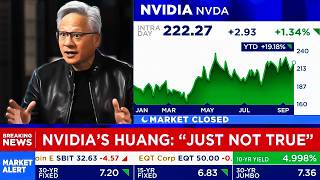
The big story yesterday was of course Jensen Wong keynote CES and what he was going to talk about and how the market would react to it for a stock frankly that hasn't done all that much lately. If you back this out you can get the picture last 3 months for example just take a look at what Nvidia has done.
Um yes he talked about faster AI chips. Um yes he talked about robotics which many obviously think of as the next big wave and this Vera Rubin chip is now in full production which people like Stacy Rascon at Bernstein top analyst suggests in his words looks like a monster the rest of the keynote was more incremental but that seems to be the big takeaway from Mr.
Rascon Dan Ies etc. Let's talk to another big shareholder in Nvidia. It's Brad Gersonner. He is the Altimter founder and CEO and he joins us now. His first appearance of 26 with us and it's great to see you. Thanks for coming on today. Great to be here guys. Happy New Year. You as well. Um so what was your thought about the Jensen Wong keynote?
Your big takeaway. Was it a is it a needle mover in in any way? Well, maybe just a comment first, Scott. I think that, you know, you just ran around the the horn on the desk and I think everybody is is spot on. This is going to be a stock pickers market. It's not 2023 or 2024 where we were early in the super cycle and we were recovering from the pullback in 2022.
Um, you know, and remember last year wasn't straight up and to the right either. The NASDAQ was down 20% on Liberation Day in April of last year and ended the year up 20%. Um, and so I think there's a lot to be excited about as you look at this year, but as Venezuela reminded us over the weekend, as the Scotas decision on tariffs will probably remind us, there's certainly a lot of things we have to get through this year.
But if we just look at the general operating framework, and then I'll get to Nvidia, you know, lower taxes, we're in a rate cutting cycle, inflation under control, um, you know, earnings growth is is occurring. We've got this AI super cycle, this massive investment super cycle. We have this re-industrialization and bringing on reonshoring our national supply chains.
That's also a huge investment super cycle. So, the backdrop looks good. And then we have these companies that are all getting more fit, right? They're leveraging AI. This is tough for the employment picture, but it really does lead to this golden age of margin expansion. And I think what you heard from Nvidia yesterday was a lot more of the same, right?
The consensus estimate this year, I think, is that they're going to grow earnings to about 65% maybe 30% in 2027. You said it's an earnings driven market, so they don't need to expand multiple. The multiple 25 times earnings. It peaked in July of 24 at 41 times earnings. It troughed last April at 21 times earnings.
Now we're at 25 or 26 times. So, it's not a demanding multiple. And as a shareholder, Scott, I'm thrilled and happy just to sit here and let an incredible company generate earnings and let our returns come from earnings. We don't need our returns to come from multiple expansion in Nvidia. you you you sound like somebody if you paint the picture that you just did of the backdrop which you think exists who's taken their exposure up.
I I would say I I don't know the answer to this so I'm going to ask you straight up. Um that's what it sounds like that you've increased your long exposure to this market. Is that fair? That's fair. I you know so let's just walk through you know last year. We started last year medium large in terms of our exposure.
By April, we were tiny in terms of our overall exposure to the market because of our fears about I came on this program and talked about you know the Navaro nuclear option around tariffs. Um we were back in the mar market extra large in May. We stayed there for most of the year. We pulled back in October because things started getting really frothy.
Um but as the market came in, right, as Nvidia went from $210 a share uh back to $170 a share, we were buying that. And so we're back into a medium large position as we start the year. But but as the desk said, this is a stock pickers market. So our biggest bet is in AI infrastructure. Nvidia, TSMC, Heinix, Samsung, Amazon, Microsoft, Cororeweave, uh Google.
Um we think that we're still very early in the super cycle. People, um it's hard to believe, but we're underestimating, right? Think about the total capex here, Scott. In 2023, these companies spent $150 billion on capex building out uh data centers. This year, over 500 billion. Th that's not speculative.
That is purchase orders. Those are buildings. That's power. That's stuff that we know is coming online. Chips that we know are going to get deployed. Um, and frankly they would buy a lot more if they could, but we just don't have enough powered shell in order for them to deploy more than the, you know, six gigawatts in the case of Amazon that they're going to deploy this year.
Um, and so, uh, you know, we think that that that will continue to play out. It's where the majority of our bet sits today. Um, and we think, you know, we don't we don't rely on earnings, uh, multiple expansion in order to get paid this year. All of these stocks are trading in mid20s in terms of their multiples.
in the case of something like coreweave which has fallen out of favor trading at five times ibita. So you know we think there's an opportunity if they just deliver the numbers that we expect them to deliver this year. The story was at the end of last year it was all about TPUs and how the TPU is going to take out you know the GPU.
I think what people will gain an understanding of this year. First, Google is a massive consumer of NVIDIA GPUs, right? Not only for its own workloads but also the workloads uh you know in Google cloud. I think people will appreciate the fact that you know the TPU while while it has some advantages is not going to produce the token efficiency that Reuben and the Reuben family of chips is going to produce.
Um the numbers that we heard yesterday, Nvidia remains the far away leader in terms of perf per watt. The amount of performance or tokens you can get for a fixed amount of power into a data center. Listen, what did Jensen Wong say on the stage? He must have said it 15 times. Demand, demand, demand. We we're here in Silicon Valley.
I will tell you the single biggest problem every company has is how do I get my hands on more thinking tokens? How do I get more capacity? The demand is off the charts. It will continue to be off the charts. Let me just step back for a second. We we we've said this before. All software and all compute in the future must think.
That means it's no longer pre-ompiled software, dumb software that's just running on a CPU. The entire compute stack of the world forever more has to be accelerated because it has to produce tokens that can be intelligent. Otherwise, enterprises are not going to buy it. Okay, that is a massive change.
That's not training a model one time and and then we're done with it like everybody thought in the Deep Seek scare moment at the beginning of last year. Okay, the truth is when Jensen came on my podcast and said we we're going to 1 billionx inference. He said that a year ago. He was understating the amount of inference token generation that we were going to need.
The world is going to be supply constrained on inference compute as far as the I can see. It was part of the inspiration. We were also investors in Grock. We're investors in Cerebras. Nvidia bought Grock because in Cerebras and Grock have now demonstrated the world will buy all the tokens they can produce because they're producing fast inference thinking tokens.
Um that is something that's not even baked into the cake of what I think Nvidia is going to be able to deliver in terms of increased productivity this year. And so when I look at it, I would just say Joe stay the course, right? The world is going to ring their hands just like they did in the early age stages of internet, early stages of social and they're going to say, "Oh, we have too much of this or we have a deepseit can do all this with." No, the fact of the matter is every single major enterprise in the world.
This is no longer the Mac. This is every sovereign on the planet um that has to build sovereign capability when it comes to AI. This is every major enterprise on the planet. I will tell you it's incredible to look at the growth curves of companies like Rock and Cerebras. Every enterprise in the world is buying fast inference tokens off of them.
And so the TAM, the total addressable market for AI is every business and every consumer. We haven't seen anything like that since the internet itself. And so I understand why people say, "Oh, Nvidia's up 12x. It can't go up anymore." Hell, I remember coming on here in 2023. The stock had doubled. It had gone up 2x and everybody was saying sell it.
It's gone up 2x. It can't keep continue to go up. It's gone up 12x since January of 23, but the earnings multiple is lower. The earnings have grown faster than the 12x stock uh performance has grown. And so that's what you have to keep your eye on. I think it will continue to be a market leader. Nobody works harder uh than that team.
But listen, hand it to Lisa Sue at AMD. I saw what the the the MI450 if she can deliver that with the specs to Open AI, you know, she rebooted that company. She's placing a huge bet. Um I think, you know, there's going to be a lot of stress on that. We don't own it today. Um but, you know, that they're going to make a run at it.
I think a lot of these custom AS6 are going to make a run at it, but I think the shot that was across all of these bowels from Jensen yesterday was if you're coming after the king, right, you better have something a lot better. He just improved his inference performance by 5x, not even including Grock, which I think will give him, you know, another huge boost.
He improved training performance by three and a halfx on uh Reuben Chips. Now, let me just put that in perspective. It means you can get the exact same performance you get out of Blackwell for 1/if the cost, right? That's better than Moore's law. He's doing that every 12 months. The guy doesn't sleep.
to keep up with them. Not only do you have to come from behind, you have to somehow figure out a way to run faster. I think it's going to be very hard to do. So, I think the shot across the bow, it becomes very hard for these custom AS6. If you're open AI or you're meta and you're building a custom ASIC to compete with these guys, it it just got a lot harder yesterday.
Um, so we'll see how that plays out. Um, but I think in technology, from my perspective, listen, software is trading at a a two decade low multiple, less than five times forward revenue. Why? because people don't know what the future looks like. Internet's trading at low multiples today. Um, and all of this is because we're undergoing this massive transformation.
I think there will be a lot of interesting software companies and internet companies. Snowflake's one that we own that that will come through on the other side accelerating. Snowflake's accelerating its revenue this year. It's a beneficiary of AI. But that is the skepticism that exists in the world.
The place where there is no uh doubt in my mind we're going to consume everything we produce is around AI infra. &. Today, Nvidia CFO spoke at a fireside chat with JP Morgan. CFO Colet Crest told us that demand has increased since the $500 billion figure that Jensen shared on stage at GTC back in October.
Colette also told us that the US government is working on licenses for Nvidia to ship the H200 to China. Jensen indicated in an interview with Bloomberg today that they are seeing demand from companies in China which he believes indirectly means that the Chinese government is likely to allow the sales to go through.
Also today, Nvidia and Seammens announced they are expanding their partnership to build the industrial AI operating system. Under this collaboration, the two companies are reinventing the entire industrial value chain. Everything from design and engineering to manufacturing, production operations and supply chains.
This fits right in with Nvidia's theme at this year's CES, which is physical AI bringing artificial intelligence into the real world. I'll talk more about that in a moment. Yesterday, after Jensen delivered his CES keynote, he held a short Q&A session with analysts. And so, really quick, let me mention a few points that stuck out to me from that Q&A.
Jensen was asked about the Grock deal and said that Grock's technology excels at extremely low latency inference, which is going to be essential in the future when demand for low latency inference rises from AI powered devices. So, the massive low latency inference demand in the future from consumer devices appears to be the main reason why Nvidia did the deal with Grock.
Jensen also told us that in the future, Nvidia expects to become the world's largest company in storage processors, similar to how they are currently the world's largest in networking. Nvidia will establish a dominant position in storage processing like they already have with networking. That is a big deal.
Jensen was asked about how tokens are growing at 5x and when a reaceleration or slowdown would occur. Jensen said that the 5x growth driver is reasoning and that the next reaceleration factor is Agentic Systems. Token usage will surge. It could grow 50x. This is exactly what I've been telling you for months.
enic AI that extends well into 2026. And Jensen is clearly confirming this. When asked about Gro's technology being integrated into Nvidia's product portfolio, Jensen said that the product portfolio will remain mostly centered on Grace Blackwell and Vera Rubin, but some could take new forms specialized for extreme low latency.
This is in line with what I've been suggesting in recent videos, hypothesizing that we may see a new low latency inference focused variant of Reuben from Nvidia in the future following the Grock deal. Jensen seems to be hinting at that potentially happening in the future. Maybe there will be another variant of Reuben or maybe it'll be a new type of accelerator altogether.
That remains to be seen. All right. Now, once again, I'm going to rapid fire multiple points that stood out to me from Jensen CES keynote last night in case you missed Monday night's video. We learned a lot of important details. First, Jensen made it very clear that Agentic systems are going to take off from here.
I've been saying in recent months that nd I think 2026 will be the year we see Agentic AI at scale go mainstream. Jensen also spoke about the importance of open- source models and directly confirmed something I've been saying over the past month. . I repeatedly made the point that this is why Nvidia stopped offering DGX cloud capacity to customers back in September and struck a deal to buy additional capacity from Core Weeav directly confirmed this on stage.
Jensen told us that Nvidia has built up massive amounts of DGF capacity in order shared a lot of exciting details about Nvidia's physical AI business. First, Jensen reiterated that Nvidia offers the full robotic stack equipped with three computers that make physical AI possible. AGX Thor, . Physical AI is a very broad industry and part of that industry is autonomous vehicles.
Jensen announced NVIDIA Alp. Alamo is trained end to end. Not only does it receive sensor input and take action, it also reasons about what action it's about to take, tells you the reasons by which it came about that action, and then of course the trajectory. Nvidia started working on self-driving technology 8 years ago.
Jensen announced that the first autonomous car from Nvidia is going to be on the road in Q1 in partnership with Mercedes-Benz. Jensen told us that the Mercedes-Benz CLA was just rat vision is that someday every single car and every single truck will be autonomous. The ecosystem of companies working with Nvidia on expects this to be a giant business for Nvidia.
This is going to be the first large-scale mainstream physical AI market. And Jensen believes that over the next 10 years, a very large percentage of the world's vehicles will be autonomous. And this is only part of Nvidia's physical AI business. I'm telling you as I've been for months, , and I seriously think most analyst long-term estimates are too low given what's ahead.
Ahead of Jensen's keynote, I made the point that I would be surprised if Jensen made any big announcements related to data center since CES is geared toward consumers, but that I would be happy to be wrong about that. And now I am very happy to have been wrong about that because Jensen gave us an update on Ruben.
Jensen told . This is very important and this makes me very optimistic about Nvidia's earnings report and guidance in February. Think about this. Foxcon published their December revenue report. And looking at this graphic, we can see that Foxcon's revenue jumped sharp started ramping in substantial volumes.
And Foxcon had a very strong fourth quarter in the months following. This . Now, couple that with the fact that Reuben is already in full production and on track to launch seamlessly this year. Plus, we that should be coming online very soon in the early part of this year. All of this put together makes me very optimistic that we will get both a very strong earnings report and very strong guidance from Nvidia in February, even stronger than usual.
And that makes me optimistic that we may see a very positive reaction to Nvidia's next earnings report. Now, of course, if the stock rallies a lot ahead of the earnings report, then that decreases the likelihood of a positive reaction after the earnings report. But you get what I'm saying. Foxcon's revenue report indicates that Nvidia should report very strong earnings in February.
Large-s scale sovereign AI projects coming online very soon increases the likelihood that we will get very strong next quarter guidance and Vera Rubin being in full production means we are likely to get very s well. Putting all of it together that is a very positive setup in my opinion and this evening we get to hear from Jensen again.
This time at Lenovo Tech World starting at 5:00 p.m. Pacific, 8:00 p.m. Eastern. I probably won't be able to get a video out in time after that presentation. So I'll try to cover what Jensen says at Lenovo Tech World in Wednesday's videos. So be on the lookout for those. Very briefly, I'll mention that I'm very bullish on iron in 2026, and I'm optimistic about the year ahead.
Last I looked, Iron had a very positive green day yesterday and then a notable red day today. I wouldn't worry too much about the short-term volatility. company. There will be pullbacks along the way, and I view pullbacks in iron as opportunities to responsibly add to long-term positions at lower prices.
At the time of recording, I'm not aware of any iron specific news, and I continue to be very bullish on Iron this year as the company starts to deliver on their AI cloud forecasts. Again, ignore the short-term noise and focus on the long-term fundamentals of the company. Now, back to Nvidia. I'm glad that Nvidia is starting to really shine the spotlight on the company's physical AI business.
As I've been saying for months, this part of Nvidia's business does not get enough attention today, but I think it will start to get a lot of attention throughout this year and in 2027. Jensen is clearly telling us what is coming next. Physical AI stands to benefit massively as they have embedded themselves as the underlying infrastructure powering all of it.



Comments 0