저자: Daniel · 외국인
요약 보기
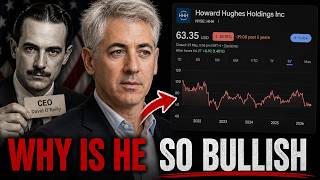
HHH 주가는 연초 대비 약 20% 하락한 $64이나, Ackman의 Pershing Square가 $9억 투입 후 지분 약 47%로 확대. 1분기 매출 $235.9M(+18.4%)로 컨센서스 상회, 토지 부문 EBT +33%. 보험사 Vantage 인수($21억)로 보험 플로트 기반 지주회사 전환을 추진하며, 회사 자체 NAV $104 및 2030년 $211 목표를 제시. 다만 저자본이익률과 GAAP PER 등 상반된 지표를 근거로 밸류에이션 괴리를 강조.
다듬은 글
The stock of Howard Hughes Holdings is currently trading at around $64 per share, down nearly 20% since the start of this year. This disappointing performance comes at a time when the broader market is hitting new highs, leaving many retail investors wondering why this real estate giant is lagging so far behind.
But if we look closely at what is happening behind the scenes, we find that legendary activist investor Bill Ackman is more bullish than ever on this business. Pershing Square, Ackman's investment firm, recently increased its stake to nearly 47% after infusing $900 million into the company. Ackman is not treating this as a simple property developer.
Instead, he is executing a massive multi-year plan to turn Howard Hughes into a diversified holding company. He is directly using the Warren Buffett playbook to transform this real estate business into the next Berkshire Hathaway. The market seems completely blind to this long-term strategy, focusing instead on short-term interest rate headwinds and uneven real estate earnings.
In this analysis, we are going to dive deep into the numbers to see if the current sell-off represents a generational buying opportunity. And of course, good day to you everyone. If we haven't met, I a the most timely manner. I make sure to research and write all the scripts myself, so make sure to let me know if you see any areas that I can improve on.
Without further ado, let's get straight back into it. To understand why Ackman is so confident, we first need to break down exactly what this unique company does. Unlike traditional home builders that buy land, build houses, and move on, Howard Hughes owns massive master-planned communities across the United States.
These master-planned communities function as self-contained mini cities where the company controls all aspects of development, including residential neighborhoods, office spaces, retail centers, and hotels. They own the land, they sell portions of it to home builders at a massive premium, and then they build commercial properties to capture the recurring cash flow from the residents who move in.
This is a highly profitable, self-reinforcing flywheel that creates immense long-term value. If we look at the financial results released on May 7th, 2026, we can see this land development engine in full effect. Howard Hughes reported a strong first quarter with total revenue rising 18.4% year-over-year to reach $235.9 million.
This comfortably beat consensus Wall Street expectations of $196 million by over 20%. The real star of the quarter was the master-planned community segment, which handles the initial horizontal land development. Earnings before taxes in this land segment surged 33% year-over-year to $84.4 million. This is up from $63.3 million in the first quarter of 2025, driven by robust performance at Bridgeland in Texas.
At Bridgeland, the company saw a 67% increase in residential acres sold, alongside a 14% increase in pricing per acre. On a trailing 12-month basis, land sales generated a massive $497.2 million in earnings before taxes. Meanwhile, their income-producing operating assets also showed steady growth during the same period.
This segment, which includes commercial office buildings, retail spaces, and multi-family apartments, generated adjusted maintenance-free cash flow of $29.5 million. That represents a 14% growth compared to $25.9 million in the prior year quarter. On a trailing 12-month basis, this recurring cash flow reached $99.1 million, indicating high-quality, stable earnings from completed developments.
The company's condominium pipeline is also highly de-risked with over $1.6 billion of contracted future revenue already locked in. Most of this condo revenue comes from the pre-sale of over 200 units at Malia and Aalani which are the 12th which are the 12th and 13th residential towers at Ward Village in Hawaii.
We are looking at a highly predictable multi-year stream of cash that will flow directly onto the balance sheet as these projects are completed. To truly appreciate why these master plan communities are so valuable, we must examine the broader real estate industry and regional migration trends. The United States has experienced a massive demographic shift over the last decade with millions of families and businesses moving from high-tax, high-cost states to the Sunbelt.
Howard Hughes has strategically positioned its assets directly in the path of this migration. Their premier communities, Summerlin in Las Vegas, Nevada and The Woodlands and Bridgeland in Houston, Texas are located in the fastest growing regions in the country. These are not just suburbs, they are premium, highly desirable destinations with outstanding schools, parks, golf courses, and commercial hubs.
Because the company owns the entirety of these massive land parcels, which can span tens of thousands of acres, they act as a local monopoly. If a home builder wants to build a house in Summerlin, they cannot go to a competitor. They must buy the land from Howard Hughes. This gives the company incredible pricing power, which is why they were able to increase their average price per acre even as high mortgage rates slowed down the national housing market.
Furthermore, this developer model completely eliminates the speculative risk that destroys traditional builders during a downturn. Instead of building thousands of homes on leverage and hoping buyers show up, they simply hold the raw land on their balance sheet. They only sell land to builders when there is actual verified consumer demand.
And they only build commercial office or retail spaces when they have high pre-leasing commitments. This highly disciplined approach to capital allocation ensures that they are never caught holding excess inventory during a recession. We must also recognize that these land banks are incredibly long-lived, providing a runway of development that will last for several decades.
For instance, Douglas Ranch in Phoenix, Arizona, spans over 37,000 acres and is projected to eventually home over 300,000 residents. The sheer scale of these projects creates a massive barrier to entry that no competitor can easily replicate. But despite this incredible business model, the stock has struggled, and the standard return on invested capital looks low on paper.
To answer this, we must examine the classic conflict between return on invested capital and the weighted average cost of capital. When we look at the financial statements of a master-planned community developer, the return on invested capital typically hovers at a very low level of around 3 to 4%. This is because they hold billions of dollars' worth of raw land that sits on the balance sheet for 20 or 30 years before it is sold.
This land is highly valuable, but because it does not produce current income, it acts as a drag on the traditional return on invested capital metric. Meanwhile, their average cost of capital is around 7 to 8%, reflecting the higher interest rates of the current environment. On paper, this makes it look like the company is destroying shareholder wealth because their return is lower than their cost of capital.
But this is exactly where the market psychology gets it wrong, and it is the exact inefficiency that Bill Ackman is exploiting. First, the book value of their land is held at historical cost, which is far below its actual current market value. When we adjust for the true market value of the land, the underlying economic return is actually much higher.
Second, Ackman is introducing a massive game-changer that will completely restructure the company's cost of capital. In late 2025, Howard Hughes announced a $2.1 billion acquisition of Vantage Group Holdings, a major specialty insurance and reinsurance company. This acquisition, funded partly by a $1 billion preferred stock commitment from Pershing Square, marks their official transformation into a diversified holding company.
This deal is straight out of the Berkshire Hathaway playbook because insurance companies generate what we call float. Float is the money collected from insurance premiums that has not yet been paid out in claims. This float represents an incredibly cheap, permanent source of capital that can be invested for years.
Instead of keeping this float in low-yielding bonds, Ackman plans to use Pershing Square's world-class investment team to invest Vantage's capital into high-quality public equities. This allows them to invest low-cost insurance capital to earn double-digit returns, effectively bypassing the expensive debt markets.
This will dramatically increase the company's return on invested capital while driving down their weighted average cost of capital. If we look at their operating cash flow, the strength is already visible. In 2025, they generated adjusted operating cash flow of $446 million, representing a cash flow yield of over 11%.
This is incredibly strong for a company that is also investing hundreds of millions back into physical asset development. They are generating massive cash from their current assets to fund future growth without needing to dilute shareholders or take on toxic high-interest debt. Now, let us turn our attention directly to the current stock valuation because this is where we see a truly massive disconnect.
With the stock trading around $64, the company's total market capitalization is roughly $3.8 billion. Based on their adjusted operating cash flow of $446 million, the stock trades at less than eight times operating cash flow. For a business that owns some of the most valuable, irreplaceable real estate assets in the country, this multiple is absurdly cheap.
Wall Street analysts are currently valuing the company using a standard price-to-earnings multiple, which is around 31 times based on GAAP net income. But, this completely misses the point because GAAP net income is heavily depressed by non-cash depreciation charges. Real estate developers incur massive depreciation on their built assets, even though the underlying land is actually appreciating in value over time.
If we only look at the price-to-earnings ratio, we are looking at a highly distorted picture of the company's true earnings power. In May 2026, Howard Hughes released an updated valuation framework to help investors calculate their intrinsic value. Under this new model, which includes the contribution of the newly acquired Vantage insurance business, the company estimates its current net asset value to be $104 per share.
That is nearly 60% higher than the current stock price of $64. Even more exciting is their long-term forecast, which projects the intrinsic value to reach $211 per share by 2030. This represents a compound annual growth rate of 23% over the next 4 years. This massive target is fully supported by the cash generation of their master-planned communities and the high-yielding equity investments inside the Vantage insurance portfolio.
By transitioning to this holding company structure, Howard Hughes is unlocking hidden asset values that the market has ignored for years. They are transforming from a low-velocity real estate developer into a high-velocity capital compounder. We can see that Ackman is not just guessing here. He has a highly detailed, data-backed plan to close this massive valuation gap.
The market's short-term focus on interest rates has created a massive valuation gap between the stock price and the underlying asset value. When we look at the long-term potential of these premier master-planned communities, the downside risk seems extremely limited. The cash flows from land sales will continue to fund commercial construction, creating a growing stream of recurring net operating income.
On top of that, the Vantage acquisition provides the permanent capital float needed to supercharge their investment returns. This is why Bill Ackman is willing to commit a billion dollars of preferred equity and hold a 47% position. He understands that real wealth is compounded slowly over decades by buying undervalued assets with low-cost permanent capital.
As individual investors, we can learn a valuable lesson from this high conviction setup. Instead of chasing high-flying momentum stocks, we can find incredible value by looking at under-the-radar asset-rich compounders. The transition of Howard Hughes into a diversified holding company is still in its very early stages.
It will take time for the market to fully appreciate the power of the new insurance float model, but for patient long-term investors, the current valuation of $64 per share looks incredibly attractive compared to their intrinsic value of over $100. We will certainly be keeping a close eye on their progress as the Vantage acquisition closes this quarter.
This deep dive shows us how high conviction value investing works when backed by deep fundamental analysis. It is all about finding the gap between a stock's market price and its true intrinsic value. We have laid out the data and the strategic roadmap. So now it is up to you to decide if this compounder belongs in your portfolio. .

Comments 0