저자: MattMurphy · 외국인
요약 보기
마벨 CEO가 연간 애널리스트 미팅에서 2028년 데이터센터 매출 300억달러 이상, 2030년 맞춤형 실리콘 시장 2350억달러 및 마벨 목표 300억달러(점유율 약 13%), 2030년 매출 목표 700~900억달러(중간값 800억) 등을 제시. 핵심 성장동력은 랙 내부 구리 연결을 광으로 전환하는 scale-up optics(내년 본격 램프업, 올해 매출 0 → 내년 3억달러 이상 상향). 최근 자사주 100만달러어치를 두 차례 매입했다고 언급.
다듬은 글
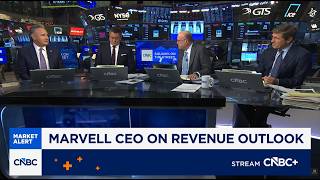
Marvell Technologies has been one of the top performers this year and the company's posted at annual analyst meeting annual analyst meetings. And Matt, I've been with you when you had annual meetings and no one believed in you and they were wrong and you because they thought you were too aggressive.
They were wrong. So, I want to ask you Matt, what gives you the conviction to make projections that frankly were jaw-dropping including that one by your CFO? 30. In 30? 30 for 30. That's right. Well, look Jim, I've been CEO for 10 years. I've been in this industry for 32 years. And now the silk you have gray hair and I think you were running you didn't have any gray hair.
doesn't match the one you guys flashed. I probably need to redo the photo. But look, I think we always put out what we think is pragmatic, judged and achievable. And so if you look actually 2 years ago, we were in New York, same hotel, same venue talking about our AI and data center ramp and we were talking at that time about a $15 billion data center 2028 Marvell revenue.
If you look at sell-side analyst consensus today after our meeting yesterday, the implied data center revenue in 2028 for us is over 30 billion. So, basically it's it's fundamentally 2x in that period. Now, along the way we've updated investors, we've been taking people on the journey, but yeah, we've we've achieved the targets along the way and the business continues to perform really well.
On June 2nd a very famous prediction by Jensen Huang. Yeah, that was be the next trillion-dollar company. It seemed absurd. At 42 times the earnings you make, you will be at a trillion dollars. So, it is not absurd and it could be 4 years from now. Yeah, it was not rehearsed and shocking when Jensen said that, but at the same time if you actually take the range of 70 to 90 billion and you put a multiple on it 4 years out, you know, who knows what's possible.
But he saw it I need to know whether you saw it first that it wasn't it was not actual The kind of GPU versus TPU. It was connectivity. You discovered connectivity. Explain to people what connectivity, which may be bigger for you than actual XPU TPU. Yeah. No, no, we're we're unique actually in this AI semiconductor cycle in that you had the three big compute companies, right, driving massive growth when when generative AI first rolled out.
That was followed by a huge memory wave, right, which we've all followed, right, three large trillion-dollar memory companies. That that's what they do really well. And what we're seeing now is there's a there's a gap because there's not enough in the connectivity layer to connect all of those things.
You got a lot of installed compute, a lot of installed memory, but guess what? They all need to talk to each other through high-speed optical interconnections, switching networks. And what you don't want is any GPUs or memory sitting idle. And and actually what happens when you start talking about agentic AI and reasoning models, there's more and more diverse kinds of compute, so the connectivity layer even gets more complex.
So, that was my June 2nd sort of thesis at Cognitive X was, "Look, we we see this as the next big unlock." And our business has just been ripping since, and that's when Jensen came on stage and basically said, "Yeah, I agree with Matt. His his business is doing really well." was only April of '24, I think, Matt, when you were talking about your XPU custom total addressable market of four at $40 billion.
Now I think you're saying it's $235 billion. That's right. That's 2 and 1/2 years. Yeah. Yeah. I mean, we know the numbers. We share them every day with everybody in terms of the spending, but is it astounding to you? And what gives you the confidence that number's going to be right? Yeah, the custom number it it really ran ran on us, for sure.
I mean, and it was interesting, if you go back 2 years ago, the debate was actually can custom even materialize as a portion of the market. Now, you fast forward, and it's not just us, right? There That whole segment has clearly clearly been solidified as a real thing. And so, you roll forward just a few years into 2030 and yeah, you're looking at a $235 billion market just for custom silicon.
We participate in that in in two areas by the way. Well, you're 13% or so, aren't you? Something like It's a pretty reasonable It's a It's actually The The crazy thing is we said, "Hey, we can we Our target is 30 billion in revenues Right. in in 2030 in custom. Yeah. And then somebody pointed out in the meeting, "Look, if you just divide that by the 235, it's only 13% market share." And we've got customers there today.
I mean, our business in 2028 is going to be $12 billion plus in custom already. So, that that that drive from '28 to '30 is not not a stretch and it's not a huge portion of the market. So, I think that's why we give some head room too on our ranges. We said, "Look, it's not just $80 billion target. There's a range of outcomes." We We actually gave ranges on all of our businesses.
So, you know, investors can take a look and they can make their own judgments, but we think the midpoint of 80 billion is very achievable at the company level. That's interesting because the street's elated pretty much at all the targets. But, I think it was Morgan Stanley that said, "They're happy, but we don't know whether Marvell needed to raise the bar this high." Was there any discussion about hedging bets?
Yeah, I I you know, it's interesting. I you know, there's this always this debate. Are you conservative? Are you aggressive? You know, what do you like? And I actually I never like to use those words. I always look at most probable outcome judged and pragmatic. And we call it like we see it and we give a range.
And that has served me and the company I think extremely well for the last 10 years. You know, we've grown the revenue from basically low low $2 billion in revenue 10 years ago. We're looking at 20 billion next year. We've taken investors on the journey. And yeah, I think you could say I've made some moves that are very would would would be aggressive.
Maybe forecasts we gave or acquisitions we did or divestitures we did, but in my mind all of them were very rational, thoughtful, and pragmatic. And that's how we think about it. So, no change in how we're running the place, no change in me. So, when you look out to our targets in 2030, it's very consistent with how we've been doing it.
But you have a particular edge that people have to understand, which is that you figured out and know how to break through the copper wall. Copper wall? Right. I mean, if you think about it, if you go back like 15, 20 years, inside the data center, today you look at a data center, there's optical cables everywhere, right?
You see all these fiber optic cables plugged in and out. Those all used to be passive copper at one point. And because of the data bandwidth, the data the data rates required and the bandwidth required, more and more of the data center links have been moving from copper or passive to optical. So, that's driven our business quite nicely today, but there's another wave.
Basically, what's happening now is the there there's two terms. One's called scale out networking, and then there's scale up networking. Scale out is connecting all of the racks together, all the networking inside the the data centers. But now, people want to hook up and coherently connect GPUs and XPUs together.
Talking like In the rack, you mean? In the rack. And is that all copper still? Inside the rack, it's all copper today. Okay. So, And it's going to move to optical because you're running copper's not good. When does that actually happen? Oh, it's going to start next year. Yeah, we have a we have a we have a category a sub-business we call scale up optics.
Mhm. And it's $0 this year. And we said next year, actually two quarters ago I said it would be 300 million in revenue. I then said it was going to be material higher than that last quarter, and then it's gone up again. So, this is ramping now. Is this the fourth leg you were talking about or no? That's a That's the third leg.
There's another There's a fourth David there's David David there's always one more leg. Oh, I That they're only two. What are you doing here? You said we only have one more question. No, YOU GOT TO HAVE FOUR. IT'S A FOUR-LEGGED STOOL. OKAY. YES. All right, so I think there are people out there who say, "Wait a second, there are moratoriums going all over the place.
The political situation is not good. You got to worry." Matt, it doesn't sound like you're using a $400 total addressable market that you're that worried about the political implications of of data centers. Yeah, I mean we think about the external environment all the time, and I think we we we we battle that constantly, and we have to think about it at a company at our our scale.
But I got to tell you, at the end of the day, we're a semiconductor company. We build world-class chips for a living. We work directly with our customers. And And right now, our customers in particular are the largest hyperscalers who have been, you know, executing their data center plans and build-out for many years, right?
So, they've got a flywheel that they're building on. We've got line of sight to where they want to take their business. We're going to be part of that. Yes, we have to be aware of the external environment, but we've seen no impact from any of these externalities right now on our market potential, and certainly not right now, even in the near term, on our revenue growth.
I mean, we basically said for next year, um we we took everybody up next year from 18 to 20 billion, um primarily because of connectivity, actually, what I just mentioned. So, even in the near term, we don't see that impacting our business. to congratulate you, Matt, for everything that's happened. I do want to point out that twice the press has has fuddled you, and people have attacked you.
And you What do you do? You went in the open market and bought how much stock? I I bought some shares. I I bought twice, actually. I bought twice. a million 70. I bought twice in the '70s. Right. Thank you for coming on the show and telling people, "Listen, here's my answer to the doubters. I just bought a million dollars' worth of stock." You call it like it is, Matt Murphy, who runs Marvell Technology. Thank you. Yes. Thanks, guys. Appreciate it.

Comments 0