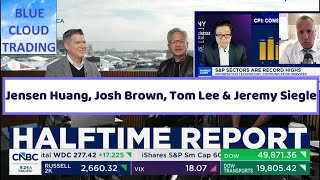
저자: JensenHuang/BradGerstner등—사회자ScottWapner제외,제목기준주요출연자JensenHuang,JoshBrown,BradGerstner,SteveWeiss,MalcolmEthridge · 외국인
요약 보기
AI 인프라 투자 과열 우려로 빅테크가 급락 후 반등. 빅파이브 AI 설비투자 6,500~7,000억 달러 전망에 대해 Gerstner와 Huang은 수요가 강하고 지속 가능하다고 주장. Josh Brown은 주가 급락 구간의 저가 분할매수를 강조. Amazon 실적 이후 낙폭 과대로 보고 추가 매수 입장. 차트 분석(Brad 방송 구간)은 PLTR·SLV·QLD 등에 대해 신호 해석 위주이며 방향성 예측은 제한적.
다듬은 글
Carl, thank you very much. Welcome to the halftime report. I am Scott Wner and we are outside of Levi Stadium in Santa Clara. It is the site of Super Bowl 60 and you can bet we're tracking the markets today as well which are higher including the NASDAQ. Amazon though, wow, it is getting hammered after its earnings.
Yet another victim of big spending concerns and it has been a brutal week for many names including Nvidia which was down about 10% over the last 5 days though it is getting a very nice snapback today. And speaking of coming up an interview with Nvidia CEO Jensen Wong right here in the company's backyard.
Crypto a focus today as well. Bitcoin's big beatd down of late. We will discuss and we'll discuss all of it as well with Altimters Brad Gersonner. He is with me for the hour today. Also joining me, the investment committee, Josh Brown, Steve Weiss, and Malcolm Ethridge. We do want to begin where we always of course do, and that's by looking at the markets, which look a lot different than they have for the past few days as we're getting a nice rebound.
And and Brad, I I'll turn to you. I mean, big tech had a trillion dollars wiped out on these spending fears. What were you thinking about over the last few days, and what should our viewers take from it? Yeah, I mean it it it surprises me how surprised the market was. I feel like this had been well telegraphed, but you're right.
A hundred billion dollars of incremental spending by Google and Amazon above and beyond the consensus expectations on capex is pretty extraordinary. But listen, you know, we're going to hear from Jensen later. 650 billion to 700 billion of spend out of the big five companies in the US. and they say they're still token constrained.
The reality is Andy Jasse said last night that he has demand coming in over the bow. He can't fulfill the demand. It's it's high ROI. So he's going to get a big return on this. They need to make the investment. The beneficiaries I think are all the people who are building the infrastructure and the chips in order to enable us to advance AI.
Does the rebound today suggest to you that the the damage has run its course to this point or are we just susceptible at any moment with any headline to have the similar reactions that we've had over the last few days? Well, listen, you know, one of the themes I think we got to think about is when the rate of change goes parabolic, and that's what we're seeing today with AI.
There's a fog of war and when there's uncertainty in the markets, discount rates go up and multiples come down. people start questioning terminal values and that's why valuations change even before numbers change. Let's be clear, Google's numbers were spectacular. Amazon's revenue growth spectacular.
Microsoft only missed by 100 basis points and had incredible Azure growth. The world is desiring to consume a vast amount of this AI resource. It's it's a struggle to keep up building it. All right, they still got some work to do to get ready for the big game on Sunday. So, from time to time, those are the sounds that you may hear outside of Levi Stadium.
But Josh Brown, I'll turn to you. Uh, it's been a pretty brutal week. Yes, we've come back, but the losses are still not pretty to look at for all of these hyperscalers and in some cases a little bit beyond that. What's your take? Well, first of all, I can't lie. I'm a little bit salty. You and Brad are about to have a way more fun weekend than I am.
Uh we we still have residual ice in the driveway and you guys will be at the game. Um here's here's what I noticed this week yesterday and I was on the show yesterday. Um adding to some of my software victims. Um you don't have to buy these stocks, but if you were out there as an active seller yesterday and you did not have a margin call, you're a donkey.
I'm not saying it's the low, but consider this. Microsoft was in a 30% draw down from its high RSI 24. Palanteer RSI 26 in a 40% draw down. Oracle 61% draw down RSI 20 almost in the teens. CRM 20 RSI, uh, Intu, Intuitit 20 RSI, Adobe, AppLavin, um, you name it. PaloAlto, 20 RSIs. For the people that are investors, not traders, RSI is relative strength.
30 is oversold. 20 is, oh my god, what the hell is going on? Are we having COVID again? So, the sellers yesterday, I'm not a thousand% sure what they were thinking. The only thing I could guess is either a gun to their head from a margin clerk or they have no idea what they're doing. So the bounce today makes sense and it's across the board.
It's gold and silver. It's Bitcoin, too. These things have nothing to do with AI disruption. It was just an absolute puke. Momentum bottomed out. We could sort of rebuild here. So now the question is, did you like every name on your sheet? Like were you looking at some of these stocks and saying, "Why do I even own this in the first place?" If you're up 10% off that low from yesterday, that tradeable low from yesterday, today is a better day to make some decisions.
Maybe I want more Microsoft and I want less Oracle. Okay, it's it's not ideal, but like we should not be selling stocks at 2021 22 RSI. That's just literally giving in to the to the the uh the algorithms who are probably doing a better job at catching those lows than people are. I guess you know perfectly picking up where both Josh and Brad left off.
You are an Amazon shareholder. You bought more on this selloff because you obviously think that it's overdone. Andy Jasse says they have the fastest AW growth in 13 quarters. This is not necessarily how you would expect the stock to react other than caught up in the whirlpool of spending concerns. Yeah, it actually is the way that I expected the stock to react before we went into the print yesterday.
And I I think that one of the things we have to come to terms with is that the market dynamics have shifted since co in such a way that retail investors are actively trading a lot more than they used to be. There's a ton more information out there. There are a ton more tools out there. Trading is free.
And so the market having this reaction where it sells first and then decides what to do after the fact, I think we have to accept that that really is just one of the dynamics of how the market's going to work. So I expected that this company that I already thought was underowned long before coming into this week.
It traded down about 15% into the open this morning uh after its print yesterday. I already love the stock where it was. So, it made perfect sense to me that I would want to add more shares. Now, considering all of the things that we've talked about, including the fact that Amazon's got a $200 billion uh backlog that they're talking about having to figure out a way to work their way through.
Well, that explains why it's so important to them to spend so aggressively to ramp up to be able to meet that and and capitalize on as much of that as possible. Malcolm, hold your thought and everybody hold yours as well. Let me go to Washington quickly for some breaking news from our Aean Jabvers. Amen.
What are we learning, Scott? That's right. We are learning now that the White House has taken down that racist social media post from President Trump's uh Truth Social account. And remember, the post went up shortly before midnight last night. And what it showed was a a video about the 2020 elections which ended with a quick cut uh to a cartoon image of Barack and Michelle Obama depicted as cartoon apes.
It was widely criticized throughout the morning uh as racist, including by Senator Tim Scott, an ally of the president up on Capitol Hill. Now, the White House has taken that image down from the truth social uh feed. And the White House says, a White House official emailing me a short time ago saying a White House staffer erroneously made the post.
It has been taken down. So, the White House confirming that that image has been removed from the president's feed and saying that a staffer erroneously made the post. Scott, back over to you. After it's it's worth noting, Aean, uh the White House first calling the uh anger about the post fake outrage.
That's right. But it reached, I suppose, a a crescendo, uh that they had no choice but to take this down. That That's right. Caroline Levit put out a statement earlier in the morning saying, "This is not racist. In fact, all it is is an image of President Trump as the king of the jungle from the Lion King.
It's a perfectly fine meme and anybody who's complaining about it is guilty of, you know, fake outrage. Then you saw Senator Tim Scott, who of course himself is African-American, come out and say this was uh the most racist thing he'd seen out of the White House and that this post should be removed.
Now we see the post being removed, notwithstanding Caroline Levit's statement that it wasn't racist in the first place. Okay, Aean, appreciate the uh the update from you uh down in Washington as we'll get back to the business at hand and and that continues to be reacting to those earnings and the selloff in Amazon, which Steve Weiss takes me to you because you own the name as well.
I do. I do. And you know, yeah, maybe the selling's overdone, but let's keep in mind that stocks trade near-term on performance relative to expectations and longer term on fundamentals. So even though there was good growth in the quarter, the guidance was a little disappointing. The spend of course was was much more than anybody was looking for.
So that's what's impacting the stock today. This is a stock that's underperformed for the last year measurably. So I'm not selling any. It's not one of my larger positions. Uh so I'm not getting hit there. I'm suffering enough pain on my larger positions uh such as Meta, but uh not making any changes there either.
So, you know, throughout my career, uh, to Brad's point, I've always bought the companies that are the beneficiaries of capex and come back into the ones that have been the expender of the capex when that cycle is near an end. The issue here is that we don't know where it's ending. The other issue is that the technology is moving so quickly that we don't know if the money they're investing in the technology today will turn out to be great investments going forward.
Now if you parallel it to what happened with the internet that was basically one technology sure there were innovations to it but we didn't see wholesale improvements as we saw with anthropic this week that said hey what about those decisions are the right ones I think to some degree Microsoft happens to be you know the victim of that now coming into this year and even last year I thought Microsoft would be the number one beneficiary of AI and that uh that has been wrong.
So, the stocks underperform. That's the one I'm most uncomfortable with. I'm not uncomfortable really with uh you know with Amazon or the others. Uh and I like the tool belt. I don't know if we'll get to this later, but I did sell the remainder of my FTA aviation. I bought this stock well up about 150% within a year and I bought it as a air as a as a engine airplane engine leasing company.
Then they had this announcement. and my target was 200 that they're now going to be making generators. And while I think the stock still moved higher, that was a tool belt company that I didn't expect it to be. So, I thought best, hey, take your profits. Uh, but there are others. Caterpillar, a tool belt company.
So, that's how I look at the world. Josh, you and I think we did this, did we not? yesterday looking at the destruction that's happened in some of the software stocks, you knowing the businesses that you own extraordinarily well and deciding that I may not be buying perhaps at the bottom, but I'm buying more of the names that I like the most, still willing to place those bets and not stay away entirely.
Why? Yeah, this is the difference between uh having investments versus being long PLTU, which is the 2x Palanteer ETF. Um, if you're trading PLTU or you're trading strategy 2x long, you really have to nail the timing and you really have to be picking up on um, you know, watching the VWAP and understanding what other traders are doing.
And that's a a completely different game. And I'm not good at that game. If you're an investor and you already know, I think that there's like a 5 or 10 year period where this company carves out a huge piece of the of the territory and ends up with all the cash flows in this space because they build this competitive position, this moat, this capacity of clients, etc.
And you just say to yourself, I loved it at 32. Now it's 27 because it's in some basket that's being liquidated by a margin clerk somewhere or a hedge fund that's looking to cut exposure or whatever. You sort of have an advantage in markets like this week. It doesn't feel like it in the moment, but if you're not highly dependent on nailing the perfect timing, you can rationally and calmly lower your average cost um in select stocks or uh add to things that you've been up in that you thought you'd never get a chance at those again.
This is not this is not news to people, but it's a good reminder. A day like today, things don't you had eight straight days down for the IGV. It's in a a 20 some odd percent draw down. So, at a certain point, you just have to say, "I like this company. I get that it's under pressure." That's right.
It's it this is not an exercise or or a game and trying to pick the exact moment. It's trying to anticipate something that may come to pass and trying to get ahead of that. Appreciate that conversation. I've got to go back to our headquarters now. Dom Chu has a market flash for us. Dom? Yes, sir. Scott, uh, what we have right now are homebuilder stocks on the move to the downside in a fairly significant fashion intraday.
And this is all due to a Bloomberg report citing people familiar with the matter that the Trump administration and officials are exploring possibly opening up an antitrust investigation into US homebuilders. This all amid a push by the White House to bring affordability uh back for Americans. Uh this report goes on to say that the Justice Department could open the probe in the coming weeks.
According to people familiar know a decision has been made and that the administration may abandon the effort without launching an actual investigation. But that particular move and those headlines are causing those homebuilder stocks as you can see names like KB home, LAR, Dr. Horton and others as well as many of the big homebuilder ETFs like the Spider Homebuilders ETF and the Eyesshares Homebuilder ETF all kind of moving to the downside as you can see intraday.
So, we'll bring in more details as we know more here, but that's the reason why, Scott, those homebuilder stocks are on the move. I'll send things back over to you guys. All right. Appreciate you, Tom. That's my camera right in front of me. The Super Bowl here in Santa Clara, right in Nvidia's backyard.
And we are joined now by the company's founder and CEO, Jensen Wong. Brad Gersonner is of course still with us as well. And I can't tell you how happy we are to have you. Thank you. Thanks. It's great to be here. Welcome to Santa Clara. This is our backyard. I'm a mile up the road. Yeah, I was going to say you couldn't actually walk over here, but you're here and you said you've never been here before.
Well, I've been not like this. Not like this. Look at all these tents. It's incredible. It's going to be a festival. So, it's an interesting time to have you obviously, which anytime is, but especially given what's been happening within the market. Today looks a lot different than the last couple of days have.
The market obviously concerned with what's happening on the spending side of the the hyperscalers and this big buildout in AI. What's your take from that? the way the market continues to react to this demand is skyhigh and there's a fundamental reason for that. We're in the once- in a generation infrastructure buildout.
This is the largest infrastructure buildout in human history and there's a fundamental reason for that. Artificial intelligence is going to fundamentally change how we compute everything. Everything from database processing, the way we do search, the way we do recommener systems, the you shop, the way you watch movies, and of course these new agentic systems that are being that that are being developed and evolved.
Last year, this last year, we saw an inflection point in AI. AI became super useful. No longer hallucinating. It's generating informed content. It's reasoning. It's thinking. It's doing research. It's able to use tools. All of a sudden, AI over the last couple of years went from being curious to super useful.
The inflection point also came with it profitable tokens. Anthropic is making great money. OpenAI is making great money. If they could have twice as much compute, the revenues will go up four times as much. I mean, literally these guys are so demand cons so compute constrained and the demand is so incredibly great.
the number of uh enterprise users, the number of consumer users, the number of startups that are being built on top of these companies, it's just going through the roof. So when you see numbers that are frankly remarkable that $660 billion this year will be spent by the hyperscalers as we continue to learn like we did from Amazon last night, you sit back and think to yourself that's completely justified based on what you see.
It is appropriate and sustainable. And the reason for that is because all of these companies cash flows are going to start rising. You know, people are comparing it to cash flows. One of those numbers are wrong. It's just the cash flow is wrong. We are addressing the largest software opportunity in history.
For the very first time, software is not just a tool. A tool is like Excel. Now, software uses tools. So, these AIs use Excel. And so I think the the uh the opportunity to to uh for this new new era of software is incredible and we're seeing it already uh moving the earnings of Meta. Nobody uses AI better than Meta.
And so if you look at the way that they're using AI, AI went from a recommener system running on CPUs to now a generative AI agentic system that is making recommendations. Everything from the way they social media works and the way they they recommend ads and help uh advertisers create content has fundamentally been changed and their earnings show it and that's the reason why they're investing so hard.
They see just a much larger future potential for it. And not just one company. This is going to affect AWS's shopping and the way they recommend goods. This is going to affect how Microsoft's enterprise software works. Every single company is is sees the same inflection point and that's why everybody leaning in so hard.
I feel like that's the point that you were it's an interesting point. It sort of turns the way you you need to think about these businesses on its head that if you're just fixated on the spending side as you were talking earlier about oh they're spending such a huge portion of their free cash flow you're kind of missing the story.
The market needs to get its arms around that. Do you as well as an investor? Yes. I if you turn the clock back, Scott, to 2008, 2009, right? Amazon could have taken their profits and sent them back to us by way of dividends. Instead, Jeff Bezos said, "I'm going to invest in this thing called AWS." Think of it as digging a gold mine.
You have to spend a lot of money to dig the gold mine before you get the before you get the gold out. These guys are digging the biggest gold mine in the history of software, right? But it costs something upfront. Now the question is do you believe Andy Jasse and Mark you know Mark Zuckerberg and Sundar and Jensen that this opportunity is that big or do you have a special insight that causes you to understand there's no gold in the bottom of the gold mine as an investor I'll just tell you this I want my personal net worth I want my funds net worth levered against AI because all human progress is going to be derived from machines helping humans think and augment human thinking and so whether it's owning Nvidia which is our largest public position or whether it's anthropic or open AI, all of these companies are going to be tremendous beneficiaries and they're doing it at scale.
There are increasing advantages to scale, right? And so I think it's hard for people to get their arms around now just like it was in 2008 and 2009, but thank god Jeff Bezos did that. Now it's $140 billion business generating 30 billion a year in annual profits that people criticized him for investing in back then.
How? It's just it it's incredible that OpenAI and Nanthropic are 20 billion run rate companies pro generating profitable revenues and accelerating growth all at the same time. These are extraordinary things and it makes perfect sense from where we sit. How can we be so certain that the amount of compute we think we'll need and that we continue to hear from CEOs like you that we will need is actually going to come to fruition, isn't it?
inevitable that we're going to at some point overdo it, but we're not going to know that until it's too late. It's not like roads. Roads once you lay it down, it stays fairly useful for a long time. The way computers work is you build up the infrastructure, but then you start replacing it five, six, seven years later.
And so I think it's going to take us some seven years, eight years to build up to the level that we have to sustain. And after that, we're going to be refreshing and slightly growing. And so we've got several years of build out ahead of us. The the important thing is this. You have to go back to first principles.
Computing has fundamentally changed. It used to be pre-recorded. Excel and PowerPoint and all these tools and all the software is pre-ompiled. They compiled it and they sent it to us. The way software works now because it's contextually aware every single time you use it. It takes into consideration the context, who you are, what you're asking about, what's happening to the world, what other information you give it, the context.
And every single context is different and every single response is different. So from now on, every single pixel, every single beep of a sound, every video that comes out of the computer is generated in real time. And that's the reason why we need computers to operate software at such a large scale going forward.
And all these tokens are what we call intelligence. And for the first time we have we're generating something of tremendous value. Intelligence as numbers. And these things we as I mentioned earlier this last year we went through an inflection point because these tokens became profitable. And so we just have to make more of it.
Can you blame in some ways investors who have PTSD from the last time tech went through this revolution and evolution at the same time for seeing certain things that remind them of then and worry that they'll happen again? It's good to always reflect on history. Um history informs us but history doesn't repeat.
And so you have to take into consideration what's actually happening. always go back to first principles and think about what is actually happening right now. The fundamental difference, a huge difference between now and um some things that happened in the past with the internet, there was a ton of dark fiber.
There is no there are no dark GPUs. 100% of the GPUs are rented. In fact, GPUs that we sold six years ago, the prices are going up. It's not like it's antique. I mean, it's incredible. It's like a flying wine. The demand is so high that GPUs I sold six years ago are going up in price. And so I think the demand is just incredibly high for the reasons that I just said.
One, we went through an inflection point. AI has become useful and very very capable. Two, the adoption of it is incredibly high. And three, because these AIs are thinking, the amount of computation it needs is great. And so to the extent that people continues to pay for the AI with you know and the AI companies are able to generate a profit from that they're going to keep on doubling doubling doubling doubling.
You get asked about the bubble question all the time. But to Jensen's point back then you know you're wrapping fiber around the earth five times and you realize well that was a little too much. How are you thinking about that question relative to how we answered it? It turns out that fiber had 7% utilization.
We called it dark dark fiber because we knew when they were putting it in the ground it was it was dark. It wasn't we're building for the future and we were borrowing money to do that and we only had 30 million people connected to broadband internet. Today we have billions of people who are using using this getting benefit daily.
But but one one of the things I would say Scott is one of the questions here Jensen is okay if you accept that all of this needs to be built there's a lot of chatter Andy Jasse said last night on the Amazon call yeah but we have an inference chip that's 40% you know cost 40% less there's a lot of talk about all these other chips so h how are you confident that Nvidia is going to continue to maintain your share right the leadership position in terms of all of this buildout as you look forward
nobody develops the technology more advanced than ours at a pace higher than ours and at a scale as large as ours. We have the largest supply chain of any computing company in history. We have a giant supply chain and so so our technology is the best. Now that translates to the lowest cost tokens because when your performance is 10 times your cost is 30% higher then your token cost
is maybe one. And so that advantage is the reason why people adopt our technology. Our demand, Nvidia's demand in AWS is incredibly high. And so we're we're just super excited about the the buildout that we're doing with them. We're going to we're going to have a very significant buildout this year in the next couple years.
You know, AWS is doing great. They're great partner of ours. Consumption of Nvidia through AWS is gigantic. Brad raises a really interesting question as this these all relationships are so unique in that these companies that are spending all of this money they are customers of yours and they're competitors of yours and they continue to make it clear that they want to be bigger competitors of yours.
Andy Jasse and uh Brad was alluding to what he said on the call. quote, "Customers are starving for better price performance, and typically and understandably, the dominant early leaders aren't in a hurry to make that happen. They have other priorities." I mean, Alphabet's making its own chips, too.
These companies love you. They need you, but they're coming after you, too. It's okay. You know, none of that bothers me. I'm the We're the only company in the world that takes our road map and all of our secrets and we share it to our customers who are also building their own chips internally. That's how much confidence we have.
The reason for that is because Nvidia is the only platform and software likes platforms. Software are built on platforms. If it's built on Nvidia, it runs best on Nvidia. There are tens of thousands of startups around the world, developers all over the world who build on Nvidia. And so by definition, it runs best on Nvidia.
We're the only architecture that's in every cloud. We're in AWS, we're in Azure, we're in OCI, we're in GCP, we're everywhere. We're exposed to AI that is well beyond just the things that we're talking about here. Look at the stuff that we're doing in digital biology and life sciences. Our big partnership with Lily.
They're building AI supercomputer. The physical AI. We're the only company really addressing all of the world's autonomous vehicles and you know all the robotic systems and all the physical sciences. The world of AI goes well beyond language. it represents, you know, probably 60% of the world's AI activity.
The rest of the other 40% that's practically all Nvidia. And so our exposure to AI is broad. We're on every single platform. We're in the cloud. We're on the ground. We're in autonomous vehicles. I mean, we're just simply everywhere. And the key is just we have so many developers. When it's built on NVIDIA, it runs best on Nvidia.
Who do you consider to be your biggest competitor? Well, the thing that we worry about most is just making sure that AI is effective. It has to work. The technology is has great promise. Some enormous breakthroughs. Chat GBT was a breakthrough. Uh uh OpenAI's 01 was a breakthrough this last year. Uh just recently, uh Claude Code is an inflection.
And then now Chad GPT 5.3 Codeex another inflection. You know, we want to make sure that AI continues to be incredibly effective. We want to make sure that protein AIs, chemical AIs, physical AIs, robotics AI, self-driving car AIs, open model AIs, all of these different AI industries have to flourish because the world is gigantic.
Remember AI is not a technology only. It's a five layer cake. It's in it's energy, its chips, it's infrastructure, its models, and ultimately its applications. We need to make sure that all of the world's applications are revolutionized because of AI. When that happens, the demand will continue to grow and we would be successful in helping the world reinvent computing for the first time.
And so our focus, you see my focus uh all the investments that we make, all the partnership that we make, it goes across all five layers of the cake. It goes across all the different domains of applications because you know it's going to it's going to take the whole planet to change the computing infrastructure for the world.
Okay, speaking of that, the whole planet, are the Chinese competitors? They're they're customers. They they want to be customers. You'd like them to be bigger customers than they are now. Aren't they competitors of ours? No doubt. I think the um the way to think about that is that we got competitors.
The United States has competitors all over the world. And if you break down AI and think about AI as a five layer cake, the US has to win at every single layer. We have to win at the energy layer. This is an area that quite frankly um uh we've got a lot of work to do and we're going to have to work hard to make sure that we win the energy layer, the chip layer.
We have to make sure that every software company in the world uses American tech stacks so that our chips are the best in the world. We have to win at the model layer. We have to win at the application layer. So on so forth. Every single layer has a battle and nobody could take it for granted. Uh, everyone, every every one of the layers have to go win on their own.
Uh, we want to win win win together, but every layer has to go win. Do you worry about Brad another deepseek moment that the Chinese to Jensen's point, they're not sitting back idle and suggesting, okay, US, you win. We're playing now for second place. They're playing to win. No, for sure. And in fact, I I hear disturbing things all the time about the Chinese stack making great inroads in the Middle East and in the Southern Hemisphere, etc.
because frankly they're working really quickly to put their chips and their models their open- source models DeepC Kimmy K2 Quinn etc and exporting those to the world. So Jensen was an important part with David Sachs our our our AISAR of putting forth an American agenda to accelerate the American AI stack around the world.
We're still not going fast enough. We need to accelerate and make that go faster. You're absolutely right about that. And I think with respect to China, listen, there's a lot of fear that why would you give China any chips? Why would you? They already have chips. They already have incredible AI. The US wins when the world runs on American technology.
And I think we need to focus on running the fastest race we can possibly run, right? And if we do that, then just like the internet, our values will be embedded and imbued around the world in the in in the US AI stack. But the but make no mistake about it, I think the Chinese are out in front and we got to up our game.
We got to get faster in Washington and we got to get out there and thank God we have Nvidia and the leading technologies in the world in the United States, right? That just doesn't happen, right? We create the culture and the climate for innovation and entrepreneurialism. We're sitting here in Santa Clara.
AI has occurred in San Francisco and Santa Clara because of the great innovations we have. We got to make sure we protect that and accelerate it. You mentioned some of the the criticism that's been around. Should we sell chips to the Chinese because they they want to kick our butts in in AI to to that point.
China is a very large market. It makes no sense to forfeit to concede a large market if you would like to win globally. The American chip industry should do everything we can to win all over the world, including in the Chinese market. We have to compete. It's their home turf. They got all kinds of advantages.
And so we have to go compete hard. But there is no question conceding half of the world's markets make no sense if you want to win globally. So when someone like Daario Amod from Anthropic says it's crazy those are that's his word for the US to allow companies to sell there that that they're an adversary.
You you wholly disagree with that? I completely disagree with that. Of course we would never allow Chinese military to use American technology but that's that's that export control is well established. Of course, we would like to then go and compete in the marketplace. We want, of course, also for Anthropic and Open AAI and all of our American companies to succeed.
They've got to work hard. They've got to go run fast. We make sure that we offer them the best of all of our technologies. We give them all the advantages that we can, but in the final analysis, we've got while we're helping them succeed, we've got to go win around the world and not forfeit markets to anybody.
You mentioned Open AI and I got to ask you because this has been a week, hasn't it? With the the back and forth of, you know, some of the criticism that had allegedly come from the Open AI side about you and maybe some about from you uh about them in a couple of reports, which you've addressed and you did the other day with with my colleague Jim Kramer.
Um, but are we really to believe that there's no there there's no friction between the two of you? There's really no drama between the two of you in in any point? No, there isn't. Yeah, there just isn't. Um the the the new AI models uh at OpenAI needs a lot more compute capability than our last generation hoppers.
That is for sure. The amount of computation it needs, the model's 10 times larger, the amount of comput it thinks 10 times longer. And so it needs a lot more computation than our last generation, which is exactly the reason why Grace Blackwell MVLink 72 was invented. and their latest generation model 5.3 codeex revolutionary trained on Blackwell MVLink 72 and so they need our new generation of technology that that goes without saying and that's the reason why Nvidia is moving so fast you know every single year we're coming up with 5x 10x more capability and we just got to keep that pace going nobody else in the world could do this like we do because as as you know these are not chips only these are AI infrastructure and We're revolutionizing, innovating AI infrastructure at a scale nobody's ever seen, at a pace nobody's ever seen and all because the amount of computation necessary for AI is growing so fast.
But otherwise, the rest of that stuff is just fake news. You know, I think there was a moment, Scott, when everybody thought that there was going to be like exclusive partnerships like Amazon was going to be anthropic and, you know, Microsoft was going to be open AI and Nvidia would stay in one of those lanes and pick a winner.
It's too big. Everybody's going to be everywhere, right? These guys are going to, you know, be have open AI models. They're going to have anthropic models. They're going to have Deepseek models running on, you know, on their chips. And I think when you look at this next round of funding, right, Nvidia and Microsoft just invested in Anthropic, right?
Open AAI probably is going to get investment. There's a lot of rumors out there from, you know, from Amazon or others. Like none of that should surprise anybody. If you want to be in the game of AI, these are the two frontier labs in America. two leading labs. Put X.AI in there as well. It's going to be fascinating what they do with Starlink and data centers in space.
And you're also part I'm a big investor. You're also big investor and partner and partners there. So I think you should expect that as the new normal and you know like we like to make a lot out of these things because of course they're competing. Everybody's competing to make sure they're the lead in those investments.
But I think here's the thing that I think it tells you. Everybody had this idea the last couple months. Open AAI is dead and enthropic to the moon, right? Open AAI just launched another incredible model yesterday with Codeex. They're going to raise a lot of money. I can tell you there's a lot of money that wants to invest, strategic money, financial money, etc.
And the good news for your for your viewers is both these companies are going to be public over the course of the next 12 to 18 months and retail investors are going to get to participate. All right. This is an interesting. Can you imagine being large early investors in Google, Amazon, and Meta? Incredible.
Insane. And that's what we're looking at. That's a perfect place to leave it. Um, as we said, in your backyard here in Santa Clara, I can't thank you enough for spending time with us, Jensen. Thanks so much. Thank you very much. Pleasure. And all right, guys. Thanks so much. Welcome to Closing Bell.
I'm Scott Wner live from Santa Clara, site of Super Bowl 60. And speaking of big round numbers, the Dow hitting 50,000 for the very first time ever. We're going to track it over this final stretch. Can we close above there as well? Well, we shall see. Which means you can't go anywhere. We're also going to speak live to the CEO of Levis's, the company's brand, taking center stage this weekend.
We look very much forward to that. And the mayor of San Francisco, Daniel Lur. He'll join me, his city in the spotlight over the next few days. Lots to discuss. We of course though, we begin with the markets as stocks are surging back today. How about the equal weight S&P 500 also hitting a new record high today and that's a very, very big part of this market story.
So is Amazon. It's lower its AI spending plans. Well, they blew past expectations. And that's where we begin today. History on Wall Street. The Dow hitting 50,000 for the very first time ever. Let's bring in our panel. The Wharton School professor of finance wisdom tree chief economist Jeremy Seagull, CNBC contributors High Tower Stephanie Link, and Requisite Capitals Bin Talkington.
So good to have everybody with us. Professor, I'm going to you first on this 50K for the first time ever. I mean, we set this up about three weeks ago and who would have dreamed that this is 50K. I mean, I I I remember 10K in 1999 and uh you know, it was 25K uh in 2008. So, you know, um I 2018. So, in eight years, we've we've actually doubled the Dow.
And as you know, the Dow is is underweight technology. So, it's more of the the value stocks, more of the uh uh the older stocks. It does have a couple certainly tech stocks in it, but uh for that to hit a new high like this, I mean um it shows the fund despite what we see this rotation, there's a lot of fundamental strength in this economy.
Yeah, Steph, it it shows the durability of the story, the bullish backdrop and the narrative that has allowed the market to get to this level in some respects without technology taking it there. I mentioned in the intro the equal weight S&P hitting a record high in its own right and that part of this story needs to be focused on heavily.
Oh, 100%. And I think the reason you are seeing the equal weight doing better is because you are seeing the broadening out and that is tied directly to the economy growing four to 5%. And we haven't even had the impacts from the one big beautiful bill yet. But we know we're getting fiscal monetary policy uh accommodation likely.
We have deregulation. We may or may not get housing. That would be icing on the cake. I think the reason the markets are rallying substantially today and have been so resilient is because we are seeing that capex spend from the hyperscalers and I'm sure we're going to get into all of that in a bit but they're going to spend the the big seven are going to spend $700 billion up 75% yearoveryear up from the 450 billion they spent last year.
That is a tailwind for the economy 100%. And because we've talked about the food chain, all of the various different industries that are going to benefit the, you know, the power companies, data center, grid, the financials, and the consumer. So, I think this really feels good, and I'm so glad that we're finally seeing a broadening out.
And that's, by the way, tying back to very good earnings as well. What a difference a couple of days makes too, Bin. You know, the last couple of days obviously been dominated by questions over all of this AI spending and whether all the angst over it is justified or not. I asked that question to Nvidia CEO Jensen Wong who joined me earlier right here.
Listen, demand is skyhigh and there's a fundamental reason for that. We're in the once in a generation infrastructure buildout. This is the largest infrastructure buildout in human history and there's a fundamental reason for that. Artificial intelligence is going to fundamentally change how we compute everything.
Everything from database processing, the way we do search, the way we do recommener systems, the you shop, the way you watch movies. So Bren, what do you make of that commentary? I mean, it it it certainly helps soothe, I think, all of the concerns that are out there about these tremendously large numbers that we keep hearing,
right? And I think those part of those tremendously large numbers are why we see the Dow doing well, why RSP is breaking out because we have so much spend into the economy. And so, you know, GDP is picking up. And so when the OBBB actually gets put in, you know, we we feel that this is part of why you're getting that broadening because you know these data centers, the grids, those are workers, electricians, those are components that are actually being built out largely in the US.
And so I think you're going to continue to see this broadening out. You know, we added the Ecoway RSP in January of 2024 expecting a broadening out. So, uh, two years early, but but but nice to see that happening, and I think you're going to continue to see that, but I do think you're going to see individual names in tech.
I mean, Apple's done very well, and they're clearly the one company that doesn't have the capex, but has the high free cash flow. Professor, you know, Jensen Wong makes it clear that there's just too much angst and anxiety over these big numbers that it's so justified because demand is so large and the transformation so big that it's going to take this level of spending from these hyperscalers to get us to where we need to go.
I feel like at times the market just has a hard time accepting it because the numbers are so big. Yeah, I mean and one thing he said it struck me that demand for his older chips, you know, four, five, six years are the prices are going up and you know when you you think about the history of technology, you know, older technology never goes up in price.
The demand is is sky high. I I was just floored by that. But I fully agree with him. This this is uh probably one of the greatest uh technological revolutions uh uh that we've ever experienced. It's it's going to change the world uh in many ways that we don't know but it's going to be for the better because we can prod produce more and do more with less effort which you know is basically what technological progress uh and and uh science and uh progress is all about.
So I mean I'm I'm very excited by what he said. Of course being being ahead of Nvidia that that would be what he would think about. I think the the doubts are is is it going so fast that we're going to see a breakthrough that uh you know could uh devalue some of the technology that is developed uh like we did in 2000 with the fiber optics the multipplexing which which uh really uh was able to put so many more signals through a fiber that all the Nortell system JDS unifies suddenly collapsed.
Is there going to be some sort of surprise there? Good for the consumer, but bad for some of these companies. I think that that is what is keep keeping some of the people on edge, but as long the demand is is astronomical. Yeah, we we were just showing a board of the mega cap names and of course they're they're still mixed because there are questions individually about some of these companies.
I want to take a look at shares of Meta as well as we head through this final stretch. There's the mixed picture that I was talking about. Meta's been red for much of the day. Uh but you'll see if you throw up an intraday chart here and you track the point of our conversation with Jensen Wong when he said something specific about Meta, I want you to listen to this.
Nobody uses AI better than Meta. And so if you look at the way that they're using AI, AI went from a recommender system running on CPUs to now a generative AI agentic system that is making recommendations. Everything from the way they social media works and the way they they recommend ads and help uh advertisers create content has fundamentally been changed and their earnings show it and that's the reason why they're investing so hard.
All right, Steph, you're you're the Meta shareholder. Those comments obviously got our attention. And though the stock is red, you could see a bit of a move off the worst levels of the morning when Jensen Wong sang the praises of Meta and what they're doing in this area. Well, we talk a lot about monetization and some people are very frustrated that some of the hyperskllers are not seeing it, some of the software companies aren't seeing it, etc.
These guys are Meta is seeing monetization. They just grew revenues 23%, but they raised revenues by $3 billion more than what people were expecting. So, they're going to go from something like 23% to something like 30%. Because of all of the the usage and the spend on AI and of course the family of apps grew 24%, impressions grew 14%.
Price per ad, that is monetization's definition, and that was up 6%. and it's been comfortably in the upper single digits in terms of pricing power. That's great to see. I think the stock trading at 2122 times forward estimates for this kind of growth is is a buy. You know, I own it and it's one of my biggest positions and I will continue to buy it because I do think over time estimates are going higher.
Now, I know the one concern is that free cash flow is coming down. It's only going to be 9 billion this year after all the spend. Um, and that is something to watch because I'm not crazy about negative free cash flow, which is why I think Amazon is down today, why Oracle is down 60% from its highs, but I think that over time this spend is going to lead to stronger results and stronger free cash flow.
So, I'm willing to give them the benefit of the doubt. So, so let me come back to you on that because that that's the point that Jensen made when when he was sitting right here that if you're simply focused on the spend, you're missing the other part of the story. You can't say they're spending such a significant part of their free cash flow without realizing that most believe he clearly does.
the CEOs who are making the spend clearly do that if you continue to ramp that up, you're going to get higher free cash flow. You just got to wait for it. But it's going to happen. Yeah, 100%. I I have no I have no doubt. That's why I'm willing to give them the benefit of the doubt. I really don't want them going into the debt markets in a big way, Scott.
That would kind of get me a little bit more not cautious, but just not something I want to see. But if they continue to deliver these kinds of numbers and estimates and they keep revising estimates higher in the face of this spend, just imagine when they can see a leveling off of the spend, what the operating leverage could be for this company.
You're going to have this 20 to 5 to 30% growth on the top line. You're going to get margin expansion, then you get operating leverage, and that really will take the stock will really take off from there. But we have to wait a little bit for now, and I'm willing to do that. Yeah, clearly. Um, professor, we were struck uh just like you on the comment that Jensen Wong made about what all of that uh demand is doing to the price of Nvidia chips, even the older ones.
Listen to this. In fact, GPUs that we sold 6 years ago, the prices are going up. It's not like it's antique. I mean, it's incredible. It's like a flying wine. The demand is so high that GPUs I sold six years ago are going up in price. And so I think the demand is just incredibly high as our Nvidia shareholder.
Yeah. I think what's so amazing is we're we're all listening from Jensen, Christina, etc. Their earnings don't come out till the end of this month. We're looking for 65% revenue and 70% earnings growth, but the stock can't get above 200. And so if you look at all of the like the big mag seven, Nvidia is by far the cheapest.
you look at price to sales, margins, revenue, earnings growth, but there is such skepticism because it can't get over 200. And I think that we're in this moment where, you know, people are saying, well, this is already priced in, but I think it's not. And ultimately, I do believe it will break above that 200 because when you're consistently getting these massive revenue and earnings growth and these hyperscalers are going to spend, Nvidia continues to be, you know, one of the core companies that should be in portfolios to capitalize on this historic spend that we're seeing with the hyperscalers.
Professor, I'll give you the last word, excuse me, in our panel conversation. Uh again, as we're focused so heavily on on Dow 50K and we've been so fixated on everything going on in in tech, I know there's a lot of belief that this is just a blip what's been happening in the market and sooner rather than later money is going to start flowing back to to these names.
Do you believe that too? I I certainly do. But we can't underestimate, you know, as you pointed out the equal weighted S&P surging. Uh what is so remarkable is that almost 80% of the firms say they're in the very early stages of of implementing AI to improve their own productivity which means improving their own margin which means profits earnings uh and increased prices and I think the market is be is sensing that while all the providers and producers and and the mag seven are are in advanced stages of producing it doesn't mean they can't keep on rolling.
You know, the very early stages are those companies that have not used AI fully and all the surveys say there's a long way to go there and that's why I think this broadening out uh is just the beginning. All right, we're going to make that the last word. Thanks everybody. Professor, we'll talk to you soon.
And Brennan, Steph, I know we will as well. All right, it's been an ugly week, a no good, very bad week for crypto. Bitcoin is bouncing a bit today, but it is very much in focus, especially for Mackenzie Sagalos, who covers that for us. Hi, Mac. Hey, Scott. So, Bitcoin trading back at that $70,000 level, up about 17% from the overnight low.
But this is still a damage control market with the rest of the complex still far off their highs. Ether, XRP, and Salana are down as much as 70% from their recent peaks. And you can see how tied this is to the Treasury trade strategy, 24% higher going into the close, even after a brutal quarter. It posted a 12.4 billion Q4 net loss on an unrealized hit to its digital asset holdings.
The company needs Bitcoin to add another 6K just to get back to break even on its position. And on institutional flows, around 40% of spot Bitcoin ETF holders are underwater. We have seen roughly $1.3 billion in net outflows in the last three days. Meanwhile, the bare case is getting louder. Michael Bur is warning that this kind of drop could trigger a death spiral among corporate holders.
It echoes what Jim Chainos has argued for a while now that packaging non-earning exposure with leverage can end badly when the unwind starts. Scott. Yeah, Mac, thank you very much uh for that in-depth look for us, too. Let's bring in CNBC contributor Funst Strat's Tom Lee uh who's so timely to speak with not only for DAO 50K and the jump back in tech, but also as the chairman of Bitine.
Tom, I know you're watching what's taking place in crypto. We're talking about a 7-month low uh for the stock Bit, the Ethereum paper losses, $8 billion. Is this in jeopardy of going into a pretty dark place? Uh, hi Scott. Thanks for having me. Um, you know, Bitmine is designed to be a vehicle that tracks Ethereum prices, but on the upswing because we're going we're adding Ethereum will outperform.
So, Bit uh Ethereum's draw down. Bit mine's going to be in this draw down stock. Bit mine has no leverage. uh it has roughly 4.3 million Ethereum that earns 3% annually and we have 600 million cash earning about 4% in money markets. So the company is making about a million dollars a day. So there is no risk, no need for the company to actually raise money because it's debtree and actually generates about 360 million a year net income.
Um I think crypto sentiment is rock bottom because it has been a terrible draw down. I mean, just the past 10 days, Ethereum's down 40%. Um, and that's triggered, I think, a lot of concerns about whether crypto is even viable. But, you know, all of those statements that I just heard and from just a minute ago, I heard the same thing in November 2022 after FTX.
And that's the reality that crypto is sort of characterized by hyper volatility and big draw downs. And in just in the last 8 years, Ethereum's had seven draw downs of 60% or more. The good news is seven of seven of those were all V-shaped recoveries. So we had a waterfall decline. If crypto's bottoming now, which it kind of looks like it is, especially given Micro Strategies 25% move, the recoveries are Vshaped.
So we we we recover as quickly as we've fallen. Just want to follow up on that. where what you suggest there's there's no risk to the the company is that assumption that Ethereum has stopped going down that this is a a bottom if there is what some have predicted to be a coming quote unquote death spiral for certain cryptocurrencies if the situation with Ethereum gets worse what happens here
uh well yeah I mean it's it's a fair question I think we can look at uh metrics For instance, if you look at the number of active addresses on Ethereum, it's up 117% versus a year ago. In fact, in just the last 3 months, that's actually gone up parabolically. Uh, as you know, uh, coming out of Davos, what was the big story around what Wall Street plans to do?
It's tokenization, which is moving a lot of their financial infrastructure onto the blockchain. Scott, that's that's not going to change just because crypto prices have fallen. But what is the blockchain that is evident, you know, listed uh named by whether it's UBS, Standard Charter or Fidelity where they're tokenizing products, it's on Ethereum.
So Ethereum is not in a death spiral because the utility is going up. The price of course has been awful. Unfortunately, you know, crypto prices are volatile. it it's not like earnings estimates change for Ethereum. In fact, uh network usage is up 80% in just the last six months. It but it does mean prices move a lot.
I mean, it's it's sort of a feature of crypto itself. Tom, we'll talk to you soon. I appreciate you joining us. Uh it's a very big day in the markets and this has many investors focus on what's happening in crypto. Hello, welcome to BlueCloud Trading. I'm George. It is Friday. It is 5:22 p.m. Eastern time.
Market is closed. A really good day today in the markets. Um, it surged. The Dow went over 50,000. It actually closed at 50,115 today. It was up 2.47%. You can see what happened here. Price gapped up in the morning and then just kept on moving. NASDAQ, same thing. Up 2.18% for the NASDAQ. S&P 500 was up 1.97%.
And look at the Russell up 3.59%. That's huge. Now, we just saw some clips from the halftime report earlier today and closing bell. And what I'm going to do in this video, folks, is cover not all of them, the majority of the stocks and ETFs they discussed. Uh we're going to look at this S&P 500, the Dow, the Russell, the Euro stocks, which actually they did not discuss, but I I feel it's uh important that we talk about that.
the QQQ ETF, the VIX. We're going to look at the MAG seven stocks like Apple, Meta, Microsoft, Netflix, Tesla. So, not all of them. We are going to take a look at, look at this, 20 a list of 20 stocks and ETFs all in here. Uh, and then we'll also take a look at one of our members requests, QLD. So, there's a lot to cover and I'm not going to spend too much time on each one individually.
And but the beautiful thing is we're using something called the Ichimoku indicator. I'm going to I'm going to give you guys a quick synopsis of that in a second. But before I do, let's take a quick look at the heat map. I just want to show you guys how the the market looked today. Um I mean, crazy, right?
Look at this. The technology stocks were up quite a bit. Uh the semiconductors did well. The financials did well. Uh the healthcare stocks did well but look Google and Meta were down so was Amazon. Tesla was up 3.5%. The consumer defenses did well. Industrials, real estate, utilities were kind of mixed.
Basic materials and energy were also strong today. And um let's take a look at the themes. I like this new themes segment here. And you can see pretty much everything was up. What was not up? I guess under social media networks were down 0.99%. You can see how Google and Reddit was down 7.43%. Let's see what else.
Um, the Telea Medicine was down, docs down 16.78. Under healthcare and biotech, there it is again. Uh, let's see. Aging, population, and longevity. Okay, some of the stocks there. Uh, anyway, the majority did pretty well. I mean, pretty much every sector was up today, which is nice to see. And um all right, so let's do this.
Let's go ahead and I'm going to give you guys a quick little synopsis of this indicator, this very very cool indicator that I use. It's called the Ichimoku indicator. It's a Japanese indicator. And what it does is it helps us to identify the trend essentially of the markets. It could be an ETF, it could be a stock, it could be a currency, it doesn't really matter.
Uh but what it does essentially is it tells us how you know strong is that is that trend and what we're looking for is a cloud the ichimoku cloud right which is what you see right here the senko span a the su span b and uh you've got the tenkinen the kee junen and the chica span those are the five lines that create this indicator just a quickly I'll just let you know what what each is you've got the conversion line or tenkinson which is the midpoint to last nine periods.
That's the green line. You've got the the baseline or the key junen. That's the midpoint to last 26 periods. You've got the chu span. That is the current price projected 26 periods into the past. We want to see that white line above the candle 26 periods ago. We also want to see price above both of these two moving averages.
And we always want to see the green line above the red line. The faster moving average should be above the slower one. Then you've got the cloud itself. Now, how is how did they come up with this? Like, and why is it out here into the future? Well, uh they basically took the midpoint of these two moving averages here, the Tenkinson and the Keeunen, and what they did was project it out 26 periods into the future.
So, as each week goes by, we're looking at a weekly chart. This will also move and and it will all always be based on these two moving averages, and it's always going to take the midpoint. And that's how it's how that first line is created. The single spam Basically what they did with this one is they took the midpoint of the last 52 periods.
Instead of plotting it, you know, under the candle or above the candle, they projected it out 26 periods into the future but creating the susp. And that's how the cloud is comprised. Then they fill it up and it's very easy. Now, the idea here, Ichimoku stands for at a glance, we want to quickly assess when we're looking at a stock.
As I skip through these, you'll see how valuable this um visual is here because you can your eyes are going to be able to quickly recognize whether or not it makes sense to consider the stock or maybe discard it, maybe not consider adding a position quite yet. um you know and double you know um double check your your stocks if you have uh if you're using this indicator you want to check to see where the your stock lies in relation to the IND um technicals here now I've also thrown one more indicator it's called the directional movement index and this is more of a secondary confirmation type you know indicator that you can also use now let me just switch it to the daily for a moment so I can show you what's going on here So ideally, and we don't have that by the way on the S&P 500, but ideally what you're looking for is that green line there, which is the positive DI9 to be above that green line should be above the red line, which is the negative DI9.
We don't have that here. And that's mainly because, as you can see here, price in the S&P 500 was dropping quite a bit these last couple weeks. Now, now we did have this one big day today, but it's not going to change that indicator that quickly. Um, the good news is the red line is moving down, the green line is moving up.
And when they converge and the green line pops back above like it did back here, for example, you go straight up, it does tend to lead to a move back up in in the stock. Same thing over here. Okay? And sometimes it's shortlived, sometimes it's a longer extended situation. So, yeah, this is another great thing.
Now, there's one more line here. It's the ADX. If when that white line is moving up, that means the momentum is increasing. It doesn't it's very agnostic. It doesn't really care what um you know what lines are are you know if the red line for example is above the green line and that's moving up. What that means essentially is that the momentum is increasing to the downside and that's what was happening here.
Once that momentum starts to drop, okay, that means that the selling has stopped. As you can see here, it found support at the cloud here. Multiple times whenever price comes down to the cloud, it is a very strong level of support as you can see there. Anyway, so let's let's go ahead now that we have the basic rules here of both of these indicators, we can quickly uh I'll give you guys my my take on uh on the stocks that they talked about.
So S&P 500 looks good on the on the daily chart. It is um back above the cloud on the weekly chart. It's also above the tenon in Keeunen. Okay, so we've got both of the time frames, the weekly and daily, giving us a confirmation that this is still a strong uptrend. Um, and uh, so it gets a blue flag.
So if you see a stock or ETF here that has a blue flag on the left, that means that it qualifies for something that I would I personally would consider adding to my portfolio, okay? Because it's technically sound. Now one other thing even if the this again the direction movement index I don't really pay as much attention to it's more it's important to look at this because it kind of gives us uh some insight as well.
If you look at this on the weekly chart for example see how the it's been crisscrossing a lot. What that essentially means that there's been a lot of consolidation here. Price has been stuck. You see that box there? So unlike unlike the Dow Jones, which we're going to take a look at, the S&P 500 is still kind of flat.
There's not a whole lot happening here in the S&P. Look, let's look at the Dow. Oh, interesting, right? So, look what happened today. This was huge. It was up 2.48%. Look at how long price was stuck in this little tight tight range. And as I mentioned yesterday, what we're looking for, we're waiting for essentially was a break above that level.
And I said, we're we're getting closer and closer. Um, look at this. This is also giving us confirmation, right? The green line is above the red line and it's moving up. That's what we want to see. What else do we have as confirmation? The ADX, right? That's also moving up. I've got this set at a setting of nine.
It's uh different than what you would find on the standard indicator. It's a little faster, but I found it to be a lot more useful. What else do we have for confirmation that this is a true move to the upside for the Dow? It's is the volume today. So, as price, let me just show you some support levels and resistance levels.
As it broke through that $49,6.34 level there from that high, okay, we had high volume as well. This is significant. So going into next week, the Dow is still the strongest. And I've mentioned this, by the way, recent, you know, all week. The Dow has been looking, you know, the strongest and most bullish of all the indices.
Look at the Russell, though. The Russell 2000, I mean, it had a big jump, up 3.59% today, which is huge. The IWM ETF is one way that you can invest in the Russell 2000. And uh it also broke through this like support level. You can see how price was pulling back here. price actually closed yesterday under the keys and things were looking kind of negative, very negative actually for the for the Russell and then of course we have a big gap up right there.
So um and by the way if you switch it over to a fiveminute chart let's take a look at that five minute chart here we are on the 6th of February. Okay, so this red line that you see here the dotted red line that was yesterday's close. So on the five-minute chart, we were under the cloud. We were okay.
And then pre-market and after hours, you can see that huge jump that took place. So you probably woke up this morning like, whoa, market's up quite a bit. Pre-market things were looking a lot more bullish. And uh the sentiment has changed essentially. And so there's that dotted green line is the opening price.
So that's a big jump. In fact, it just boop popped right above that cloud. Popped above the 200 day. That's the dotted yellow line that you see right there. and it just continued to move up throughout the whole day, right? It just kept kept on moving. So, I like the Russell. Um, and here's the weekly chart also looking pretty good.
But again, on the weekly chart, we're still kind of stuck in this consolidation area. All right. And let me look at the Dow one more time. Yeah, the Dow is a lot more bullish still. So, it broke through that consolidation. FEZ, the Euro stocks. Here it is on the weekly chart. uh holding up above the tenkensen cinjunen we have a bullish cloud the chica span is above price everything looks pretty good here on the weekly chart but the daily you know it also basically popped it was uh dropping dropping dropping and then popped I like the fez uh quite a bit as well because again if you look at this weekly chart we haven't really stopped uh with the European stocks they've just been continuously moving straight up they haven't even been consolidating really if you think about Maybe there's a little bit of consolidation right there for about for a little for a short period of time.
Actually, let's switch it to the weekly so you can see what I'm talking about. So, it's been just moving up up up and we're we're above that $66 level, which is a monthly level. And again, I've talked about how that I mean, you have to go back in time quite a bit to find that prior high back to 2007, right?
That's when we were at that level last. And so the fact that we're we're breaking those levels, that's that's important. The QQQ ETF here, here it is in the monthly chart. It's been moving sideways for multiple months now, five months. It's a consolidation. Here's the weekly chart. All right. You can see it's basically not nothing really truly happening here.
How about the And in fact, on the weekly chart, it actually kind of looks still looks weak. the QQ and just because we had a big jump today, that does not mean that this is the end of whatever is happening here with this consolidation in the Q's. In fact, let's look at let's look at this a little deeper.
Do you see what's happening down here? The red line is still moving up. The green line is still moving down and the ADX is still moving up. The volume increased this week prior, you know, again, we're looking at a weekly chart and it increased and it it closed under the tenants. It hasn't even broken back above here yet.
If we switch it to the daily chart, right, there's the the damage that happened. It actually got into the cloud and you know, today was a big day, but did it really break, you know, convincingly above the cloud? It did not. Okay, it's still under these moving averages on the daily chart. So, I'm a little concerned to be honest with you.
Uh the last time that we were at 63701, okay, was right here back on January 28th. And the time before that was over here, okay, October 29th of um 2025. So this does not look like a particularly strong chart. Obviously, I'd stay out of the cues for the time being, folks. Be careful in the technology stocks.
Here's the VIX. So the VIX yesterday it had popped and closed above the cloud and this represents volatility and fear in the markets because there was a lot of fear in the markets right and everything has been diffused today down 18.42%. Look at this it just basically gap down and then continue to drop drop and closed under the cloud but it's also right above that 200 day moving average.
So you know just keep that in mind. All right so let's keep going. Let's look at Apple. Notice how there are no flags here. No blue flags. That's because there's something off technically with every single one of these stocks. And I wouldn't consider adding it quite yet. But we can look at the weekly chart.
And the weekly chart on Apple actually does look quite strong because you've got a bullish cloud, right? You've got singan above the single span B. You've got price above the moving averages here. In fact, today uh this week was a big week for Apple. But the daily chart, we still have a bearish cloud.
Okay, right there. Um, and it's just emerging above the cloud now for three days. And, uh, we do have a positive crossover. So, the cloud itself is still bearish. Now, you know, you might want to take that gamble, but personally, I like to wait to see to make sure that the all the elements of the indicator are bullish before I consider a trade.
So there's Apple for you. Here's Meta. It's inside the cloud. Again, if price is inside the cloud or under the cloud, you should skip it in my opinion because there's something technically wrong with the company. It was down 1.31% today where all other techn you know, technology stocks were doing well.
You know, Meta was a loser basically. So stay out of that one for now. And notice one more thing, guys. If you look down below here, the negative DI line crossed above the positive DI line. Okay. And if we look at the weekly chart, we're inside the cloud and we're under the Kee Junen. So, yeah, it's nothing um positive that that I'm seeing here yet for Meta.
Microsoft continuing to drop. Yeah, it had one day uh where it's up 1.9% and it created a bullish little pattern. They call this the bullish harami when you have a large red candle followed by a small little bullish candle. I'll just show you guys that on this little cheat sheet that I have right here.
It is. So, take a look. If we look under the bullish column here, we're going to go under double candle patterns and we're going to look at this right here. This c this pattern right here. It's again the large red candle followed by the small bullish candle. Harami stands for pregnant. So it's easy easy to identify.
You're looking for again a large red candle followed by a small little bullish candle. If you see this after a pullback after price has been dropping. That's bullish. Okay. And uh we are essentially seeing it in that respect. That's not enough, however, in my opinion, for this thing to to for us to really truly um feel confident that this is this is the end of the pullback, you know, for Microsoft.
Okay, I mean, look, it's it's had a few other opportunities. We had here's a bullish origami right there. And look, it it led it moved up and stalled at the cloud and then gapped down back under the moving averages. It's still in a weak state. The momentum is still increasing to the downside. See that ADX still moving up.
So stay out of that one. Netflix. Okay, so Netflix up 1.64%. Okay, look at it. Look at the overall the big picture. It's in a decline. Look how long it's been under the cloud and it's still under this 8211 level. Uh it was um I'll take that back. It did close above it just just barely at 8220. Let me let's look at that on a five-minute chart.
Okay, there it is. So the these are five minute chart uh candles. It barely closed above it. But look at that wick at the top. You know what that represents is selling. So the last minutes it did it did start dropping again. That's not enough um information or enough you know um data for me to feel confident that this thing is going to turn around here for sure.
So Tesla also it was up three and a half% but it stalled right at the 9th period. It's under the cloud. I'd skip that one, too. Look at the negative DI. It's above the positive DI. Chica span is under price. We've got a bearish cloud. It doesn't, you know, you don't really need to spend too much time on these.
Just skip them al together. Adobe under the cloud. Still in decline. No. Looking at daily charts now. Apple loven. Okay. It had a nice little popup over here. This is a three candle type pattern. I'll show you guys what that looks like. And it is a bullish pattern. Um, let's see. Where is it? It kind of looks like the morning dogee star.
Do you see this right here? Right. So, it's declining and you have a little reversal type candle. It's not going to be exactly the same, but it's almost like that. And we have a bullish little candle here. It was up 8.39%. But when you look again, look at the overall picture here. This is not you can it's very difficult to predict that this is the end of the pullback.
All right. It might pull it actually might move up for I wouldn't be shocked to see this thing move up a little bit to the and then it will find resistance at the green uh line the nine period and probably continue to the downside. It certainly could break through it. But I'm just saying just be just think of that as your target if you're considering buying Apple loan.
That's still a 12.4 12.8% move just to reach the green line the next level of resistance. Okay. All right. BMR. This is do Tom Lee's um you know he he's basically the uh appointed chairman of Bitmine Immersion Technologies which is basically tied to Ethereum. So if Ethereum is moving up so is BMR pretty much.
You try to make some distinctions there between the two that BMR is not going to get as hit as much as ETH. Uh let's look at ETH for example. was up 10.27%. That's the Ethereum ETF and BMNR was up 17.64%. So there you can see there is a little bit of a difference there, but they're both tied to each other.
Um bottom line is I would stay out of that for now. Obviously it's in a very very embedded decline still. CRM Salesforce still under this monthly level of 1936 under the cloud. No on that one. DHI is above the cloud on the daily chart, but we have a negative crossover. I don't know if you can see it.
Six band A just crossed under the single span B. That's negative. Let's look at the weekly chart, too. Still under the Kee Junen. The faster moving average is under the slower one. Yeah, it's not something I would be interested in. FTA, this was Steve Weiss's final trade on multiple occasions in the past and he talked about a little bit today on the weekly chart.
It's in this basically strong uptrend. It seems to be pulling back slightly um on the daily chart. So we this these last few weeks has pulled back. It might it it temporarily got back above that 9 period, but then it it draw drew back. So it was up 5.21%. This is pretty close to a buy signal, honestly.
If it if it can break through that this little trend line here, you see that? That's that's not a bad looking um pattern. I'll show you what what that looks like. Let's let's look at the uh So, right below this, I have the stock patterns cheat sheet. So, it looks like a essentially looks like a continuation bullish variant flag.
Okay, you see this right here moves up. You'll see it creating smaller lower highs, lower lows, but they're very, very tight right there like that. And it creates like this almost like a flag looking type pattern. And if it breaks through that uh level there, then it you should expect it to move up.
Now, this is the bearish version. If it's been declining and then you see a small little uptick here where it creates a little higher high and higher low, but it's very very again a tight movement. If it drops under, that's bearish. So, uh by the way, if you guys like these this pattern, you can get this as well as the cheat sheet that I use here, the candle pattern reference sheet on my Twitter page, x.com.
Go to x.com and find me under at bullcloud trader. Once you're on this page, scroll down. You you'll see posts replies. Click on highlights and scroll down a little bit. And there it is. Okay. It's the third tab in. All right. Now, let's get back. So, yeah, it has some potential, but it's not a buy signal yet.
What about gold? They talked about gold briefly. Yeah, it got uh beat up a little bit um you know since Thursday, January 29th. Remember that big drop? And it continued and now it's starting to recover a little bit, but it has not really cleared above that 9 period yet. It was up 3.07%. So, I'm still a little suspicious about gold.
Here's the weekly chart. The weekly chart looks good, but the daily chart is still weak in my opinion. All right. It's been kind of like moving sideways here. What about Bitcoin IBIT ETF? It was up 9.92% but it too uh does not look particularly strong here. It's been in a huge decline for so long. And this might be the the area where it recovers but I'm not going to take that chance.
I I don't know. IGV software index fund that's also declining. Today was up three and a half%. You know the look what will most likely happen is it it will certainly probably move up next week. I wouldn't be shocked Monday and Tuesday, maybe even Wednesday, come up come right back up to that tenon just like it did back here and probably drop again.
But how far are we from that level? We're about a 7% move. Okay, so expect that potentially. And again, that might be the end. Uh but we won't know until we can see it on the charts. And so I'd stay out of that. Intuit it. Similar situation here. I'd stay out of that one. KBH, you know, this one moved above the cloud and now it's re-entering the cloud.
We have a bearish cloud. Stay out of KB Home. Leen, Lenar Corporation is under the cloud, closed under it. It's under the 200. No on that one. Eli Liy is in um it just popped above the cloud, but it's under the Kee Junen. Chico spin is under price, so I'd stay out of that, too. Right. MSTR Micro Strategy.
Now, it's called Strategy Inc. It It popped. Now, you know what's kind of cool about this one? All right. I was like checking this out earlier. Um, see that $11 level? Where's that come from? Well, interestingly enough, it was go back. Let's go back in time a little bit. In fact, let me switch it to a weekly chart.
So, whenever I color level blue, that typically represents a weekly support level or resistance level. It's an easier way to identify the based on the time frame. Now, look at this guys. Do you see these these two levels here? These two candles. This one right here and this one. So price came down to that level and bounced.
You see it came right back down to that level and bounced. I actually created this this um support level. If you look at the little box when I had when I hover over it, it says created September 10th of 2024. Okay. Uh, so this right here was August 9th, 2024 right here. Isn't that Isn't that crazy? So the very next, you know, a couple months later, like I I basically drew this and I said, "Oh, okay.
We need to get up. We're basically above this nice support level." Here we are. Okay, February 6, 2026, and we're back there. We're back at that same level. Now what what's a natural reaction is for price to basically once it touches that level or come really close to it is to bounce because it's a stronger level.
You know if you have a weekly support level expect price to stall. Doesn't necessarily mean it's always going to bounce. It doesn't always necessarily mean that that's the bottom, right? But there's a higher likelihood now that this particular stock um will actually move up. So, we will see if I'm correct about that.
But it was up 26.11%. That's a pretty big move. Uh, you know, there are these levels are important because it every time price reached that level in the past, right, there were buyers that stepped in to help push it back up. The question is, are those buyers still there ready to to we're talking about big whales now.
Are they ready to put more money into this? And they they certainly moved it up quite a bit. That again, this is a weekly uh candle that you're seeing here. That's a a bullish candle. It's almost like a hammer type candle. So, if you see something like that after a pullback and it's got a long wick.
Again, let me show you the the the uh the cheat sheet. Let's go to that again. I'll just show you guys real quick. It's a single candle pattern, which is bullish. And so, here it is. Do you see that? So, price has been pulling back. There's a tiny little body the top and there's the the wick, the long wick at the bottom.
That's called a hammer. The same exact candle. If it happens at the top of a move after price has moved up, instead of it being called a hammer, it's called a hanging man. So, again, the little head and there's the body. So, in this case, this is bullish because it has pulled back. All right, as you can see after that long long pullback, it's a pretty long wick.
A lot of volume. You know, the directional movement index is not telling us anything here. I mean, it's still negative. Okay, it's certainly still negative and it did stall right at that 200 day, right? And it did not break above Tenkinson. So, we'll see how this thing plays out, but um it is interesting.
We should certainly watch that level is what I'm suggesting. How about Oracle? And by the way, it doesn't necessarily have to be a support level that I draw. You can look at moving averages. And this this particular one, the 200 day moving average, is obviously a very significant one. It stopped right there.
Oracle might actually bounce here. It was up 4.65%. But it's under the cloud right now. The Chico Spin is under price. Here it is on the daily chart, right? It's it's had a big decline, you know, and this is a good company, you know, it's got profit margins of 25.2%. Um I think it was uh I think it was beaten down um without really just cause, but it is down nonetheless.
And so we have to like accept the reality that sometimes stocks are going to decline and it it's it might defy logic and reason and yet the stock still declines. Okay? And so we have to in in those cases uh manage the trade as best we can and recognize that hey you know what uh I you got to start trusting the charts a little bit more.
But uh the good news is like at least for today you know it was up 4.65%. And uh you know this is a bullish harami. We talked about that earlier. The large red candle followed by the small little bullish candle the pregnant looking type pattern. Okay, A&W Palo Alto, that also looks good. We got a hammer after that pullback, but it's under the cloud.
So, no. PHM, this one here looks okay on the daily chart because it's above the the moving averages in the cloud. But if you look at the weekly chart, faster moving averages into the slow one here. So, it didn't quite qualify, but it's pretty close. PHM is not a terrible looking uh stock. All right.
So, I would I would keep an eye on that one. Palanteer PLTR I'm sorry. Yeah, Palanteer Technologies in the technology sector volume is increasing to the downside here this all this week. It's inside the cloud. This is not particularly strong. It was up today 4.53. So let's look at that daily chart. Here it is on the daily chart.
So again, don't get too overly excited over one day's candles. Here's here's an instance where we had a bullish candle. Here's another instance where we had a bullish candle. How did that work out? The next if it does move up the rest of this week, uh this coming week, it's going to come up to that 148.21 level based on that prior low there or I'm sorry, that low uh or around that area basically.
And that is currently around 8.8% away and then maybe it will stall and and continue to the downside potentially. ELTU here we have another bullish harami, but it's under the cloud. So not interested in Palanteer Bull 2X shares SLV up 5.25% but it's been broken in my opinion. Silver is broken. That bearish har they got they call that the bearish engulfing pattern right there on silver.
That's a weekly. When you see a negative pattern like this on a weekly chart, it's so so much more significant than when you see it on a daily, right? because there are a lot more people that are, you know, watching the long they're looking at the longer charts too, right? So, they're looking trying to get guidance from these higher time frames.
And this is not a good this is what happened last week, right? The week, I'm sorry, the week ending Friday, uh, January 30th. Okay. And this is what it looks like this week. Again, looking at that daily chart, it might bounce here, but I'm not jumping in for joy. I'm not I'm not particularly excited about it.
And then finally, let's look at one more. So, we just went through all those stocks. QLD, one of our members. Here's the weekly chart. It's holding up on the Keeun, but as I mentioned earlier, the Q's aren't looking particularly strong. And if you look at this directional movement index, look at the ADX moving up, negative DI moving up, positive DI, higher volume.
I I would not be uh adding this position even though it's up 4.16%. Here it is in the daily chart. Okay, it's under the cloud, right? So, I'd stay out of this one. Folks, if you'd like to learn a little bit more about trading and maybe even check out the upcoming membersonly video, now this is where I go over my entire portfolio.
I'll be doing a video this weekend. I do it every weekend. You can see all the old videos as well. Once you become a member, you can get access to those. And it's just me, okay? There's no nothing else except me and and the charts. And I'm going over my entire portfolio. I'm also providing 27 new stock ideas.
By the way, this list that I created last week, that was on fire. Pretty much every stock up. Okay, great calls. And I'm basically focusing on the strongest sectors, the strongest industries within each sector and then picking the best in my opinion stocks within those strong industries. So I'm doing a top- down approach and I'm using Ichimoku to help guide me and uh you know just my past experience with trading.
I've been trading for over you know 25 years. So if you want to get access to those videos, here's what you do right on my YouTube channel. Click the join button. It's right next to the subscribe button, which by the way is free to subscribe. You can subscribe for free. Hit the notification bell. You'll see these free videos, but you know, I think that you'll get more value from the membersonly videos.
Click on join. You'll see that there are three different tiers here. Now, under BlueCloud supporter, you're helping support this channel, and I do appreciate those people who have have become BlueCloud supporters. You click the join button. You can request a stock or ETF be analyzed in an upcoming video.
All right. You'll also get access early access to some of the free videos that I do right now. Next level up, BlueCloud Trader. This is where you get access to the exclusive member only videos. Okay, you can also request up to two stocks or ETFs to be analyzed each month. And the ne the next and final tier is the bootloud legend level membership.
Here you get access to those member only videos. You can request up to three stocks or ETFs to be analyzed. You get access to some of my recorded day trading videos. You'll also, this is the critical one, the daily stock and ETF trades update. Now, this is every single day before the market closes. Okay, I am sharing all the trades that I place that day.
Once you become a member, there'll be a new tab that pops up next to posts and it will look like this. We'll say membership. You click there and that's where you'll find the post. Okay? So consider that if you want to learn a little bit more about trading or just maybe you just want to you're curious. Anyway, I will catch you all in the next video.


Comments 0