
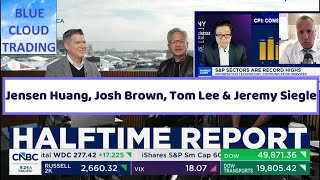
저자: TomLee&JoshBrown-CNBC출연발언,영상주출연자는TomLee로추정 · 외국인
요약 보기
연준 매파 기조 완화와 금리 정상화를 전망하며 S&P500 연말 8200~8400 목표 제시. 기술주·암호화폐 강세를 근거로 들고, 중간선거 전후 조정 가능성과 AI 규제 우호 전환을 언급. Josh Brown은 S&P 종목 중 41%만 200일선 위에 있고 시장 폭이 좁다고 경고. 이후 Blue Cloud의 일목균형표 차트 점검에서 XOM, XLE, 에너지 등 일부 종목 긍정적, 다수 종목 중립·부정 판단.
다듬은 글
Blue Cloud trades all night. Welcome back to the channel everyone. In a moment, I'll show some CNBC clips from today's episode of " Break Report." I will open the charts and delve into the technical characteristics of some of the stocks mentioned. We will look at key support levels, resistance levels, momentum and see if the price action really backs up what the talking heads are saying.
Click the "Like" button . Subscribe if you haven't already , and let's watch the first clip. Author, the last data point you're interested in, Tom, is that unemployment or employment report, which you think means the previous one in August may have been somewhat exceptional. And from this you conclude that any inflationary pressure from the labor market is unlikely.
So, again, you think that if oil is brought under control, inflation might cease to be a problem. Yes, good morning, Joe. That's right. I think that looking at last week's employment report, the market was operating with the most hawkish sentiment on the Fed, which was going to raise rates three times, including a 75% chance of a hike in October.
This employment report was softer. Hmm, we'll get the inflation report in 2 weeks for September. In our view, we believe that these one-off measures will continue, so I think that over the next 6 months, inflation rates will be softer. And that would allow the Fed to not only abandon its hawkish policy , but also, I think, allow bond yields to actually normalize because uncertainty about inflation would start to diminish.
And I think there are a lot of clues because I think tech stocks are hitting new highs and cryptocurrencies are doing so well that they can't do well in a tightening monetary environment. So I think they expect easing financial conditions ahead. So, you look at different markets, what's happening. That would be important, Tom.
So, you think, when you said yields are normalizing, what do you think a normal yield would be right now for the 10-year bond if there weren't these, what you think, fake-outs in different markets? I think one number we can work with is that before Jackson Hole, the 10- year bond was 4.75%. And I think anything below 5% would be interpreted by the markets as really positive for risk.
And I mean, there's a good chance that in the next 6 months we'll see yields below 5%. You also expect the S&P to rise, perhaps 9%, by the end of the year. So you have maybe 8200, maybe 8400. And you call the current market, which I think, again, you're going against conventional thinking all the time.
You think of this market as a compressed spring, ready to grow, almost as if it's being held back by artificial intelligence, although most people think it's kind of mad that its skis are only being lifted by artificial intelligence. Eh, yeah, I think we're living in unprecedented times because earnings growth is accelerating, which is hard for a lot of people to believe in their lifetime, but even third-quarter earnings are probably up almost 30%.
And sorry, the P/E, EPS revisions from the beginning of this year to now for 2027 earnings have increased by more than 20% , and the S&P has not even increased by 20%. So, the multiplier actually went down. If anyone thought the market was expensive at the beginning of the year, it actually got cheaper.
Eh, and then I think that, oddly enough , the high price of oil, because the US is an exporter, actually strengthens the US economy. So, I know it's a very complex situation, but I think there's a bit of over-pessimism here because not only is earnings visibility good, but we're also getting a lead from stocks that are expecting weaker inflation, namely technology companies and, you know, cryptocurrencies.
You also, I think, are already expecting a decline at some point . That it could still happen, and you've been talking about it for a while now. In fact, there was one point where you thought even six points for the S&P was possible by the end of the year , and then it went back to maybe the high sevens or eights for the S&P.
So would this be some kind of breakthrough in the midterm elections, or what could cause this? We really do have midterm elections coming closer and closer. I think this is ...What is this? It was 35 days . Have we made it through another week? Is it 28? This is a zombie movie. Another 20? Is it only about 28 days?
Uh, I mean, I think the correction is due, partly because I think the midterm elections are a clearinghouse . You know, this is probably going to be a very big risk signal to the markets, regardless of the outcome. And since June 30, I think the markets have been tough. So part of me thinks we had a sliding correction, and it was, you know , we had a lot of different groups in the downturn.
But as for a larger market downturn, I still believe that from mid-October until the midterm elections is when a “ speed bump ” could occur. Hmm. I'm reluctant to declare this just because the sentiment has been negative and I think when people are bearish it's hard for markets to stay afloat because we know that people are actually expressing their sentiment and remaining cautious.
Right. That's the one thing that always, uh, never changes, right? When you are faced with negative or scary situations , this is what most strategists use to predict market developments in the near future. They never learn. They never truly understand that there is actually a discounting mechanism for the market.
So, you say, regardless of the outcome. So, if, uh, the Democrats take the House and the Senate, don't you think that would cause some concern in the stock market? I think a single market is like a dead end, so Democratic control of Congress would be seen as a dead end. AI and cryptocurrency stocks have been in a tailspin due to the midterm elections as Democrats do not support data centers and do not support the Clarity Act.
But our country believes that after the midterm elections, Democrats will start supporting data centers and the Clarity Act because, first of all, data centers generally provide a lot of economic benefits to the community, and the Clarity Act had a lot of Democratic supporters. So, I think AI stocks are going to benefit after the midterm elections because, you know, changes in Congress are not really going to greenlight some projects.
You mentioned Bitcoin, implying that bond yields are perhaps at the upper end of the range. You think this is a full-blown bull market for cryptocurrencies, and this is, um, the bottom of a four-year cycle for Bitcoin. Well, that's true, Joe. I think a lot of people are saying, "Hey, they're not going to buy cryptocurrency until the four-year cycle is over." This date of the four-year cycle is actually today.
So, today is an all-time low for Bitcoin. Bitcoin and cryptocurrency in general are leading the stock market. So I think the resilience that you saw in cryptocurrency in Q3 is a leading indicator to me of how stocks will behave in Q4, which is going to be pretty explosive. But cryptocurrency has a tailwind right now because there is a tokenization movement that is supported by BlackRock, Fidelity, all the big firms.
And I think there's a narrative around agent-based AI. When we talk about superintelligence and attempts to support their capabilities, cryptocurrency is one important way to keep people informed . So, I think, as Robin says, uh, as Vlad from Robinhood says , there's a supercycle going on around cryptocurrencies .
Was there an airing...I don't follow it very closely. Was it...Do you think it will be 5,000 by the end of the year? Hmm, what a high price... This must be close to the highest ever. And then 100,000 for Bitcoin by the end of the year. Yes, Ethereum's high last year was just under 5,000. I think it will return to that mark.
And Bitcoin's high last year was 120. I think Bitcoin will close above 100,000 this year. Closes above 100. Okay, Tom. Glad you're first, because it's always, uh, early Monday morning. So, uh, recalibrate our mindset, maybe for your fans. In any case, thank you. I appreciate it. Yes, thank you. Karl, thank you very much.
Welcome to the break report. I'm Scott Wapner, and this hour's focus is on your money, with bond yields supporting the upcoming earnings season. Nasdaq is reaching new highs. Join me for an hour to discuss and debate all of this, Joe Terranova, Stephanie Link, Jim Lebenthal, and Josh Brown. Go to the markets.
We're all green except for the Dow Jones, and the Dow Jones is threatening to turn positive as we speak. Uh, as you know, there's a lot of talk around profitability, not just here but around the world. Uh, we're still around 532 on the 10- year bond. We get a little relief. There are 533. We are getting a little relief in France today.
Uh, this is obviously one of the hot spots. Ed Yardeni is out, Joe, says that for now we're sticking with our S&P target of 7900. My question, I guess, to all of you to start with is how long can stocks and bonds coexist at their respective levels. At their respective levels, right? Yields continue to rise, stocks hold up.
We hit a new high on the Nasdaq. You're barely off the high for the S&P. So, given the information we have in front of us, I think there are two things that suggest this could continue. First, there was concern about rising profitability and how this would impact the capital expenditure cycle for AI.
In fact, will this be a barrier to companies entering the market and offering debt? This was task number one. I think we had an event last week that confirmed the meeting with the president at the White House and the CEOs of the tech companies. I think the market has calmed down a lot after this meeting.
Second, I think Micron's earnings last week confirmed that demand , insatiable demand, is still there. So, I think that continues, and what's happening right now in front of us, this resilience that you see with 10 out of 11 S&P sectors showing growth. The market is looking ahead, anticipating, pricing in, and positioning itself for another strong earnings quarter.
Now, you have every sector in the green circle today, Steph. I think that, um, the backup of yields and the whole move to a more concentrated market is quite interesting, and if you look at it that way. So, over the last month, let's take that as a time frame, okay? From September 5th, okay? On September 5, the 10- year bond was 478.
Okay? So, we've rebounded about 50 basis points from then until now. And during this period, the concentration only intensified, right? One followed the other. As profitability increased, our market share decreased. Since then, the equilibrium weight has been 4 1/2 percent. Since then, Nasdaq shares have risen nearly 5%.
This is a pretty good story. Will this continue? I mean, I can't believe bonds fell 8% in September. So, bonds should be your safety mechanism, right? They should be right in the middle of the fairway, but that's exactly what happened. So, in my opinion, 5%+ for 10 years over a long period of time makes bonds quite interesting.
With that in mind, I think the long-term total return of the S &P 500 is much more attractive. We have grown by an average of 8% over the last 10 years, 7% over the last 50 years. And why I think we'll continue to see stocks rise is because the economy continues to feel really good. So, last week we had a really good week in terms of economic data.
The S&P Services Purchasing Managers' Index (PMI) reached its best level since July 2021. And this morning we had the official ISM index, which was the best indicator in the last 4.5 years. So, there is such stability in the services sector. Manufacturing is also starting to pick up, comfortably above 50.
That's the diffusion index, so that's what you're rooting for, above 50. We had some pretty good employment numbers last week . Weekly claims for aid are at their best level since 1969. And we have a GDP revision. Add it all up, Scott, and I can't imagine the returns wouldn't be really good. And yes, they will be very good at the Mag 7 level.
One of the reasons I add to the Mag 7. That 's right. Mag. For example, this is your most recent metric, right? last week, right ? But Nvidia too, about 2 months ago. So the bottom line is that we will see great gains in the technology and communications sectors. They had a good time. I hope we see all these other sectors do well as well .
I think the setup is really good because all other sectors have declined in the last month and expectations are very low. They are low at the moment. We need to get through this week. We don't have data for the rest of this week, actually. So next week we'll really start to see the evidence. The only sector that has grown over the past month is technology.
Now everything else has gone into the negative, including communication services. Now this practically does not change. But if you look at the stack, then, um, that's what it's all about . And you have some pretty big differences that, as Evercore points out, Jim, they've reached extremes today. The energy sector is up 40% year-to-date, clearly outperforming technology, which is up 30% year-to-date.
Disagreements to such extremes were rare. It is even rarer for financial sectors to show such striking results compared to previous ones. Financial sectors have fallen by 2% since the beginning of the year. Only eight times since 1990 have such disagreements occurred on such a scale. This clearly shows that we have become smaller, much more concentrated, and more dominant in terms of bond yields .
Again, the question is , will this continue as long as bond yields remain at this level? The idea, again, as I asked at the beginning, is the coexistence of stocks at these levels and bond yields at these levels, and how long that can last , and what the implications are for the market. Yes. I mean, they can clearly coexist at this level.
I'll tell you, I'm uncomfortable at this level, and if bond yields go up, I'll be even more uncomfortable. And some of the sectors you talked about, Scott, are directly affected by higher interest rates. So if you think about, for example, energy, or, sorry, many sectors that have a lot of debt, over time they will face higher interest costs.
It is a burden for them . By the way, not to the same extent, or to a lesser extent, than Mag 7, which, okay, a 10-year growth of 50 basis points is not going to derail any of their data center plans. There may be political problems, but interest rates at this level will not derail them. This is all a way of saying that we had a year where rotations were fast and furious.
It's hard to believe, but 6 weeks ago the equally weighted S&P 500 had a higher year-to-date gain than the main S&P 500. Now it lags significantly behind. We could see this rotation come back, but I think we need to see the boil go away from an interest rate perspective and that will bring some relief.
You also mentioned finance, which we, Scott, were worried about, that maybe with interest rates rising, something would change in the financial sector. I don't think it's holding back finances. I think what's really holding back finances is the shrinking IPO calendar. We had very strong expectations for the fourth quarter.
IPO traffic is still expected to come in, but with all this interest rate volatility in the stock markets, this IPO calendar is looking a little less, er, exciting as we approach the end of the year. Josh, if we just stay where we are, uh, domestically, and where the yields are, is there any reason to believe that the domestic market picture will change anytime soon?
I don't think so, and I think we're almost like saying if something is going to happen after it's already happened. The S&P 500's year-to-date returns are lying to you. The whole world changed in March with the attack on Iran. Nothing has changed since then. We had a nice summer rise in the rest of the market, but it has now given way to a continued defensive stance.
The thing is, people are n't quite used to it yet. What does the defensive position look like in 2026 compared to what it looked like when professional asset managers began their careers in the 80s, 90s, 2000s? The defensive position now is that you pull the lever and buy positions in giant, uh, technology companies that have dominated the markets for the last 15 years and no one ever yells at you for being equal or superior.
Uh, and that's exactly what people do. So I want you to think about this. Only 41% of the S&P 500 components are above their two own 200- day moving averages. Uh, that's the number we're seeing actually drop, and it could be much lower. We simply don't have most of the stocks in the bull market right now.
Hmm, but then again, the index is lying to us, and we know how it works. This is concentration, and it's not just a concentration of market capitalization, but also where the profit growth is coming from. And by the way, Stephanie, Mag Seven is now, uh, it's an easy button. It's outperforming the S&P by 14.1% versus, uh, 13.8% for the S&P 493.
And you don't really have to pay much to get this deal. You have a forward multiplier for the entire market of 19.1 times, uh, and for technology, 21.6. So not only are people rushing back to this old Mag Seven deal, the old faithful, uh, for defensive reasons, they're not actually forced to find themselves in the weird position of having to significantly increase the valuation of their overall portfolio.
And finally, the Nasdaq itself has an RSI of 65, which is a really healthy indicator. But then I'll tell you that only 2.85% of these stocks on the Nasdaq trade with an RSI above 70. Hmm, there's a reason why the Nasdaq has become a safe trade. Forward earnings estimates have risen sharply, up 32 1/2% year-to-date.
So you have these Nasdaq giants , I think they mask a lot of the pain that people are feeling because of names that are not related to this AI trading . This has been going on for some time now and it is getting worse. And I think that's a big change that we've experienced since March with higher yields, more expensive oil, rising inflation.
Think about what we talked about before Iran, Scott. We talked about downsizing. We talked about cutting insurance. Now the question is how many more increases and how long will they keep rates at this level ? And I don't think there's an end to this in sight. So, to answer your question, no, I actually think it will be the status quo.
So, Joe, if you only have 40% or whatever number Josh mentioned above above its 200- day moving average, does that create an opportunity, or does it just show some underlying risk in the market that such a broad swath of stocks is underperforming the overall market, rather than an opportunity? Because, you know, we've been arguing that you play offense and defense within the framework of capitalization.
So these are the same arguments that were made in the show. But if you have that many stocks, remember, we mentioned that X stocks are hitting 52-week lows versus 52- week highs in a record market that's still setting records. Does that tell you that this creates opportunities for all the names that aren't doing this, or does it show you the underlying risk to the market itself?
Yes, that's an interesting question. I think the cyclical component of the market is well- adjusted if you are an investor who allocates funds in this direction. This is well-positioned to reboot valuation and performance, and indeed restore positioning. I won't be there now . I won't be there because the driving force behind my investment strategy is momentum, and this cyclical component of the market has clearly deteriorated and lost its momentum.
But there is a possibility if you think you will see a decline in the price of oil and that you will start to see a decline in yields. Obviously, this is a cyclical process. Hmm, the evidence we have in front of us right now is nonexistent. Hmm, on the other side of the midterm elections, is there a solution for oil?
I don't know. There were signs that it was possible, but I'm not going to invest based on that hope. I'm just identifying where the potential opportunities are. As I said, I won't be there . You know, maybe Steph or Jimmy, you'll take the opportunity to look at the assessment reset and the cyclical process.
Okay, here it is . But I...no. Okay, this is not an impulse. Many of them, such as in the industrial sector , fell by 18-30%. Yes. But the estimates become more compelling, especially after I highlighted the economic data. If the economy is recovering, you don't want to be anywhere near cyclical. But the economy is actually accelerating, and multipliers are shrinking.
And last quarter, we had 11 out of eight out of 11 sectors that actually showed double-digit earnings growth. And they really grew. I think they will grow back. I think they can maintain these increases until the end of the year. Again, because the economy has momentum, Morgan Stanley agrees with you.
They say the industry is the best risk reward in the market right now because prices have dropped so much. It was painful. Services stocks fell 18%. Vertiv fell 34%. GE even fell 18% higher. Of course, all of this is from their highs. But the lag is only accelerating. Delays are 30 to 40%, and we talk about it all the time.
For me, it's visibility. Organic growth is accelerating, and a lot of that has to do with data centers and their expansion, but I just don't think that's going to continue. I think it will accelerate, and I think those gains will be great, and I think you will be rewarded. But you had to be patient because owning these things wasn't easy.
Well, Vertiv, [ __ ] very quickly . Very quickly. [ __ ] Vertiv beat its target today by 329. More or less, you know, 31% growth. They talk so much about stocks and squeezing the multiplier that it creates opportunities. But to get to your point, you know, it's so closely tied to data centers. I think when you look at industrial enterprises, you need to look at those related to artificial intelligence and data centers, and then all the others.
Yeah, but I mean the aerospace cycle is still alive and well, and Boeing hasn't been successful, and GE hasn't been successful, and I think they're going to have great free cash flow numbers and good forecasting. So I think you would pick and choose some of these names. I own Dover , you know, it's a short cycle.
If ISM accelerates, they win, and these stocks did nothing either. So I think you can choose your place in the industry. Not everything has to be about AI-powered data centers, but that's clearly where the hype lies. And as for Vertiv, I mean they're going to show 31% organic growth this year alone.
This is madness to me. Yes, okay. Industry is easy. I agree with you . Because of the rise of AI. Consumer discretionary goods, would you go there? I have made a lot of money on some of the titles I own in discretionary partnerships. I think you have to be picky about this, but Starbucks is great. Um, Amazon is disappointing.
We'll talk a little about Estee Lauder. Um, it was updated today. Yes, yes. So I think there are places that can be found within discretionary capabilities. I wouldn't , and I no longer have anything related to housing. I just think that unfortunately this is going to be a problem for a long time. You also point out that it's hard to find stocks or try to pick stocks in these areas thinking they'll do well in an environment where many of them haven't .
Of course. For example, if you want to buy a discretionary name, well, tell me which one. But can you name me five? Can you name me 10? But I don't know. Yes. I don't know if you can. I think you can identify them. The problem is, what is the catalyst? I mean, there are just a number of consumer-owned stocks, specifically travel and entertainment companies, that have failed, performed very poorly over the last few months.
And someone might say, "Okay, if the war with Iran is resolved, maybe Disney, maybe Wynn will start to show success." I mean, that's a reasonable thing to say, except there's no indication of when this resolution with Iran will happen. Exactly where I'm going. And no one, no one, can make me name 30 stocks related to artificial intelligence or technology that you would buy today, that you know, buy.
You...I don't think you could literally name me 10... I can't name you today consumer-owned stocks that are owned by consumers. I ca n't exactly name you the catalyst that will move them. But, you know, we started this conversation, we started talking about energy, and then we moved on to industrials, and now to discretionary companies.
I think energy is very interesting because while people might say that a settlement with Iran would cause energy prices to plummet, I would say not so quickly. And I would say that just now the CEO of Saudi Aramco said that it will probably take two years or more to replenish commercial and strategic reserves around the world.
And I really think the energy sector, whether you look at Exxon or Stephanie, I think you're in Chevron, maybe I'm wrong, or XLE, these are stocks and ETFs that are in an uptrend right now . Look at the 50- day or the 200-day. And unless you get energy prices or crude oil to fall to $60 a barrel, I don't think that's going to happen, by the way, because of the need to rebuild inventories.
If the price of West Texas Intermediate simply drops to $75, these companies will be minting money. I agree with that, but I see a bigger problem in that the price of oil will fall while yields will remain high. Yields are high due to oil and other reasons such as generous supply for the AI capex cycle , shortages.
It is much more difficult for me to get an increase in profitability . Growth, Scott. Yes, but it's still 100% growth, but still not 100% growth. It's close. I don't think anyone expected 8% nominal GDP growth this year. No one expected 8% nominal GDP growth this year. No one. Even me, and I was very optimistic about growth.
So, this is much better than expected, and it's the dominant part of the higher rates. I would even argue with that . Well, there is debate here. I mean, let's talk about the other side, which is that there's a huge supply of debt coming in. And this doesn't just apply to Treasury bonds that we know about.
I mean, what happened with the Paramount debt deal last week, which flooded the market with securities that traded poorly on the secondary market. So, Scott, we can't ignore this, I think you mean . We cannot ignore the fact that the supply of paper is very large right now. But I think, Joe, to your question, what happens if yields stay high when the price of oil goes down?
I agree with Stephanie. I think it's more due to growth. Let's say this. If you could name all the reasons why you think yields are rising, none of them will persist in the near future and potentially lead to a decline. Inflation is what it is. The development of artificial intelligence is what it is.
Growth is strong, accelerating towards Steph's point of view. Not to be like that is a duty. I don't want to argue. We are making progress on inflation. I mean, we're not where they want to be, I get it. But we are reaching... Remember, we had 9% inflation. Yeah, I get it, but it's like... So now we have 3%.
Okay, but last week Core's performance came out better than expected. The PCE, average hourly earnings , came in better than expected, although I do n't like to say that because I want everyone, consumers, to make money. But average hourly earnings fared much better on the inflation front. The three-month average CPI is currently fluctuating within two units.
So, you are making progress. We will not reach 2% with 5 % economic growth. I just don't see it. But I think we'll eventually see performance improvements, and that should help. But that's why lately, Josh , all roads lead back, as we said at the beginning, to mega-capitalizations. Nvidia hit its first record high since May.
Market capitalization 5.7 trillion. Um, Melius is upgrading Microsoft to a "buy" rating today. You have positive reviews on Amazon. You have positive reviews about Apple. And I don't understand why anyone thinks any of this will change anytime soon . This is true. Last week I said that Nvidia , which is about to break out, is the most important graphics card on the market.
Um, I think today proves it. Listen, you're now in a situation where you need to make one of two bets. Or will the mega-caps take us to the end of the year with the S&P 493 involved, and they will eventually find their lows, exhaust the sellers, and these stocks will come back. Or, um, another bullish scenario is that it won't happen, but it won't matter.
Because Apple is in a product cycle. One of the largest promotions in the world. Um, and we could talk about consumer discretionary goods, which is nonsense. This is a fictional sector where they just throw away things they don't know what else to do with. Um, we can talk about those stocks, which are mostly tiny , with a few exceptions.
Um, but the truth is that if Apple is in a product cycle and hitting highs, um, and now you have Nvidia after consolidation, which for God knows how long, is starting to hit new highs, and you have earnings revisions going up for those two companies, Microsoft is in a kind of stagnation. Meta has regained its rhythm.
They took back the narrative. They are getting multiple expansions in addition to a new earnings growth story. Hmm, these are the stocks that really matter. For example, how will the S&P end the year? And I know there are a lot of people who think, " Well, it shouldn't be like this." Sorry. I don't control it, I don't control it.
The Fed has nothing to do with this. We could have the S&P up over 20% in a year thanks to Apple, Nvidia, Meta, Microsoft performing better . This seems to be exactly what is happening. And, and you know, there are no stars in this game . If you are managing money and trying to provide shareholders with returns, um no, no, nobody wants to hear about asterisks.
The point is , what happened, what was the result? Now, I don't think this market can handle 7% in 10 years, but it's not. Now it's five with a slight change in percentage. That was the average absolute rate for the 10-year bond during the 1990s, a decade in which I think we can all agree that stocks performed quite well.
And so, unless there's some weird spike that catches everyone off guard, we can live with it. We can survive. You need to be more specific about what else you are buying from Nvidia. Stephanie is right. Joe is right. I agree. This is reflected, for example, in financial statements . Hmm, it's both sides, you know.
A flattening yield curve is clearly not good for banks, which is why they have fallen 7% from best tech to worst in the last month. Finances. Today, there is a great solution in this area. Let's take a look at Wells Fargo, guys, because Morgan Stanley upgraded Wells to outperform. And, uh , you know, Steph has a very long history with that name.
At one point it was the largest stock in her portfolio, she sold it and recently bought it back. Well, this is a big decision. What do you think? Well, the CEO was on CNBC on September 9th, and he talked a lot about how raising the asset limit was actually starting to benefit their business. So, the asset restriction was introduced on June 3 last year.
It took them that long to actually build market share in investment banking, in asset management, in actually allocating capital to grow their business. And so he was talking, the CEO was talking about the net interest margin probably bottoming out . And when he said that, that's what made me actually buy it back, because that's what we were waiting for.
Net interest income will increase by a couple of basis points. It's not going to be something to get excited about, but I think these other aspects of their business, beyond net interest margin growth, that's good; and especially 11 times earnings or 1.4 times book value, and that lags behind Mag or the Big Six banks, ahem, by about 14% year-to-date.
Good. Uh, let's take a break. And when we get back, our decisions of the day. One leading analyst sees nearly 80% growth in the committee's name. We reveal her, and later, Josh Brown, his best stocks on the market. Okay, welcome back. Look at SpaceX. Uh, it's grown by 20% since the IPO. Adam Jonas today from Morgan Stanley says it's rising much higher.
It's 167. He says 300 is the goal . Cheap and getting even cheaper. Stephanie Link owns this title. This is a great growth potential. Yes. This action. Yes. I mean, the stock is still down 17% from its high, so they still have a lot of catching up to do , but you know, I was talking about this being a very long-term position.
It's like you buy it, install it, and forget about it, because there are many ways to win, and we just don't know which one will win, or maybe they'll win all three in terms of space , connectivity, or AI computing rental. What I find interesting is that last quarter they actually increased their capitalization by 65%, but they talked about it saying that the payback would be within one year.
In my opinion, that's a very significant return on investment, so I think as you see better earnings coming, I think the stock will go higher. Okay, do you also want to make a guess today? You mentioned this earlier, upgraded to overweight. Yes. Goal-108. This is at Barclays. And I did a CNBC Pro video about this a couple of weeks ago, because in the last one you did one of these at Starbucks.
Yeah, well, it looked pretty good after that. We have some good ideas, so... Last year, the CEO became the new CEO. He's, uh, been with the company for a really long time, but he's implemented this strategy called Beauty Reimagined, and he's basically just about product innovation, better experiences, digital, and just execution, better execution, and also focusing on profit.
And they seem to have lost their way over the years. I mean, these stocks are still down 74% from their January 2022 highs . So they recovered well from the lows. I think there's a lot more to come because they're starting to see organic growth, better cost reductions, and then obviously better profits.
CBOE TD Cowen today upgrades rating to " buy". Yes. I bought them back in June for 266. I was ready to stop myself at the end of September. We had a nice little move, and that was renewing the license agreement with S& P, uh, securing options there for CBOE, and also securing the potential tokenization of those SPX options.
Uh, Barclays is speaking out today on consumer finance, Cap One and, uh, Synchrony. They like...You have Synchrony, Steph. You have, you have Capital One. Jay, you're the first one on this, and then , Steph, I want to hear from you about Capital One. Target–237. This is, um, a little lower. Yes, Sync-Synchrony.
There's a clear momentum gap in Synchrony, and it really fundamentally challenged the retail commission-centric model, which is going to struggle in an environment where you see rates continue to rise , ahem, and the bottom end of the economy is struggling. Spotify UBS goes up to 675. They were at 690.
They still like this stock, Josh. Yes, technically this thing is in no man's land. I also like this promotion. She, um, tends to haggle with Netflix, and neither of them can find, um, enough buyers to pull them out. That's it. To pull them out of this range. I think Spotify could be one of the best businesses in the entire world.
They have more users than most companies you can imagine. They are profitable and growing. So I think the stock should work out eventually, but it hasn't lately . Good. Okay, we're back. Josh Brown's best stocks on the market. I mean, you know why I said "Brady Bunch edition," right? Tell me. Why? I mean, what are you wearing?
Oh, I, I, Cindy, that's right . I was like Greg, Peter, Josh, the long-lost Brady. Take this away. Although I look good , and I can't remember the last time my hair fluttered in the air like this. I have to be honest. So, finally, I added some product to it. We are all grateful. Yes. So, Sean and I thought this was the end of the third quarter.
Let's look at some of the names that have been on the list all year and some of the names that have fallen off because, you know, we're talking about a lot of stocks and not all of them are working. And some of the ones that work just keep working, and they don't even give you a reason to look for a new name.
So, let's start with the winners. Intel, that's more than double what we first wrote about it. It has grown by 163% since January 26th, when I introduced it on air, and by another 39 % since April 27th, when we continued. That's a 200% increase since the beginning of the year, and it never gave you any reason to doubt it.
So we just wanted to look at the stock levels, as each position is related to risk management , and update them. The second is Valero. This is important because it is not technology. This is not an artificial intelligence data center. This is a truly unique pocket of the stock market. It's not even remotely similar to other energy stocks.
Valero, Phillips 66, and Marathon are the top three names in XLE, ahem, by a wide margin. Uh, this one also doubled, uh, compared to where we introduced it on the show . And, you know, it's just the kind of thing where you don't have to be completely focused on technology just because artificial intelligence is the deal of the year.
I know my colleagues on set know this, but I think it's worth, um, reminding the audience that there are winners in every sector all the time. It's just not the whole sector, and Valero is a great example. Hmm, two names that dropped out, CRH. This is cement. Hmm, he's not as reliable as what he sells.
It was a name that broke. We have given you a stop loss. The stop loss worked and it continued to collapse. And I think the lesson here is that , um, you don't want to change your rules just because the market tells you you're wrong. I think if you make a deal and you have a predetermined risk management, you say to yourself, “Okay, I’m not sure why this is happening, but it is happening.
"I'm not going to deny it." And often your first sale is your best sale. It's down 33% since we wrote about it in January, but the stop loss got you out much earlier. And fortunately, because as you can see, it seems like almost every day it strives to reach a new low. Initially Solar, we didn't like it when we wrote it.
This is the last one. We essentially said, "Look, this is on the list of the best , um, best stocks on the market, but that doesn't mean it's worth buying." We didn't like the parabolic nature of this growth, which you can see here. And, um, fortunately, we were right. Hmm, so we avoided that, and not every stock that is the best stock in the market quantitatively is created equal.
And I think this is a really great example of where a list can lead you if you don't know what parameters to pay attention to. Hmm, and not every stock with good performance will stay that way . So, um, I would like to highlight these four. Thank you for that. Uh, I'll just reach out to you since you're done with CRH.
You own this name. Yes. And you know, Josh has a rules-based methodology. The schedule is terrible, so I'm not surprised he, ahem , broke the rules to get out. For me, it was a great long-term compound mortgage tool. The reason it is falling on a fundamental basis is interest rates. Market capitalization of $54 trillion versus $19 billion in outstanding debt.
However, knowing what it does, gravel aggregates, concrete, knowing the amount of infrastructure, data centers, ISM manufacturing surveys, it will probably continue to be a good long-term compound mortgage instrument. And dips like this one, where the price goes from 18x in July alone to 13x now, have proven to be great entry points.
So while Josh is 100% right about following his rules in the technical aspects he uses, in terms of long-term fundamental complex mortgage analysis, I'm not going to sell it. Good. Uh, Valero, that was on the winners list, Joe. Yes. Uh, I still sold any long positions from last year at 144. I keep talking about potentially selling some just from a risk management perspective .
I just can't bring myself to do it knowing what's happening with the fundamentals surrounding domestic diesel issues and, more importantly, diesel issues in Europe. This affects gasoline. Remember, you are producing diesel and gasoline at the same time. Uh, First Solar, do you want to take this too?
Terribly. That's a terrible name. Uh, imports of Chinese polysilicon, the cost of which is much lower than expected. There is potential for a minimum import price for this in December. We'll see what happens, but it definitely fell by the minute. It's also a victim of interest rates and, uh, the declining housing trade .
So, First Solar gave us three different ways to lose. Uh, that's probably in my " never again" pile. Good. We're, uh, going to take a break. I have never seen an ETF rise so much or even fall so much . Right? I mean, he shouldn't act like that, but obviously this is a very big surprise from a political point of view.
I don't find this political or otherwise, but it has more to do with demographics. They are the seventh largest country in the world, the tenth largest economy, 63% of which is related to services and growing, and they have what everyone in this world wants: power. We have, uh, new assets in the JOET ETF.
This is digital banking in Brazil. I believe the stock is up almost 14% today. In line with your comments about how impressive the results are. Good. Mr. Josh Brown, what is your latest deal? I don't think Nvidia is finished growing. Ha? Good. Well, ask Mr. Ives about that . Thank you very much. Chenier, who is here?
It's me. Um, you know, keep making higher and higher highs, higher and higher lows, and recently it fell because it wasn't included. Maybe it was the S&P 500. This is a buying opportunity. LNG exports are the whole point. Was in Cleveland for a game last week. He sent me a picture of the Cleveland Cliffs.
I'm going to send it to you. He told me to share it with you. Oh my God. Al, I understand you. I have a feeling it will work out . I feel like it will be a day of celebration. He sent me a photo. I will forward it to you. So, whatever it is, Al, don't worry. I understand you. Uh, Steph. So, I still like copper.
Antofagasta, really well run company, good execution, another Latin American game. JOET. Steel Dynamics. Brother, go ahead, Jimmy. I told you so. Don't worry. He threw the ball to you. No, we are on the same team . Steel. Forward. Good. See you later. The exchange is like: "Hello everyone, welcome to Blue Chip Trading." I am George.
Monday, October 5. It is 4:33 PM Eastern Time as I record this video." We just watched some excerpts from Halftime Report and from Squawk Box this morning when Tom Lee was on the air. So, we'll look at a few stocks that were discussed on that show. As you can see, the markets are up today. All indices increased.
The S&P 500 rose 0.66, the Nasdaq rose 1.05% , the Dow Jones rose 0.18, and the Russell 2000 rose 0.66. Let me briefly show you what we are going to cover. We will look at indices such as Spy, Qs, Dow, gold, Russell, Euro stocks, oil, silver, Bitcoin, Ethereum and Vix. We will also look at 33 stocks and ETFs in a mixed format.
Now I have highlighted the strongest of them at the top of the blue flag: EWZ, MAGS, MTUM, SMH, VLO and XLK. And the rest of them don't look particularly good. Or, you know, there's something technically wrong with them. So, we will also consider them. Good. Let's first, before we start, take a look at the heat map.
Here she is. And by the way, Finviz just released a new feature that is really cool. Okay, look at this. Now they will receive real-time earnings data. And that's great. And there will be a link to Finviz Elite if you are interested. Be sure to take a look. I just wanted to share this with you. So let's see what happened in the markets today.
Here on the S&P 500, you can see big names like Nvidia, Broadcom, Microsoft, they've all gone up. But not all, ahem, semiconductor stocks performed well. As you can see, we had a little bit of red here. Both Google and Meta have grown. Tesla increased by 2.2. Visa and Mastercard have grown. Most healthcare stocks, or at least some of the smaller but smaller companies, have performed very well .
Consumer goods stocks performed well . Energy stocks were mostly in the red, as were stocks of basic materials companies. Everything else was pretty mixed. If we look at the groups here, we see how the sectors performed today, and you can see that the leader was communications services, followed by energy, industrials, healthcare, technology, and then real estate again at the very bottom, down 0.48% for the week.
Real estate fell by 2.21%. Technology, industry, utilities at the top. Technology rose 7.41% in a month. Real estate decreased by 0.8.08%. So, let's get started . Let's take a quick look at this. We won't waste too much time. As I said, we are using the Itimoku indicator, and this will help us understand what is happening here technically with the price dynamics.
And if we look at the weekly chart here, it's still very optimistic. The S&P 500 is still holding well above the nine-period and 26-period levels. These two moving averages are above the Ichimoku cloud. This is what we are looking for. Same here, on the daily chart. QQQ ETF. This is a daily schedule.
Very strong. We broke through this trend line. We are still moving upwards. We have a nice bullish engulfing pattern here. You look at the weekly chart, it looks very strong as well. The Dow Jones rose 0.20%. Rolled back here, but stopped right at the 26- period. We may get a small rebound soon, but it is obviously not as strong as the spy index and Qs.
The reason these two received a blue flag is because they met all the criteria we look for on the weekly and daily timeframes, mainly in relation to the Ichimoku indicator. The Dow Jones, as you can see, is below the nine- period mark. It has been rolling back for five days. I would still refrain from doing this.
Gold is also currently below the Ichimoku cloud. On the weekly chart, this is bearish territory. On the daily chart, we are also below that cloud and 200, that dotted yellow line you see here, but we are holding above the 376.88 support level. Okay, we talked about this before. The Russell 2000 is still down, but today we just broke through the nine-period level.
It increased by 0.66 %. Hmm, the volume here was decreasing as the price was moving up. So that's not very convincing. And I would stay away from Russell at this stage. Euro stocks are also still below the Ichimoku cloud. Okay , Euro 50 shares, this is the ticker FEZ for this ETF. Not yet. Royal K is down 0.29% but is stuck between two moving averages here on the daily chart.
Hmm, on the weekly chart we are above the cloud. So, we have a higher timeframe , which tells us that yes, it looks pretty good, but the daily chart isn't quite ready yet. Silver is still under a cloud on the daily and weekly charts. Bitcoin is inside the cloud. So , this is a neutral graph. Okay, we have a neutral chart for Bitcoin on the weekly chart.
On the daily chart, it is bullish. Okay, looks pretty good. Let's take a look at Ethereum. Here it is on the weekly schedule. It entered the cloud, also a neutral chart here on the weekly chart, and on the daily chart we are right on this nine-period chart. Good. I will go into a little more detail about my strategies, about entering and closing positions in a members-only video, and I posted one this weekend.
So if you guys are interested in checking this out, all you have to do, friends, is go to my Blue Cloud Trading channel, scroll down, you'll find the members-only video there. Click on it. Once you do this, this window will appear and you will need to select Blue Cloud Trader to access this video. If you also want to receive daily trading updates, become a Blue Cloud Legend level member and you will also get access to them.
You 'll find them under the posts, okay? You'll find them, for example, like this... Let me show you the posts here, okay? Once you become a Blue Cloud Legend member. Now let's get back to the graphs. So, let's look at the VIX, which is actually up 1.63% today. But as you can see, it's still below that cloud, and it's still below the nine-period and moving averages.
So, in my opinion, this is a good sign for the markets. We want to see, you know, the VIX below these moving averages. This doesn't look like an increase in volatility at the moment. Okay, let's look at the stocks now. As I said, NDTS, right ? Uh, out of 33, only six passed the Ichimoku test, okay? So, again , on the weekly chart, you can see that the price here is above the cloud, above the moving averages.
So, this is the Brazilian Index Fund ETF. Today it is up 12.57%. Here is the daily schedule. Okay, we have a shooting star, which is a reversal candle. Be careful with this . Uh, MAGS 7 ETF, here it is on the daily chart, and here it is on the weekly chart. He still looks very strong. Momentum ETF MTUM still looks very strong here, on the weekly chart, and on the daily chart.
Good? SMH looks good on the weekly and daily charts. Okay, the price is above these moving averages. VLO, which is Valero Energy Corporation, looks great here, on the daily and weekly charts. This is the oil and gas processing and marketing industry. XOK still looks fantastic. It is holding above this week's level of 198.73.
Uh, and now it has become a support level, for two days in a row, that is, since Friday, and today is Monday. There's something technically wrong with the rest of these guys, so we won't waste much time. Here, for example, Apple, you can see that it is currently below the nine-day period, but still above the cloud.
CBOE is inside the cloud, so it is a neutral chart on the daily chart. Uh, Capital One is negative. In fact, it is under the Itimoku cloud. Financial stocks have n't been doing very well lately . CRH, building materials, basic materials. Look at this. They have been in a built-in decline below the 200-day, under the cloud, for a significant period of time.
I would obviously refrain from that, right? They are still declining. Therefore, you usually need to wait for this breakout above the cloud. CVX, Chevron, is still below the moving averages right now. Here it is on the daily schedule. We need to break through higher. Disney is in the cloud, so it is neutral on the daily chart .
In the cloud are shares of Estee Lauder, also neutral right now, although, you know, there are other negative things happening here, for example, the faster moving average is crossing below the slower one. There is a Chico range here under the price, it is not good. The cloud is still bullish. First Solar.
This is a company from Massachusetts that supplies solar panels. Well, it does n't look very good on the daily chart. It's very bearish here. You can see that it is below the cloud, and on the weekly chart it is also below the cloud , but it seems to have stalled there for the last 3 weeks. You can see that it is at least staying within that range.
Uh, GE Aerospace is in the cloud on the weekly chart, under on the daily chart. So, no to GE Aerospace. GEV, Vernova, still under a cloud, no. Intel is above the cloud, but below this nine-period, so no on Intel yet. Let's also look at the weekly schedule. It's very bullish on the weekly chart, but the daily chart just gives us, you know, essentially, sideways movement.
Okay, we're not getting any buy signals. Uh, LNG broke through the cloud, but it's still below the 26-day period, so we don't have a good chart on the daily chart. Uh, Meta is below the nine-day period here, below the nine-day period on the daily chart. Let's look at the weekly schedule. The weekly chart is still very bullish.
Okay, you can see that we recently broke this little consolidation frame . And for the last 3 weeks we have been holding higher. The cloud is becoming bullish. The moving averages are in the correct order, but again, the daily chart is not quite there. He's almost there. RSP, which is weighted by the S &P 500, is under a cloud, having broken through the 9-day range today, but this is not a buy signal.
This is clearly bear territory. Starbucks is also very bearish. I'm not sure why, um, one of the show's guests mentioned that they thought this was a good stock to trade right now. This is not tru, well, it's holding above the cloud here on the weekly, but it's almost neutral because it's right on the 200-day chart.
You can see it right here. I wouldn't add a position here. And then we have SPCE, which is Space Exploration Technologies. It broke through the cloud on the daily chart. It has only been public since June 2026. So, new action, but, you know, there's not a lot of data here about the cloud and anything that could form on the weekly chart.
If you trade it on a daily chart, it looks quite bullish. I almost took a position in it today. She looks good. Uh, Spotify Technology, bullish harami, but it's under a cloud, so no on that. Um, STLD, Steel Dynamics, they're also in the cloud, so no mention of that for now. SYF, that's Synovus Financial, in the cloud, no.
VRT, Vertiv Holdings, is in the cloud, so no. It's clearly a downtrend, okay? The cloud actually assesses the situation quickly. Each Ichimoku means at a glance. And at first glance, we can say that we're clearly in a recession here, and the cloud, you know, gives us all this information. Um, WFC, we have a bearish cloud here, we're under a cloud, no with Wells Fargo.
We had this bullish hammer candle here and then it went up a little bit above the Tenkan-sen, but it's not enough, in my opinion, to, um, you know, correlate to get the stock. Wynn Resorts is still in decline. This doesn't look good. He had been in decline for some time. Look at this 200 decline on the daily chart.
If you look at the weekly chart, we are also in the cloud. XLE looks pretty bullish on the weekly chart, okay? I like that the energy sector is still on a weekly chart. He's still good. On the daily chart, it needs to overcome the red line. We need to see a few more events. But it looks like it will likely break above this nine- period range.
You can see this little short descending channel and it broke out. So that's a good sign. Uh, we have XLF here on the weekly chart on the daily chart. I'm basically recovering above 200. It's the dotted yellow line, but it's below the nine- period mark. Not for financial metrics at the moment. XLI is an industrial ETF and it is under a cloud, so no for that.
XLY is consumer discretionary. Not for this ETF. And XOM is an integrated oil and gas fund. This one here broke above the moving averages, is above the cloud, um, on the daily chart. Let's look at the weekly schedule. Wait. So the weekly chart looks pretty bullish, okay? I like what I see here. On the weekly chart, everything looks good.
On the daily chart, the only negative point I see is that the nine-period, this green line, is technically still down by just a few pennies. It's not that much. It will most likely break higher. What I see here is an ascending triangle, and it will most likely break through these highs and continue to rise .
But until that happens, I would hold off. And, friends, that's enough for this video. Thank you for watching and supporting my channel. If you liked what you saw, consider becoming a member to support the channel. You can also become a Blue Cloud supporter by clicking the " join" button here. Blue Cloud supporter, Blue Cloud trader, and Blue Cloud legend.
These are three levels with different benefits for each of them. And if you like the software that I use, TC2000, the charting platform that I just showed you all these charts on, click here, where it says nine more links. And you click on this link and you can get a coupon for $25 off the software.
This is the Finviz Elite link. We also have a link to TradingView charting software. My Twitter page is here. If you click on it, you will be taken to x.com/bluecloudtrader. You can scroll down and access this free candlestick pattern reference sheet and this cheat sheet right here. Some of the patterns you just heard about, like the ascending triangle pattern.
Guys, thank you again. Good evening. See you in the next issue of " Ichimoku Guiding Light". Blue Cloud trading overnight.


Comments 0