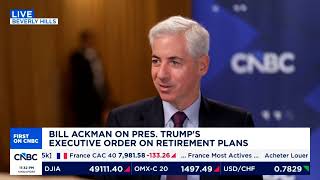
저자: BillAckman · 외국인
요약 보기
Ackman는 Pershing Square의 폐쇄형 펀드 IPO 이후 초기 매도세가 개인 투자자의 단기 매매(flipping) 때문이라고 설명했습니다. 또한 밸류에이션은 합리적인 수준이라고 보고 있으며, S&P 500이 약 20~21배에 거래되는 것은 과거 평균인 16~17배보다 높지만 더 높은 품질의 기업 구성이 이를 정당화한다고 주장했습니다. 그는 Fannie Mae와 Freddie Mac의 자본 재조달 및 상장 가능성이 매우 높으며, 이것이 큰 가치 해방(value unlock)으로 이어질 것이라고 전망했습니다. AI에 대해서는 Meta와 같은 시장 선도 기업에 유리하다고 평가했습니다. 이란 전쟁이 종결 국면에 들어서고 있으며, 그에 따른 지정학적 후속 효과도 긍정적일 것으로 봤습니다. 이스라엘은 AI 및 방산 분야의 수혜국으로 꼽았습니다. 다만 현재 특정 종목을 직접 언급하지는 않았습니다.
다듬은 글
Welcome back to Money Movers right here at the Milken Conference in Los Angeles today. With me now in a first on CNBC interview hot off the public market debut of his company is Pershing Square CEO Bill Ackman. It's good to see you here. Nice to see you. So as we talked last week on the IPO day, but since then I did want to ask you about that performance the first day cuz the the stock sold off a a lot and you know there were a lot of narratives around closed-end funds and whether there was really enough retail investor appetite.
How how do you perceive the the early trading? Well, what we did I thought it was doing a good thing, which is typical IPO, you know, kind of retail investors get the short stick, right? The kind of well-known institutions get what they want. Yeah. And the small guy gets a fraction. So I'm like, you know what?
We're going to give the retail and actually it was unusual because a typical closed-end IPO is all retail. And they take 100% of the demand. In our case, it was mostly, you know, 85% institutions, about 15% retail. I gave the retail a full allocation because I thought, you know, let's I want to you know, democratization of finance, let's help the little guy.
And uh and then they took until almost 2:00 p.m. to open the stock. And I think what happened was in retrospect, someone who put in for a 10,000 shares, but only expected to get a 1,000 shares woke up with 10,000 shares and they're like, "Oh my god, in order to settle the trade, I got to sell this before the end of the day." And so we've had sort of a onslaught of selling.
I mean, no one invests $50 to get two securities to sell them at, you know, a discount to that. It just didn't make any sense to me, but I think it was sort of more of a technical kind of factor. The stocks are kind of regaining their footing and and uh recovering. selling? I mean, you never know who's actually selling, but I I I don't Yeah, I think it's mostly the the retail investors who got more a bigger allocation than they thought they would get.
So you you still raised a few billion dollars. Five Five billion dollars. Um what How how long will that take to deploy and how are you thinking of doing that? So we're deploying it as we speak. Uh actually we're about 35% deployed. So, we invest in very liquid companies. We're actually, you know, like the prices of where things trade.
And we have kind of obviously a plan on how we intend to deploy the capital. You like the prices of where things trade. are today. Where stocks are today. I was going to ask you about the overall market and how you're feeling about valuations right now because we've had quite a run-up. You know, interestingly, despite the overall market move, I think stocks are still you know, the companies we like are pretty cheap.
Um you know, the when people compare market multiples, you know, today we're maybe something in the low 20s, 20, 21 times earnings, something like this. And while the market average is 16 or 17 times in history, you know, the the average company of 20 years ago is very different than the average company of today.
I mean, the the these are market cap weighted indices. It used to be really big companies couldn't grow very quickly. Now, the biggest companies are among the fastest growing, you know, high-quality businesses in the world. So, the the mix of the market is much higher quality, much faster growing, much better businesses.
So, you're paying a low 20s multiple on an overall market basis, it can be cheap. Good deal. What's your highest conviction idea right now? Um I'd rather I don't know if I could It's like kind of ranking your children. I Um I'd rather not point out specific ideas cuz we're in the midst of deploying capital.
Okay. I'm going to I'll I'll pass on that one for now. But AI trade. I mean, you you're exposed there. You've liked Alphabet, Meta, Uber. Right? Where where Where do you First of all, every company is an AI company today. And if you're not, you're going to fall behind. They all say they are. But how do you determine which ones
The key is is AI going to disrupt you or is AI going to enhance your business? And I think for the kind of the market leaders in many cases, AI is a huge asset. You know, Meta, you know, I've just talked about much I mean, I've talked to customers of Meta. They're they're earning a much higher return on their ads, which obviously means they're going to buy more ads.
Obviously very good for Meta. I mean, AI in that case is very powerful you know, pro-growth technology. You're not worried about how much Zuckerberg is is spending. The stock sold off after earnings on that. And and questions about really what that future vision is around AI because they don't have the enterprise cloud business.
You know, the the I have a lot of confidence in Mark Zuckerberg. He's had been a pretty good excellent allocator of capital over time. Um People questioned his WhatsApp purchase. You go back in time all the various what looked like, you know, expensive outlays generally turn out okay. Yes. And I you know, again, we hear from the customers that they're getting better outcomes from Meta-related advertising.
The company talks about that this they are earning very attractive returns on investment. You know, we're we like companies that can earn high returns on capital and and are investing into that. Fannie and Freddie aren't really AI companies. But that's the the way, they're they're they will be big beneficiaries of AI.
Why? Well, one, they can run the businesses way more efficiently, I expect. Right? If you think about mortgage securitization, a lot of this is documentation, legal paperwork, things that, you know, AI could be very you know, increase productivity. And then just underwriting, you know, assessing the quality of a loan book, things like this.
You absolutely could be a meaningful unlock in terms of profitability. What's your expectation at this point about them going public? Uh well, one, they already are public. Uh so, people forget this, right? They're they're listed in the pink sheets. Uh they're not listed on the New York Stock Exchange.
Uh I think it's But really being unshackled from the Unshackled, I think it's high on the president's list. I I don't know if the president put out a tweet over the weekend uh about Fannie and Freddie. So, it definitely seems to be top of mind for him. But we we're patient. Um obviously we've been patient because we've been involved in this these investments for a while.
What's a win there? I mean, is there still some level of government support? Like how do you ultimately see this solution for Fannie and Freddie is the following. So, the the most important thing that needs to be resolved for the existing shareholders of Fannie and Freddie is that government has been repaid.
They're the government injected $191 billion into both companies. Government got repaid $301 billion, which is that preferred investment plus a almost a 12% interest rate. So, the government got more than it was contractually owed. Meanwhile, the $191 billion plus a couple billion of um upfront payments sits on the balance sheet of the company as if it's never been repaid.
That those payments have to be acknowledged by the government. That's kind of step one. Once you do that, now they have kind of extinguished the balance sheet line item. You account for the payments on the preferred. You now have a effectively uh you know, a company's that are very well capitalized.
Um the government exercises the warrants it owns. It gives the Trump administration 7.2 billion uh shares of both companies. And then you list on the New York Stock Exchange. And that those three steps will unlock hundreds of billions of value. So, I think the probability of that occurring I think is very high.
Are you in touch with the Trump administration on this? I have been. With the FHFA? Talked to everyone. Commerce? Yes, I think Is your I think it's inevitable. I think it will happen. I just don't know. President's been busy, but he'll get to it. You think it's a done deal? think the step from there is ultimately they have to be released from conservatorship.
Yes. But vast majority of value is unlocked with just the three steps. And then the president has time to work with his team to reset uh the capital rules for the companies and for them to emerge as independent, non-government controlled enterprises. But where the government ultimately still provides a backstop in the form of a I think the senior preferred should stay outstanding as a bit like a line of credit.
But it has to be paid for. I don't think it'll ever get drawn. But just that incremental or that important government backstop beyond the fortress balance sheet that they need to hold will make all the mortgage players very comfortable. I mean, the stock So much for my not talking about individual companies.
Well, they I think the market likes what it what it hears. Big move higher in Fannie and Freddie, but it sounds like you're pretty confident and you're as bullish as ever. Absolutely. On both? Very very much so, yes. Speaking of the president being busy, he signed an executive order last week that I think you had a you had a lot to do with the idea.
This is on the retirement savings. It's going to be a huge issue for you. And so, what they're going to do now is try to increase the access, I guess, for people to sign up. is we have 54 million Americans in this country that hardworking Americans that don't have some form of a IRA or 401k or a savings plan.
And actually, there are government resources available. There are something called the savers match, you know, $1,000 for people to open an account and save for the future. And if you're not if you only make money when you're working, i.e. you're a Uber driver, and you know, when you when you're not on, you're not getting paid, you're going to fall behind.
Uh you can't have a world in which, you know, 60% of the company gets excited when the stock market goes up and 40% is resentful. And so, what the president uh announced um is that basically in effect 401k plan for every American. Right. And something called to it, though. You know, they're not going to be if they're paycheck to paycheck.
it's a matching program, but like many companies do for their employees. But if you're an Uber driver, if you're a restaurant worker, if you work for a company that doesn't have kind of plan, this is the I call it the Trump savings plan or the American I think they call it the American Dream Account.
It was not my idea. Actually, an idea of Alex on Firstenberg. I don't know if you know Alex. Yeah. Um I just pitched it to the president and he liked the idea and um and and it's it's moving forward. I think it will be launched beginning of next year. I think it will be a important milestone. I mean, there are other you know, uh for example, Australia has their superannuation system.
Mhm. You know, whatever, 30 years ago, Australians did not have any meaningful savings. They began the program. Now, the typical Australian has a bigger money put aside for their retirement than we do. Mexico's doing the same thing. Uh and this is actually a case where we're behind. And every federal employee has a a thrift savings plan.
Uh and why not for every American? So, I think it's a great idea. a lot of sense, and it also I think you alluded to the fact that people don't feel part of the system. And what we end up with is a socialist mayor of New York City. Exactly. Um Mayor Adams, you've been you've been outspoken about him and and some of these policies.
And I do wonder how you're thinking about New York. Your firm is based in New York, you live in New York. Yeah, look, I want New York to remain one of the greatest cities in the world. I think it it is, and it can be even more so. But not if we scare away the Ken Griffins of the world, right? I mean, Ken is sort of iconically been a a major driver of economic growth.
And the New York experiment works because the Ken Griffins of the world locate their businesses there, and their highly compensated employees pay substantial majority of the taxes in the city, and that supports, you know, kind of the entire continuum of, you know, working class to, you know, very well compensated people making it a great city, you know, for all.
If what you do is you you demonize If you demonize Ken Griffin, and he Yeah. you know, Great. moves his entire company to Miami. Um you know, the the cost of being in New York is massive if you're in our industry. Right? The the tax burden versus being in Austin or being in Miami. And if instead of being kind of appreciated for your contribution to the city, you're demonized, people are just going to leave.
leave if we see more stuff like this? You know, I I want I'm I'm not the guy who sort of abandons abandons ship. Uh but I I want to I don't want a city where everyone leaves. That's not a great, you know, what Right now we're the notion that we have a budget problem now in one of the, you know, in the middle of a market boom in New York City.
Imagine if we're in a recession, how the math works, right? There's just enormous waste in city government, and that's what the mayor should be focused on as opposed to, uh you know, but putting on a you know, pied-à-terre tax that's just going scare away people who are a net a huge net positive for the city.
The other thing that both you and I, I think, talk about and I think are worried about in New York and and around the country and around the world is anti-Semitism and the rise and spread of anti-Semitism. And I and I wonder if you think business leaders should be speaking out more. You are, I think, unique for doing that and whether there's, you know, a role that the business and investors can play in what's happening in the world.
Look, it's a uh it's an unfortunate uh outgrowth of the events of October 7th. Um a lot of it is, I I believe, coordinated by people who's who are, you know, not even in this country, right? Iran has been a I think a major funder of sort of anti-American protests and kind of otherwise. Um I think, you know, that that that war is a is a very good one and uh the war is a very good one.
Yeah, it I think we've we've Sorry, unpopular, though. I don't know. I I don't know who surveys to trust. Look, I think uh most Republicans uh many Republicans support the president and it's it shouldn't be a bipartisan issue, right? You have a nearly nuclear launch capable Iran that we've set back in a very dramatic way.
Uh the major driver of uh terrorism around the world. They're fierce enemy of the United States. They threatened kind of global uh shipping, energy, etc. And now the president and our military are getting that completely under control and it's something that was hanging out there for many, many years.
It's a bit like Fannie and Freddie. Like the president, you know, he doesn't let stuff linger. You know, this is something it's it's generational what he's doing. I do think investors are wondering like what how does it end? When does it end? I think we're almost done. I think I think it's it's it's weeks as opposed to many months or it's it's a few months as opposed to it's not it's not years.
This is toward the tail end of a war. Does it make you think differently about the world, investment opportunities in that region? I think I think the Middle East has been reset in a very positive way. Right? It's not been good to be a terrorist in the last couple of years. Right? Hamas, Hezbollah, you know, Houthis, Iran, you know, the the greatest enemies of democracy and the United States have been set back in a dramatic way.
I think the Abraham Accords are going to expand, you know, kind of meaningfully. I think Iran has shown itself to not just be an enemy of the United States and Israel. Right? The first thing they did is they attacked all the other Gulf uh you know, kind of countries. So, I think a peace dividend emerges from this.
So, I think we're hopefully weeks away um from from resolution. That's going to be very, very favorable to not just the United States, but to the to the globe. world. I know. Not everybody sees it that way, but um I think some people take a very short-term view. Obviously, no one likes higher energy prices.
I get that. Um you know, it's been challenging if you're an Asian country and you're you're I mean, the United States is a net exporter. Um obviously, it has an impact on inflation. But I think that's a short-term phenomenon. And it's worth the short-term impact on higher gas prices to deal with you know, global potentially existential threat for the country.
Tel Aviv Stock Exchange bet, you know, soon after October 7th, was that I mean, that's still one of your best Yeah. It's got to be one of your best returns. Sure, for sure, for sure. I mean, I think Israel is in a very I mean, I think it's a country that it's I describe it as Silicon Valley as a country.
Imagine if the United States was just Silicon Valley and it uh and that's and they're a huge beneficiary of AI. I mean, Israel's biggest kind of uh competitive disadvantages is they're 9 million people that live there and they're competing against countries with tens of millions or hundreds of millions of people.
But in the world of AI, you know, your population is is not a critical as important you you don't need more than you don't need millions of people to to be a a major competitor in in the world of AI. And AI and cybersecurity and defense tech are probably the most important growth areas and they're they're very well positioned for that.
Well, Bill, we need another hour, but I think we got through the big the big the big issues. Thank you for having me. Thank you for taking the time. I'm always good to catch up with you. Of course, Bill Ackman of Pershing Square. I'm great lineup of guests here at Milken today, Carl, about talking about all the you know, all these investment themes and the and the war obviously is is front and center.
So, it's good to hear from Bill and how he thinks about the world being different as a result. Indeed. Indeed, as we are lowered this morning on these reports of a drone attack in the UAE. Uh we've taken a leg lower down down about almost 400 points. Let's get a news update with Leslie Picker as well. Hey, Leslie.


Comments 0