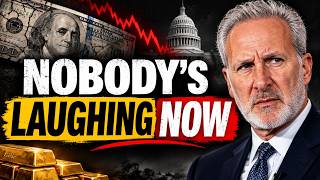
저자: PeterSchiff · 외국인
요약 보기
결론: 피터 쉬프는 미국 국가부채 증가와 이자비용 급증, 중앙은행의 금 매입 확대를 근거로 달러 체제 압박이 실재한다고 주장하지만, 붕괴 시점에 대해서는 불확실하다고 정리한다. [부채·이자 구조] 국가부채가 36조 달러를 넘었고, 순이자비용은 연 1조 달러를 넘어 국방비를 상회한다. 2022년 이후 기준금리 인상으로 저금리 시절의 단기 부채가 높은 금리로 재조달되면서 이자 부담이 급증했다. CBO도 향후 10년간 순이자 지출이 계속 늘어날 것으로 전망하며, 몇 년 내 사회보장제도 수준의 최대 지출 항목이 될 수 있다고 본다. [재정 우위(fiscal dominance)] 부채가 커지면 중앙은행이 물가를 잡기 위해 금리를 충분히 올리기 어려워지는 상황을 재정 우위라고 설명한다. 과거에는 아르헨티나·터키 같은 나라에 쓰던 용어가 최근 서방 은행 이코노미스트들에게서도 미국에 대해 언급되기 시작했다고 한다. [달러 신뢰] 미 재무부 TIC 자료상 외국 공적기관의 미국채 보유 비중은 2010년대 초 약 1/3에서 현재 1/4 미만으로 감소했다. 중국은 2013년경 1.3조 달러 이상 보유했으나 이후 수천억 달러 줄였다. 세계금협회 기준 중앙은행은 2022년과 2023년 각각 1,000톤 이상 금을 매입했고, 이후 매입 속도는 2010년대 평균의 약 두 배 수준으로 유지되고 있다. 2022년 러시아 중앙은행 자산 동결이 각국 중앙은행의 동기 부여로 언급된다. [반론과 한계] IMF 집계상 달러의 외환보유 비중은 2000년대 초 약 70%에서 최근 약 58%로 하락했지만 연평균 0.5%p 수준의 점진적 하락이다. 유로는 재정 위기 이력, 위안화는 자본통제 문제로 대체통화가 되기 어렵고, 달러는 '상대적으로 덜 나쁜 집' 지위를 유지해 왔다. 그래서 1971년 이후 이어진 '특권(exorbitant privilege)'이 위기를 지연시켜 왔다는 설명이다. [사실과 해석 구분] 확인된 사실은 부채 규모, 이자 지출 급증, 외국 공적 보유 비중 감소, 중앙은행 금 매입 확대다. 쉬프의 해석(재정 우위 심화, 달러 체제 신뢰 훼손)은 의견이며, 급격한 통화 위기가 언제 올지는 예측 불가능하다고 명시한다. 시청자에게는 국채 보유 추이(TIC), 중앙은행 금 매입 데이터, CBO 전망 등 월간·분기 단위로 갱신되는 지표를 추적할 것을 권한다. [출연자 전망] 쉬프는 부채와 이자 구조가 지속 불가능하며 중앙은행의 금 매입이 체제적 신뢰 상실을 보여준다고 본다. 2008년 금융위기 예측으로 신뢰를 얻었으나 이후 달러 붕괴 예측은 아직 현실화되지 않았다는 점도 함께 다룬다.
다듬은 글
On a Tuesday morning in October with almost no fanfare, the United States Treasury quietly updated a number on its website. The national debt had crossed $36 trillion. There was no press conference, no emergency meeting. Stock futures didn't move. Most Americans scrolling through their phones that morning had no idea it happened at all.
But, in a small office in Connecticut, a man who had been warning about this moment for almost two decades sat down in front of a microphone and said something that would be clipped, shared, and argued about for weeks. He said the math had finally caught up with the rhetoric. Let's see. That the United States government now pays more in interest on its debt than it spends on national defense.
And that almost nobody in Washington wants to talk honestly about what happens next. His name is Peter Schiff. Let's see. You may know him as the guy who predicted the 2008 financial crisis while being laughed at on live television. Or you may know him as the guy who's been predicting a dollar collapse every year since.
One that so far hasn't arrived. Both of those things are true. And figuring out which version of Peter Schiff you're listening to right now, the man who saw 2008 coming, or the man who's cried wolf for 20 years, might be one of the more important financial questions you answer for yourself this year.
This is a story about debt, about a currency, and about a warning that keeps getting louder while fewer people seem to be listening. It's also a story about what happens when a problem is too big, too slow, and too boring for most people to notice until one day it isn't. Let's start at the beginning.
Peter Schiff was not always a household name. Before 2008, he ran a small brokerage firm in California. And he was, by most accounts, a fairly fringe figure in financial media. Follow me. He appeared on business television panels making the case that the American housing market was a bubble built on debt that could never be repaid, that banks were handing out mortgages to people with no realistic way to pay them back, and that when that bubble popped, it would take the broader economy down with it.
There's footage still circulating today of other panelists laughing at him. One analyst told him on air that he didn't know what he was talking about. We'll see. Another said housing prices simply don't fall nationally. That's not how the market works. Within 2 years, home prices had fallen nationally for the first time since the Great Depression.
Lehman Brothers collapsed. The global financial system came within days, according to multiple officials who were in the room at the time, of of a complete freeze. Schiff had been right, specifically, publicly, and years in advance about one of the worst financial crises in modern American history. That's a fact.
It's documented, recorded, and verifiable by anyone willing to search for the old footage. Here's what's not a fact, at least not yet. Whether he's right about what he's been saying since then. Because here's the part of the story that rarely gets told alongside the 2008 vindication. Schiff didn't stop predicting a crisis after 2008.
He kept going. We'll see, Mr. He said the Federal Reserve's response to the crisis, printing trillions of dollars to stabilize the financial system, would trigger runaway inflation. It didn't, not for over a decade. He said the dollar was on the verge of losing its status as the world's reserve currency.
It hasn't, not yet. He said gold would skyrocket as confidence in paper currency collapsed. It rose steadily, but nothing like the dramatic spike he described for years. So, which is it? Is Peter Schiff a man who sees financial catastrophes before anyone else does, or a man who's been predicting the same same catastrophe for 20 years is destined to eventually be right simply because he never stopped saying it?
The honest answer, and we're going to spend the rest of this documentary trying to actually earn that answer rather than just assert it. is more complicated than either side of that argument wants to admit. And it starts with a number that almost nobody outside of Washington policy circles pays any attention to.
A number that once you understand what it actually measures, makes it a lot harder to dismiss what Schiff has been saying, even if you've dismissed him for 20 years. That number is called net interest on the federal debt. And in the next part of this story, we're going to show you exactly what it is, why it's quietly become one of the largest expenses the United States government has, and why a growing number of economists, not just Schiff, not just people selling gold, are starting to use a phrase that used to be reserved for failing countries halfway around the world.
The phrase is fiscal dominance. And once you understand what it means, you'll understand why this story isn't really about Peter Schiff at all. It's It's about arithmetic. And arithmetic, unlike a television panel, doesn't care whether you believe it or not. To understand net interest, you don't need a finance degree.
You need to think about your own life for a second. Imagine you have a credit card. Every month, you pay the minimum, and every month, the balance grows a little as you're spending more than you're paying off. For a while, the interest charge on that card is small, manageable, easy to ignore. But if the balance keeps growing, and if interest rates on the card go up at the same time,
it comes a point where the interest charge alone, just the cost of owing the money, not the original spending, starts eating into your paycheck in in a way you can't ignore anymore. Let's say that's roughly what's happening to the United States government right now, except the numbers have so many zeros that it stops feeling real.
In the fiscal year that ended in September 2024, the federal government paid out more than one It can't be so $1 trillion in net interest on its To put that in perspective, that's more than the entire budget for national defense. It's more than the government spends on Medicaid, the healthcare program for low-income Americans.
Approaching what the government spends on Medicare, the healthcare program for seniors, one of the largest and most politically untouchable programs in the federal budget. And here's the part that should genuinely concern anyone looking at this honestly, regardless of what they think about Peter Schiff personally.
This number is isn't the result of some one-time emergency spending. It's not COVID relief. It's not a war. It's simply the cost of money the government already borrowed years ago, in some cases decades ago, coming due for refinancing at today's much higher interest rates. Here's how that works. Government doesn't borrow money once and pay it back slowly like a 30-year mortgage.
A huge portion of US debt is short-term, meaning it has to be refinanced constantly, every few months or every few years, at whatever the prevailing interest rate happens to be at that moment. For over a decade, from roughly 2009 to 2022, interest rates sat near historic lows, close to zero in many cases.
That meant the government could carry an enormous and growing debt load without feeling much pain from it. Because the interest rate on that debt was so low it barely registered. Then starting in 2022, the Federal Reserve raised interest rates aggressively to fight the highest inflation the country had seen in 40 years.
That was, by most mainstream economic accounts, the right call. Inflation needed to be controlled. But it had a side effect that gets far less attention than it deserves. All that old cheap government debt started coming due and had to be replaced with new debt at interest rates four, five, six times higher than before.
This is the part of the story where Peter Schiff's warnings start to sound less like ideology and more like arithmetic because this isn't a prediction. This already happened. The Congressional Budget Office, which is not a gold investment firm, and a not a doomsday newsletter, but the non-partisan agency that scores the federal budget for Congress itself, projects that net interest payments will continue climbing for the next decade, regardless of what policy changes happen in Washington, simply because of how much old debt still needs to be refinanced at today's higher rates.
By the CBO's own projections, net interest is on track to become the single largest category of federal spending within the next several years, surpassing not just defense, but eventually rivaling Social Security itself, the largest government program in the country. Sit with that for a second. The government's single biggest expense within a few years on the current trajectory, it won't be the military, it won't be healthcare, it won't be any program that builds a road, educates a child, or defends a border.
It will be interest. Money paid out for the sole purpose of having already spent money with nothing new to show for it. This is where the term fiscal dominance comes in, and it's worth understanding precisely because it's not a dramatic phrase invented by a pessimist. It's a term economists use to describe a very specific mechanical situation.
Normally, a set a central bank like the Federal Reserve sets interest rates based on what's best for the economy, raising rates to cool inflation, lowering them to stimulate growth without worrying about how those decisions affect the government's own finances. That's the textbook model of how monetary policy is supposed to work, independent of fiscal pressure.
To fiscal dominance describes what happens when a government's debt becomes so large that this independence starts to break down. It's the If raising interest rates to fight inflation would also mean the government can no longer afford its own interest payments, the central bank faces an impossible choice.
Fight inflation properly and risk a fiscal crisis in the government's own finances. Or keep rates lower than inflation actually calls for, protecting the government's budget at the cost of letting inflation run hotter than it should. Historically, this term has been used to describe countries like Argentina or Turkey.
Nations widely seen as having unstable finances and weak central banks. Hearing economists at major Western banks, not fringe commentators, start using this exact term to describe the United States, the issuer of the world's reserve currency, is new. It's happened gradually over the last two or three years as the interest numbers have grown too large to ignore.
This is the environment Peter Schiff has been describing for years, arguably before most mainstream economists were willing to use the language to describe it. Not a dramatic overnight collapse, a slow mechanical trap where the government's own debt load starts dictating monetary policy. Rather than monetary policy being set purely to serve the economy.
So, if the mechanics check out, if the debt is real, the interest payments are real, and the trap is increasingly being acknowledged even outside of Schiff's own commentary. Why hasn't the crisis he's been predicting for 20 years actually arrived? That question takes us somewhere unexpected. It takes us away from Washington entirely and toward a very different kind of institution, ones that don't appear on cable news.
Don't give interviews and don't explain their reasoning to the public. Central banks in countries most Americans rarely think about have been quietly making a decision over the last several years that tells you more about how seriously the world is taking this problem than any single economist prediction ever could.
In 1944, representatives from 44 Allied nations gathered at a hotel in Bretton Woods, New Hampshire to design the financial architecture of the post-war world. The agreement they reached made the US dollar the center of global finance, which they backed at the time by gold with other currencies pegged to the dollar.
That system eventually broke down in 1971 when President Nixon ended the dollar's direct convertibility into gold. But even after that, the dollar remained the world's dominant reserve currency, the asset that central banks, governments, and institutions around the world held as their primary store of value.
For most of the following 50 years, that dominance was essentially unquestioned. If you were a central bank in Japan or Brazil or South Korea, and you wanted a safe place to park your country's savings, US Treasury bonds were the obvious choice, liquid, stable, and it's backed by the world's largest economy.
That's been changing quietly, and the evidence is sitting in public data that almost nobody looks at. The US Treasury publishes a monthly report called the TICSI report. Treasury International Capital data, which tracks how much US debt foreign countries actually hold. Over the past decade, the trend in that data has been remarkably consistent.
Foreign official holdings of US debt, meaning holdings by other governments and central banks specifically, have fallen as a share of total outstanding debt from around a third of fall all foreign held debt in the early 2010s to well under a quarter today. China's numbers tell an even sharper version of the same story.
At its peak around 2013, China held more than 1.3 trillion dollars in US Treasury bonds. By recent reporting, that figure has fallen by several hundred billion dollars, even as China's overall foreign currency reserves have remained enormous. The money didn't vanish. Instead, it moved. Where it moved to is the second half of this story, and it's the part that connects directly back to Peter Schiff's argument, whether you find him credible or not.
Central banks around the world have been buying gold at a pace not seen in generations. According to the World Gold Council, which tracks this data independently of any single country's self-reporting, central banks purchased more than 1,000 tons of gold in 2022. They did it again in 2023. The pace has remained elevated since roughly double the average annual purchases seen throughout the 2010s.
This is not one country making an unusual decision. China, Russia, India, Turkey, Poland, and several other nations have all appeared consistently near the top of annual central bank gold buying lists in recent years. Countries with little in common politically, economically, or geographically independently arriving at a similar conclusion about where to park a growing share of their national reserves.
There's a specific event widely cited by central bank reserve managers themselves in the World Gold Council's own annual surveys as a turning point in this thinking. In 2022, following Russia's invasion of Ukraine, the United States and its allies froze approximately $300 billion of Russian central bank assets held in Western financial institutions.
It was an unprecedented move, the kind of action that until that point most countries assumed could never actually happen to a major economy's sovereign reserve. Every central bank on Earth watched that happen, and many of them, according to their own public statements and survey responses, asked themselves a version of the same uncomfortable question.
If it happened to Russia over a political dispute, could it happen to us? Gold doesn't have that vulnerability. A bar of gold sitting in a vault on your own soil cannot be frozen by a foreign government sanctions list. It doesn't depend on another country's banking system agreeing to honor a claim. In a world where trust in the existing financial order is being quietly, systematically questioned by the very institutions that used to be its biggest supporters, that's precisely the kind of asset that becomes more attractive.
this is the piece of the puzzle that makes Schiff's 2020 argument harder to simply wave away in 2026 than it was in 2010 or even 2018. For most of the time he's been making this case, the rest of the world's central banks were not behaving as though they shared his concerns. They kept buying dollars.
They kept holding Treasuries. The dollar's dominance, while theoretically vulnerable according to Schiff's framework, was not actually eroding in any way you could point to in hard data. That's no longer true. The data itself, published by the US Treasury, verified independently by the World Gold Council, shows a real, sustained, multi-year shift.
The central banks are not panicking. They're not making dramatic announcements. They are doing doing something far more telling. They are quietly, patiently repositioning the way sophisticated long-term thinkers tend to move, not with urgency, but with consistency, year after year, regardless of which headline happens to dominate financial news in any given month.
So, here is where the story becomes genuinely difficult to simplify into either Schiff is right or Schiff is wrong. Two of the core pillars of his argument, an unsustainable and accelerating debt burden and a documented shift away from the dollar by the world's reserve managers, are not predictions anymore.
They are documented current facts that are verifiable through primary government and institutional data, independent of anything Schiff himself has said. But, a third pillar of his argument, the one that gets the most attention, the one that produces the dramatic headlines and the viral clips, is the timing.
Timing, when does this actually turn into a visible crisis, remains genuinely, honestly uncertain. And understanding why it's uncertain, why a problem this real and this well-documented can continue not erupting for years, even decades, will say is where we need to go next. Because it's the part of this story that explains both why Schiff has been right about the mechanics and wrong so far about the clock.
Here's a question worth sitting with. If the debt problem is real, if central banks are genuinely losing confidence in the dollar, why hasn't anything dramatic happened yet? Why are stocks still near record highs? Why does the economy by most conventional measures still look fine? The answer lies in something that doesn't get explained well in short clips or dramatic headlines because it's not dramatic, it's structural.
will say. And it's the reason Schiff has been both consistently right about the direction of this story and consistently early about its timing for most of the last two decades. will say. The United States dollar does not need to be healthy to remain the world's dominant currency. It only needs to be less unhealthy than its alternatives.
And for most of the period since the 2008 financial crisis, it's exact that's exactly the position it's occupied. Think about what the alternatives actually looked like during that stretch. Europe spent much much of the 2010s dealing with its own sovereign debt crisis. Greece, Italy, Spain, countries whose debt problems were in some ways even more acute than America's, threatening to break apart the entire Eurozone.
Japan spent decades in near-zero growth and deflation with a debt-to-GDP ratio even higher than America's. And an aging population is straining its finances even more severely. China, often floated as a potential rival reserve currency, maintains strict capital controls, meaning the yuan isn't freely convertible the way the dollar is.
Makes it structurally unsuitable as a global reserve currency no matter how large China's economy becomes. In a world where every major alternative currency carries its own serious visible problems, the dollar has been able to remain the safest house on a troubled street even while its own foundation quietly weakened.
That's not a reason to dismiss the structural problem. It's an explanation for why the problem has been able to persist visibly years without producing the crisis Schiff has repeatedly predicted. This pattern has a name among economists who study currency crises historically. It's sometimes called the exorbitant privilege, a phrase first used decades ago to describe the unique advantage the United States has simply by issuing the currency the rest of the world relies on for trade and reserves.
That privilege buys time. It allows a country to run deficits, accumulate debt, avoid immediate consequences that would crush almost any other nation attempting the same thing, but privilege is not the same as immunity. And the central question this entire story ultimately rests on is whether that privilege is eroding slowly the way the Treasury and World Gold Council data suggests, or whether it remains durable enough to absorb these pressures indefinitely the way it has for the last 50 years.
There's a specific honest critique of Schiff's framework worth including here because a credible investigation doesn't only present the evidence supporting one side. The dollar's share of global foreign exchange reserves tracked by the International Monetary Fund has indeed declined over the past two decades from roughly 70% in the early 2000s to approximately 58% in recent reporting.
That is a real documented decline, but it's also a gradual one averaging roughly half a percentage point per year, not the kind of sudden collapse that would validate the most dramatic version of Schiff's warnings. A gradual multi-decade decline in dominance is a fundamentally different story than an imminent currency crisis, even if both stories start from the same underlying data.
You see, it's also worth noting that no clear alternative reserve currency has emerged to actually replace the dollar at scale. The euro carries its own structural weaknesses from the 2010s debt crisis. The yuan remains restricted by capital controls. Gold itself, while while increasingly popular with central banks, isn't a currency that can facilitate the trillions of dollars in daily global trade and financial transactions that the dollar currently handles.
The absence of a ready replacement has historically been one of the forces that's extended the dollar's dominance longer than its underlying fundamentals alone might otherwise justify. The same way a company can remain the market leader in an industry for years after its product start start falling behind, simply because switching costs for its customers are too high.
So, where does this leave the timing question? The one piece of Schiff's argument that remains genuinely, honestly, unresolved. The most defensible position, the one that neither dismisses the documented structural evidence nor accepts the most dramatic predictions at face value, is this. Pressure is real, measurable, and has been intensifying for years, verified through primary sources entirely independent of Schiff's own commentary.
Whether that pressure continues building gradually the way it largely has for the past two decades, or whether it eventually reaches a tipping point that converts into the kind of acute visible crisis Schiff describes, is not something that can be known in advance by him, by economists, or by anyone else making confident predictions about exact dates.
What can be known, what is actually trackable in real time through public data, are the specific indicators that tend to move before a crisis becomes visible to the general public, you see, rather than after. And that's where this story needs to end, not with a prediction about what happens next, because nobody, including Peter Schiff, can honestly give you that with certainty, but with a clear-eyed understanding of what to actually watch me, so that whatever does happen, you're someone who understood the mechanics in advance, rather than someone hearing about it for the first time in a headline long after the people with the best information already moved.
So, let's bring this story to where it actually needs to land, not with a verdict on whether Peter Schiff is right or wrong, because the honest answer, as we've seen, is more more complicated than either side of that argument wants it to be, but with a clear understanding of what's actually documented, what remains uncertain, and what's genuinely worth watching going forward.
Here is what is fact verified through primary sources entirely independent of Schiff himself. The national debt has crossed $36 trillion. Net interest payments have surpassed a trillion dollars annually, now rivaling the largest categories of federal spending. Trajectory The Congressional Budget Office itself projects will continue for the next decade regardless of future policy changes.
Foreign official holdings of US Treasury debt have declined as a share of the total for over a decade, documented monthly by the Treasury's own tick reports. Central banks around the world have purchased gold at roughly double the historical average pace for four consecutive years, verified independently by the World Gold Council.
These are not predictions. They are the recorded current state of the world as of now. Here is what is opinion. Schiff's interpretation of what these facts mean, an interpretation shared by a growing number of mainstream economists, but still an interpretation rather than settled fact. That this debt trajectory is unsustainable without significant structural change.
That the Federal Reserve's independence is being compromised by fiscal pressure. The situation increasingly described using the term fiscal dominance, even by economists who would never call themselves shift supporters. That central bank gold buying reflects a genuine structural loss of confidence in the dollar system is a rather than a temporary or coincidental trend.
And here is what remains honestly a prediction uncertain by its very nature no matter how confidently it sometimes delivered that this pressure will convert into an acute visible currency crisis to say rather than continuing as a gradual multi-decade decline the way the dollar's reserve currency share has already been eroded for 20 years.
Nobody can know this with the certainty some commentary around this topic implies not shift not his critics not the central bankers themselves quietly repositioning their own reserves. What separates a useful understanding of this story from an exploitable one is being honest about exactly where that line sits between documented fact is reasonable interpretation and unknowable prediction.
The clips that go viral tend to blur all three together presenting prediction with the same certainty as fact because uncertainty doesn't generate the same urgency the same views the same reaction. But uncertainty is the actual honest state of this entire situation and pretending otherwise in either direction confidently dismissing shift entirely or confidently accepting his most dramatic timeline is does you a disservice either way.
What so what do you actually do with a story like this one where the structural evidence is real but the timing is genuinely unknown. You watch the things that are actually trackable. The Treasury's monthly TC report showing whether foreign official demand for US debt continues declining stabilizes or reverses.
purchase data showing whether the current four-year buying trend accelerates continues or tapers off. a specific number sovereign debt analysts use to assess fiscal stress in other countries, was not a one. The Congressional Budget Office's own projections show climbing toward levels that would be considered a serious warning sign if applied to any other nation on Earth.
These aren't dramatic headline-grabbing numbers. They update quietly every month or every quarter without fanfare the same way this entire problem has built quietly for decades, largely ignored until the numbers became too large to explain away. Peter Schiff was right about 2008 years before anyone else was willing to say it publicly, and he was dismissed, laughed at, told he didn't understand how markets work.
He's been saying something similar about the dollar for almost two decades since. Let's say. And for most of that time the dramatic version of his warning hasn't arrived. Both of those things are true simultaneously, and neither one cancels the other out. What's different now? Let's see. What makes this moment worth paying closer attention to than the version of this warning Schiff was giving a decade ago is that the specific numbers underneath his argument, the debt, the interest payments, the central bank gold buying
is aren't predictions anymore. They're the current documented measurable state of the world, verified by the same government institutions that would have every incentive to downplay them if they could. Let's see. Whether that translates into the crisis he's been describing for 20 years on some specific timeline in some specific way remains the one part of this story nobody can honestly answer yet.
But understanding the mechanics well enough to watch it unfold in real time rather than hearing about it for the first time in a headline after the fact, that part is entirely within your control. And that, more than any single prediction, dramatic or otherwise, might be the only real takeaway this story can honestly offer.


Comments 0