원문 보기
The stock market has been an absolute roller coaster lately. Tariffs, trade wars, actual wars, recession fears, the S&P 500 swinging hundreds of points in a single day, JP Morgan putting recession odds at 40%, inflation persisting, and everywhere you look, headlines screaming about uncertainty. It's a kind of environment that makes even the most confident investors pause and think, is there a better way to do this?
Is there a portfolio that can handle all of this? Something that doesn't leave you white-knuckling through every Federal Reserve press conference. Well, there's one portfolio that people keep pointing to in moments exactly like this one. A portfolio designed supposedly to make money in every economic environment.
Bull markets, bear markets, inflation, deflation, recessions, everything. And it is called the all-weather portfolio, built by one of the greatest investors alive, Ray Dalio. Today, we're going to unpack it and break it down. What it is, how it works, and most importantly, whether it's actually right for you.
And hi, in case we haven't met, my name is Tay from Financial Tortoise, where we learn to grow our wealth slow and steady. But before we get into today's video, an important reminder. The Financial Tortoise Community enrollment closes tonight at midnight. Today is the last day. So, I'll take a minute to make the case clearly, because today's video is actually a perfect illustration of why this community exist.
We're going to spend the next 15 minutes breaking down one of the most sophisticated portfolio strategies ever built. Created by a billionaire, road-tested over decades, designed to withstand every possible economic environment. And at the end, I'm going to tell you that for most people, a simpler approach will probably be a better option.
That gap between what sounds sophisticated and what actually works is exactly what the Financial Tortoise Community closes. I've done over hundreds of one-on-one coaching sessions with professionals who have real portfolios, real complexity, and real money on the line. Physicians, engineers, executives.
Almost all of them come in with something that looks impressive and costs a fortune, but leave with something simple, low-cost, and easier to stick with for a long term. Here's what you get inside the community. Three personal one-on-one coaching sessions with me. Your accounts, your questions, your plan.
A monthly live Q&A where real financial questions get honest answers in real time. A private community of professionals on the same path. A full course library covering investing, taxes, money mindset, and more. Premium tools including Financial Tortoise AI Assistant, Monarch Money, and Projection Lab.
All included. One flat annual fee, no commissions, no upsells, and a 30-day full refund if it's not what you expected. Doors close tonight at midnight. If you want to join, go to financialtortoise.com/community. The link is in the description below. Now, let's talk about Ray Dalio. Let's learn about the man who built this portfolio, the all-weather portfolio, Ray Dalio.
Because to be honest, Ray Dalio and his credibility is one of the biggest reasons why this all-weather portfolio has gotten so much attention. Ray Dalio is the founder of Bridgewater Associates, essentially the largest hedge fund in the world managing over 150 billion dollars in assets. He started from a two-bedroom apartment in 1975 and built it into a firm that has generated more money for its clients than virtually any hedge fund in history, over 55 billion dollars in net gains.
Time magazine named him one of the 100 most influential people in the world. And in the past decade, with the publishing of his book Principles, a part autobiography and a part blueprint for making decisions, Ray Dalio went from being a name known only in financial circles to one of the most widely read thinkers in the world with over 4 million copies sold.
Thus, it's not a surprise that when Ray Dalio talks about a portfolio, people would drop everything to listen. So, what is this all-weather portfolio? Well, let's start with the intellectual foundation. It is based on this concept of the four seasons. Ray Dalio's belief is that when you strip away all the noise, the politics, the headlines, the earnings reports, the economy is really only ever in one of four states: rising growth, falling growth, rising inflation, falling inflation.
That's it. And different assets thrive in different seasons. Stocks thrive when growth is rising. Long-term bonds thrive when growth is falling and deflation sets in. Gold and commodities thrive when inflation is rising. Bonds also cushion you when inflation is falling. But here's the key. Nobody knows which season is coming next.
Not Ray Dalio, not the Fed, not a single person on this planet. So, his answer was elegant. Own something that performs well in all four seasons: rising growth, falling growth, rising inflation, falling inflation. And that is the whole idea. It's not about predicting the future, it's about designing a portfolio that is prepared for all of it.
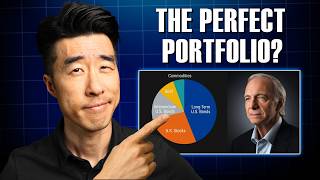
Okay, so with that foundational theory understood, let's now see the actual portfolio. Here is the portfolio breakdown, what you would actually own, and why each piece is there. 30% in stocks. This could be reflected by a broad market index fund like VTI, Vanguard Total Stock Market ETF. And this is a growth engine that will perform well in economic expansions.
Next, we have 40% in long-term bonds. This could be represented by a fund like TLT, iShares 20+ Year Treasury Bond ETF. This is here to protect you in falling growth and deflation. Next, 15% intermediate bonds. This could be represented by a fund like IEI, iShares 3-7 Year Treasury Bond ETF. This would act as a stability cushion because it is less sensitive to interest rate swings than long-term bonds.
Next, we have gold and commodities. 7.5% gold, reflected by GLD, SPDR Gold Trust. This is your inflation hedge and crisis asset. 7.5% commodities, reflected by a fund like DBC, Invesco DB Commodity Index. Additional inflation protection. One important note before we go any further. Ray Dalio himself said in an interview with Tony Robbins that these weighting would not be exact or perfect.
This is a retail accessible approximation of what Bridgewater actually runs, which uses leverage and far more sophisticated instruments. This is worth keeping in mind before treating these percentages as gospel. Okay, now that we have a good understanding of the man behind the portfolio, the theory it is based on, and what it actually looks like, let's go a step further.
Because this isn't just about having a very diversified portfolio, it actually goes beyond that. Let's talk about its secret sauce, the risk parity. Many people look at the 55% bond allocation and think, that seems way too conservative. But that thinking misses the point of this portfolio. Think of a traditional 60/40 portfolio.
You have 60% in stocks and 40% in bonds. Sounds balanced, right? Except, stocks are roughly three times more volatile than bonds. So, even though you have 40% in bonds, over 90% of your risk is still driven by what stocks do. The bonds are barely moving the needle. So, Ray Dalio's insight was this. Don't balance dollars, balance risk.
Because bonds are so much less volatile than stocks, you need far more dollars in bonds to make the risk contribution equal to stocks. That's why the portfolio ends up being 55% bonds. This concept is called risk parity, spreading risk equally across different economic environments, not just spreading money across asset classes.
It's a different angle of looking at risk. Traditional diversification asks, am I spread across enough asset classes? Risk parity asks, am I actually balanced against different economic realities? So, the big question. Now that we understand the theory behind this portfolio, what it looks like, and what makes it uniquely special compared to a traditional diversified portfolio, how does it perform?
Does it actually do what it promises? Does it actually live up to its promise? Let's get into that next. First, let's talk about where it genuinely shines, because the data in certain scenarios is actually quite remarkable. First data point, the 2008 financial crisis. When the S&P 500 collapsed 37%, this portfolio dropped roughly 5%.
While the rest of world was in financial freefall, the all-weather investors barely felt it. That is not luck, that is a portfolio doing exactly what it was designed to do. Second, the 2020 COVID crash. The stock market fell roughly 33% in about 5 weeks, the fastest crash in history. The all-weather portfolio, it only dropped roughly 6%.
When the world was panicking, this portfolio held on. Finally, stepping back, the big picture numbers over 43 years. 88% of the years were positive, only five down years out of 43. The S&P 500, by comparison, had seven down years out of 43. And when this portfolio did fall, it recovered in an average of 15 months.
The S&P 500 took an average of 38 months. So, the promise of the all-weather portfolio is not fake. The intellectual framework is sound. The protective qualities, especially in stock market crashes, are real. The question, as always, is at what cost? Let's compare its long-term performance against some other very popular portfolios out there.
Here are four portfolios measured over the same 30-year period from 1995 to 2025. And we're going to assess its performance on two metrics that matter to many people. One, how much your money grew, and two, how much pain you endured, volatility. First, let's start with Ray Dalio's all-weather portfolio, so we have a baseline.
Its 30-year annualized return is 7.4%, which means if you started with $10,000 30 years ago, it would have grown to approximately $86,000 today. Not bad. That is a pretty decent size portfolio. And the pain to get there? Not bad either. The worst drawdown was -21% in 2022. Essentially, at its worst time, it only lost 1/5 of its value.
All right, moving on. Second, we have the simple 60/40 portfolio. 60% in total US stocks, 40% in total US bonds. Its 30-year annualized return is around 7%, slightly lower, which means if you started with $10,000 30 years ago, it would have grown to approximately $74,000, about $10,000 less than Ray Dalio's all-weather portfolio.
And the pain? Pretty similar to all weather. The worst drawdown would happen about 19% in 2009. Third, the Bogleheads three-fund portfolio. About 50% in US stocks, 30% international stocks, and 20% in bonds. Its 30-year annualized return is 8.1%, which means if you started with $10,000 30 years ago, it would have grown to approximately $107,000.
Now, the balance is getting better than the all-weather portfolio. But of course, the pain is worse. The worst drawdown would happen about 44% in 2009, which means you would have had to watch your portfolio lose value by more than 40%. And finally, number four, the super simple one-fund total US stock market portfolio.
Its 30-year annualized return is slightly more than 10%, which means if you started with $10,000 30 years ago, it would have grown to approximately $185,000. Amazing. This is more than two times what the all-weather portfolio would have produced. But of course, the pain in this one really hurts. The worst drawdown would have been 51% in 2009, meaning you would have to watch your portfolio get cut by half.
How many of us can really stomach that? As you can see here, there's a quite a bit of difference in returns and final balance when we stretch the timeline. And scale that to millions, and we're not talking about a lifestyle difference. We're talking about an entirely different financial future. But here's the number that really stands out to me.
Compare the all-weather portfolio to the simple 60/40 portfolio. Just two ingredients. The 60/40 had very similar volatility. And it did this with just two funds. No gold, no commodities, no annual rebalancing of multiple assets. For me, the takeaway here is this. If your goal was to reduce volatility with similar returns, you don't need gold, commodities, risk parity, or Ray Dalio.
You just needed more bonds. A simple 60/40 got you almost the same smoothness, and required only two funds to manage. Now, let's get into the most uncomfortable chapter. 2022. 2022 was the exact economic environment this portfolio was supposed to be engineered for. Inflation surged. This was a scenario where gold and commodities were supposed to protect you.
Where the portfolio's diversification was supposed to activate. And yet, the all-weather portfolio fell over 20%. Its single worst drawdown ever recorded. Recovery took nearly 3 years. Why? Because the Fed raised interest rates so aggressively, so fast, long-term bonds got completely demolished. The portfolio's 55% bond allocation, its biggest bet, its core defensive layer, became its biggest liability.
Stocks and bonds fell together simultaneously in the same direction. The core assumption of the entire portfolio broke down in the one scenario where you thought it would hold its promise. Here's another context. The 40-year tailwind that not enough people talk about with this portfolio. Interest rate peaked at over 21% in December 1980.
Over the next four decades, an entire investing lifetime, they steadily fell. When interest rates fall, bond prices rise. The all-weather portfolio, with a massive 55% bond allocation, had an invisible tailwind for its entire existence. The portfolio's spectacular performance in 2008 and 2020, both crashes occurred in falling interest rate environments.
Thus, the diversification looked like genius. 2022 was the first real glimpse of what happens when that tailwind reverses. And one more thing worth mentioning on gold. It's described as an inflation hedge, the crisis asset, the safe haven. But gold peaked in early 1980, and didn't reach new all-time highs again until 2008.
That is a 28-year drawdown. Imagine owning an asset for 28 years that goes nowhere. The psychological cost of holding gold through that period, while watching the stock market compound around you, is enormous. Most people can't and won't do it. Bottom line, in many economic conditions, specifically stock market crashes driven by economic slowdowns, the protection is impressive and real.
2008 and 2022 proved that. But 2022 proved that when inflation spikes and the Fed responds with aggressive rate hikes, this portfolio has no adequate shelter. Both its major defensive assets fall at the same time. To me, an all-weather portfolio that struggles in high inflation is built like an umbrella that works fine in light drizzle, but breaks when the real storm arrives.
The name says it will protect you from all weather, but the data tells a more complicated story. All right, so we talked a lot about data here. But here's a key question that is probably in the back of your mind. So what? And more importantly, how is this relevant to me? Love that you guys straight to the point.
So let me address that. My personal take is that if you want to simply build wealth while managing volatility, you don't need this level of complexity. Actually, there are simpler alternatives that can get you to where you want to go. If what you want is less volatility than a pure stock portfolio, you don't need five funds, risk parity, gold, commodities, or a deep understanding of macroeconomic cycles.
You probably just need more bonds. A simple 80/20 stock bond mix gives you meaningfully lower volatility than 100% stocks. Two funds. Want lower volatility closer to all weather? Increase your bond holding and go with a 60/40 stock to bond mix. As you just saw, it gives you near identical smoothness to all weather, and actually has smaller maximum drawdown and faster recovery from 2022.
Want smoother? A 50/50 gives you even more cushion. Still two funds, still simple, still not requiring you to monitor commodity prices. For me, the real insight from all weather isn't own gold and commodities. It is more bonds means less volatility. That's a lesson you can apply without any additional complexity.
All right, so the final verdict. Yes, Ray Dalio is an investing legend. Some might say he's a genius. And I got to say, I agree. This portfolio is a genuine intellectual achievement. The Four Seasons framework, the concept of risk parity, these ideas changed how institutional investors think about money.
And in times of uncertainty like right now, I completely understand why it's appealing. The world feels unpredictable. The desire for a portfolio that can handle anything is completely human. But here are two things that are also true at the same time. One, brilliant and right for you are two very different things.
Two, this portfolio was built for a billionaire's family trust, road-tested during a 40-year bond bull market, and made famous by a motivational speaker, Tony Robbins. So you have to ask yourself, how much of that is relevant to me? For most investors, a simple portfolio built with low-cost index funds will outperform the sophisticated portfolio over most time horizons.
And that is not because all weather is bad, but it is because simplicity is underrated. Time is your greatest ally, and the best portfolio is the one that you can actually stick with for 30 years without second-guessing yourself every time gold drops. Ray Dalio himself put it best. The first step is to accept that you don't know what the future will bring.
He built a portfolio around that truth. The irony is that for most of us, the best response to the same truth is even simpler than his answer. Own the whole market, keep costs low, stay the course, and let time do the heavy lifting. One last thing before I go. Tonight is the last chance to join the Financial Tortoise community.
Enrollment closes at midnight, and I will not be opening again until I have the capacity to take on new members. If you've been on the fence, don't let tonight pass. Head to financialtortoise.com/community. The link is in the description below. Thank you guys for watching, and if you want to go deeper on some of the simpler alternatives we discussed today, check out my video on the three-fund portfolio. I'll link it right here. Until next time, all the best.





Comments 0