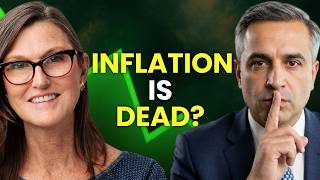
저자: CathieWood · 외국인
요약 보기
Cathie Wood은 AI·로봇·에너지저장·블록체인·멀티오믹스 융합으로 향후 3~5년 글로벌 성장률이 7% 이상(산업혁명 시기 0.6%→3%, 5배 증가 근거)일 수 있다고 주장. 운송의 전력망 전환으로 유가가 $30 수준까지 하락 가능하며 이는 인플레이션을 낮춘다고 봄. 역사적으로 1929년 이전 50년간 단기금리가 장기금리보다 높은 역전이 60% 이상이었지만 경기침체가 없었다는 근거로, 명목GDP 6~8% 하에서 단기금리 6~8%, 장기금리 5~7%를 전망. 4조달러 부채는 AI 생산성으로 성장을 통해 해결 가능하다고 동의. 진행자 자막 요약 중 일부는 전문가 해설로 보이나 출연자 발언 기준으로 추출.
다듬은 글
Cathie Wood recently joined CNBC for an exclusive interview to make a startling economic prediction that global growth is about to surge past 7%. This bold forecast challenges almost every conventional assumption about inflation, interest rates, and the looming national debt. In this live sit-down with host Joe Kernan, the ARK Invest chief executive argued that a convergence of artificial intelligence, robotics, and energy technologies will soon trigger an expansion rivaling the Industrial Revolution.
By the end of this video breakdown, you will see exactly how this projected technological wave could dismantle long-term inflation, rewrite the rules of the bond market, and potentially inflate away our massive national debt. Let's hear Cathie Wood on CNBC. ARK Invest Cathie Wood writing a letter to investors earlier this week with a lot of of of interesting notions.
Um let's welcome Cathie Wood. I'm not going to going to read someone's summary. I just want to get right to you. Cathie Wood joins us now in an exclusive interview. Cathie, I'll tell you what my summary is for what you said. US economy has powered through rising interest rates, inverted yield curves, tariffs, government shutdown, and wars.
And it's continued to generate high growth rates and you continue to see that in the years ahead with something added in that could rival the Industrial Revolution, basically AI. Absolutely. And actually we are informed by the Industrial Revolution. If you look at the 400 years before the Industrial Revolution, Brett Winton, our future our chief futurist, has done this work.
Real GDP growth globally was about 0.6% and then with the Industrial Revolution, which was the last technology revolution effectively, we moved up to 3% global GDP growth. So that was a fivefold increase. Uh we think that during the next 3 to 5 years, we will be seeing regularly, and perhaps on average, growth uh north of 7%.
Uh and that is just a two and a half-fold increase uh despite the fact that we have so much more technology evolving today than we did back then. Back then it was electricity, telephone, and industrial internal combustion engine. Now we've got uh AI, importantly, robotics, energy storage, blockchain technology, and multiomic sequencing in the life science space.
Uh so, uh much more technology moving much faster. So, I actually think that 7% is going to look conservative in hindsight. Got a lot of other uh interesting news. And so, we've got the straight closed, and you know, inflation fears, you know, on everyone's lips. You think it's on the verge of breaking down long-term.
Why? Yes. Uh I think productivity growth, importantly, uh is a reason. We also do believe that oil prices uh are going to go down fairly dramatically uh because transportation is moving to the grid. Uh and uh the grid does not use oil. Uh 57% of oil consumption is transportation related. Uh and so, we think increasingly as transportation moves to the grid, oil will unwind.
And in there, we we say, and there's a chart showing whenever we're in a crisis, we tend to go down to $30 oil. Uh we think this won't be a crisis, except perhaps for uh oil companies and energy-dependent countries, uh but we think that could happen again, but be sustainable this time around. The Industrial Revolution, you had an inverted yield curve that did not cause uh a recession, and you expect something similar uh again.
Can you explain why short-term rates go up, but long-term rates uh are expected to stay stable? Why does that happen in in uh an economy that you're forecasting like that? Yes, again, taking some lessons from the Industrial Revolution, short rates, uh this was during the the 50 years that ended in 1929 before the Depression, short rates averaged the same rate as nominal GDP GDP growth, which was 4.8% back then.
Long rates averaged 3.8%. So, short rates uh were taking their cues from nominal growth. Long rates uh were taking their cues more from uh really deflation or no inflation back then. Uh so, and and you'll the yield curve was inverted more than 60% of the time on average for uh about uh 100 basis points.
Uh so, we do think we could see nominal GDP growth uh in the 6 to 8% range. That would be uh where we'd expect short rates to go, and long rates to be 5 to uh 7%. So, uh from a government yield point of view, we're at the lower end of that range already. I don't know if you said Joe Lonsdale the other day said we're talking about $40 trillion of of debt in uh it's such a daunting number that that we don't seem to have any any way out.
He said not to worry, you know, everyone wants to raise taxes. Do not raise taxes. We're going to get into a a disinflationary decade starting in 2030 from AI. It's going to the growth is going to be so high that that you're not even going to need to raise taxes and that all these things are going to take care of themselves.
Did you see him say that? Kathy, you agree? I I didn't see him say say that, but I I I agree generally with the the notion that we're going to grow out of this. I was very early in my career uh under Reaganomics and this was the same argument debate taking place back then. And of course uh growth did take care of the problem back then and I do believe it's going to take care of the problem again.
You know, it's interesting uh I think many people are going to start competing for that growth number. We're in the uh 7 to 8% range and I I've seen Elon Musk I think he's in the 20% plus range uh for real GDP growth. So uh but but I do agree that the surprise here is going to be how rapid the growth is going to be and we're seeing it already from uh the AI companies.
They're astounding astounding growth rates. To understand the scale of what Wood is proposing, we have to look at the historical data compiled by ARK Invest's chief futurist Brett Winton. Wood explains that for the four centuries leading up to the Industrial Revolution, global real GDP growth crawled along at a mere 0.6%.
When the steam engine, electricity, and the internal combustion engine finally took hold, that growth rate leaped to 3%. That was a fivefold increase in global economic momentum. Now, let's look at the mechanics of this energy transition because it highlights the core strength and the potential vulnerability of Wood's entire thesis.
A permanent $30 barrel of oil would indeed be an incredible disinflationary force, lowering the cost of manufacturing and shipping across the globe. But, where I land on this is that Wood is overlooking the messy middle phase of the energy transition. Even if electric vehicle adoption continues to rise, the demand for oil is not going to vanish overnight.
Petrochemicals, aviation, and heavy maritime shipping are incredibly difficult to electrify, and they will continue to require massive amounts of oil for decades. Furthermore, as the transportation sector shifts to the grid, the demand for electricity will surge to unprecedented levels. If our electrical infrastructure cannot keep up with this demand, energy costs could actually skyrocket rather than fall.
Wood's prediction assumes a seamless transition from oil to electricity, but grid congestion, copper shortages, and regulatory delays are highly likely to keep energy costs volatile and sticky for much longer than her model predicts. 181 words. Let's make it tighter. Say 140 words. Now, let's look at the mechanics of this energy transition because it highlights the core strength and vulnerability of Wood's thesis.
A permanent $30 barrel of oil would indeed be an incredible disinflationary force. But, where I land on this is that Wood is overlooking the messy middle phase of the transition. Even if electric vehicle adoption rises, oil demand will not vanish overnight. Petrochemicals, aviation, and heavy shipping are incredibly difficult to electrify.
Furthermore, as transportation shifts to the grid, the demand for electricity will surge to unprecedented levels. If our electrical infrastructure cannot keep up, energy costs could skyrocket rather than fall. We must also consider the geopolitical fallout of Wood's energy thesis. If oil indeed falls to a sustainable $30 to $35 a barrel, it would devastate energy-dependent nations and legacy oil companies, a point she briefly acknowledged.
But, for the broader global economy, she views it as a massive productivity boost. This transition from fossil fuels to the electrical grid forms the bedrock of her disinflationary outlook, which directly informs how she views the broader bond market. That is when Curran pushed the conversation toward a historical puzzle that has been keeping Wall Street awake at night, the inverted yield curve.
Traditionally, an inverted yield curve, where short-term interest rates are higher than long-term rates, is viewed as a reliable warning sign of an impending recession. But Wood challenged this conventional wisdom by digging into the 50-year period ending in 1929. During that era of rapid industrialization, short-term rates averaged 4.8% matching nominal economic growth, while long-term rates sat lower at 3.8%.
This meant the yield curve was actually inverted more than 60% of the time on average by about 100 basis points without triggering a prolonged economic collapse. Wood argues we are entering a similar era where short rates will take their cues from nominal growth, likely hovering between 6 and 8% while long-term rates remain anchored between 5 and 7%.
If this is the kind of breakdown you want more of, like the video and subscribe to the channel so you don't miss the next one. What is my take on this historical comparison? While it is an elegant piece of financial archaeology, we have to recognize a massive structural difference between the late 19th century and today.
The 50 years leading up to 1929 operated under the gold standard. Under a gold standard, long-term inflation expectations are naturally anchored because the government cannot simply print money to resolve fiscal imbalances. That is why long-term bond yields stayed remarkably low and stable at 3.8% even as short-term rates fluctuated.
Today, we live in a fiat currency system with $40 trillion of federal debt. Investors today demand a higher term premium on long-term bonds to protect against inflation and currency debasement. Assuming that long-term yields will quietly sit below short-term yields while the government prints money to fund its deficits feels highly optimistic, if not entirely unrealistic.
This tension between high economic growth and massive government debt is exactly what Kernan raised next. He pointed to a recent discussion with tech investor Joe Lonsdale, who argued that the United States is heading into a highly disinflationary decade starting in 2030, driven entirely by artificial intelligence.
Lonsdale's thesis is that AI will boost productivity so dramatically that the country will easily grow its way out of its $40 trillion debt pile, completely eliminating the need to raise taxes. When Kernan asked Wood if she agreed with this outlook, she enthusiastically endorsed the idea, noting that she saw a very similar debate play out early in her career during the rise of Reaganomics in the 1980s.
ara. ara. Narrata. Let us break down the supply-side argument because it lies at the heart of the tech sector's current optimism. The idea of growing out of debt is incredibly appealing because it avoids the political pain of spending cuts or tax increases. If the denominator of your debt-to-GDP ratio grows fast enough, the overall burden becomes manageable.
But, we have to look at the sheer velocity of the math we are dealing with today. During the Reagan era, the national debt was under $2 trillion, and the interest expense was a fraction of the federal budget. Today, net interest payments on our national debt are already pacing to cross $1 trillion annually.
If interest rates stay in the 5 to 7% range as Wood predicts, the compounding cost of servicing that debt could easily outrun the early productivity gains of artificial intelligence. Have you ever tried to outrun a compounding interest bill? It is a brutal math problem. Even if a business doubles its efficiency, if its credit card debt is growing at a double-digit rate, the efficiency gains get swallowed up by the bank.
That is the exact tightrope the global economy is walking right now. The race between technological deflation and fiscal inflation is the defining economic battle of our generation. This brings us to the sheer scale of the growth numbers being thrown around. Wood mentioned that we are about to see public figures and corporate leaders actively competing over who can project the highest growth rates.
She pointed to Elon Musk, who has publicly stated he expects real GDP growth to exceed 20% annually as robotics and artificial intelligence fully integrate into the workforce. Wood's own forecast of 7% real growth suddenly looks downright conservative when placed next to Musk's hyper-optimistic predictions.
But, even a 7% sustained real growth rate would represent an unprecedented acceleration in human productivity. Let us put a 7% growth rate into perspective. At 7% compounded annual growth, an economy doubles in size roughly every 10 years. For a global economy currently sitting at over $100 trillion, that would mean adding the equivalent of another entire global economy in a single decade.
While the software side of artificial intelligence can scale at near zero marginal cost, the physical world does not cooperate quite as easily. To achieve 7% real GDP growth, you do not just need smarter algorithms. You need massive physical infrastructure. You need millions of humanoid robots, massive new power grids, millions of specialized silicon chips, and the physical mines to extract the lithium, copper, and cobalt required to build them.
The physical constraints of manufacturing, supply chains, and permitting are highly likely to act as a hard speed limit on how fast this new industrial revolution can actually run. The interview concluded with Wood pointing out that the real surprise of this decade will be how quickly these technologies converge to disrupt legacy industries.
When we look at her five key technology platforms, artificial intelligence, robotics, energy storage, blockchain, and multi-omic sequencing, they are not developing in isolation. They are feeding into one another. AI designs better batteries for robots. Robots automate the manufacturing of silicon chips.
Blockchain provides the decentralized security layers for autonomous machines. This compounding feedback loop is what makes exponential growth so difficult for the human brain to intuitively grasp. We are wired to think linearly, but technology scales exponentially. But this convergence also creates a massive divergence between winners and losers.
In a world defined by technological deflation, legacy companies that are heavily burdened with debt and slow to adapt will find themselves in a precarious position. If you are an oil company built on the assumption of $80 crude or a traditional manufacturing firm relying on manual labor, a wave of $30 oil and humanoid robotics is not a growth opportunity.
It is an existential threat. This is why Wood warns that while this era will not be a crisis for the broader economy, it will certainly be a crisis for energy-dependent countries and legacy corporations that fail to transition. What we are ultimately looking at is a high-stakes race between the physics of the real world and the compounding efficiency of software.
Cathie Wood's vision of a hypergrowth, low-inflation future is a compelling alternative to the doom and gloom narratives that often dominate the financial news. But as investors, our job is not to buy into the hyperbole of 20% growth rates or seamless energy transitions. Instead, we have to watch the physical bottlenecks, the copper supply, the electrical grid capacity, and the actual rate of humanoid robot deployment.
If those physical foundations can match the speed of the software, we might indeed see an economic boom that rewrites the history books. If they cannot, the transition will be far bumpier, far more expensive, and far more inflationary than the model suggest. Thanks for sticking with me all the way through. haven't yet, and I'll catch you next time.


Comments 0