원문 보기
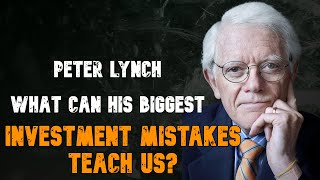
Peter Lynch's biggest investing mistakes and the lessons behind them. Peter Lynch is widely celebrated as one of the greatest investors in Wall Street history. His results at the Mellan Fund, 29% annual average returns from 1977 to 1990 made him a legend. But the story of his success is not only the story of brilliant stock picks and insightful research.
Much of what made Lynch a formidable investor came from his willingness to learn from his mistakes, admit them openly, and convert each failure into a principle that guided him forward. And the truth is, he made many mistakes. The difference between a great investor and an average one is not the number of mistakes made.
Every investor makes them. The real question is, what do you learn from them? Lynch has always emphasized that investing is a game of imperfection. You don't need to be right all the time. In fact, Lynch would say if you pick 10 stocks and six turn out well, you are already winning. But this mindset did not appear magically, it was built through years of painful experience.
One of Lynch's biggest lessons comes from buying into story stocks, companies that had charismatic CEO narratives, flashy marketing, or media buzz, but no rail business foundation to justify the hype. Early in his career, he sometimes found himself buying into stories rather than earnings. He learned the hard way that excitement is not the same as profit.
A company may be in a fascinating industry, but if it doesn't generate cash or have a clear path to profitability, investors are only buying a dream, and dreams can collapse quickly. Lynch explained this perfectly. Far more money has been lost by investors in companies with a great story than in companies with a poor story, but real earnings.
Another mistake Lynch openly admits was holding on to losers for too long simply because he wanted to be right eventually. He calls this the emotional trap. Many investors fall into it. When a stock drops, they panic. But they also justify holding it because selling feels like admitting defeat. Lynch learned that if the company's fundamentals deteriorate if sales decline, debt rises, management weakens, then waiting for a rebound is not courage, it's denial.
Price declines alone do not justify selling, but a broken business does. Lynch also learned the danger of buying companies he didn't fully understand. Early in his career, he occasionally purchased stocks in industries that seemed attractive but were too complex to analyze clearly. If you can't explain what the company does in a few sentences, you shouldn't own it.
That single sentence came from years of painful investing errors. Another famous Lynch mistake came from chasing market timing. At one point, he believed the market was due for a major correction. So, he became cautious and hesitated to invest even when he found good opportunities. The correction never came.
He missed out on major gains. Lynch's realization, nobody can reliably predict the market. Not analysts, not economists, not even legendary investors. Trying to time the market is not a strategy, it's gambling. Instead, his new philosophy became simple. Focus on the businesses, not the noise. If the business grows, the stock will eventually follow.
One of the most relatable mistakes Lynch admits is selling winners too early. When a stock doubles, there is a strong emotional urge to take profits. The fear of giving back gains can overpower logic. But Lynch discovered that many of his best performing investments went on to grow five, 10, even 20 times after doubling.
He learned to hold on to great companies and let compounding work its magic. Mistakes also taught him humility. He realized even the most well-ressearched investments can fail. A perfect spreadsheet cannot predict a dishonest CEO, a sudden regulation change, or a disruptive technology. The stock market has a way of humiliating those who act as if they are smarter than the system.
Through his own failures, he understood this core reality. Investing is dealing with uncertainty. You must build a mindset that can withstand being wrong repeatedly without losing confidence or discipline. Perhaps the deepest lesson Lynch learned from his mistakes is the importance of self-nowledge.
Many investors buy stocks based on what others recommend. They rely on the confidence of someone else. Lynch emphasizes know what you own and know why you own it. When you understand a company deeply, downturns become tolerable. When you don't, every market drop feels like a crisis. Ultimately, the reason we study Lynch's mistakes is because they didn't destroy him, they shaped him.
His errors became rules. His disappointments became insights. His humility became his competitive edge. And that is the message for every investor. Success requires being comfortable with failure. You will buy stocks that go down. You will misjudge companies. You will fall into emotional traps. This is normal.
What separates the successful from the defeated is what happens after the mistake. Peter Lynch didn't hide his failures. He analyzed them. He learned from them. and then he moved forward stronger, smarter, and more disciplined each time. In the world of investing, mistakes are not the enemy. Ignoring them is the psychology behind Peter Lynch's worst trades.
Why emotion is the real risk. Every investor believes they are rational until the market proves otherwise. Peter Lynch discovered throughout his career that the greatest danger in investing does not come from recessions, interest rates, or even corporate fraud. It comes from the investor's own mind.
Fear and greed are always present. They whisper in the background during every decision. Should I sell now before I lose more? Should I buy more before it rises again? Lynch learned that successful investing requires battling these inner voices constantly. When a stock price falls sharply, fear takes control.
Even if the fundamentals remain strong, most investors feel anxiety building. Lynch himself felt it many times. He would look at a stock he believed in, watch the price drop 20%, 30% or more, and feel doubt beginning to creep in. What if I misread the numbers? What if the business is in more trouble than I think?
This panic response is deeply human. Our brains are wired to avoid loss, sometimes even when opportunity is right in front of us. One of Lynch's famous teachings comes directly from this emotional struggle. The key organ for investing is not the brain, it's the stomach. If your stomach can't handle volatility, you will sell at exactly the worst moments.
That is what Lynch witnessed repeatedly, not only in others but in himself. The opposite emotion, greed, is equally dangerous. When a stock rises quickly, investors often assume it will continue rising forever. Lynch sometimes bought more during these euphoric rallies, thinking he was confirming his success, only to watch the price reverse shortly after.
Overconfidence blinded judgment. Momentum fooled logic. Greed transforms caution into carelessness. Lynch realized that both emotions lead to the same outcome, buying high and selling low, the exact opposite of what investors intend. One of his biggest emotional mistakes came from trusting market predictions.
Analysts on television. Economists writing bold forecasts. Everyone claims to know when the next crash or bull run will happen. Lynch once tried to prepare for a predicted downturn by holding too much cash, missing extraordinary gains when the market unexpectedly surged. That experience taught him a timeless truth.
Nobody knows the future, not even experts. The market rises more than it falls over time, but declines feel more intense, more frightening, more urgent because fear screams louder than reason. Another emotional trap Lynch identified was anchoring, the tendency to cling to a specific price level as if it holds meaning.
For example, if he bought a stock at $50 and it fell to $35, he sometimes refused to sell because he kept waiting for it to return to $50. He wanted to break even. But the stock market does not care about an investor's pride. A $50 purchase price is history, not a guarantee. This anchoring bias caused Lynch to hold underperforming stocks longer than he should have.
Through pain, he learned that price alone does not dictate value. The true anchor must be business fundamentals. Lynch also confronted the dangerous influence of crowd psychology. When everyone loves a stock, it feels safe even if valuations make no sense. Herd mentality gives people comfort even when handing off a cliff.
During hype-driven moments in the market, Lynch sometimes entered too late or added more than he should have, only to find that the peak had already passed. A lesson emerged. When everyone agrees loudly, the risk is usually highest. Perhaps one of Lynch's greatest emotional breakthroughs came from embracing mistakes publicly.
Most investors try to hide their bad decisions. Lynch did the opposite. He exposed them. Why? Because naming a mistake forces you to think clearly about it. It removes ego. It prevents repetition. Every mistake became a chapter in his internal rule book. And the most important rule written from those chapters.
Always trust your own research. Lynch discovered that listening too much to others, brokers, analysts, media led to bad trades. When he relied on recommendations instead of firsthand understanding, he was flying blind. Emotional confidence borrowed from others collapses easily. But confidence built on personal knowledge is resilient.
Lynch also learned that patience is an emotional skill. Not everyone can wait years for a company to grow. Many investors demand instant results. If the stock does not rise quickly, they lose faith. Lynch realized that most great companies need time, sometimes a long time, to prove their potential. Impatience kills more profits than bad decisions.
Through all this, he formed a powerful philosophy. Investing success is 10% numbers and 90% temperament. Anyone can calculate ratios. Anyone can read earnings reports. But very few can remain calm when chaos hits. Very few can continue believing in their analysis when others call them foolish. Very few can act rationally while feeling uncertain.
Lynch's mistakes taught him mental discipline. They taught him to treat volatility not as danger but as a routine part of investing. They taught him that emotional control is a competitive advantage. And most importantly, they taught him that humility protects wealth better than intelligence alone ever could.
In the end, his greatest takeaway was simple. You will never eliminate emotion from investing. But you must prevent emotion from making the decisions. Peter Lynch's legacy is often celebrated as a string of brilliant wins and market beating strategies. Yet, what truly elevates his wisdom is his humility in acknowledging mistakes and extracting powerful lessons from them.
And in this final part of our minieries, we dive deep into the real stories where Lynch, yes, even the legendary manager of the world famous Mellan Fund found himself on the wrong side of the trade. Because the truth is investing is rarely a straight line upward. Even the greatest investors experience doubt, misjudgments, and painful losses.
What sets them apart is not perfection, but the relentless pursuit of learning from imperfection. One of Lynch's most famous admissions is his error in overbelieving in stories that seemed too compelling to fail. He invested in companies where the narrative was beautiful, the executives were charismatic, and the future appeared guaranteed.
Yet, some of these companies crumbled, not because the story was bad, but because the numbers, the real fundamentals, didn't support the dreams being sold. Lynch later described this lesson simply. You must always separate facts from fantasies. Another mistake Lynch openly discussed is holding losers for too long.
When we invest, our ego becomes attached. We want to be right. We tell ourselves it will come back. It has to. Lynch understood that dangerous psychology too well. He said, "The stock doesn't know you own it. If the business underperforms and the thesis breaks, the investor must break up with the stock no matter how much time or pride has been invested.
Lynch also learned the opposite mistake, selling winners too soon. It's a painful irony in investing. We babysit the losers and abandon the winners. Lynch recalls multiple moments when he sold shares early to lock in gains, only to watch those same companies multiply in value for years afterward. His revised approach became a core rule when the story continues to improve.
Let the stock run. Don't interrupt greatness. Another crucial lesson came from ignoring his own strategy. Peter Lynch was famous for coining invest in what you know, but even he occasionally strayed into industries outside his circle of competence due to market hype or enthusiasm from analysts. Those trades rarely worked.
Lynch emphasized that personal knowledge, being a customer and observer of real world trends, gives investors an edge no Wall Street report can match. Whenever he forgot that, he paid the price. Even his greatest wins often began as simple everyday observations. But perhaps his most profound mistake involved misjudging timing.
Lynch admitted he sometimes underestimated how long it would take for a strong company to turn around or for a thesis to materialize. Great fundamentals don't always mean instant stock growth. The market can stay skeptical longer than expected. But if the thesis remains intact, patience, not panic, becomes the investor's advantage.
Lynch humorously summarized timing with one of his most popular lines. Far more money has been lost anticipating corrections than has ever been lost in the corrections themselves. The challenge, he said, is to remain present. Stay calm while others rush in fear. The true lesson behind all these mistakes is that there is no perfect investor.
Lynch's reputation wasn't earned because he avoided errors. He made thousands of them. What distinguished him was the discipline to constantly review the reasoning behind each decision. His process of self-criticism became his greatest tool. He documented mistakes, questioned his emotions, and refined his methods continuously.
For Lynch, every bad investment was tuition, a cost paid to the school of the stock market. But what do we learn from Peter Lynch's journey? First, that knowledge is power, but only if it is based on real research-driven understanding. When we buy a stock, we must be able to explain in one or two sentences why the business will grow.
If we can't do that, we're gambling, not investing. Second, Lynch teaches us to trust our own eyes. When a store is always packed, when new products sell out instantly, when trends shift clearly in daily life, these observations matter more than any analyst forecast. Third, focus on the business, not the stock price.
Prices move constantly. Businesses evolve steadily. The investor who tracks prices becomes impulsive. The investor who tracks businesses becomes wealthy. Fourth, diversify, but not without purpose. Lynch warned against diversification where investors buy everything and understand nothing. Hold enough to reduce risk, but only what you can truly follow.
And fifth, remember that mistakes aren't failures, their data, their guidance, their invitations to improve. The greatest sin in investing is not losing money, it's refusing to learn why. Lynch emerged from his mistakes stronger, sharper, and wiser, which is exactly why he generated one of the most extraordinary track records in financial history.
Now, here's the final takeaway. Peter Lynch retired early, not because he lost his touch, but because he believed that success means knowing when enough is enough. He wanted to spend time with his family. He wanted a life beyond charts and earnings calls. And that may be his ultimate lesson. Investing is a tool, not a purpose.
The purpose is life itself. What good is wealth if you aren't present enough to enjoy it? Peter Lynch remains a legend, not because he was flawless, but because he showed the world that greatness comes from curiosity, humility, and a willingness to admit, "I was wrong. Now, let's learn." And so, as we conclude this three-part documentary exploration, we walk away inspired.
Inspired to be rational yet adventurous, cautious yet optimistic, confident enough to make decisions, and humble enough to grow from them. That is the Peter Lynch mindset. And if you embrace it, if you let every mistake become a stepping stone, your investing journey will not just be profitable, it will be transformational.
Thank you for joining us on this deep dive into the mindset, achievements, and lessons of one of the greatest investors of all time, Peter Lynch. His journey reminds us that success in the stock market is not about predicting the future, but about understanding the present. It is about staying curious, remaining disciplined, and continuing to learn every step of the way.
If this video helped you rethink how you approach investing or inspired you to take the next step in your financial education, we would be glad to have you with us as we continue exploring the wisdom behind the world's most successful investors. If you enjoyed this documentary, please like this video, subscribe to the channel, and turn on notifications so you never miss our future content about value investing, market psychology, and long-term wealth building strategies.
This is only the beginning. More powerful stories and insights are coming soon. Thank you for watching, and remember, invest in what you know, trust your research, and let patience be your greatest advantage. See you in the next video.


Comments 0