저자: BillyExplainsFinance진행자 · 외국인
요약 보기
마이클 버리가 X에 '시장이 부정(denial) 단계에 있으며 닷컴·2008 사례상 이 단계는 6~9개월 지속된다'고 게시. 핵심 우려는 AI 서버용 GPU의 감가상각 과소 반영(실제 노후화 속도가 장부보다 빠름), 오라클 등 AI 기업의 고객이 곧 대출자인 구조, 미국 재정 여력 부족. 반대 측은 버리의 과거 약세 예측 적중률이 낮다고 지적(스티브 아이즈먼은 감가상각 주장에 반대). 결론은 고평가 위험은 인정하되 폭락 시점 예측은 과도하다는 균형적 시각.
다듬은 글
The man who predicted the 2008 housing crash just posted two sentences that are spreading across every trading desk in America. He says the stock market is grieving and doesn't know it yet. The market's response so far? It closed at a record high the same day. So, who's actually right here and should you care?
Let's break it down. If the name sounds familiar, it's because Michael Burry is the investor the movie The Big Short was partly built around the guy who bet against the entire housing market years before the 2008 financial crisis. When almost everyone on Wall Street thought he was crazy, he turned that bet into one of the most famous trades in financial history.
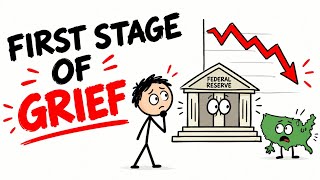
Since then, he's run his own fund, Scion Asset Management, and built a reputation for making loud, early, contrarian calls, some brilliant, some wrong. Which brings us to October 5th of this year, when he posted something on X that immediately started getting screenshotted everywhere. Here's the exact quote: The stock market is quite obviously in its first stage of grief, denial.
Per 2000 and 2008, this stage lasts 6 to 9 months. That's it. Two sentences. No price target, no specific date for a crash. Just a claim that we're currently in stage one of five, the classic stages of grief, borrowed from psychology, denial, anger, bargaining, depression, and acceptance. His argument: In the run-up to both the dot-com crash and the 2008 financial crisis, there was a period where the market kept climbing, kept setting records, kept ignoring warning signs before reality eventually caught up.
He's saying we're in that exact phase right now, with the AI boom playing the role the dot-coms played in 2000 and mortgage-backed securities played in 2008. The timing wasn't random, either. The day before his post, the S&P 500 had just closed at a fresh all-time high. He followed up a day later with a pointed example calculating that Anthropic's private market valuation alone could theoretically buy 78 profitable S&P 500 companies mentioning names like FedEx Freight and Lululemon by comparison.
His point, valuations in AI right now aren't just high. They're detached from what similar amounts of money buy anywhere else in the market. This wasn't a one-off tweet. Burry has been building this case for months. He's raising concerns about something far more technical than just stocks are expensive.
He's looking at how AI companies account for their hardware. Data centers are packed with high-end GPUs. On paper, companies depreciate or write off the cost of these chips over several years. But Burry's argument, these chips could become obsolete much faster than their accounting models suggest. If that's true, today's reported profits are artificially inflated masking the real financial health of these businesses.
He specifically flagged Oracle's massive, roughly $64 billion AI backlog, making a sharp observation. In many of these deals, the customer is now the lender. In simple terms, AI companies are actually financing the very infrastructure meant to prove their technology's value. And his biggest worry goes far beyond any single stock.
Burry argues that the US government is in one of its weakest fiscal positions in modern history. If a shock hits, policy makers have almost no room to step in, especially when the AI build-out has become the economy's primary growth engine. An engine they simply can't afford to let stall. If If like this help you cut through the market noise, hit subscribe.
I break down macro calls like this every single week. Now, here's the part Burry's critics don't want you to miss. Here's the honest context missing from most of the viral posts about this. Burry has made bearish market calls essentially every year since 2021. By one count, he's flagged roughly a dozen separate crash warnings over recent years, and only a handful actually lined up with real market declines.
One widely shared headline put it bluntly, "He's called 12 of the last three crashes." That doesn't necessarily make him wrong this time. Even a correct warning has to be wrong many times before the one time it isn't. But it matters for how much weight you put on any single post. He's also getting direct pushback from people with similar track records.
Steve Eisman, another investor made famous by the same housing crash trade and the same movie, has publicly disagreed with Burry's depreciation argument specifically, calling the concern too academic given how strong actual chip demand has been. And it's worth noting Burry's own positioning. His last confirmed disclosed bets were put options against Nvidia and Palantir, filed back in November of last year, and he's since gone quiet on new SEC filings, closing his fund down from public disclosure requirements, which means we don't actually know what, if anything, he's currently betting on.
Here's the balanced way to think about it. Burry's specific technical argument that AI infrastructure may be depreciated too slowly on company books is a real accounting question worth understanding, not dismissing outright, regardless of who's raising it. Valuations in parts of the AI sector genuinely are stretched by historical standards, and that's not controversial even among AI bulls.
But, the market is overvalued and the market is about to crash on a specific timeline are two very different claims. And Burry's track record shows he's been much more reliable at the first one than the second. His own framework even admits the uncertainty. He gave a 6 to 9 month range for a phase of grief, not a date for a crash, and openly left out what happens after.
If you're invested in AI-related stocks, the lesson probably isn't panic and sell everything because one investor posted on X. It's understanding that elevated valuations carry real risk, diversifying accordingly, and not assuming record highs today guarantee record highs tomorrow, regardless of who turns out to be right about the timing.
So, to recap, Michael Burry says the market's in denial, the first of five stages of grief, and based on 2000 and 2008, that stage historically lasts 6 to 9 months before something worse follows. His specific worry centers on AI accounting and valuations. Critics point out his long history of early and sometimes wrong bearish calls.
Nobody actually knows who's right yet. That's exactly why this is worth understanding instead of panicking over. If this helped you see both sides clearly, subscribe for more breakdowns like this. See you in the next one.
Comments 0