원문 보기
thing that teach you in business school about compounding and the laws of you know, the power of compounding it applies to saving yourself from challenges. Meaning, just make a little bit of progress every day. You won't notice the progress for the first 30 days. 90 days in you're starting to notice the curve is starting to move.
6 months in you've made huge progress. Uh don't look at where you fell from. Don't look at the startup that had a $300 million valuation where you raised money and now you're starting all over again because the original idea didn't work. Don't don't focus on the 300. Focus on where you are. Focus on the next step.
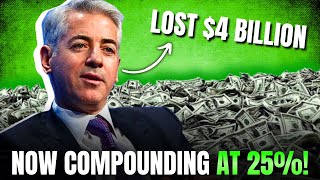
Make a little progress every day and it works every time. Uh and you know, the never give up thing is entirely true. Um and I'm a good example of that. So, I've I've made bigger mistakes in the investment business than almost anyone. I lost $4 billion on one investment. And yeah, it's big number. Um and uh and despite that all of my investors who stayed with me over time have done extremely well.
You know, it's been a 16% compounded return for 20 years of Pershing Square, but it wasn't straight line up. There was a moment where we were down 35% uh in 2017 from the peak. Uh investors were redeeming capital. I was going through a divorce. Um you know, there I had a litigation in connection with one of my investments.
It was a really sort of grim moment and um you know, I took my own advice. Made a little progress every day. Used good judgment. And I'm way better off uh today having gone through that sort of moment. Our firm is you know, one of the important things about our uh the investment business. Problem with the investment business if you're a long-term investor is investors generally give you money over relatively short period of time and you're and you're trying to generate value over a long period of time and there's this mismatch and people talk about you know, the asset liability mismatch problems.
You have a bank where you're taking deposits, you're making longer term loans. That creates risk. The same thing's true in the investment business. So, my ambition was always to get to a place where the capital was permanent, where it would never leave. And the path by which I got there, it was that failure that created the opportunity to create permanent capital.
And that's been a huge advantage for us. So, look at every challenge as an opportunity. The good always comes from the bad. You just have to look for it. That podcast I uh I've sent that reel with Friedman, that interview that you did about the little steps. And I I sent that to uh both of my kids. And we played that And I keep sending it to them.
Every time it pops up on my Instagram, I repeatedly send it to my son and daughter. Um I was going to try to figure out how to tempt you into doing it, but you did exactly that podcast of the little steps of compounding. Um nutrition, sports, health. Maintain your health first. Yeah. Actually, I'll I'll tell that part of the story.
Yeah, so I'm also a huge believer that you can't make it through a challenge unless you're physically, mentally healthy. So, you know, good sleep, weightlifting is actually This is a good audience to talk to is very It's good for your muscles. It's also really good for your brain. Uh and uh nutrition.
I don't know I haven't checked out the food here. Um but I'm kind of a believer that this seed oil thing is not good for you. I went zero sugar beginning November. It's been amazing. Uh I recommend you do that as early as possible. Sugar is poison. Uh and uh the sooner you give it up, when you the withdrawals are like a couple weeks without heroin, I think.
But But once you're through the the uh the withdrawal, um it's kind of a life-changing thing. So, nutrition, sleep, exercise, uh you know, some sun, uh and you can you can get through anything. Um you This is a slide of the mere 45X return of Pershing Square since inception. Um Do you want to explain the, uh, best investment, worst investment?
Actually, the thing I'll point out here, you see if the line sort of gradually goes up, that's a 21% compounded return for the first dozen years. And then there's like a relatively small decline. That relatively small decline is down 35%. And at the time it felt momentous. But the beauty of compounding with the passage of time is you look back, doesn't look that doesn't look that meaningful.
You know, right? So that's the thing that you have to remember. The challenge you're feeling feels monumental. You know, the business loss, the money loss, the [snorts] maybe you got sued, maybe you lost a lawsuit, a divorce, I mean, I you have a health issue, it feels just like your life's over. Um, and uh, it's how you successful people, it's how you deal with the challenge, how you deal with the failure that determines your success.
It's a little it's less about the success. It's more about the inevitable challenge and making it through it. And a lot of people, you know, just sort of veer off and give up at that moment. If you don't, you know, it it works. Most people think compounding is all about money, but billionaire investor Bill Ackman says it applies to life as well.
As we know, Ackman faced major setbacks, including 35% crash in his fund and a loss of nearly $4 billion on a single investment. Yet instead of quitting, he kept learning, improving, and moving forward. His message is that success is not about avoiding failure. It's about getting back up and compounding small improvements over time.
Today his firm, Pershing Square, manages more than $31 billion in assets. Over a recent five-year period, the portfolio has generated annualized return of roughly 25%, demonstrating power of long-term compounding. This proves that persistence and compounding can turn even the biggest setbacks into remarkable comebacks.
Both in life and investing, compounding does not reward perfection. It rewards persistence.



Comments 0