원문 보기
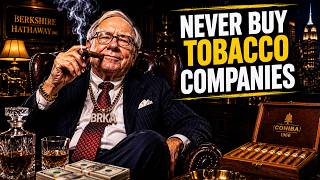
My question deals with tobacco stocks, which have been beaten down lately. Does Berkshire own any tobacco stocks, and are some of these stocks attractive now that prices are down on some of them? Yeah, we have owned We won't comment on what we own now, but we have owned tobacco stocks in the past. We've never owned a lot of them, although we may have made a mistake by not owning a lot of them.
But we've we've owned We've owned tobacco stocks in the past, and I've had people write me about whether we should do it or not. Uh we own a newspaper in Buffalo that carries tobacco advertising. We don't Uh well, actually, Charlie's a director of of a sensational warehouse chain called Costco, which used to call Price Costco.
You know, they sell cigarettes. So, we are part of the distribution chain with a 100% owned subsidiary in the Buffalo News, and we have felt that if we felt they were attractive as an investment, we would invest in tobacco stocks. We made a decision some years ago that we didn't want to be in the manufacture chewing tobacco.
We were offered the chance to buy uh a company that has done sensationally well subsequently, and we sat in a hotel in Memphis in the lobby and talked about it and finally decided we didn't want to do it. Can I give you some because we thought it wouldn't do well. We knew it was going to do We knew it was going to do well, but now, why would we take the ads for those companies, or why would we own a supermarket, for example, that sells them, or a 7-Eleven, you know, or a convenience store that sells them or something of the sort, and not want to manufacture?
I really can't give you the answer to that precisely, but I just know that one the one bothers me and the other doesn't bother me. And I'm sure other people would draw the line in a different way. So, the fact that we not been significant holders of tobacco stocks has not been because they've been on a a boycott list with us.
It just means that overall, we were uncomfortable enough about enough about their prospects over time that we did not we did not feel like making a big commitment in in them. uh Charlie? I think each company, each individual has to draw its own ethical and moral lines. And personally, I like the messy complexity of having to do that.
It makes life interesting. I hadn't heard that before. We'll make him in charge of this decision. no, but I don't think we can justify our call particularly. We just We have to draw the line somewhere between what we're willing to do and what we're not. And we are guided by our own lights. We owned a lot of bonds at one time of RJR Nabisco, for example, meant some years back.
And should we own the bonds and not own the stock? Should we own the, you know, should we be willing to own the stock but not be willing to own the business? Uh those are tough calls. Probably the biggest The biggest distributor of The biggest seller of cigarettes in the United States is probably Walmart.
But, just because they're the biggest seller of everything. They're the biggest seller of Gillette products. And they're huge. And, uh you know, do I find that morally reprehensible? You know, I don't. If I own We owned all of Walmart, we'd be we'd be selling cigarettes at at Walmart. But, other people might call it differently, and I wouldn't disagree with them.
Questions about the future of the tobacco business? I probably know no more about that than you do because it's uh it's uh it's fraught with questions that relate to societal attitudes. And and you can form an opinion on that just as well as I could. But, I would I would not like to have a significant percentage of my net worth in the tobacco business myself.
But, uh they may have better futures than than I envision. I don't really think that I have special insights on that. Charlie, you No. You have to come to a conclusion as to how how society is going to want to treat And and the present administration, for that matter. And and uh the economics of the business may be fine.
Uh but, that doesn't mean it has a great future. I think there are some strong arguments that can be made to say Classic Coke should never be part of anyone's diet. If such an argument could be made and you were convinced of it, would that change the way that you viewed Coca-Cola Company as part of your portfolio?
Well, I think that's a hypothetical. It simply wouldn't happen. I mean it uh I've been drinking five of them a day, you know, and uh maybe it's the combination of that and peanut brittle, you know, that does the job, but I I just feel terrific. [laughter and gasps] The uh We passed one time on the chance to buy an extraordinarily probable company because Charlie and I met the people that ran it.
And they were they were perfectly decent people, too. And we went down in the lobby of the hotel that that we met them in and we just decided that in the end we didn't want to be involved in that. On the other hand, I would have bought stock as a publicly traded stock in the same company. I'm Charlie will give you his view on that later.
Uh so, I do not have a problem buying stock in companies, marketable securities, the bonds of companies in the market that engage in activities that I wouldn't probably endorse myself. I would have trouble owning outright and actually directing the activities of some of those companies. But any major retailer in this country is virtually is going to be selling cigarettes, for example, with if they're not declared illegal, it does not bother me to own it would not bother me to own those retailers outright or does not bother me to own the stock.
Yeah, but you wouldn't buy a company that made the tobacco and concocted the advertisements. No, we we would and you know, I can't tell you perfectly why that I don't I mean I can't tell you that the perfect line or I can't tell you precisely why that's where I draw it, but I will tell you that is where I draw it.
We would not be in the manufacturer, but but we owned stock at one time in RJR Reynolds before it had the LBO. We owned bonds in it and you know, I would still be doing it if I liked either the bonds or the stock. We would not buy the manufacturer. And like I say, we walked on one that uh we went down to the hotel to talk about it though, too.
So, we would have to say that that that we were thinking about it, but we decided not to do it. We didn't think very long. The uh we don't claim to have some kind of perfect morals. You can draw these lines where you wish, but at least we've got a huge area of things which is perfectly legal to do that we think grieves us, so we won't do them.
And we see more and more in America a culture where just anything that's unlikely to send you into prison, which looks like it'll make money, is okay. And that is a very bad development. But I think I think it's a little crazy myself to say that it's terrible if people eat hamburgers or eat or drink Coca-Cola or eat candy or anything like that because they're like they get away with it.
That is a perfectly optional decision, and and who knows whether somebody has lived a happier life that lives to 75 and and their overweight condition causes them to die a little sooner they lived to 85 and lived on carrots and broccoli, and you know, has lived a better life. I know which one I prefer.
Hi, Mr. Buffett. I'm Alan Maxwell. My wife and I are shareholders from Omaha. I'm going to keep things simple so you can understand them. Good. Um Alan's a friend of mine, so he can get away with that. Thank you, Colonel. Uh excluding the Buffett stake, your salary is approximately or is $100,000 a year.
It's been stuck there for a while, but we'll talk about the board. Well, you'll be happy with my question. You can make it a motion if you're heading where I think you are. [gasps] In other words, we're paying you 10 cents a share to manage a $90,000 investment. That's remarkable in today's corporate culture.
Thank you, Mr. Buffett. Thank you. Yeah, thanks. Alan, thank you. But I have to tell you, as I did last year, I would I would pay to have this job. I mean, it is it doesn't get any better than this. Well, rather than you doing something for us, I would like to suggest that we, the shareholders, do something for you.
As a shareholder, I would be willing to pay you 25 cents [snorts] an A share. So, that way you could save a little extra money for your retirement. Would you support such an idea? Alan, I'm getting social security now. And that really pretty well takes care of things. My family would go crazy if I made any more money.
This would help But I appreciate the I appreciate your offer, however. My heart's with you. Thank you. Okay, thanks, Alan. When being asked a question on tobacco stocks in 1997, you mentioned that individuals and companies occasionally have to draw moral lines about what they're willing to do. You stated at the time that you were not comfortable in making a big commitment in tobacco stocks, and that you were uncomfortable about their prospects.
Charlie has also referenced passing up on a private tobacco deal that you both knew was a cinch, yet you both have no regrets in saying no to the transaction. I'm not suggesting that the oil and gas business has the same known negative externalities as cigarettes. They do not. With tobacco, the cause and effect relationship between the products and cancer is direct, obvious, and measurable.
With hydrocarbons, the societal costs and benefits are far more complex to evaluate. Has the alarmism from the climate community now become pervasive across society to the extent it has become irrational? Well, I'll give you a 10-word answer to that. They uh I can't remember all the questions that were there, but I would say that people that are on the extremes of both sides are are a little nuts.
I I I would hate to have all the hydrocarbons banned in 3 years or you know, you wouldn't want a world it wouldn't work. And on the other hand, you know, what's happening will be adapted to over time just as we've adapted them to all kinds of things. I do not think I I'm interested in that quote from 1997 because you know, we've talked about this before.
We'd have no problem owning Costco or Walmart, you know, and a substantial number of their stores and you know, they they sell cigarettes is a big item, you know, it's it's something that brings people in. They know the price of cigarettes and and they put them up front and [clears throat] it's a very tough situation.
We made that decision a long time ago when we went to Memphis and we looked at a business that was a very very good business and it was much less harmful at least from everything I could find out. It was much less harmful than smoking tobacco chewing tobacco was and these were decent people and they were running a legal business and they all chewed themselves so they they and they told me that their mother was 100 and chewing tobacco and all these things but Charlie and I did go down in the lobby of that hotel and we just said to ourselves this is probably the best business we've ever seen.
I called my then son-in-law Allen Greenberg and he'd studied chewing tobacco and its effects when he was working for a NATO related organization and and we decided not to do it but you know, would we you know, I see I used to see ads in our paper from financial companies where I knew they were terrible, you know, and I it's it's a very tough thing to decide whether you get in or out of a business.
It's a very tough time to decide what what companies benefit society more than others. I mean, it's I don't know whether I think Chevron's benefited society in all kinds of ways and I think it continues to do so and I think we're going to need a lot of hydrocarbons for a long time and we'll be very glad we've got them but I do think that the world's moving away from them too and and that could change.
I don't like making the moral judgments on stocks in terms of actually running the businesses, but there's something about every business that if you knew what you wouldn't like. And if you expect perfection, you know, in your spouse or in your friends or in companies, you're not going to find it. And and uh what you elect to do yourself, if you own an index fund, you're going to own if you own an Let me Chevron is not an evil company in the least.
And and I have no compunction about owning in the least about owning Chevron. And if if we owned the entire business, I wouldn't I would not feel uncomfortable about being in that business. Charlie? Well, I agree. You know, you you can imagine two things. Young man marries into your family. He's a English professor at Swarthmore or he's a he works for Chevron.
Which would you pick? So, I don't see I want to admit I'd take the guy from Chevron. Well, I hope your daughters agree with you. Yeah.


Comments 0