저자: 미상 · 한국인
요약 보기
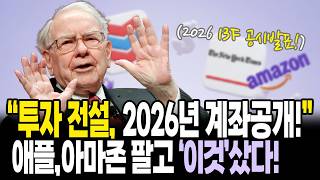
워런 버핏의 최신 13F 포트폴리오 변화를 분석한 영상으로, 버크셔가 뉴욕타임스 주식을 신규 매수하고 아마존 지분을 대폭 줄였으며 현금성 자산을 사상 최대 수준으로 보유 중이라고 설명한다. 뉴욕타임스(NYT) 투자: 버크셔가 지난 분기 뉴욕타임스 주식 약 3억5천만 달러어치를 신규 매수했다고 공시되었고, 공시 직후 시간외에서 약 3% 상승했다. 과거 지역신문을 매각했던 버핏이 디지털 구독 플랫폼으로 전환에 성공한 기업을 골라 투자한 것으로 해석된다. 유료 구독자 1천만 명 이상을 확보했다는 점이 근거로 제시되었다. 아마존 및 애플: 버크셔가 지난 분기 아마존 지분의 약 75%를 매도해 약 230만 주만 남겼다. 애플 비중도 축소되었으나 여전히 최대 보유 종목(약 22.6%)이다. 셰브론(쉐브론): 이번 분기 800만 주를 추가 매수해 보유량이 1억3천만 주를 넘었다. 트럼프 대통령의 베네수엘라 석유사업 재건 발언 이후 주가가 올라 2026년 초 이후 약 19% 상승했다고 설명된다. 에너지 업종 확대 신호로 해석된다. 보험사 Chubb(체브) 지분을 9% 이상 늘린 것도 언급되었다. 보험은 버크셔의 핵심 사업이라는 논리다. 현금 및 단기국채: 2025년 하반기 기준 약 3,820억 달러로 역대 최고 수준이다. AJ Bell은 시장 고평가에 따른 투자처 부재와 후계자 그렉 아벨의 대형 인수합병 자금 마련을 이유로 꼽았다. 2026년에는 4,000억 달러를 넘길 것으로 전망했다. 포트폴리오 상위 종목: 애플 22.6%, 아메리칸익스프레스 20.5%, 뱅크오브아메리카 10.4%, 코카콜라 10.2%, 셰브론 7.2%, 무디스 4.6%, 옥시덴털페트롤리엄 4.0% 순이다. 영상의 결론은 버핏이 산업 전체가 어려워도 경쟁력 있는 선도기업은 예외로 본다는 원칙을 적용했고, 과열된 기술주는 과감히 정리했다는 것이다. 특정 종목에 대한 단기 가격 방향 예측 발언은 없다.
다듬은 글
Do you remember when investment legend Warren Buffett sold all of his local newspapers, saying that most newspaper businesses were finished ? However, interesting news has recently been reported. On the 18th, a disclosure was released stating that Berkshire Hathaway had purchased more than 5 million shares of The New York Times .
Why did he choose a newspaper company again when he had viewed the newspaper industry negatively? I will tell you what new possibilities Buffett saw in The New York Times, what changes he made to Amazon and energy stocks, and even the top three of his current portfolio . Today's content is based on reports from AP News and Wales Book and the latest 30th disclosure from Berkshire containing Way's portfolio management results for the second half of 2025 .
Let's check it out right now . First, let's turn the clock back six years . In 2020, Buffett sold 31 newspaper companies he owned, including his hometown newspaper Omar World Herald, to Lee Enterprises . The sale price was $140 million, which was considered somewhat low in the market at the time . At the time, Buffett expressed concern, noting that most newspapers were losing their monopolistic competitive edge .
It was due to structural problems such as declining advertising revenue and reader attrition . However, in 2026, he decided to invest again in the media company, The New York Times. According to a 30 F filing, Wayne at Berkshire newly purchased $ 350 million worth of New York Times stock in the last quarter .
When Berkshire Hathaway disclosed that it had acquired a stake in The New York Times, the New York Times' stock price surged nearly 3% in after-hours trading. Then why did Buffett become interested in newspapers again ? Many experts interpret this as the New York Times having established itself as a digital subscription platform beyond being a simple newspaper .
Unlike regional newspapers that were sold in the past, The New York Times has secured more than 10 million paid subscribers worldwide. We are generating revenue not only from news but also from various content such as games, cooking, and sports . In other words, it appears that Buffett invested in a digital company with a unique brand and cash flow, rather than the declining newspaper industry .
Professor Franklin of Northwestern University, cited by AP News, analyzes it as follows. This should be viewed as an investment in a specific company, The New York Times, rather than Buffett jumping back into the entire newspaper industry . Professor Franklin added that this investment amounts to Buffett acknowledging that The New York Times has successfully completed its digital transformation .
Ultimately, this can be seen as a case where Lawfit's investment principle—that a leading company with overwhelming competitiveness is an exception even if the entire industry is struggling—is applied . Berkshire's transformation does not stop here. There is news even more shocking than the acquisition of The New York Times .
It is precisely the massive reduction in tech stocks. According to a 30 filing, Berkshire sold approximately 75% of its Amazon shares in the last quarter . There are now only 2.3 million shares remaining. Another surprising thing is the reduction in Apple's weight. It means they have entered into profit-taking or risk management for tech stocks in general .
Then, what stocks did Buffett buy additionally? This involves increasing the stake in the first global insurer, Chevrolet, by more than 9% . As insurance is the roots and core business of Berkshire Hathaway, it appears the company is strengthening its fundamentals by increasing its focus in the area it knows best .
Next is Chevron, the leading energy stock. In particular, Chevron purchased an additional 8 million shares this quarter alone, bringing its total holdings to over 130 million shares . This was a very timely decision. This is because Chevron's stock price surged after President Trump promised to revitalize Venezuela's oil business .
In fact, Chevron is the only major U.S. oil company operating a significant business in Venezuela. Since early 2026, the stock price has risen by nearly 19%, proving that Buffett's choice was correct. What is particularly noteworthy is Berkshaw's cash reserves. Based on disclosures for the second half of 2025, Berkshire’s cash and short-term government bond holdings reached an all-time high of approximately $382 billion, equivalent to over 500 trillion won .
AJ Bell, a UK investment platform, forecasts that this figure will exceed $4 billion by 2026 . It amounts to loading live ammunition on a scale without glass in the history of American corporations . Then why is Buffett hoarding cash to this extent ? AJ Bell presents two key reasons for this from the perspective of Buffett's final resolution .
The first is a signal of market overvaluation. This means that Buffett has not found any companies with attractive prices in the current stock market . The second is perfect preparation for the next CEO, Greg Abel . The analysis is that it provided overwhelming financial resources to Greg Abel, who will take over management, so that he could immediately carry out large-scale mergers and acquisitions during a market downturn .
It is precisely the elephant hunting that Buffett has always emphasized—that is, large corporate acquisitions. Under Greg Abel's leadership, there is a high possibility that Berkshire will secure new growth engines by acquiring entire giants in the energy or infrastructure sectors . AJ Bell analyzes that this massive bundle of cash is not merely savings, but can be seen as a strategic move prepared by Berkshire to dominate the next era ahead of a generational shift.
So, what are the top three stocks that make up the largest portion of Berkshire Hathaway's stock portfolio as of 2026 ? We will fact-check for you in order of specific gravity . Apple is still in first place . Even after reducing its share, it maintains an overwhelming first place with approximately 22.6% .
American Express took second place with about 20.5%, upholding the pride of financial stocks . Bank of America took 3rd place with approximately 10.4%, and Coca-Cola took 4th place with approximately 10.2%. What's noteworthy is Oi Chevron. The proportion jumped significantly to about 7.2% and up to 2%.
Moody's followed in 6th place with 4.6%, and another energy company, Occidental Petroleum, in 7th place with 4.0% . As you can see, Apple is the only tech stock, and the rest is packed with financial, consumer goods, and energy stocks . Perhaps this is the standard for true diversification and margins of safety that Buffett talks about .
Now, let's summarize the changes to Berkshire's Way portfolio disclosed in Thirteen F. First is flexible thinking. Although I was concerned about the newspaper industry in the past, I have reinvested in The New York Times, a company that has successfully transitioned to digital . Second is cool-headed judgment.
No matter how much I liked a stock, I adjusted its weight depending on the situation and decisively liquidated overvalued tech stocks . The courage to reconsider a field I once said was wrong if the company innovates, and to decisively cut ties with tech stocks that seemed like they would last forever if the situation changes .
I think that might be the wisdom of investors to survive in the complex 2026 market . If you found today's video helpful, please subscribe and like . thank you

Comments 0