
원문 보기
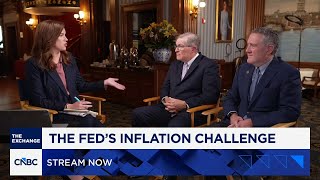
Welcome to ETF Edge, your go-to place for all things exchange traded funds. I'm your host, Dominic Chu. Has the Feds holding steady opened up new market opportunities or further clouded the picture for both fixed income and equity investors? Joining me now for the conversation are Jeffrey Rosenberg, senior portfolio manager of Black Rockck system systematic alternatives ETF alongside Bryant Vancronite who's the senior portfolio manager at Allspring Global Investments.
Thank you both for being here with us right now. I had mentioned a couple of the things in our intro with regard to the Fed and yields, but overall this market has been one that's been very bumpy for a lot of investors across many different asset classes. And perhaps that leads us to start maybe with you Jeffrey about this.
I I wonder what your take is from a portfolio manager standpoint about just what kinds of factors are driving the most of the market narrative in your mind these days. Yeah, Dom, I I I think you know just to pick up on yesterday's conversation uh with the with the Fed chair, I I found the most interesting interchanges around his characterization of financial conditions.
He had this conversation with one of the reporters where he started to talk about the questions came in around oil uh and what was the impact of the rise in oil and he started to talk about how Treasury yields had had this amazing correlation uh with oil and then in October uh it just stopped and then he went on to say I I don't write a Wall Street newsletter so I'm not going to comment on that.
Well, I don't write a Wall Street newsletter either, but I do run ISO systematic alternative active ETF and we want to talk to our clients about what's going on in in the portfolios. And and so what he didn't talk about was something that I think was the most important takeaway. You know, the correlation between Treasury yields and oil 80% this year.
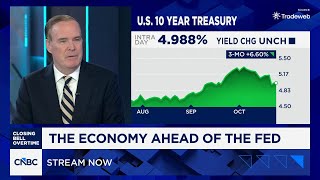
That's outsized relative to normal kinds of correlations. We basically been trading off of oil for good reason. It's the inflation. It's the downstream impact. oil reached new highs in October over 115 uh and treasury yields went down. So it told us something really important that in the market's mind the geopolitical risk is secondary to the AI risk and what happened in October is we've had a little bit of an AI retracement and yields went lower because an AI retracement writ large is an economic retracement.
Uh it's a little what you're seeing in the GDP report today. AI is everything everywhere all uh the time and that growth is being held up by AI both on the investment side and through the wealth effect the consumption side and what that means is if you have a wobble it's a it's a growth impact it's a disinflationary impact and the only thing that hedges your portfolio in that environment thing that everybody wants to hate loves to hate ourselves included uh the long end of the Treasury curve I thought that was a really interesting interchange he didn't take it all the way, but it's a really important lesson that we should take away from this last month of market performance.
Okay, Jeeoff, let me follow up with you on that one there because for the longest time, we had talked about this idea that treasuries have traditionally been a safe haven in times of geopolitical conflict, in times of economic distress. If you were worried about the economy in the future, you thought things were going to go down, you bought treasuries because they were the more attractive asset to hold.
that was not the case over the course of the past 6 to9 months when we saw yields rise the way that they did. Does this in your mind signal for you a a return to I mean I don't know what's normal these days but more traditional market constructs of the relationship between stocks and bonds. So it it's really a nuanced uh kind of answer here and and and unfortunately the simple answer is no.
um it's not a return to you know normal where normal was bonds hedge stocks and we we we have a great confidence in that and and and just to understand why because these are the the the the conflicting forces on bonds you know the oil price increases the persistent rise uh of or not the rise but the level of inflation above target that that uh Wars talked about yesterday these are challenges to fixed income and it's a challenge to the efficacy of fixed income as a hedge because we have too much inflation.
So that limits the ability of the Fed to provide accommodation when inflation is above target. So that part we haven't gotten away from. What what I think we learned in the last month is that if it's big enough, if the AI uh uh trend turns against the macroeconomic and inflationary trends, it it can bring about a a wholesale change in that direction.
That's disinflationary. and bonds may react as they did in the month of October positively to that. So there is some diversification benefit to be recognized there, but it's not going to be one directional and it's not going to be without a cost. the cost is if you're outside of that tail probability scenario of of AI, you know, unraveling the economy and you're in the more core scenario that this has got a lot longer to play out, then bonds are going to be challenged by that core scenario, rising inflation, rising term premium, the fiscal challenges, everything that that we talk about.
And so it highlights, I think, you know, another part of this conversation, which is, you know, the investors needs for alternative forms of diversification. And I mentioned Iel, it's a fund that I run. You know, this is bringing hedge fund type strategies to the masses through an ETF rapper, something no one has ever seen and no one has ever done before.
What we're doing in this fund and it's about using alpha as a diversifier because you have just a lot of beta in your portfolios. And on the equity side, that beta is good. It's been, you know, the beneficiary from the AI tech trade, but you have the challenge of a lot of concentration in that. So, how do investors deal with that?
Well, diversify your diversifiers and fixed income isn't, you know, the perfect solution here. Um, and so you want to think about how can I diversify my equity portfolio. And so, by adding some alpha, which is what we do in IELTS, uh, can be one of those solutions. Interesting as well because that's the alternatives perspective, the fixed income perspective.
Uh, Bryant, I I I'll turn to you for this one here because you handle more of the kind of straight up equity side of the equation for Allspring with regard to your portfolios and and their exposure. I I wonder to kind of Jeffrey's original point here. What was your key takeaway as you listen to Fed Chairman Kevin Worsh during his press conference and comments yesterday visav how you think equity markets are shaping up right now given that backdrop that we're seeing on a macro kind of big picture basis.
Seems like investors concern around what Chair Warish was saying was what really what he didn't say. They want to know more about the reaction function. They want to know thresholds at which point the committee will begin to act, how fast they're going to act, and he's chosen to say nothing about those things.
And so the market's worried about that. But I did hear two things that I thought were important uh to keep in mind. One, he did show some resolve around wanting to fight inflation. So there will be a reaction, it seems like, but we're not ready yet to say when that's going to happen. So that's one thing.
The other thing I thought that was really interesting and fairly astute in the way he said it is that the infl the the rising rate environment is working its way into the cracks of the economy and it's happening slowly and but it's happening in really profound ways and as you look closely at equities you can see it starting to unfold so there's three ways I see it happening number one it's changing demand and so you think about the demand for certain products or certain services and I put housing at the epicenter of that as rates have moved higher we're seeing pressure on demand for housing and of housing affordability that is impacting the economy.
It used to be said that housing is the economy and the economy is is housing. Now AI is the economy and the economy is AI. But we're seeing that work its way into the cracks of the housing market. The second thing we're seeing is it's working its way into the cracks of financing. And when money was cheap, every business know how no matter how good the asset base was, know how competitively managed it was, it had access to capital.
They kept a lot of companies actually in the private markets longer than maybe they should have. But as rates rise, we're starting to see the companies that that deserve the capital from those that don't. And you're seeing the projects that deserve the capital from those that don't. And I put the the AI spend, the hyperscalers versus the neoclouds right in that that epicenter.
And we're seeing how it can impact companies differently. The third and final thing that that I look at right now is the way change in rates is into the cracks of duration. And I know we talk about duration on the bond side, and that's more Jeff's world, but in my world, we see it too. We think about how it impacts valuation of equities and the longer the duration of the cash flow stream, the more the impact of rising rates negatively impacts the value of the stock.
And so software companies are are the key uh poster child for for for long duration cash flow streams. And so it's coming through the cracks. It's not seeping through in a massive way. It's not flooding in yet, but it's working its way in. And that's giving us chances to put capital to work in different areas of the market right now.
Brian. Okay. I want to follow up there as well because one of the things about rising rates that the way that we've seen them is to your point, it does affect the way capital flows around. It does kind of get you to a point where you have to kind of really pick and choose the types of projects that you greenlight, the types of investments that you make because the hurdle rates, those required rates of return are now higher across the board because the risk-free rates that you get in treasuries are now higher across the board.
So where exactly are those valuation gaps really starting to manifest themselves outside to your point of say Neoclouds and hyperscalers and some of the straightup AI trade? Yeah, I think that's right. So you have a higher risk-free rate and that you also are starting to see some differentiation in the credit spread.
So the caliber of the qual quality of your cash flow stream, the certainty of your cash flow stream is determining the spread over that treasury. And so there's some companies that are showing those are blowing out meaningfully and it's putting pressure on the equities. And so we talked about the hyperscalers as an example of that.
Uh you're looking at it also though from from how are banks responding. So banks aren't having a financing issue but the more rates move certain asset sensitive banks versus liability sensitive banks are beginning to diverge from each other. Uh and we're seeing it in the real economy. People uh making hard choices because affordability is going up.
So the affordability of homes, affordability of cars and all that cascades through uh the construction markets etc. So uh it's working its way into the real economy. And what I like about this is that we're starting to see the good ideas rise to the top and you're seeing the bad ideas begin to fall apart.
It's been very challenging in the equity markets to find uh differentiation. Things have moved in in lumps and I I think I think ETFs frankly have allowed investors to do that. We have so many thematic ETFs that that that people push into categories. The Allspring special large cap value ETF ASLV is a diversified ETF across different sectors and industries where we can participate in all of these these unique areas opportunities but it really is about single stock selection and alpha opportunity um that's generated because people are thinking too thematically thinking too macro at times Jeff let's talk about the uh alpha that you can find especially for a product like yours if you talk about systematic investment especially when it comes to fixed income and and other alter alternative investments.
You've now put I ALT and those hedge fund type strategies that you alluded to before in an ETF wrapper, making them a little bit more accessible and easy to kind of comprehend for investors who are trying to get into a product that can be a diversifier while still adding outperformance. So, if you have a a mandate that can allow you to go different places, what exactly have you seen about the opportunities where you are kind of putting money to work so to speak in some of that I alt strategy?
Yeah. Um I I want to also uh you know I'll just contrast a little bit uh with with what Brian said. You know in in IEL we do this across uh the capital stack. So we do it in equities. Uh we do it across macro markets. Um and and so one of the things I'll disagree with Brian a little bit on is that uh this is a market that has been uh really characterized by winners and losers.
uh it's driven by the AI uh theme. The AI theme is a wedge. If you're on the wrong side of the AI technology revolution, your stock and its prospects are are are suffering. If you're on the winning side of it, uh you're thriving. And that divergence in fortunes is creating a very very fruitful opportunity set for the types of strategies that we employ in IELTS.
And that strategy is long, short, market neutral. So we can find opportunities on the long side, but we can also find opportunities on the short side. That's the unique innovation that we're bringing to this portfolio to the ETF rapper that just doesn't exist. I mean, we're Black Rockck, we pioneered market access, beta, cheap beta.
Beta is plentiful. It should be cheap. IVV three basis points. Um, alpha investing is something completely different. It's a little bit challenging. It's new. We've been doing it on the institutional side for a generation. Retail, deep retail investors have never really had access to these types of investment strategies.
And so when you bring in the short side capability, you open up a world of investment opportunities. And that world today is very very plentiful because you have so much dispersion going on. And that dispersion, as I was mentioning, we do it in the micro side, but you also see it on the macro side because AI again is a driver of differentiation.
And the more differentiation that you're having across both macro and micro markets, the greater the opportunities. And here's really the important part is that fund can deliver returns without the beta and the factor exposure. So you get diversification from what you already have too much exposure to in your portfolios which is the concentration of the AI winners the concentration that we see within portfolios.
Without that tool of being able to open up the capacity to reduce exposures through short shorting uh you you really end up with portfolios that are overly concentrated to the winners in the market because most of what portfolios track are market cap weighted exposures. even if I can kind of do some active management around it, we see it's highly limited.
Uh often it's structurally limited because portfolios have mandated diversification requirements. It's a big reason why active equity investors uh have really, you know, lagged their benchmark because the concentration of portfolios makes it so hard uh to to find active risk without taking underweights to the big winners and the big winners have been AI and technology.
So what you get in IELTS is just something you've never seen before and it's so important today and it's so fruitful in terms of the opportunity set for for adding additional sources of returns. What what just really quickly Jeff what what exactly have you seen? Where have you seen the best opportunities for short andor long positions here?
Is it is it more prevalent in the currency and rates markets? Is it more prevalent in certain commodities markets? Is it more prevalent in fixed income or equities? How how is that kind of analysis because you do run an actively managed fund. How is that kind of shaken out and where do you see some of those notable convergences and divergences?
Well, a couple of things. One is we have more of a strategic approach to allocating our risk across the buckets of opportunity. Um and so when you think about opportunities in the FX space, in the crosscurrency interest rate space, in the commodity space, that will occupy a portion of our funds risk.
And then think about so think about as that as the kind of the top down opportunity set and then you think about the bottoms up uh opportunity set that's really inside the equity market. So thinking about the differences between growth and value and factor exposures trying to neutralize the generic factor exposure and isolate the real pure idiosyncratic exposures.
Uh and that's where we've seen a tremendous amount of opportunity. The interesting thing, Dom, is it's been an incredibly strong environment for both macro orientations of of alpha and these micro orientations of alpha. And I think a lot of that has to do with the the the downstream effects of the AI theme.
It's not only the AI theme. We have other themes as well like the geopolitical risk. We had a reflation theme in the market that was very powerful driver of some of the macro alphas that we uh express in the fund. But you also have that at the same time happening as very strong powerful sources of alpha at the idiosyncratic space and the combination has been this very uh unique environment very strong environment for alpha oriented returns.
It's interesting Bryant because what Jeffrey describes is pretty much fruitful ground for a stock picker or somebody who's looking for those micro nuances among assets within the equity sphere. So I guess on that line, Bryant, if you are able to be a stock picker, what types of things are you looking for for where that next leg of outperformance is going to come from?
Are there certain factors, characteristics, certain themes that you think are going to play out as opportunistic for the say next 6 to 12 months? Yeah, there's there's three basic building blocks that we think set up any company for success. And without them, you likely aren't going to have long-term success uh as a business.
So, number one, we need to identify some unique competitive advantage. Uh what asset base does a company have that creates a unique edge that allows customers the need to use them? And can they maintain that asset base and invest in that asset base over time? Number two, that asset base should show a propensity to throw off lots of free cash flow.
We like low capital intensity, all else equal. We like high free cash flow margins. And so that cash flow becomes the fuel that feeds into number three, which is a strong balance sheet. Ultimately, how a company uses their capital is the only thing they control. We can talk about the Fed and interest rates or GDP or broader economic issues, but company management teams control how they use their capital.
But in order to do that, you have to have availability of capital. You have to have financial freedom. So all of our businesses, all of our companies have tremendous financial freedom to invest in their future. And so where we found opportunity today is in places like technology. We think the capex spend by companies like Google.
Google having a tough day today after earnings obviously, but we think the money they're spending is showing high returns. We believe that they're they're willing to disrupt themselves to create a much bigger, better, more dominant asset base in the future that will have even better free cash flow profiles in the future.
So technology we think is a great place right now. We also think healthcare is really interesting. demographics are on your side and all the new drugs that are currently hitting the market is allowing us to expand the duration of life cycles. We think that's going to get get even bigger over time. So, a name like Lab Corp where they do diagnostic testing, blood uh skin testing, we're going to need a lot more of that and that that's critical to not only our long-term health, which is maintenance, but also the customization of medicine.
And so, Lab Corp is using their capital for R&D, for acquisitions, to expand on that asset base. And maybe one final place that we're seeing opportunity right now is in industrials. Very broad sector, but when you narrow down aerospace and defense is a category that we think is showing structural opportunity, not not cyclical, but but true true structural opportunity where the commercial aerospace uh ramp up is is happening, but the aftermarket tale is so long and so supportive of consistent free cash flow and the the rearming of the world.
hate to have it happening but the reality is uh America NATO overall is going to be rebuilding their munitions and so defense spending uh in names like Rathon for example who has both arrow and defense we think is an opportunity for the company to grow that competitive edge and that cash flow so opportunities everywhere it's a stock picker market finally in my opinion and we're taking advantage of it
interesting so Alphabet on one hand then you've got RTX on the other hand and then Lab Corp a little bit more healthcare defensive for sure there. Uh Jeff, I'm going to give the last word to you here. Where are you seeing those opportunities akin to kind of what what we heard from from Bryant there?
There have been opportunity there have been selloffs in places like the Treasury Complex in in investment grade, right? Because it's more tied to spreads over Treasury products. Even in places like high yield that are structurally a little bit more tied to risk aversion and risk appetite in addition to rates as well.
Um even private credit has been a place where people are looking. So, so how exactly do you see all of those opportunities shaping up and how do you handicap them? Yeah, uh Brian mentioned it as well. You know, on the credit side, you know, there's been a a pretty decent repricing. Triple C's have been repricing, you know, all year long.
So, we're starting to see some better differentiation in terms of credit credit availability. I think the biggest opportunity though is still in the quality uh space and in the kind of the midfrontend part of the curve. Um, while we've had a widening, we we are still on the tight end of of credit spreads.
What's happening? There's a there's a little, it's not little, it's pretty big theme around AI again and hyperscalers. We got Microsoft in the markets today, you know, pushing out uh a very large deal. There's a lot of debt issuance that is coming down the pipe and it is repricing uh the bond markets.
It's repricing to a better starting point. Um but it's still a relatively tight spread environment and so that favors you know a bit more quality exposure where you've really seen the kind of resumption in value in fixed income um is by having some term premium come back into the market and that kind of front to middle part of the of the maturity spectrum is where you see that in quality uh spreads uh you're getting the right balance between kind of yield pickup over cash uh without taking a lot of indirect equity expos exposure by having, you know, too much down in quality in the credit space.
So, I think that is is kind of the sweet spot for kind of income and fixed income right now. All right, opportunities on both the credit and the equity side of things. Thank you very much to Jeffrey Rosenberg over at Black Rockck as well as Bryant Vancronite over at Allspring Global Investments. We've asked Jeffrey to stick around for the ETF Edge podcast.
You can catch that and all of our other content over at ETFedge.c.com. Thanks for watching. Thanks to our guests and we'll see you next week. Get the ABCs of ETFs with the ETF Edge newsletter. Your weekly update on the hottest trends, expert analysis, actionable ideas, and exclusive insight from top industry experts. Sign up now at cmdc.com/etfed edge newsletter.



Comments 0