
저자: Malcolm/Brandy등CNBC·Yahoo패널및FinVid해설자 · 외국인
요약 보기
엔비디아가 마벨에 20억 달러 투자하며 NVLink Fusion 생태계로 끌어들이는 전략을 발표. 엔비디아는 칩 회사를 넘어 AI 인프라 기업으로 전환 중이며, 주문 규모(Blackwell·Rubin 2027년까지 약 1조 달러)와 에이전트 AI에 따른 추론 수요 급증을 근거로 저평가 상태이므로 장기 분할매수가 합리적이라는 주장. 반면 일부 패널은 지주회사화·마진 압박·주가 박스권을 우려.
다듬은 글
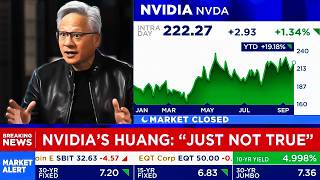
The other day you said you were watching the $170 level very closely. Well, it took a deal with Marvell. It took Jensen Huang's comments on this channel, followed by an improvement in the overall environment, for the stock to rise significantly above this level. Yes, and I think a better environment is a really big driver, especially because ETF trading is taking up a huge share now.
A lot of people buy ETFs. Nvidia is part of over 600 of them, so that also helps the stock rise 5%, but the main news today—Nvidia is investing $2 billion in Marvell Technology. This deal is centered around Nvidia's platform, which allows specialized chips to be connected to its infrastructure. Marvell develops such specialized AI chips for other large technology companies, such as Amazon.
They actually compete with Nvidia's GPUs, but this partnership changes the dynamic, giving Nvidia a shot at a much larger market and making Marvell a strategic partner of Nvidia. This investment, Scott, is just one of many. Just this month, look at the screen, you see that Nvidia has allocated $2 billion each to Nebia, Lumentum, and Coherent.
Before that—2 billion in Synopsys, a billion in Nokia, shares in X AI, Open AI, Intel. I couldn't even fit them all on the screen because there were only five blocks. The CEO often reminds investors that this is no longer just a chip company, but an AI infrastructure firm. Here he is this morning exclusively on CNBC.
The market is missing 're such a big company and have such a large share of AI computing and all of the AI infrastructure, many might think that all of our growth is already priced in. However, it is clear that a few things have changed in the last few months, in fact, perhaps in the last half a year.
We have increased our share of non-cloud customers , with the top five cloud providers now accounting for 40% of our business. Most people think that the bulk of our business is cloud, but in fact one of the fastest growing segments is the corporate sector and industry. And the person sitting next to him is Matt Murphy, CEO of Marvell.
The argument is that the market is focused only on large hyperscalers, but Nvidia's ecosystem extends far beyond them, into the enterprise sector . You've heard about the industry, and now deeper into the supply chain with investments like today's deal with Marvell. Scott. Thank you, Cristina, great report.
Thank you. Christina Partsinevelos. Malcolm, I'll come over to you. You still hold those shares. I think what we heard this morning exclusively on this channel from Jensen Huang was as clear and concise an explanation as a CEO could give to his investors as to why the market is getting this wrong. Yes, and, listen, I completely understand the position of any investor who says that these stocks may have already exhausted their potential.
Perhaps it's time to take profit or exit the asset, because which is better? They've shown just incredible results over and over again , and I just don't know if it's possible to achieve anything more than 80% gross margin. So I'm going to leave the stage. But I also think it means missing out on some opportunities, considering that this company is now an innovator—that's what they call themselves, echoing Christina's sentiment—and not just a chipmaker.
Yes, they may be losing ground on the GPU front when it comes to rendering chips, but Jensen is already working to lead the next wave, so much so that the company is investing a lot of its own free cash flow in pursuing new opportunities. So they're trying to grow their next customer in an industry that's just starting to grow, instead of resting on their laurels, with the G7 and hyperscalers as their huge customers today.
Brandy, you own them too. What do you think about Jensen's words and, in particular, today's stock movement? I think this is completely justified. By the way, the shares have risen by 60% over the past year. So it's not "dead money." I mean, Microsoft was the "dead money." The shares are just resting now.
The stock's forward P/E is now cheaper than Exxon's, and they're on track to grow earnings by 75% this year. They are resting. I feel like the stock will eventually break the 200 mark, which is where I consistently sell calls because it can't go higher, but I think we'll see the same kind of stock movement as last year.
They are just resting now, and will eventually make a leap and leave investors behind, as they have consistently done before. So I would n't even remotely give up on this company with the kind of earnings growth we have ahead of us and a low P/E ratio compared to Exxon . So, Nvidia continues its investment boom as the company announced plans to invest $2 billion in Marvell technology.
To decipher AI strategy, we welcome Antoine Skaiban, a technology infrastructure analyst at New Street Research. Antoine, it's very nice to see you. Maybe we should start with something simple, Antoine? Bring us up to speed . Why is Nvidia making this partnership and investment in Marvell, Antoine? What exactly does CEO Jensen Huang get out of this, in plain language?
Thank you, John. Glad to be on the show again. I think there are a number of reasons for this, potential reasons. Of course, if you're Nvidia, you want to weaken your strongest competitors, right? And for Nvidia, one of its strongest competitors is Broadcom, which helps large customers like Google and others bring to market very specific chips that can compete with its own GPUs.
So by partnering with a company like Marvell, they strengthen the Marvell ecosystem and, for example, allow Amazon, which has its own ASICs designed by Marvell, to integrate them more closely with their GPUs. And this, of course, can cast a certain shadow on Broadcom. This is the first thing. Second, Marvell generally has a very strong portfolio in many areas that are critical to AI infrastructure.
Specifically, these are optics and DSPs used in optics, especially for very high bandwidth or long distance communications. So it also makes a lot of sense for Nvidia to partner with Marvell from this perspective. So, as a regular investor listening to this, Antoine, did you see that headline, read the news from the companies, and think, yeah, this is a good deal for both Nvidia and Marvell, a win-win for both?
No, I think when Nvidia invests in all these companies, they're also trying to strengthen their partners to make sure they have the capabilities to launch new products quickly and improve their roadmaps at the right pace to prevent Nvidia from having bottlenecks anywhere, because there are so many in the AI supply chain today , and I think part of this partnership is aimed at that .
It was interesting, because one chip company invested in another. The CEO of Marvell told CNBC, I don't know if you saw this, Antoine, that he doesn't see it as a zero-sum game, but he believes they're actually increasing the total available market, expanding the entire market overall. Do you think so too?
Yes, I think the market will be very large and there will be room for many suppliers to grow confidently. We're talking about a market that has already grown from around $200 billion last year. This year it will grow to $400 billion. That's an additional $200 billion in just one year. Keep in mind that just five or six years ago, the entire market for data center computing chips was perhaps $20 billion .
And now we are growing by $200 billion in just one year. And we will continue to grow. We have a lot of data from the supply chain, for example from Taiwan Semi. We know how much capital expenditure they are investing. We know the capacity of their factories, so we understand how many chips and how much additional spending there will be on those chips for data centers over the next few years, and there will be room for growth for many of these vendors.
Antoine, I want to talk to you a little more about Nvidia. Listen, you cover Nvidia, you like Nvidia, I know you recommend that clients buy the stock. I'm just curious what you think about the stock dynamics. You know, if you look at the graph more broadly, Antoine, listen, it's up more than 50% in the last 12 months, but it's down almost 10% this year, and basically since July of last year , Antoine, it's not moving anywhere.
What is actually happening here? I mean, I guess I'll start with one observation: If you look back to October, when Jensen was in Washington talking about $500 billion in orders for Blackwell and Rubin by the end of 2026. And two weeks ago, this figure increased to 1 trillion. And this, of course, now applies to the period until the end of 2027.
But if you do the math, that's an additional 500 billion orders in just 4 months. So that's about $1.3 trillion in current order levels that Nvidia is getting from its customers. And these are just facts, there is no reason for doubt. So I think what's happening now is that the markets need to wait and see, because these numbers are so big that they need to build confidence not just on what Jensen says, but on whether the economy can actually spend that money.
And I think that's what will be the catalyst. I think we'll probably get more clarity from hyperscalers about their plans for next year, just as we got an understanding of their plans for this year in early 2025. This will likely help, and of course, just seeing Nvidia beat expectations and raise forecasts, as this pace will see Nvidia generating nearly a trillion dollars in revenue by the end of next year.
So that's maybe $20-$25 profit per share. So it's definitely not sustainable to keep the stock below $200 with these profits. So I think the way Nvidia is beating expectations will also be a catalyst. Nvidia is making a $2 billion deal with Marvell for the next phase of creating its own AI chips. Marvell shares jumped nearly 13%, their second-best day of the year.
Christina Partsinelos is here in the studio with all the details. Cristina. Well, the deal actually focuses on Nvidia's platform, which allows specialized chips to be connected to its infrastructure system. Marvell develops these custom AI chips for large tech companies like Amazon. They also compete with Nvidia's GPUs, but this partnership changes the dynamic, giving Nvidia a shot at a much larger market as it opens it up to competitors.
This was news last May, and now it's also an injection of capital into Marvell, making it a key partner in the field of AI infrastructure. However, Marvell is just the latest investment for the microchip giant. Just this month, Nvidia committed $2 billion each to Nebius, Lumentum, and Coherent. Before that, there was 2 billion for Synopsys, a billion for Nokia, and stakes in XAI, OpenAI, and Intel.
Money continues to be spent. So, why such outrageous costs? Well, Nvidia doesn't just sell chips anymore . The CEO reminds investors at every event that this is no longer a chip company, but an AI infrastructure firm that seeks to control the entire "AI factory" or ecosystem, bringing in suppliers that create optical networks, specialized silicon, and interconnects.
These companies are becoming financially and strategically connected to the Nvidia ecosystem. The main takeaway is that Nvidia is aggressively investing to ensure that AI development flows through its ecosystem, regardless of whose chips end up on their racks. Many of these investments are made in exchange for future profits, right?
Not in this case. Not from Marvell. Perhaps more details will emerge in the near future, but for now it's just a $ 2 billion investment . And the news about the use of special Marvell chips in Nvidia systems appeared last May. So this is not the most recent part of this story. As an Nvidia shareholder , how do you feel about all these stakes in other companies and Nvidia's valuation itself?
Well, they generate so much money, Yeah. that they have enough money for it. I never liked the idea of investing in my supplier or customer. But it seems that this has now become common practice. I truly believe that if I did n't own Nvidia stock, I would buy it at this price. I think the sentiment around the company is quite negative, and I don't think it's justified.
Somewhere around 165, if you go back to July of last year, that's a level that's actually been a low several times in the last 9 or 10 months. So, we held our ground where we needed to. That said , I mean, the price is still below the 200- day moving average, which is currently declining, for those who know technical analysis.
I understand the optimism about the end of the quarter, but we can all say that against the backdrop of a good market until recently, Nvidia has been showing worse results since October-November. Yes, I'll just say that it's either going to go very well or very badly. And again , we have some understanding of the history of when these ecosystems are created based on investment, right?
I don't think you would have these deals or interconnected activities without these investments. So when I think about what Karen just said— 90% of their revenue comes from GPUs—I think the customer dependency factor is very important. But when they make these deals, say, for specialized chips with Marvell, retaining customers, that extends to their other major customers as well, right?
And when you mention gross margin of 75-76%, I hear and see that it will be under pressure. So they have to broaden their appeal to many people who will be doing custom development . Another thing is they just announced this low- power Grok chip and everything. Well, they invested in Intel to develop CPUs and such.
This looks very complicated, and I think in the slightest downturn, no one would be evaluating Nvidia based on the value or quality of their investment, but that's the point. They are turning into a holding company. Holding companies trade at a discount to the sum of their asset parts. It also looks like they are vertically integrated, like a large industrial company from the 1900s.
I know there's something different going on here, but they're trying to capture all the growth areas of what was once the Industrial Revolution. So I understand everything. I don't think this is good for the company's valuation. I want to start with two companies that I just talked about on Squawk on the Street this morning: Nvidia and Marvell Tech.
Today, Nvidia decided to give Marvell $2 billion. Here , hold on to two billion. After all, they agreed to work together on an AI infrastructure plan. Remember, Nvidia is about much more than just chips. It's a whole software ecosystem, and companies that use Marvell for networking can also use Nvidia.
This is a smart move by Nvidia—to attract companies that don't use Nvidia to switch to their platform. Of course, Marvell also benefits. Nvidia shares rose 5.6%, while Marvell soared 13%. Here's the compression multiplier. I think Nvidia stock was trading at a P/E of 14 at its lowest point today. That's the P/E of a boring old bad-loan bank.
How can Nvidia be confused with a boring bank that has credit problems? This makes no sense at all. I hope you a integration of Marvell ind. Nvidia invests $2 billion in Marvell. Marvell joins Nvidia's AI factory and AI-ready ecosystem through NVLink Fusion. And the companies will collaborate in the fields of introduced NVLink Fusion at Computex in May 2025.
At the time, I noted that NVLink Fusion would strengthen Nvidia's "moat " by helping to keep customers in the makes a better chip, they will simply integrate it with Nvidia's technology and remain customers . Nvidia is no longer just a chip company. This is a company that builds AI infrastructure. If customers want to use their own accelerators, they are welcome to.
Nvidia will still sell them the other parts of the system and keep them in its ecosystem. We see this clearl terms of scaling networks compatible with NVLink Fusion. : Vera CPU, ConnectX NIC, BlueField DPU , NVLink interconnect, Spectrum-X switches, and RackScale AI computing. I'll the development of their custom chips.
AWS and Nvidia announced back in December that Amazon Trainium 4 would it. But today's announcement is further proof that Nvidia's NVLink Fusion is being actively adopted by that spans the entire technology stack. They are much more than just a chip company. Also as part of the partnership, Nvidia and Marvell are working together to transform the global telecommunications network throug at GTC in October, Jensen announced a new computer for radio networks, NVIDIA Aerial, in NVIDIA's other capabilities and become the foundational AI infrastructure in every industry.
Furthermore, in today's press release, Jensen writes, and I quote: "The tipping point for inference has arrived. " "Demand for token generation is growing rapidly, and the world is racing to create AI factories." Jensen's comments about the rapid growth in token demand and the tipping point for inference bring me back to what I've been talking about in recent videos.
I'll be talking about agent-based AI and the inflection point in demand for inference again because it's so important to NVIDIA's growth over the next few years, and most people do n't even realize it's happening. For many months, I have said that I expect a surge in demand for computing driven by agent-based AI that will continue throughout the year.
And now we are at a significant turning point. There is a reason why GPU spot prices have recently started to rise. Agent AI will significantly increase the demand for computing power. With agent-based AI, we a requests. We're talking about agent-based systems, which consist of many AI agents that can use tools and perform tasks on your behalf.
This will make many people experience another ChatGPT-like moment whe begin to understand that there will be a clear return on the investments in AI that we have seen in recent years. There's a reason why Open Interpreter skyrocketed in popularity earlier Interpreter, Interpreter, quote, "the iPhone for tokens." Open Interpreter some time, enterprises were hesitant to implement Open Interpreter due to security risks.
Then at GTC, Jensen announced the Nvidia Nemo Interpreter, which is based on Open Interpreter. Interpreter secure for enterprises and capable of confidential work. We are about to see large enterprises begin to massively adopt agent-based AI, deploying large-scale agent systems to increase productivity and improve the performance of their teams.
These businesses will consume incredibly large amounts of tokens, significantly increasing the demand for computing power compared to what we have already seen. Please hear me well. I do n't want to sound exaggerated tipping point is happening, and have no idea what implications it will have for Nvidia's growth over the next few years.
Now, with this context in mind, let's look at what we are currently seeing in the market. Nvidia is essentially trading at a market multiple based on this year's earnings, and well below the market's based ignificantly higher than the broader market's. And this is even as we see a significant surge in demand for inference fueled by agent-based AI, and as spot GPU prices rise markedly.
I view Nvidia's low valuation as a market imbalance that will be resolved over time . now one of the most fundamentally attractive companies in the entire market. I think someday in the future we will look back on this moment as an incredible opportunity to buy Nvidia shares. I'm not calling for investing everything at once.
That's not what I mean at all . I am saying that I think it is wise for long-term investors to responsibly apply cost averaging , buying stocks ituation is extremely clear, despite the indecision of market participants. Let me mention one more thing about the turning point in the conclusions that we are seeing.
Recently, on Lex Friedman's podcast, Jensen quite seriously suggested the possibility of Nvidia becoming a $ 3 trillion total revenue for fiscal year 2026 was $215.9 billion. Jensen is usually quite conservative in his predictions for the future. And Jensen is quite serious about the possibility of Nvidia becoming a $ 3 trillion revenue company .
If this happens, stocks will definitely go up in the future, much higher. I'm not saying it will happen immediately. Ultimately, these things take time, but I expect Nvidia to be worth significantly more in the coming years than it is today. For now, we need to focus on fundamentals, ignore short-term noise, and remember that we are only in the early stages of large-scale implementation of agent-based systems.
This will significantly increase the demand for computing. And after that, the next surge in demand for computing power will likely be driven by physical AI. We a are talking about physical AI agents that perform physical tasks in the real world. Nvidia's CFO called physical AI, and stage of growth for Nvidia." This industry is fundamentally transforming society, and Nvidia is positioned to benefit enormously from it .
Nvidia sells equipment for data centers wher models are trained and tested, and Nvidia sells hardware that allows for real- time inference on the device via Nvidia AGX, which allows robots to intelligently interact is implementing it as the fundamental foundation that supports it all. solutions based on Nvidia's robotics stack, and it's not getting enough attention.
I continue to believe that most analysts' long-term valuations for Nvidia are too low, given what lies ahead . In terms of ramping up production, Blackwell Ultra is now entering the series very quickly, leading to accelerated revenue growth. Rubin is scheduled to launch in 2026. Next, we expect Nvidia Grock 3 LPX in the second half of 2026.
Subsequently, we expect the launch of Rubin Ultra in 2027, followed by Feynman in 2028. We have a clear roadmap for data center products through 2028, and Jensen believes that by 2030, $3-4 trillion worth of AI factories will be built globally. This means that Jensen expects the demand for AI to grow and the overall market size to expand, which is the underlying reason for all this.
I don't think we're close to anything like a bubble bursting. Given all of this, I seriously believe that Nvidia still has a lot of potential ignificantly more in the coming . Now, before I end, I want to point out that all using the original structure and comments. Sometimes the same montage keep e above in mind, I hope you have a great rest of your day, and I'd love to hear ike this video so more people can see it . And while you're , hope to see you in the next video.



Comments 0