원문 보기
Even though he has officially retired from the business world, Michael Burri continues to make headlines, particularly on his Twitter page. He now uses the social network as his primary means of communication with the media, traders, his 150,000 fans, and the rest of the world. However, for the past few months, the genius of Sign Capital, the "Big Showman" as he's nicknamed, has been multiplying warning messages to the markets: the situation is too tense, beware of a correction.
But as in 2007, no one seems to listen to him or even pay the slightest attention to these alarming and disheartening signals. Michael has since deleted all his tweets and now only talks about his meals or his walks in the forest on his page. We wouldn't expect anything less from him. If you don't yet know Michael Burri, we'll introduce him.
You'll quickly understand why you should listen to him and why, at the beginning of 2021, he is so worried. To support our work and stay informed about our latest videos, thank you for subscribing to Monia Radars. Who is Michael Burri? He was born In 1971 in San Jose, under the California sun, Michael, likely affected by a form of autism (Asperger's syndrome), had always experienced social difficulties, but he very early on demonstrated exceptional intellectual abilities, very different from those of the average person.
Initially, he wasn't destined for finance; Michael is a medical doctor, more precisely a neurologist, a brain specialist. It was during his studies, in his free time, that he enjoyed playing the stock market. His thirst for knowledge and understanding of the markets led him to study major theories of value, particularly those of the American economist and billionaire Benjamin G., whom we present in another video.
He discovered that many stocks on the stock market did not reflect the true value of companies. He then developed and tested his theories on a discussion forum, and his results began to attract attention. In 2000, based on these successful experiments, he borrowed funds from his family and some contacts, including the investment fund Vanguard, and founded his own Hedge fund manager Michael Van, with his keen eye, discovered every stock he could find.
Nothing escaped him; he could track every index and global economic parameter, and he missed nothing. His incredible brain simultaneously analyzed massive amounts of data, allowing him to approach the markets differently, with a comprehensive view. In short, he took a step back and saw what others didn't.
Four years later, the fund had grown by 170%, reaching $600 million. But there was no question of stopping there. Michael searched everywhere, delving into the heart of every stock available on the market, and he became interested in American mortgages, more specifically a certain category of loans: the infamous subprime mortgages.
These are home loans granted to low-income households, secured by a mortgage. The borrowing conditions are far less favorable than those offered to regular borrowers. The terms are long, the interest rates high and variable depending on the real estate market; the higher the property value, the lower the interest rate and monthly payments.
And vice versa, but at the end of 2006, after skyrocketing for almost ten years, the American housing market began to show signs of fatigue. Households had reached their debt limits, and buyers were becoming scarce. Michael already knew this; he sensed an imminent reversal of the situation. But there was worse: the banks, perpetually searching for hiding places, had meanwhile securitized a large portion of their premiums.
In other words, they had transformed them into securities that were then resold on a primary market and listed, then traded on a secondary market with interest payments every month and a solid guarantee. These are guaranteed debt securities, or " bonds," which are much safer and more profitable than acquiring new customers directly.
The problem is that almost all the other banks had bought them, and on top of that, derivative products had been created to speculate on the silos. Michael Burri tried to warn the world before the catastrophe, but no one listened. They laughed in his face. Yet events would prove him right, and the subprime mortgages proved to be much riskier.
It didn't look like it, but when the American real estate market began its decline, the machine started up, and when the Fed announced a rate hike in June 2006, panic ensued. Household expenses skyrocketed, defaults multiplied, property values plummeted as foreclosures occurred, and all securities indexed to subprime mortgages followed suit.
Major investors chose this moment to liquidate their positions, but it was already too late; the crisis was spreading across all sectors and countries worldwide. At that time, SignCap held nearly a billion dollars in short positions on subprime mortgages—a kind of insurance policy taken out by Michael with major investment banks.
Thanks to his incredible vision, the fund weathered the storm, posting a 487% net return by mid-2008 since its inception in 2000, compared to a mere 3% return for the sternum of a five-cent pan over the same period. This was the moment Michael Burri chose to leave. He left his young life behind and started a new one, but it wasn't over yet, as he continued to trade for his own account.
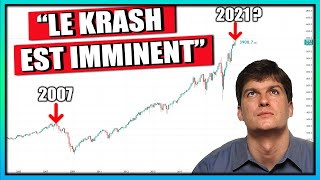
The financial press often reported on his victories, the most recent being in 2019 when he made a profit of 1300 (80%) by investing $17 million in the video game chain GameStop, while speculators fought amongst themselves and drove up prices. In short, it's clear he knows what he's doing. This brings us to February 21st, when Michael Burri announced that the markets were on the brink and that a crash was imminent.
Michael is a unique individual with heightened sensitivity. The fact that he wasn't listened to in 2006 affected him deeply, so this time he went all out. For several weeks, he had been sending out numerous warnings to Wall Street and fighting to be heard. On February 21st, he announced, " People say I didn't warn them last time in 2007, but I did, and nobody listened, so I..." I warned him this time, and again no one listened, but I have proof that I warned him.
He then deleted all his tweets about the impending catastrophe because, according to him, it was all pointless. But here we heard him, and here's what worries Michael Burri so much: he first detected a speculative bubble in stocks and index funds. This hasn't escaped anyone's notice; the Standard & Poor's 500 is flirting with 4000 points as we record this video.
According to Michael, "the index no longer reflects reality; it is completely disconnected from the physical value of the companies that compose it, and the correction is expected to be severe." There are several reasons for this. The main culprits, according to him, are the gamblers— these new investors, day traders, and speculators of all stripes, gathered on social media, who rushed into the markets with large amounts of borrowed capital and bet on risky derivatives.
Michael also criticizes index funds, which limit performance. According to him, passive management strategies contribute to maintaining the illusion of a stock market index. The impact of the impending correction will have the same effect on global finance as the signals in 2007. Because of this, investors no longer seek to know the real value of a company or a market.
Prices are driven upwards by rampant speculation on derivatives, particularly stock options. The Old and Poor's 500 has seen a 91% increase in five years, up 63% last year. Recently, Michael detected a spike in crude stock option trading and even observed, in some cases, that derivatives are being traded more than their underlying assets.
But these securities are bought on credit, and once again, as in 2007, debt has reached a new peak, and the financial market is on the brink of a precipice. You see where he's going with this, but that's not all. Michael's other source of concern is the curve of the Despite the two economic stimulus packages implemented by Donald Trump and then Joe Biden, which have so far been successful, the US debt is also on the brink.
The US debt will exceed 100% of GDP in 2021, reaching its highest level since 1945. It is not expected to stabilize until around 109% of GDP in 2030. By comparison, it hovered around 40% in 2009. The situation is unprecedented, as is often the case before a major crisis, and no one but Michael seems to be paying attention.
But what will happen when borrowers in the markets need cash? When, over-indebted, they start selling their bonds that no one can buy? To learn what usually happens in these kinds of situations, you can watch our video on the most famous financial crises in history (link provided). To summarize, on February 21st, Michael Burri...
Big Show Rythme, in 2007, announced an imminent correction in the US markets. He believes that irrational speculation on index funds and derivatives, carried out on credit by already over-indebted borrowers, will lead to a new catastrophe. He had already anticipated this crash for 2019, but the pandemic had an astonishing effect: not only delaying it but also encouraging speculation and accelerating price inflation.
Michael still doesn't know when it will happen. What he does know, however, is that the larger the bubble grows, the harder the fall will be. So what should we make of this? Contrary to what Michael believes, his message was well received, and several voices were raised to comment on these announcements.
In Roquemaure, on October 2nd, he also emphasized that he had no interest in investing in a product more liquid than its underlying asset, while Cesc Rakhmon agrees with him on the bubble linked to index funds and, consequently, the stock market bubble. However, economists are more measured regarding their forecasts.
While the debt level is certainly very high, the United States has prepared itself, and the entire $1.9 trillion planned for the continuation of the stimulus package in 2021 has not yet been distributed. It would therefore be a bit early to anticipate a collapse. In any case, and before a spark ignites the powder keg, take two hours to watch director Adam McKay's film about Michael Burri.
No heists or highway chases in The Big Short, just pure swing and genius, brought to life by an ideal cast: Kristen Bell, Steve Carell, Ryan Gosling, and Brad Pitt. The film revisits the audacious gamble taken by Sign Capital during the subprime mortgage crisis and also describes, in a simple and entertaining way, the complex financial mechanisms that led to the crisis.
Will Michael Burri still be right in 2021? Only time will tell. In any case, the message is being shared. Feel free to give us your opinion and to Feel free to ask us any questions in the comments, and if you want to learn more, check out the links in the description. If you enjoyed this video, please like and subscribe for more news, reviews, and comparisons. We hope this video was helpful. This was Money Radars, see you soon!




Comments 0