
저자: 미상 · 외국인
요약 보기
Howard Marks의 『The Most Important Thing』을 바탕으로 시장 사이클과 심리를 설명한다. 시장은 영원히 오르거나 내리지 않으며 장기적으로는 우상향하는 경향이 있다고 본다. 시장은 공포와 탐욕(euphoria) 사이를 오가며, 손실회피·탐욕·시기심·자만 등 심리적 편향이 투자 판단을 왜곡한다고 설명한다. 2000년 닷컴 버블과 2008년 서브프라임 위기 사례를 들고, 사이클 시작과 끝은 예측할 수 없으므로 리스크 관리가 중요하다고 강조한다. 특정 자산에 대한 가격 방향 예측은 없다.
다듬은 글
Hey everyone, how's it going? Welcome to another video on the Financier channel. If you don't know me, I'm an investment consultant and financial educator, and here we'll be talking about those topics. After the intro, I'll tell you what we're going to talk about. I'd like to invite you to like and subscribe to the channel if you haven't already.
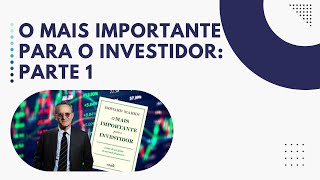
This will really help us make more videos, produce more content, and YouTube will recommend our videos. Okay, so these days we're studying Howard Marx's book, "The Most Important Thing for Investors." If you haven't watched the previous videos, I'll leave the links in the description for you to watch, and I recommend you watch them for a better understanding.
But if you haven't watched them and you're here now, don't worry, you'll still be able to understand Marx, a great American investor and co-founder of O'Capital, an investment management firm recognized for having a different view of the market. He doesn't like to follow market trends; he looks for other factors to provide a better return for his shareholders, his investors.
I accidentally modified the book here, without really meaning to. Okay, let's go. In today's part, we're going to talk about market cycles. Market cycles, according to H. Max, are characterized by the fact that, on one hand, the market doesn't stand still; that is, the market won't rise forever, nor will it fall forever.
There will be times when it rises a lot and times when it falls a lot. Of course, over time the market has grown, companies have become more profitable, so the market is now larger. Stock markets have risen over time. Of course, there are some points where they fell and took a long time to recover, things like 20 or 30 years.
But in general, the tendency is for stock markets to rise even after difficult events like the COVID-19 pandemic. And in this market cycle, he says it 's very influenced by euphoria or fear. This means that if you are very euphoric about the market, you are willing to seek higher returns, and you seek these higher returns by taking risks.
But since everyone is euphoric, you end up not looking at many risks. It's as if you think that... and you have a certainty that... Okay, if everything is going up, that's what I'm saying, the market will continue to rise, rising more and more. And if I invest now, even if I invest in something that 's expensive, it's no problem because the market is always going up.
And I wanted to give an example of something recent that happened, which was the problem with Microsoft going offline. In this case, not specifically Microsoft as a whole, but one of its applications, which was Azu. But this was also influenced by another technology company, CrowdStrike. I 'm not in the Information Technology field, so I only know very little, but look at this interesting thing, and follow along with me here: CrowdStrike shares fall 18% due to cyber blackout; it is said that the failure is being corrected.
Now think about it: a company that is believed to be consolidated in the market had this problem that impacted the whole world. At first, nobody really knew what was happening, but the markets rushed to sell because when shares fall, it means that people are selling more than they are buying. So, just think about it: a company that has been consolidated in the market for a long time has a failure, and its shares fall 18%.
This means that in this case, the market swung to the other side of the pendulum, the side of fear. When everyone is afraid, the opposite happens: instead of people starting to invest more and seek more risk, they do the opposite; they rush to sell everything they have and put it into safer assets like Treasury bonds, etc., or fixed income.
But what I want you to understand is this: you see that people, investors, normally you think they are totally rational people. I mean the idea that the market is efficient, where everyone has the same information and because of that, everyone can make the best possible decisions. This is the theory of the efficient market, which implies that all human beings are like economists—a term in economics literature that says that these people always make rational decisions.
Well, we see that these people are not economists. Because how can a company devalue by 18% just because of a mistake? It may be that if we see in the future that this mistake could cause the destruction of the company, which is very difficult, but in the first instance, where you... You don't know anything, driven by fear, right?
You're like you're on the street and you see a crowd running, you don't know what it is but you run too, you'll stay there to watch, right? So fear does that to people. On the other hand, we have a market cycle, which is the Euphoria cycle. And for that, I wanted to bring you an example that happened in the 2000s.
In the 2000s, the so-called dot-com bubble happened, right? The technology market bubble, where in this bubble we saw that technology companies were overvalued, and by overvalued I mean the following: they were delivering a promise that they would have high profits. Imagine at the beginning of the 2000s, the internet was taking shape and several companies appeared saying they were going to do this, that, and the other thing, that they were going to be revolutionary.
So at that time, when you had the internet, a series of things, a series of restrictions, you imagined, "Wow, this is the beginning of everything, the internet has no limits, I'm going to risk everything." But if we look at this graph, if you look at the date here, ah, it's more or less in the 90s...
96 And then you realize that the stock market was behaving normally. This index here is from Nasdaq, which is, let's say, the technology stock exchange of the United States, speaking in a more simplified way. And then when the bubble starts to burst, look how much the stocks rise, right? Stop and think a little.
Imagine you're right here, right at this point, and from here the stock market starts to rise a lot, and you think, "Man, am I going to miss out? Everyone's making money!" It doesn't matter if the stocks are expensive, and of course there are metrics to evaluate whether a stock is expensive or not, but that doesn't matter here.
What matters now is that we see that the stocks started to rise practically without any tangible explanation at the time. The scholars of that time say that the stocks were being sold very expensively, at absurd prices. But it doesn't matter if I bought an expensive stock. Imagine that at this point, right here, a stock is very expensive, but if it goes up, even if I sell it later, it did n't become expensive for me.
So you see that people start to seek to take a greater risk, and that's okay, in quotes, because they know that back then... The market will appreciate more, I talked about it in previous videos. For example, some people like to invest in real estate even if it's expensive, but they think, "No, this neighborhood will appreciate.
This will improve, so invest in yourself and let's move forward," right? But what happens at a certain point, at the peak of a crisis, or at the peak of a bubble, we realize, some people realize, that something is wrong. They start selling, then it falls. But they recover, only to then go downhill. So, the last one to arrive is always the one who gets hurt.
Those who enter last in the euphoria get hurt. Those who were euphoric at the beginning did well, but then sold. Okay, they did well. Remember that we can't predict these cycles. Howard Maxx even says it would be very good if we knew when a cycle begins and when it ends, but we don't know. And the way he protects himself from this is basically by analyzing the risk.
And what does that mean? It will influence us in the end, because we also have psychological aspects. This means that the market is made up of people. He is conditioned by people, so if we human beings are not effects and are affected by emotions, the market is also not rational. And then he talks about four feelings that affect investors, and the first of them is fear, which we've already talked about here.
And this fear is also called loss aversion. He cites Daniel C.E. Man, a great scholar and author of the book "Thinking, Fast and Slow," where he talks about two types of thinking in that book. He also discovers that human beings have a much greater weight given to a loss than to a certain gain. It's like finding R$1 on the street, and if you lose that R$ 100, the level of happiness you have upon finding that R$100 is much lower than the level of dissatisfaction and sadness you would have if you lost R$100.
So, human beings have an aversion to loss. This implies that, in moments of fear, people will make irrational decisions; they will seek to protect themselves in every way, even if it's not so terrible. He calls this behavioral biases. These biases are triggers and responses. Quick mental responses to protect ourselves: imagine you're walking down the street at night and you see two people passing by on a motorcycle.
You immediately think it might be a robbery, so you hide because you live in a dangerous country like Brazil. You don't even think about it; they might be two good people. But you'll protect yourself. So it's a human tendency to protect oneself. Another point he makes is greed. Because you're earning more, you won't care about the risks, and it should be the opposite.
Because the more the stock market rises, the more you should be afraid. The higher it goes, the more people are buying, and the more they 're inflating the market value. When this gets out of control, bubbles happen. And these bubbles, like the Naseg bubble, can leave people penniless in the end. Because, look, when you talk about a variable income market, for example, stocks, that stock will have the value that people give it.
For example, imagine you bought a stock for R$10, right? And that stock went up to a point where today it's worth R$20. How is that stock worth R$2 now? Because its last trading price was... The market... All of this done electronically is R$2, so its last price is 20, meaning that at that specific moment your 10 became 20, okay?
But it's possible that at a certain point in the market those shares could fall to five because the market sees the last trade, it sees that the share is worth R$5, so your assets, which were 10, go to CCO, and that's the value the market assigns to it. So, you see, the higher the market is, the more it means that if you enter at that moment—imagine now the shares are worth 20—you entered when they were worth 20, it means that it could fall back to 10, for example.
But out of greed, you think, "Wow, this stock went up 100%, I think it will go up another 100%." So, this greed makes many people lose money in the financial market, and unfortunately, because they think the stock market will always go up. That's where the market cycle comes in, and also two other feelings like envy.
Sometimes people, when they're in a very speculative market, everyone talking about making money in the market, and even... Trivial things like the Tiger game... when people are like that, my friends, it's complicated, and then everyone wants to start making money, but you see, " Wow, imagine, you bought a share here for R$10, your neighbor bought a share for R$ 5 that's now worth R$15." Then you think, "Wow, my share is R$10, it's not going up, you know what I'm going to do?
I'm going to invest in the one my neighbor is investing in too, I'm going to buy it, but now it's R$15, right?" Then you enter the riskiest moment. It might fall, you know, this envy, this issue of competition. It happens a lot in the financial market. If you keep comparing what you have with what other people have, you think, "Oh, I'm just in savings, that other person over there is investing in the stock market and is earning more than me." Then you might get into a piece of land you don't understand, the same thing with real estate, a relative of yours appears saying, "Look, I made a lot of money with real estate, I bought a piece of land there, this land appreciated a lot," and you get that in your head, "Wow, I 'm investing here in CDBs, in anything, and that uncle of mine over there..." "You're investing in furniture, you're earning more, so I'll invest in real estate too." And then, a lack of market knowledge can ruin you, so be very careful.
And the ego, the issue of vanity, because you're envious, but sometimes you're the one winning. So you want to show that you're winning, and that pride can take you further and further, in the sense of seeking more risk and thinking you know everything. The problem with thinking you know everything is that you start making predictions thinking you know everything, even though you were right once.
It might even be luck, and later on you'll go broke. An example of this is the investor Michael Bury. I don't know if you've seen the movie "The Big Short," which talks about the 2008 American crisis, the subprime crisis. There was a guy at that time, Michael Bury, who managed to bet against the market and made a profit, becoming a millionaire, I think a billionaire.
Anyway, this guy usually makes predictions, but look at "The Big Short" that went wrong. Michael Bury closed his short position with an astronomical loss, that is, he bet against the American market and had... A very big loss. Oh, and then, well, here he's going to talk about how the operation went, but look here, he made a loss of 640 million dollars.
So, sometimes—I'm not saying he has a big ego, but sometimes you get something right in the market, you bought a Bitcoin, you bought a stock that appreciated a lot, and then you think you're the wizard of the financial market—be careful because you'll try to get other predictions right and you'll end up losing.
So, guys, I hope you enjoyed this video. We'll still have another video in this series, "The Most Important Thing for the Investor." I hope you're enjoying it. And as I said, please help the channel, subscribe, leave your like, this is very important for us. This will help the channel grow. Today we are, uh, we are a community of about 200 subscribers here.
The goal is to reach at least 1000 subscribers so we can have a celebration and move forward with the channel. I'm also on Instagram if you want to follow me there, it's @inc_oficial. And that's it, guys, until next time. Bye! In the next video, may God be with you and a big hug.
Comments 0