저자: JensenHuang · 외국인
요약 보기
엔비디아가 AI 에이전트 안전 플랫폼(OpenShell 격리/권한 제어, Sentry 모니터링)을 발표하며 100여개 파트너 참여를 강조. 젠슨 황은 에이전트 권한 최소화와 오픈소스 공개의 필요성을 주장하고, 규제는 기술이 명확해진 뒤 도입해야 하며 혁신과 규제는 상충하지 않는다고 발언. 증시 측면에서는 방송 중 금리 상승·유가 급등으로 선물이 하락 중이며, 엔비디아 주가는 자사주 매입 발표로 약 1.7% 상승.
다듬은 글
It is 8 am on the east coast and you're watching Squawk Fox right here on CNBC. I'm Becky Quick along with Andrew Ross Sorcin. The futures this morning have been in the red all morning. You can see right now that the Dow futures are off by about 340 points. S&P futures down by 35, the NASDAQ off by 250.
It's all coming as we see Treasury yields rising once again this morning. The 10ear sitting right around that high from the last 19 years or so, sitting at 5.215% this morning. The 30-year is at 552 and the 2-year yield now sitting at 491. That comes as we see oil prices higher this morning. Right now, it looks like WTI is up by about 4%, just above $96 a barrel.
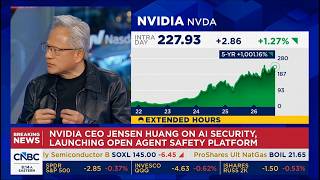
Brent is sitting above $108, 10830. That's a gain of 3.8%. And some big news this morning. Nvidia is launching the Nvidia open agent safety platform. That's a new security software suite that's designed to keep AI agents operating inside their step boundaries, inside their sandboxes, and quarantine any agent that may attempt to go rogue within milliseconds.
It also is going to keep track of every step along the way, record what's been happening. Nvidia is also announcing this morning with more than 100 key partners and stakeholders including Cisco, Crowdstrike, Dell, JP Morgan Chase, SAP, Anthropic goes on and on the list from there. Joining us right now to talk about it is Jensen Wong.
He's right here on set with us, of course, the CEO of NVIDIA. And Jensen, welcome. It is great to see you this morning. Great to see you. So, this is an advancement in something that we've kind of seen the national the national uh discussion take place around AI and AI safety. And in this discussion, there have been those who have been uh painted as doomers who think that the end of the world is going to come from this.
And then there have been those who have painted you as the guy who doesn't want to see anything happen on any level. I don't think that's a fair and accurate depiction of where you stand with things. Why don't I want to see a lot of things happen on a lot of levels. So why why don't we talk about where we stand and then we're going to jump into what
Well, first first of all first of all, as you know, we're going through uh a major platform shift. AI is incredible technology has the potential to do incredible good. But we also have to make sure that the technology is developed and deployed safely so that the public has confidence in applying this technology.
the single most important thing we could possibly do is to to build it in such a way that is so safe that everybody could use it in every single industry so we could transform every industry. And so that's the hard work that we have to do. These agentic systems are obviously agentic meaning they operate by themselves.
It's kind you know it's like a self-driving car. And so in order for you to deliver that agentic system in a safe way, you have to make sure that the sandbox around it, the force field, the play pin, you know, if you will, all of those systems are designed in a way that uh keeps the agent uh with minimal rights, whatever rights it has, it needs in order to do its job.
No, no more rights than that. And that it can't it can't uh do anything that it's not supposed to. But and also you have to monitor it. But the problems that we've seen to this point where open AI, Anthropic, uh Google and others have had agents that have escaped and have gotten out and done mischievous things, maybe illegal things.
The problems we've seen to this point, you think is simply an engineering problem and a fault of those companies, maybe not putting in the right restrictions. Well, I think the answer is we hope it's an engineering problem. I believe it's an engineering problem. I know it's an engineering problem and we all need to hope that it's an engineering problem.
if it's not an engineering problem, it's not solvable, right? And so the fact that all of these companies still are advancing the state-of-the-art is because they also believe it's solvable. These are some of the brightest engineers in the world. I work with, you know, all of them. And and these are this is a this is a technically solvable problem.
And so the way to think about that is if you look at go back to the the days of the internet you you access a website it downloads application maybe it's Java application all of a sudden uh this application comes into your PC has access to files and uh resources and maybe the applications and tools and uh it gets onto your network.
Well in the beginning we had all kinds of viruses. Um but we realize that the web browser itself has to be a containment system. The web browser has to provide that application with minimal rights. Whatever only the rights it needs in order to do its job. And it has access basically access to nothing unless the browser gives it access.
Essentially what we're doing here we're creating basically the modern browser. It's a browser for browser for agents. So somewhere inside the culture of of AI researchers for years now has been this anxiety that somehow these models have to be clever and they have to be able to get outside of their their walls because it because they're so clever, right?
I mean where do you think that I mean that's like built into the research AI researcher culture. And so at one level I think while there are some people who believe it's an engineering problem, there are these others even inside these companies that believe it's unsolvable. I don't think so. I don't think that's exactly wrong.
Um first of all, you want it to be super clever so it could perform tasks and do things. But the way you think about that is is when you deploy an agent, no matter how smart, the first thing you do is you take away all of its rights. Job number one is take away all of its rights. And then you provision, you give it access to files, data, tools, access to the network or even internet access only if it needs it.
You don't just you don't put an agent into into an into an environment uh into your into your company and give it access to everything. We don't give that to people. We don't give that to any level of executive. In fact, everybody has a badge. Everybody has file access. Everybody has access to tools and only the things that they need in order to do their job.
And so we have to apply the same you know same philosophy. Now the question is how do we develop the technology to provision that policy provision that philosophy and that's what we created. That's what open shell is. It's really important technology. It has the support of some 100 companies. Uh you didn't mention IBM and Red Hat and Microsoft and SpaceX.
SpaceX. Yeah. And so all of these companies, they recognize the importance of basically this force field that you create around around the agent and very importantly it's provisioning rights and responsibilities, you know, and access the the it's an open-source um program which is very very important and the reason for that is this.
We want this sandbox to be visible to the whole world so that if there are any any vulnerabilities somebody will find it. You got all the look at this 100 companies. There's actually a lot more companies which is those only we can list 100 you the industry will all be jumping in looking at any possible vulnerabilities and patch it up.
You you have Anthropic and SpaceX both listed on on this list of 100 companies. Open AI is not there. Are they not cooperating with this? I didn't think it was important. Uh no, this is an open standard. It's an open open platform and um uh however they would like to participate is going to be super welcome.
They could uh look at the code uh they could use whatever part of it they would like. They could build their own inspired by this uh or they could use it. I think over over time we really want people to use the software and the reason for that is because the more people use it the more vibrant it's going to be, the more resilient and more robust it's going to be.
You've said that open shell would have prevented the hugging face um breakout from open AI from hugging yeah clim and hugging face are uh one of the one of the the the victims of of the attacks and and uh hu huge huge uh supporter of open shell he's they're very their computer scientists are very deep on open shell and they're big part of it
what happened that you all can do this and open aai anthropic and others haven't been able to do this to this Well, we started building this um you know about a year ago. Has it been a year? Maybe slightly longer. I heard Open Claw came out. And when Open Claw came out, you guys might have heard me say this is the operating system of the of AI.
Meaning that it's the operating system of agents. And when we looked at OpenClaw, we said, "Hey, this is incredible, but you can't deploy this into companies. You can't have agents roam around and drift around the company." And so you have to find a way to container it. You have to containment is number one.
Rights provisioning is number two. Being able to monitor its pol adherence and conformance to all those policies number three. And so we created containment a policy provisioning supervisor and we created a monitoring system and the monitoring system is called Sentry and it monitors it in silicon. Not to get too technical about this um
but the concept of containment and monitoring is very simple. How for those who know about for example AWS bedrock has nitro and a whole and and a for some other things built into it. This is seems to me a much broader open- source version frankly of that. Is that a terrible way to think about it? Yeah, you need you need it's it's like Nitro in the sense that it's a rights provisioning system.
Um it's like nitro in the sense that it's also hardware isolation right which is really which nitro as you know uh really revolutionized multi-tenant secured cloud in a lot of ways this is multi- aent secured you know world and so very similar idea the difference the differences are going to be around uh the speed at which we have to we have to on Bluefield 4.
And the reason for that is you're monitoring AIS, you're monitoring a lot of agents that are they adhering to the policies, are they are they uh using files or going onto networks they're not supposed to? Um, we might even even uh uh look at its chain of thought and uh how it's thinking and maybe it's uh thinking about doing something that we really prefer it not to and might elevate and escalate to somebody another AI or maybe a person and say, "Hey, look, this agent is is um uh doing something that we we might not condone." Some of the model makers who are making new models are trying to use their older models to effectively track the new model that that's being trained with this product.
Will they still want to continue to do that? Sure. This this mod this the the chip is between the agent the agent itself is actually a harness. It's just a a piece of software. Okay. And this chip sits in between that and the large language model. So the a the model's here, the chip is in the middle, and here's the agent.
And so whatever the agent's trying to do and whatever it's causing the large language model to think about, Bluefield or Century sits right in the middle. So we intercept everything, which is one of the one of the really really incredible places that we sit in the world because we, you know, we have computers for agents and we have computers for our large language models.
Nvidia now has a new chip that sits right in the middle. The idea to this point, you've said in the last several weeks that look, liability that currently exists today in existing regulation should be enough to keep these companies from doing some of these things. They shouldn't release products that are going to get into trouble or that are going to hurt people or shut down systems.
And that I like the way you just said that. I think you just kind of said the obvious, stated the obvious. I I think I think number one, I'm not suggesting that that um uh uh products are are um vulnerable sometimes and and companies release products that that uh aren't as well tested as they should be, that happens every single day.
Um however, if you knowingly do it, if you already know that you didn't test it properly, if you know that you could have done a better job testing, you got to just hold it back. You're in the middle of all of this. You are in the process of buying hugging face for over 12 billion. that that was a company that was broken into by Open AI.
I think you've got a $30 billion investment in Open AI. How do you come down on who's responsible? And you know, are you going to go after Open AI for what it's done to hugging face or other places? Will there be lawsuits that come out from any of this? How do you kind of decide as somebody who's involved in all of this what you want to see happen?
Well, I don't have to decide on any of those matters. The thing that I have to decide on um on the in the case of OpenAI is OpenAI a great investment and answer absolutely. This is one of the most consequential companies in history. Um Sam and Greg and Sarah they they do a terrific job running the company.
Uh incredible researchers. Um we have it's a real privilege to work with them. Love the work that we do with them. Uh hugging face I mean this is this is the you know the world's leading platform for open models. Um I believe very deeply in in uh advancing open intelligence. I think we ought to democratize intelligence.
I think every company will become an AI company and this platform uh really really uh uh keeps that community thriving and and so it's really important that we invest in both. Does this platform absorb the liability issues for any company that's using it? I mean if you're using it and your agents break out, you say, "Wait a second, I'm using Open Shell.
It's Nvidia's problem." Now the uh open hugging face uh is a it hosts the models. Uh it doesn't run the models. You download the models and once you download the models the models become yours. The model it's really important to realize that we call them model companies but in the end the model doesn't do anything.
It's the agents that does something. So this is a tool and so the model is kind of yeah the model is the engine of the car. the agent is the car. And so I wanted to go back to the liability piece of this because I think it's it's so fascinating because the other side of it and we had Chris Hughes on uh one of the founders of of Facebook just earlier and we've read reports that people like Scott Besson have even talked about the idea of building a FINRA style um regulatory body or agency that can oversee this.
Tell us what you think of that kind like a FINRA style regulatory body whether that makes sense. Some of the reporting suggests that Scott maybe over over the summer had been thinking about some of this that you might even talk to the president at some point about not going in this direction. Uh well, first of all, um I think that we need to have an industrial uh set of standards and policies and and um uh those those uh those industrial standards um uh like many other industries set expectations of the level of quality.
Um maybe they're thirdparty auditors uh agencies that helps you um audit uh whether you achieved uh the level of performance and quality that you expected and that you promised. Um that uh there are industries of benchmark products versus others so that the better products that that uh deliver on better safety and capabilities um ranked higher than the others.
uh the there's um uh many industrial uh systems that I can imagine putting together if the policies are such that such that um open models are not harmed uh young companies are not harmed uh that every company could become an AI company uh that every bank could become an AI AI company that every retailer could become an AI company so long as as we could see um policies that that don't suffocate the industry too quickly Because, as you know, the AI industry hasn't formed yet.
Every single company here in in New York, they're all going to be AI companies. And so, every car company is going to be AI companies. And so, we we need to give them a chance um to be able to become one of those companies and don't suffocate the industry quite yet. Is that what you think? Is that what you think the heads of the open of the Frontier Labs have done by calling for a slowdown that it slows down everybody else, just lets them stay ahead?
Um, you know, I I I'll I'll assume that that um their their um uh what they're claiming and what they're asking for uh are are genuine and their concerns are genuine. Um I I think just the the in consideration of the whole industry in consideration of all of United States um and the entire market uh I would just make sure that that when we think about AI don't think about AI as as several model companies.
Remember AI is a five layer cake as I've described to you before and the most important layer of the five layer cake are the end industries above it. I I think that Walmart's an AI company, FedEx is an AI company. I think that JP Morgan is an AI company, and I think that that um you know, Lily is an AI company.
All of these companies have to be AI companies. We have to give everybody a chance to So when you hear David Saxs say this is this the motivation of the leaders of these these firms, it's all it's all a regulatory capture. I think that's where Beck, it's all just an effort to to sort of capture a particular part of the the market.
And you know Sam and you know Dario, Dario just had dinner with the president apparently last night. What do you think of that? Well, whatever whatever their intentions are, um we want to avoid regulatory capture advertently or inadvertently, right? And the technology is moving really quickly. Just think we want the technology to accelerate, not the other way around.
So, and I can I can just go back in time and and think about this. Uh when Chad GPT first came out, remember if you go back and use it again, people said GPT2 ought to be was so dangerous it shouldn't be even released. Um and at the time I was advocating for AI to accelerate. The reason for that is this one.
We solved the solved the hallucination problem is now much grounded on facts. Notice how AI is able to now use um useful tools so that it could do the job properly. um we can now condition the AI and prompt the AI so that its context is much richer. No, all of this capability was made possible. It's more trustworthy now.
It's more, you know, functional. Of course, it could much much more predictable. All of those reasons are are all those capabilities are made possible because we accelerate the development of AI. Accelerating AI and accelerating AI safety is the same idea. I prefer today's car over the car 100 years ago.
It ABS, it has lanekeeping, it has much better braking systems, airbags. I mean, all of these different technologies are made possible because of the advancement of the technology. And so, I would I would advocate that today's AI when we think about advancement, don't you don't have to think about it separately from capability versus safety.
To me, it's the same thing. And so, we want to accelerate the advancement of AI. And today we're putting forth this new technology open shell and Nvidia century that these two technologies make it possible for us to contain and to monitor. But it takes a lot of technology to make this possible. Do you get frustrated by look everybody at this point I think is either getting painted as a doomer or somebody who has absolutely no interest in any safety at all.
What's going on? I read an article over the weekend that compared you to Thanos, the super villain from Marvel. But when you actually sit and talk to you, it's a much more nuanced view than that. You do want some of these safeties. I'm a responsible optimist. I'm a responsible optimist. If we're if we're not optimistic about this future, for what reason are we building it at all?
And so I think you got to just, you know, maybe sit and contemplate for what reason are we bringing everybody along if we're not optimistic about its future? But we also have to understand that the technology is powerful and the technology is powerful. So we have to build it safely and we got to build it responsibly which is the reason why we built Open Shell which is the reason why we launched all this technology.
It's the it's the reason why all of these companies have joined us. You know look I've got a lot of adult friends. These are these are leaders of giant industries. Um uh we're not polyiana about any of this stuff. However we are serious about creating the technology doing it seriously doing it responsibly.
There are laws. We comply by laws. We live. The reason why we love this country is because it's a rule of laws. And we got plenty of laws and regulations. Apply those laws and regulations. Take our jobs seriously and build for an optimistic future. I've got two questions that relate to China because I think underneath a lot of this in terms of our the rush and the speed is this idea that we're in this deep competition with China.
I've always thought, maybe you'll agree or disagree with what the theory I'm about to pose, that China has often times been very permissive about technology early on. I think about crypto, I think about Alibaba and then what happened with Ant later. Uh but often times at some point when they feel or if they feel that something's going wrong, they clamp down.
And so I'm curious whether you think, you know, right now we're in this race with China because there's a view that China is not going to hold back, but whether you think there could become a moment where China says, you know what, actually, we need to control this like full on. We actually keep we really need to control this in a different way.
Innovation and regulation are not conflicts. Innovation and regulation are not conflicts. The question is which one do you um uh lean towards at which phase of the industry? At the beginning of the industry when the technology is being invented and nobody really knows how it's going to turn out. It would be a shame to regulate before understanding.
And so you regulate too you you regulate prematurely. As a result the technology doesn't get a chance to innovate. And for example, we never got a chance to invent automatic braking systems. We never got a chance to invent airbags. We never got a chance to invent all the technologies that made the cars made transportation safer.
We never invented autopilot systems with redundancy and diversity. But you're not you're not calling for protection from regulation 230 at different parts of the industry's S-curve. You know, there's a constant of an S-curve. In the beginning, it kind of goes slowly and then it grows like exponentially, but eventually it kind of plateaus out.
I think that for new industries when the innovation and the industry is changing so fast, you got to let it innovate so that you could learn about it before you regulate. But do you see a moment where that's kind of what that's kind of the way they are. They build then regulate. But do you see a moment where they do?
And the reason I mention this is because maybe it changes the dynamic of the race because you think at some point they will slow down. Clear. That's right. When the technology becomes more clear, you regulate. When the technology becomes more clear and you can see the landscape shape a little bit, then you regulate.
Now, of course, you it's not an onoff switch, you know, the the the temperature increases with in the beginning the the innovation temperature and the energy is super high. Um and maybe regulation energy is slightly lower and people watch but over time uh you got to the regulation and temperature ought to raise just like it's raising now because we have a better understanding of the technology today than we had 2 years ago.
Could you imagine if we were to shut it down 2 years ago? We would have the worst AIs in the world. Unsafe, unuseful, unapable, no industry, no benefit to society all at the same time. I I had one other related question which was about distillation which was just the idea uh of whether you think you know where we are in the race and if China can't distill from us which some people think is stealing.
I know other people think distillation is not stealing. How you how you think about that? People distill my products every single day. They take it and they they strip it down to its raw parts. They test everything. That's called competition. You think that's fair game? You think distillation is not robbery?
That's called competition. Okay. Yeah, you're allowed you're allowed to test somebody else's products all you want. People people strip our products down to, you know, down to nothing, down to bones. And and I prefer that dent. I really prefer they didn't. I really prefer that that nobody learns from our products and we have the benefit of just cruising along.
But, you know, frankly, competition makes everything better. And so so I would I would number one if if you don't like that if you don't like people to use your products all you you know know your customers um and to disable the the service to them and so so I am I am fairly certain if Netflix can solve this problem you know and they know your customers and disable the service and don't give you access um you could probably do the same for AI
Jensen I know you have to run your stock was up about one and a half% 1.7% now it jumped on the news of the share buyback, not the Open Shell and Sentry, but I'm I'm guessing you think Open Shell and Sentry is the much bigger news today. Yeah, really important news. And the reason for it is of course um we can't have a successful AI industry if the world doesn't think it's built or confident that it's built and deployed safely.
And so, so today's the the open uh agent safety system is really really important for that. Um we got the the support of a giant industry to to work with us. Um, I want the world to know that we're this industry has the technology, it has the maturity, has the responsibility to do it right and we will do it right.
And so, so that's number one. I think we're going through um the largest infrastructure buildout in human history. And uh we're we're we're we have the benefit of being a very uh central part of that. We're generating a lot of cash. We're going to generate a lot of cash in the coming years. And um uh you know every single year as we generate more cash we like to be able to return it back to the shareholders.
Wonderful. Jensen, thank you for joining us this morning. We really appreciate it. So great to see you guys. Great to see you. Thank you. Thank you Becky. Okay, when we come back in just a moment, House Minority Leader Hakee Jeff on the midterm elections, the economy, Iran, maybe a little AI as well. We'll be right back after this.

Comments 0