원문 보기
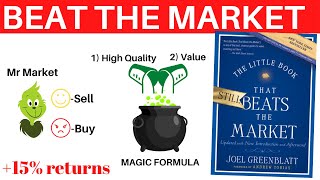
hey guys welcome back to the channel as we approach the holiday season i'd like to take this time to wish you guys a happy holiday this video will be going up on thursday and this thursday is christmas eve so i also like to wish you guys a merry christmas alright so in today's video i'd like to share with you my review of the little book that still beats the market summary this book is one of the more popular books about investing in the stock market and i'd like to share with you the lessons that i learned from this book the little book that still beats the market is written by joel greenblatt joel greenblatt founded gotham asset management which as of 2019 has assets under management of $5.6 billion and between the years 1985 to 1994 joel greenblatt's firm managed to generate an annualized return of 50% so in today's video i'll be sharing with you the strategies tips and advice that joel greenblatt shared in the book the little book that still beats the market the first thing that he shared in his book is his famous magic formula and there are two steps to this magic formula the first is high quality and the second is value by following this magic formula this allows you to buy above average companies at below average price and joel greenblatt believed that any investing strategy that follows this formula will allow you to be profitable in the stock market over a period of time the thing that joel greenblatt looks at to determine the quality of a company is its return on capital a high quality company has a high return on capital and a low quality company has a low return on capital by investing in high quality companies and not low quality companies we are purchasing a business that can invest its own money at high rates of return rather than purchasing a business that can only invest at a lower rate of return so what is return on capital return on capital measures the profitability and profit potential of companies relative to the amount invested by shareholders and other debt holders in essence it is how effective a company is able to turn its capital into profits so the higher the return on capital for a company the more effective a company is able to turn its capital into profits and that is why we want to look out for companies with high return on capital because this helps us determine high quality companies the second step in the magic formula is value so for companies with value we want to look out for high earnings yield by buying companies with high earnings yield and with value we are purchasing businesses that earn more relative to the price we are paying rather than less so we want to pay attention to companies with high earnings yield so what are earnings yield earnings yield is calculated by taking the earnings per share of a company divided by its current share price the earnings yield of a company helps us determine whether the company is underpriced or overpriced and one way to determine whether a company is underpriced is by taking a look at this earnings yield the higher the earnings yield of a company the more underpriced the company is and that's the second step for the magic formula to recap the two steps for the magic formula are first we want to look out for companies that are high quality and to determine whether a company is high quality we want to see that the company has a high return on capital the second step to the magic formula is value we want to look out for companies that have value and one way to determine that is to see whether the company has a high earnings yield the next thing is joel greenblatt's comments on his magic formula and i believe this also applies to any investing and trading strategies in general he has full faith in his magic formula and he believes that his magic formula will always make money however in the short term and also sometimes the intermediate term he knows that the magic formula won't work sometimes but he's not afraid in fact he believes that this is a good thing and the reason is this strategies that work overtime but may not perform all the time is a good thing because this means that most people are unlikely to stick to those strategies and he points out that if a strategy be it investing strategy or trading strategy work all the time everyone would use it and if everyone used it that strategy would probably stop working for example say this value investing strategy work all the time if a lot of people bought the same shares of the bargain price stock the prices of this share would be pushed up almost immediately so if everyone used the strategy the bargains would disappear and the strategy would no longer work and that is why joel greenblatt believes that you should choose a strategy that definitely works overtime but not all the time this does not mean choosing a bad strategy that does not work in the stock market you want to choose a strategy that definitely works in stock market over time however in a shorter to intermediate term the very same strategy might not work all the time the third lesson is margin of safety joel greenblatt wants to have a large margin of safety when he is investing in the stock market and the larger the margin of safety the greater the room for error in addition the larger the margin of safety the higher the probability of making profits in the stock market this chart shows both the price and value of a stock over time stock prices tend to fluctuate a lot while its value tend to remain quite constant over time as investors in the stock market we ideally want to invest when the price of stock is lower than its value as this means that the stock is underpriced and we are getting value on our money so we want to invest at this part of the chart the difference between the value of a stock and its price is our margin of safety so the greater the difference between its value and its price the greater the margin of safety we have when investing in that stock let's take a look at an everyday example to illustrate the margin of safety let's use an iphone as an example say we don't know the actual value or the retail price of our iphone and we estimate its value at $1000 and let's say the same iphone is going for $400 would you buy it chances are you'll buy the phone because the price you're paying is below the actual price and retail price of the iphone so if you bought the iphone at $400 and sold it at $1000 you'll make a tidy sum of profit $600 to be exact but say when you're selling the iphone you realize that the actual value and retail price of the iphone is $800 it doesn't really matter right because even at $800 you still make a nice profit of $400 and the reason why you're still able to make profit by selling this iphone at $800 is because you paid a low enough price at first and there was a large enough margin of safety between the price that you paid for the phone and its original estimated value the same thing is true for stocks in the stock market the reason why we want to have a large enough margin of safety is because sometimes our estimation of the true value of a stock might be off by a bit so we want to have a large enough margin of safety to take that into account so even if our estimation is off by having a large enough margin of safety we are still able to make profits in the stock market the fourth lesson from the book the little book that still beats the market is about the emotions about the stock market and we associate the stock market with a person namely mr market and mr market only has two emotions happy and angry and the thing about mr market is that his mood fluctuates frequently so one moment he can be angry and then the next he can be happy and vice versa when mr market is happy he is willing to buy from us at above average prices and when he is angry he will sell to us at below average prices and the good thing is this we are not forced to buy or sell to mr market we have the freedom of choice and we do not have to react to the whims of mr market so as investors in the stock market what we want to do is when mr market is happy we want to sell our stock to him because he is offering us above average prices for our stock and when mr market is angry we want to buy from him because he is selling to us at below average prices so that is how we take advantage of the emotions of mr market and make profits in the stock market we want to buy when mr market is angry and sell when mr market is happy and that is the fourth lesson i learned from the book the little book that still beats the market the fifth is the four different ways to store money the first is under a mattress the second is in the bank the third is to lend to companies and governments and the fourth is to invest in the stock market let's take a look at the different individual ways to store our money so if we store our money under mattress we get 0% returns on our money and if we do that we'll lose the value of our money to inflation the average inflation that we are currently seeing is anywhere between 1-2% so this means that every year the value of our money decreases by 1-2% if we just store our money under mattress not only are we not making any returns on our money we are actually losing the real value of our money to inflation the second way to store our money is in a bank the typical interest rate for an account with a bank is anywhere between 0-1% so while putting money in a bank is a bit better than storing it under our mattress overall we are still losing the value of our money to inflation if we put it in a bank the third way is to lend money to companies or government in the book the little book that still beats the market joel greenblatt fixed the risk-free rate for 10-year treasury bonds at 6% returns the 10-year treasury bonds are bonds from the u.s government and because the u.s dollar is the world's reserve currency and the u.s government is able to keep printing money bonds from the u.s government is believed to be one of the safest assets in the world and that is why u.s government bonds are considered risk-free so the risk-free rate for this bonds are at 6% so if you are looking to invest your money you need to earn more than 6% if not it makes more financial sense to invest in the u.s government bonds the fourth way is to invest in the stock market investing in the stock market generally allows an individual to earn a higher rate of return we need to make sure that the returns we are getting are higher than the 10-year treasury bonds offered by the u.s government if we are investing in a stock market we need to aim and achieve returns that are higher than 6% if not we are better off investing in u.s government bonds those are the five lessons that i learned from the book the little book that still beats the market if you have learned something and have enjoyed this video smash that like button because it will really help the channel grow and allow me to produce more content such as this and if you haven't already subscribed to this channel make sure you subscribe to this channel because each week i release one new video about investing trading in the stock market i'll see you in those other videos to your financial success

Comments 0