원문 보기
Has Michael Bury become an indicator that everything will be the other way around? Welcome back to Signal vs. Noise, where we look at unusual options market activity and ask what the market is really saying behind these movements. Today's name is Oracle, and Oracle is in trouble right now , having fallen almost half from its highs just a few months ago, and it has a little bit of everything in it right now .
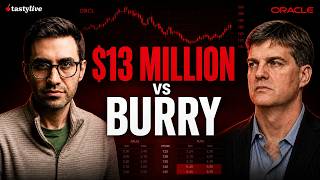
You have this notorious short seller , this beaten-up AI infrastructure trade, serious debt concerns, and almost 13 million in bullish call options volume that hit the market immediately after Michael Bury's comments. Mike Bury reopened a short position on Oracle on August 6 at $144.63, and the next day, call option buyers decided to step in and play against this move.
Over four sessions, about $12.9 million in bullish call options on Oracle appeared on the market. Oracle is currently trading around $155 at the time of writing, so the call option buyers are already in profit and Bury is already in the red on this new position. So, that's the first point. The market and traders repel anyone who opens a fairly large position.
But let's talk about the structure, because that's what makes the deal really interesting. The largest trade was a call option for November 20 with a strike of $165. 99 days to expiration, 8% out of the money, total premium paid $6.71 million. When the deal opened, asset-market volatility was around 64%, and it is this option that covers Oracle's September 14 earnings report , which is due in about a month.
So this is the most pure bullish trade in the portfolio. The buyer gets time, gets the earnings report, they pay for Oracle to recover after the report and continue to grow for a few weeks after that until November. So if you wanted to take a position against Bury with some margin, maybe even earlier, this is definitely one way to do it.
But then there was a call option on August 14, one day before expiration. Strike $146, in the money, premium $2.99 million. The asset market volatility here is 66%. It was a typical impulse deal. Oracle has begun to rectify the situation. AI stocks are currently showing growth. There are no reports, no serious catalyst that pushed this up.
The buyer was looking for immediate continuation after a small short-term price pullback just 2 days ago, which attracted me to the short side as the stock moved away from its 50- day moving average, which it is currently breaking through. Perhaps this position should be reconsidered. Now we have two more deals that also appear on the feed.
The September 11 call options we are moving to are 29 days to expiration. A call with a strike of 148 attracted about 2.89 million. At the time of opening, it was 1 % out of the money with an implied volatility of 75%. There was also a call for 180 on September 11, much smaller, only about 280 thousand, 17% out of the money.
So the problem is that both of them end just 3 days before Oracle's report and they won't get that catalyst for growth. These are definitely not profit-taking trades, perhaps more of a type of pre- report positioning, when traders start entering early in anticipation of good figures, and the buyer here is betting that the recovery will continue long before the September report, in fact even before the company reports.
So we can have three different interpretations on the same tape, right? The call on August 14th was a quick squeeze when the market sensed the entry of a known short seller and tried to punish him immediately, and it worked. Perhaps we can call 9/11 pre- earnings positioning trades, pre- emptive trades, as people try to buy on the dip in a troubled asset that is now so closely tied to the essence of AI trading, given all the leasing deals with companies like Microsoft, Nvidia, or even OpenAI.
And then there's your call on November 20th, which is actually a legitimate bet on developments after the earnings report. So, the graphical context, to me, provides insight into why traders are probably trying to get in right now, instead of waiting for, say, the September earnings report. Their all-time high was set in September 2025, when the stock traded closer to $345, and the low of $114.50 even surpassed the April 2025 low earlier this year.
So, Oracle was basically trading at its lowest level in 2 years. And since then, the stock has risen about 34% from that low. This is definitely not a case of call buyers buying a market that is showing any strength. Buying on the tape, which is currently right at the highs. A serious market cleansing has already taken place.
It's more like trying to buy at the beginning of a baseball game than at the end . So maybe that's the bullish argument on the tape. You have Berry , who is playing bearish on a stock that is already down 67%, while call option buyers are coming in as soon as we see technical signs of a reversal, well , a reversal.
And the fundamental tension is exactly what we've been talking about within the whole AI infrastructure trade. The growth is real, but the cost of financing is becoming uncomfortable. And they've fully invested in funding from Seagate, excuse me, Stargate, OpenAI, this $500 billion project. Their operating cash flow for fiscal 2026 reached a record $32 billion, but free cash flow was negative, almost $24 billion .
The debt is about $130 billion with about $200 billion in future lease obligations. And their credit rating has already been downgraded. S&P downgraded it just one notch above junk, to "three B minus." So you can understand why Michael Berry plays against them. The fundamentals don't look good. The company is losing a lot of money.
It has a huge backlog of orders for AI. She has a huge financial burden. But the market is still trying to figure out whether Oracle will become a critical name in the AI cloud space or whether it is simply stretching its balance sheet at the wrong point in the cycle. I wonder what you think about this, signal vs.
noise, chat. Let us know in the comments below. Should we go against Michael Berry now, or is it really about the market finding new support once we get past the reporting period and learn that money isn't just being burned for this AI revolution. This, of course, was another episode of "Signal vs. Noise." You watched tastytrade live. Like and subscribe for new videos.


댓글 0