
원문 보기
Nvidia announcing a series of deals with South Korea's SK Hynix and Naver. Naver saying it's agreed to expand AI infrastructure with the US tech giant while SK Hynix has struck a new multi-year partnership around next-generation AI memory. Nvidia also announcing it is partnering with LG Group on humanoid robots and data centers.
It's been a lot of headlines around Nvidia from this weekend through today. A lot of you know, handshakes happening over there. Celebratory moments with Jensen Huang appearing at a baseball game throwing out the first pitch. Notable that the Bears I believe lost in that one. And and he says look listen, it appears to him that tech is on sale.
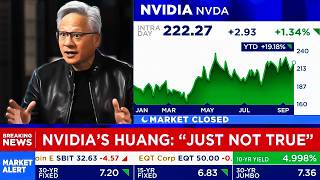
Shares of Nvidia are higher right now. Walk us through the latest here. Yeah, and I will say it's been an amazing market to follow because we haven't really seen the full participation of Nvidia in the last several weeks and even months really. It was sort of stuck in this range before then getting a lot of enthusiasm back into the stock last week that is expected at least to continue this week based on pre-market activity.
So we are higher today this morning. Nvidia though and SK Telecom announced that they plan to build now this gigawatt scale AI cloud in Korea using their DSX platform with the first AI factory expected to come online now in 2027. So Jensen Huang did highlight that telecom networks are becoming the national AI infrastructure saying that they connect people and they connect companies as well as devices and machine and they can now also be the backbone of these new AI clouds.
With their DSX SK can also be building Korea's AI cloud at scale and bringing these various agents and enterprises as well as physical AI companies to Korea and the rest of the world. And so we know that Nvidia also did announce with Naver they will be an expanding their sovereign AI infrastructure starting at roughly 55 megawatts with plans to move some of their gigawatt scale again to that DSX platform to aid its design.
But that's really right now a part of their effort to build this AI factory infrastructure that will help to serve various industries as well as just again, core part being infrastructure, which is huge. But, they called out specifically SK Hynix being this extraordinary partner to themselves, Nvidia, as well as right now co-developing this next generation of various AI factories and in particular, memory to of course accelerate the global expansion of AI infrastructure, which I think that anytime you hear any ways that we could expand right now, that very critical supply of memory, it seems like it's also right as as a big win here.
And so, Nvidia's been busy. I will say Jensen Huang has been everywhere. I mean, I feel like he is in a different country every single week at this point. But, definitely at least revising some of the recent stagnation we had kind of been in from a stock price. I mean, we've actually been on a pretty nice run down Nvidia for several sessions.
Which then made people say, you know what? Maybe people don't want a a homemade a TPU, they want an actual GPU, which then resonates all the way, David, to Jensen Huang and Nvidia. A positive for Nvidia even as a lot of people feel, you know what? Jensen's starting to talk, you know, he anointed Marvell, good that it was out of the S&P.
But, he's become, you know, he's got some good deals in Korea. But, he's become the the chief proselytizer for the group and I don't know if I want that. And why wouldn't you want that? Because I think you got to speak softly and carry a big stick. I don't want him to be out there saying the group is good.
I want others to be out there saying the group is good because I'd rather have Elon Musk say, you know what? I bought all these GPUs and it's been really great and therefore people ought to be thinking about this on the revenue stream. Stop tapping me as being somebody who just wants to get dig up Mars.
I mean, Friday was obviously a day that got a lot of people's attention. Leading up to it, we had talked for quite some time about the parabolic moves in any number of stocks, Marvell being one of the key ones on nothing. The sense being to your point where Jensen Huang said, "Oh, this is could be the next trillion-dollar company." And he said it on stage to be nice to them.
That was a Qualcomm. The stock added what? A A stock The company added what? A hundred billion dollars in market value You know, I think that Marvell is great. My point is we came in Friday, obviously, with a lot of these type types of moves. The only thing I would say, Jim, is the thing that we follow most closely, the capex cycle.
The The true thing that would stop this and have people really question has not happened. No, and you No company has taken its foot off the accelerator at all. the way I look at it, the neo cons, I'm calling them that. Like the neo The neo clouds, right? clouds, the neo cons. They are, without a doubt, the best barometer.
And you still see the EBS, you still see CoreWeave building things. We have Oracle this week. If Oracle's good, then all all systems go. It's just that a parabolic move I was going over the 25 worst parabolic moves. And unless you have accelerated earnings, what's the matter? Nothing. I'm looking at the charts.
That's Okay. Unless you have accelerated earnings, your stock is pretty much a goner. Got to go down 50% and then it doesn't come back. Sometimes it doesn't come back for years and years and years. So, I just I don't like parabolic moves. They are, indeed, as dangerous as you think they are. At the same time, it's simply saying the race continues.
It is Nobody wants to lose this race being to make sure they're there for the whatever's coming in AI. And they're going to spend whatever it takes to make sure of that. So, by the way, and that's money that will be spent and therefore it will trickle down through everything that we talk about all day long.
Well, the money will be spent, but then where's the return? And at what point is this an emotional buy? Where is the return? But they don't Did you reach the tech need to be there because if they're not, they know they lose. you Did we Did we reach the tech agreement? Yes. Okay. Did you Did you I thought this was a great point
I actually did. Ben Thompson made. He's talking about how Google agreed to pay SpaceX $920 million per month to use its Nvidia chips. Now maybe the GPUs are only be used by Google and Anthropic. And that this is the story that you want from Nvidia. This was the Nvidia story that I wanted to tell. Not the
All roads for you just come back to Nvidia. It's all you can do. Like it takes up like 3/4 of your brain. I I can't There's more out there. I can't even begin to tell you how wrong you are. It's really frightening. Is it all of your brain that it takes up? No, but see it's a $5 company Absolutely. Actually, it's even more.
You know, it's may No, it isn't. You know what? I'll talk to you Let me talk about how Matt Boss recommended Contour Brands cuz of the the Helly Hansen. Is that what you want me to go? Is that where you want me to go? How about Campbell's making a quarter because biggest goldfish is showing you right card you see goldfish made a little bit of a comeback.
I'll do goldfish. You have then how about the fact that Rao's had 13%? Is that where you want me to go? Is that where you want me to do? Rao's? What happened with Rao's? good numbers. You mean the tomato sauce? The yeah. I actually want to start on those Jensen comments. I mean Jen- Listen, Jensen is an investor in many of these The Nvidia is an investor in many of these companies including yours.
So, it's not surprising he'd say maybe there's some good bargains here. I mean, what do you think though of the of the recent action that we have seen in the tech sector? You know, there there there is such an insatiable demand for semiconductor and chips because as you envision the world of the future, the car, the drone, the robots, etc.
demand increased sophisticated silicon, not the traditional sensors, uh small type of semiconductor, more sophisticated semiconductor chips. And these systems are AI driven. Uh so, the the design of these systems create a significant opportunities for many companies. Right. And so, there's a fundamental reasons there behind the the push that we've seen into these investments?
Exactly, because the you see most advanced semiconductor chips are on a in a period of time of of great demand. Now, you look at the design of these systems, be it an EV or a robot, they're complex engineering design. So, it provides as well a great opportunity. Say company like Synopsys, our customer base expanded dramatically with the acquisition of Ansys.
And going from a physical prototype of a product to more digital twin of designing a product given the the complexity of electronics with mechanical, with thermal, with fluid, which is a fantastic opportunity. I mentioned that Nvidia is an investor in Synopsys. Now, you've been partners with them and and had a customer relationship with them for a long time, but has that involvement changed at all the way that you're doing business, the way that you sell?
Have there has there been any kind of influence there? Yes, so so historically the relationship between Synopsys and Nvidia was at the chip design level. Pretty much every chip that Nvidia design uses Synopsys, the whole Synopsys portfolio. As Nvidia started expanding their portfolio from a chip to a system into data center and into various applications, the opportunity Nvidia saw in the new Synopsys with Ansys is how does Nvidia create the future solution at the system level.
So, today Synopsys resell Nvidia Omniverse, which is the system level design environment, because we have a significant channel that every engineering work Synopsys is touching one way or another. The other part of the partnership is GPU acceleration. These complex simulation take forever to simulate.
With AI and GPU acceleration we're we're able to reduce it from months to days to hours. That's another part of the relationship and the opportunity between the two companies. Um talk to me more about that last piece because you and I've talked a lot before about AI and market demand. We've talked less about AI internally
Yes. at Synopsys and how it's affecting the way that you all do work. So you just talked about the speed. Um how how are you Is it agentic? How exactly are you guys using it? You know, I'm a big believer that AI will start having an impact on enterprises the the moment your workflow changes. The norm of the way you do work, the way you measure outcome, the way you reward employees.
It's absolutely moving into a hybrid workforce, a human engineer with agent engineers working together. We're a big adopter, of course, of our own solution, the agentic solution we're building for our customers because we have an IP business, which is a semiconductor design business. We have thousands of engineers building part of the semiconductor chip.
So we're we're using our own agentic AI and it's absolutely changing the workflow. So how how is it change Is it just speed? What what are the other things it's changing? The complexity of designing these chips, we were always running into a shortage of I'm going to call them human engineers to to to tame that complexity and support the road map that we have.
Now it's a fantastic opportunity where you have a human engineer partnering with many agent engineers to do the work. So we're able to support our expanded road map without having to either expand the human engineers because one is hard to find and two, if you're able to get the job done faster with the same, companies will do it.
What happened on Thursday and Friday was just downright ugly and many of the names that had led the Nasdaq lower are rebounding significantly today. I'm talking about the chip names, specifically the memory stocks. We can cycle through a bunch of those. Jensen Huang said over the weekend that the sell-off in tech is a buying opportunity.
You had to figure that it was only a matter of time, Dan, before investors would look at the declines in those stocks and agree this. I mean, Thursday and Friday alone, the SMH was down 10%, right? Micron was down 20. Broadcom was down 19 and maybe that was the name that started this whole bit of unrest in the in the tech market in in general.
But, what about the rebound today? Do we do we think that what we witnessed late last week was just a couple of days worth of weakness and the buyers are going to are going to come in and mass and keep this trade humming along? What do you think? I think buyers are going to continue to be there. It's our view dips should be bought, especially in a memory super cycle.
Everything we've seen Korea, I mean, over the weekend our checks showed just even further tightening in Taiwan in terms of supply. You know, Jensen in between meals, you know, in Korea, I mean, he's inking deals left and right from SK to others. And it just speaks to our view. We are in third inning, one out, man on second in terms of this game for AI and that's why I think you're going to have these sell-offs.
SpaceX maybe it causes, you know, you know, a little white knuckles going into that this week in terms of this, you know, sucking out some auction. I think that's the the wrong narrative of some of these other names. You own the winners in this tech trade. We are still early days and I think look, think about now Apple getting on the AI game.
Consumer. That's just going to be the ripple effect just like the Godfather of AI Jensen's doing in Korea. You know, Brandon, Micron's target today 1220. It Just to show you what these stocks have done, how crazy they've gone. I just don't recall a time where you've had price targets get blown past so easily and so quickly.
Wells had a 550 on Micron. That's so last week. 1220 is their new target. Marvell's going into the S&P 500 later this month. That stock has been sharply higher. Do you feel like that was just a couple of days of of shakeout that we did whatever work we had to do in terms of the the tech trade itself, clean it up a little bit, and just we're right back to feeling okay about it?
Yeah, I mean, I think the the water was boiling and we need to take the lid off and let some steam out. Okay? It's because we were just getting just too frothy. You know, the the Marvell to me when Jensen says this could be a trillion-dollar company, that's absurd that it just goes up whatever 30%. It makes no sense.
Okay? Just that needs to be, once again, take the lid off and let some steam come out. I do think though a lot of this is more about the analysts being so behind the eight ball. To me, going to 1200 is not it's 20% higher. It's why were they at 550 for so long? And so, don't forget these analysts follow price action.
It's not the other way around. So, when it was at 300 and they said it was going to 1,000, that's relevant. But saying it's going to go 20% higher once it's already had this monster move, to me is more about I think these analysts have really just missed the huge revenue, the huge earnings growth to Dan's point as we are in this like third inning.
And I think this inning lasts multiple more innings, but you do have to say that Scott, the technology is new. We're in very early innings, but don't confuse that with what's priced in. And so, to me, that's my balance. That's my my true north is just trying to balance between the the innings of the technology versus the reality of what's priced into a lot of these stocks.
The fact talk to everybody I I'm still getting calls and comments of what happened on Friday? And then everybody saw the Korea trade overnight, which was just a reaction, but they're thinking that's now anticipatory and that this is all breaking. What do you tell them? Sure. I I think Kelly, what's happening is that the debate has fundamentally shifted this year even more so to the benefit of semiconductors.
We had our Bank of America Global Technology Conference last week. You know, last year the debate was that if they build it, will they come, right? This year the debate is can you build fast enough? So the debate has completely shifted from the hyperscalers having to justify the return on their investment to just constraints everywhere you look.
So whether it's in computing, whether it's in memory, whether it's in networking, whether it's in storage, whether it's in power, and we think semiconductors are a very critical part of helping to address a lot of those constraints, and that's why I think it's not a surprise that the SOX index has done so well, primarily driven, I should add, by earnings growth rather than price to earnings multiple expansion.
The reaction I get is from people who go, "Look, did you see that price target? $1,200? That that's crazy." I mean, what do you say to the And I'm talking about people who've been in the market a long time. They've seen this game. They've seen this movie before. They know what happens. Everybody chases price targets on the way up, then there's going to be a move, and they're going to chase them down.
So and they're they they're almost in disbelief that anything meaningful can last longer than the kind of action that we've seen in this strong rally the past couple of weeks. What what is your message to them? Sure. I I think that to some extent, you know, the investors who were impacted by some of the historical cycles, whether it was a telecom cycle or the buildout of the internet, I think they saw a lot of infrastructure being deployed, but the utilization of that infrastructure was extremely low.
And right now, what we are seeing is that the usage of this infrastructure is exceptionally high. In fact, the likes of OpenAI and Anthropic, they're trying to buy computing capacity wherever they can find it. You know, there is hardly a single GPU out there that is not 100% utilized, right? There is no dark GPU, there is no dark compute.
Second, I think important thing the industry is doing is planning for multiple years out, right? So, there is already a roadmap that goes out for the next 2 or 3 years. And you have these pools of excellence, whether it is in the specific kinds of memory chips, whether it's in specific kind of wafers.
So, for example, there is only one Taiwan Semiconductor that is helping provide leading edge wafers to the entire accelerator industry. So, when you have that one person who is controlling a lot of this production, it is very hard to double order and create that overbuild. So, I think what we are seeing is a combination of very strong demand and very disciplined supply coming to the market.
And that's very different than what we have seen before. And I I think that's why this cycle is a lot more durable. Final point I would make is look the the three largest companies that I cover, Nvidia, Broadcom, Micron, they are all trading below market multiple right now. So, again, this isn't a case where valuation has gone completely out of control.
I think that the growth rates are still able to justify right much more upside to these semiconductor stocks. Yeah, and and to your point, look, and I again, I share what I hear from people who are skeptical and a little worried about the rally in order so that you can kind of push back on it. And when I look through your coverage list, I mean, if any the semis are up 66% year to date.
I'm not sure there's a single name in your entire coverage list that's lower on the year. You are neutral and underperform on a few stocks, which have done incredibly. And if anything, you'd look at this and go, "Yeah, you were too cautious." And so, that's the the the difference between those who are not looking at the numbers like you are and just saying, "Well, this seems crazy to me." And then you're right here looking at the numbers, trying to kind of separate this out.
And it doesn't even matter because basically this rally is so big it's taking up the entire space. Right. I think there is a belief, perhaps incorrect, that the hyperscalers can grow without spending on their computing infrastructure. And I I think one has to change that because if you look at the large search companies or the e-commerce companies or the social networking companies who have 3 4 billion plus subscribers, how do they grow 10 15 20 25% a year without investing in their computing infrastructure?
So I think people are more willing to believe that those companies can continue to grow 10 15 20% a year, but that is simply impossible without them investing in their underlying infrastructure that is helping them monetize, right? Get more insight about every user they have, right? The number of users, right?
when you have 4 billion users, the number of users is not growing 15%. So how do you grow 15 or 20%? It's by extracting more insight about the user and the only way to make that happen is through the underlying computing and the semiconductor infrastructure. that you're not naming them. I don't know if you even mean that, but I keep thinking about a company like Meta as you're saying this, which of course is now going to have to potentially do another capital raise to fund those plans.
So let me ask you, Ross, if the great AI AI infrastructure build out, we're still early days here, you're going to have a lot That would mean the AI chip trade still has room to run. What are the names you like here, Ross, in that trade? Well, if you go into my fund GK, you see our top three names are are right there in the top five, right?
So we've got our Well, what's become our number one holding is Micron, which I you know, you had opportunity this morning to to get in. It didn't last very long. But Micron, you know, is just in an incredible position because AI uses a ton of memory and and these new chipsets need, you know, 10x the memory of the old chipsets.
So Micron and the two other Korean companies are just in a phenomenal phenomenal position because it's basically a monopoly. So, as they increase capacity, they'll have more supply, but the demand continues to grow as well. So, you know, Micron's in a phenomenal place still trading at 10 times forward earnings.
Then you've got Nvidia, which I I mean, I just love this company. Jensen is the best CEO in the world. He's executed quarter after quarter after quarter, and how this thing has a 24 PE is insanity to me. So, Nvidia, the king of AI, is still at I consider a cheap valuation. Um and it has not recovered to the price it was last week.
And then you've got uh Broadcom, which is our third pick in chips, which uh you know, had a nice sell-off. And if you're looking to get into Broadcom, also a more reasonable valuation than just a week ago. Um so, those are our three chip names that we love, and they're top uh in our top five holdings at GK.
Look, no matter what you say, it all comes down to Nvidia. I say that because the power behind generative AI, behind agents, behind training is Nvidia. And if Nvidia runs out of orders, then the biggest company on Earth certainly won't be able to maintain its $5 trillion market cap. As I said at the top of the show, I'm feeling negative on the market right now because we've got this wave of new supply coming, and that's what killed us in 2000.
Every time we've gotten too much supply, like the Nasdaq secondary dilution in 2014, like the IPO boom in 2021, it's led to sobering declines that tend to crush the market's leaders. And it's one that few people see coming because there's nothing to do with the fundamentals. Some leaders hold up better than others.
The hyperscalers may need to raise money to maintain their status as cloud service champions, but Nvidia's the opposite. It's brimming with cash could easily fill its $80 billion buyback with its consistent cash flow. So, I've been concerned about orders from Nvidia because two hyperscalers, Alphabet and Amazon, have done their best to develop alternatives to Nvidia's chips.
Amazon's got this Trainium, and Alphabet's selling TPUs. Amazon's talking about having a $50 billion chip business all of its own, and much of it, I think you could say come out comes out of Nvidia's hide. Alphabet's got a huge business, too, and when it tested the superiority of its own chips over Nvidia's.
Now, they can make those claims because there are no clear benchmarks, even though I think they're not true. But late last week, we learned today that Google we learned that Google will be paying SpaceX $920 million a month to use that company's bountiful Nvidia hoard, which means maybe customers of Google Cloud don't want to rely on Google's TPU.
That's something that was pondered by the authoritative Ben Thompson in his eye-opening Stratechery update this morning. I found that very, very powerful. Maybe all of this though is inside baseball to you. If you've been watching what CEO Jensen Huang has been saying, well, you'll notice he's spending a lot of time with governments because sovereign AI is now serious business.
He's gotten South Korea to invest in it. Nvidia's working with Singapore, India, Japan, Switzerland, Germany, Taiwan, Israel, Qatar, the UAE, Saudi Arabia, and many others. Why does this matter so much? Well, because we keep hearing that the hyperscalers buying Nvidia's chips are losing money on the purchase.
That's what they tell us. Something I think Jensen would surely dispute. But all of these countries are buying Nvidia's wares, too. And they're not looking for a quick return. Right now, they're 14% of the business. That could rapidly become much bigger. And that number doesn't include what's in the pipe.
I think that number will be substantially higher this time next year. Enough to allay the fears that some hyperscalers just don't want Nvidia at all if they can get really get away with it, which I don't think they can. And Nvidia doesn't want to be hostage to customers that are trying their best to get off Nvidia.
It wants to get every customer it can. I worry that there won't be enough money around after the SpaceX IPO to buy shares in companies that are funding the great data center build out. Jensen's overseas trips help calm worries because he's found a whole new customer base he's really exploiting. I understand Nvidia's chips are the envy of the industry.
Each iteration, like the Vera Rubin, that's the current one, brings more business. Are the chips expensive? Can they generate a good payback? I guess it depends on who you ask. But real countries are buying these chips in droves for their sovereign AI programs, and that alone will lessen Nvidia's dependence on a handful of major hyperscalers.
I'm not changing my view. I still say own Nvidia, don't trade it. But with the upcoming wave of mega IPOs, it's going to be tough for anything tech to stand out in the near term, even a company as tremendous as Nvidia, which is most the most important stock in this entire market. &, but it was a green day for many of the tech hardware and data center adjacent names that got hit hard in Friday's sell-off.
Jensen Huang was in South Korea over the weekend making many public appearances, and we got multiple announcements. Nvidia announced deals and partnerships with many companies, so let me quickly cover some of those. Nvidia and SK Hynix announced a multi-year technology partnership for next-generation memory aligned with Nvidia's AI infrastructure roadmap.
SK Hynix will diversify into new markets that Nvidia is creating across AI infrastructure, personal AI, and physical AI. Co-developing memory for Vera Rubin AI supercomputers, Vera CPUs, RTX Sparc power PCs, and Jetson Thor. Both companies will apply AI to semiconductor chip design and manufacturing using Nvidia's CUDA-X libraries and Nvidia PhysX Nimo.
Nvidia's partnerships with memory makers are very important given the constraints throughout the industry. Additionally, Nvidia and SK Telecom announced plans to build a gigawatt-scale AI cloud in Korea using the Nvidia DSX platform with the first AI factory plan to come online in 2027. The cloud will support sovereign, physical, and agentic AI for enterprises and industries across Korea.
Nvidia and SK Group plan to expand their collaboration from AI infrastructure to joint research on next-generation AI factory architectures. Nvidia announced that AI cloud Naver will build AI factories on the Nvidia DSX platform at gigawatt scale. Naver will use Nvidia's full-stack AI platforms, models, and software to advance regional AI models.
Naver serves sovereign AI demand in Europe and the Middle East, as well as AI demand in South Korea. Naver plans to launch an AI agent platform in Korea in the second half of the year powered by Nvidia Nemo Cloud blueprints. Nvidia and LG Group are building an AI factory to accelerate LG's next wave of businesses spanning robotics, autonomous driving, data center technologies, and GPU cloud services.
Nvidia also announced an expanded partnership with Doosan Group to advance new opportunities across physical AI, robotics, and AI factory infrastructure. The collaboration brings together Nvidia's full stack with Doosan Group's capabilities in industrial automation, power generation, and advanced electronics materials to support next-generation AI infrastructure.
South Korea will be an important market for physical AI. Jensen Huang also met with Hyundai leadership to discuss Nvidia and Hyundai's work across mobility and physical AI. It's also being reported that Jensen met with Samsung leadership and discussed cooperation in next-generation foundry chips. According to Reuters, Samsung's co-CEO said that Samsung and Nvidia are collaborating on autonomous driving chips, Groq AI accelerators, and that the two companies had extensive discussions on long-term cooperation in HBM4E and HBM5.
Again, Nvidia's partnerships with memory makers are very important, and that's a big reason for Jensen's visit to Korea. In other news, Reuters is reporting that a South Korean minister said that a government notice for South Korea's GPU project had been issued earlier in the day, and that a supply of Nvidia's B300 chips was expected to arrive on time.
That same minister is reported as having said, quote, "B300 supply looks like it will come in time, but Vera Rubin looks likely to be slightly delayed. So, we will request priority supply for that." Based on his comments, it sounds like there might be a slight delay on the specific allocation of Vera Rubin that he's referring to, rather than an outright delay on all Vera Rubin shipments.
Both Jensen Huang and Colette Kress told us last week that Vera Rubin is in full production and on track to launch in Q3. Regardless, this piece of news is a reminder of the importance of sovereign AI to Nvidia's business. Speaking of sovereign AI, Nvidia published a blog post over the weekend highlighting sovereign AI momentum in the UK.
This is somewhat of a progress update showing that prior Nvidia UK commitments are turning into deployments, startups, and enterprise use cases. Nvidia highlighted Nebia's planned UK AI infrastructure expansion, additional AI cloud partner pipeline activity, and several UK startup and enterprise deployments.
And then on Monday, Apple announced Siri AI, a new version of Siri with personal context understanding, on-screen awareness, broad world knowledge, web-based answers, a dedicated Siri app, visual intelligence expansion, and more. These new capabilities are powered by the next generation of Apple foundation models, custom-built in collaboration with Google and its Gemini models.
These models run on device and on servers using private cloud compute. And then in a Q&A after the WWDC keynote, Apple executives revealed that Apple worked with Nvidia and Google to make private cloud compute work on industry-leading AI hardware. Apple foundation models run on Nvidia hardware through Google Cloud.
This is so interesting because up to this point, Apple has largely sat out of the AI race compared to the other mega-cap tech companies. And now they're entering the arena in a major way and using Nvidia hardware through Google Cloud. Keep in mind that Alphabet CEO told us this past earning season that they'at's probably going to continue for some time, especially with Apple foundation models running in Google Cloud.
Google remains a major customer of Nvidia and most likely will for a long time. In other news, Amazon is reportedly raising 14 billion Canadian dollars in a Canadian bond sale, so roughly 10 billion US dollars to help fund their AI buildout. This comes after the 80 billion dollar equity raise that Google announced last week.
Also last week, the FT published a report that Meta is considering raising tens of billions of dollars as well. The FT also cited analysts that said Amazon and Microsoft are likely considering similar raises. I'll be completely honest, I would much prefer that companies fund their AI buildouts with cash flows rather than debt or equity.
That said, the hyperscalers are seeing very strong demand from their customers and new capacity is being monet. Meta is unique in that they're technically not a hyperscaler. They're not a cloud service provider like Amazon, Microsoft, or Google. But Zuckerberg did recently say that a cloud business is on the table if Meta ends up with more capacity than what they need for their own internal workloads.
And since we're talking about mega cap tech companies raising capital, let's talk about Nvidia returning capital to shareholders. As I've said previously, by increasing their share repurchases and dividend, I think Nvidia maybe trying to attract value investors to Nvidia stock. Most growth investors are already well exposed to Nvidia, but there are many value investors who are not.
Those value investors are interested in companies with strong free cash flows, large share repurchases, and growing dividends. Nvidia leadership have said that they intend to return 50% or more of free cash flow to investors in perpetuity in the form of share repurchases and dividends. Now consider that in contrast to what's happening with many of the other mega cap tech names.
At a time when many hyperscale companies are considering raising debt or issuing equity, Nvidia is returning capital to shareholders. That in combination with Nvidia's strong projected growth and Nvidia trading at roughly a market multiple on forward earnings makes Nvidia stock very attractive to long-term value investors.
I think we are likely to see many value investors gravitate toward Nvidia stock in the days ahead, especially if we see more dilution from other mega cap tech companies. Looking ahead, we have Nvidia's annual meeting of stockholders scheduled for Wednesday, June 24th starting at 12:00 p.m. Eastern, 9:00 a.m.
Pacific. June 24th is also the day we get Micron earnings after market clos the the three to four .



Comments 0