
원문 보기
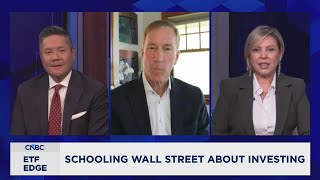
What could this mean for rate cut expectations? This morning, on Post 9, we are joined by Allianz Chief Economic Advisor, former PIMCO CEO Mohamed El-Erian, who will speak with us on the eve of the game regarding Egypt. Good to see you, Em. Thank you for taking the time. Thank you for inviting me. Um, so we've already talked about this.
You don't see any rate cuts or increases until the end of the year. Yes? That's right. And what is the reason, what are the calculations behind this? Um, first of all, I think the worst of inflation is over. I think we will reach the peak of this cycle either in June data or July. And what's left that's driving inflation comes mainly from artificial intelligence, and that has a positive supply side, unlike what we left behind , which was oil and tariffs, which had a negative supply side.
So the Fed can accept that. Why not shorten it? Too early. Just wait and see how it develops. Um, and I think the economy is in good shape right now, and let's just let it function. You really think the market doesn't fully understand the changes Warsh is going to bring. So, there are three big changes that I think the market has not yet fully absorbed.
The first is the transition from the Powell-era Fed to the Warsh-era Fed. This is a reform-oriented Fed. We saw this with forecasting. Reform is proving to be contagious. I don't know, last week we had Sarah Eisen on the panel, and the next thing we know, I was like Quick, Lagarde comes out and says, "I don't believe in forecasting anymore." I like framework forecasting.” So this breath of fresh air from the Fed is actually being picked up by other central banks.
And I do n't think the market fully realizes that this is not about rate expectations, but about something much more. It's about the five areas that he identified, and it's about modernizing the Fed. The second change is from the era of efficiency to the era of geoeconomics, economic public administration.
And then, of course, we have the massive technological changes that, as you know, I'm very passionate about. Do you think the forecast change is positive for the markets? One thing they noted on the panel last week at Centro was that since the announcement of this change, they haven't seen much volatility in rates , um, or any unease in the markets.
And I think it's critical that there may be some increase in volatility, but we've had to break this really dangerous interdependence that's emerged between markets and central banks . Chris Waller gave a great talk yesterday where he shows when this becomes a problem, and he calls 2020-2021 the years when this became a problem, and ultimately the markets didn't really benefit from 2022.
It was a terrible year for any asset you were in because this interdependence got us into a bad state. So I think in the long run it's good for the markets. Some volatility is possible as the market gets used to less forecasting. Yes, it's too early to say. Meanwhile, you have a new essay in the New York Times called “The Bessert Doctrine: The Days of Playing America Are Over.” And you pay attention to the recent speech of the Secretary of the Treasury at the Economic Club of New York.
Do you support? Yes, I think I like the fact that he made it clear that what's happening now is not accidental. That there is a doctrine that underlies this . It defines five conditions. I don't think people fully understand that this is a fundamental change . It's no longer just about efficiency and open markets.
It's about what's called geoeconomics, which is that economic performance and corporate outcomes will increasingly be determined by geopolitics, domestic politics, and national security, rather than just commercial considerations. We've seen this shift with armed tariffs, with armed payment systems, we've seen industrial policy become much more aggressive.
And this will continue, and people need to think differently about what lies ahead. You don't draw conclusions about whether this is a step away from free markets, and whether it's good or bad. So I think free markets themselves need some adjustment. For example, we saw that in the case of globalization we did not take into account distributional effects.
And then you had problems with the elections. I also think we live in a different era. Um, when he put it out there , and he was right , the US has been outplayed for a long time, especially by China . China was allowed to join the system, and China has certain obligations that it has not fulfilled.
So, he took advantage of globalization, but he failed to fulfill his responsibilities. And I think that if you're going to be part of globalization, you have to do your part. This notion of managed globalization is not that important. You still have globalization, but it's managed in a way that people don't use it.



Comments 0