저자: EdZitron · 외국인
요약 보기
OpenAI CEO 샘 올트먼은 정직성과 역량에 문제가 있는 인물로, 언론이 AI 기술의 경제성(실제 수익·비용)보다 인물 서사와 막연한 공포 마케팅에 치우쳐 있다고 비판. 모델 학습비가 2년간 1200억 달러 이상으로 증가하는 등 비용 구조가 지속 불가능하며, OpenAI·Anthropic 모두 IPO 전 현금 소진(burn)이 큰 상태라 채권·주식 조달이 어려울 것으로 주장. 'Mythos' 등 신모델의 위험 주장은 실제 보안 업계 반응 없이 과장된 마케팅이라고 평가.
다듬은 글
This is the largest con within AI and within the open AI con and the larger LLM con. I don't think investors are going to be super interested in buying tens of billions of dollars of bonds every single year, quarter for a company that's basically saying, "Hey, I need to borrow more money so that I can lose even more money." And once I've done that, I'm going to need even more money.
And why do I need that money? So I can lose it. They don't have an answer. Think of it like this. If this thing was as powerful and scary as it was, wouldn't all of these companies be freaking out internally? On the tech report with me today is writer of Where's Your Ed at? and host of the Better Offline podcast, Enders Cetron.
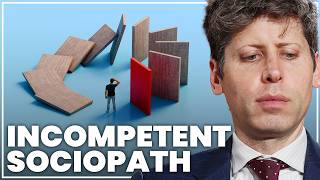
Welcome back. Thanks for having me. We're going to talk about Claude Methuselah later, but first I want to talk to you about OpenAI's CEO Sam Altman, who's essentially been dragged in the press this week after a New Yorker exposé revealed, among other things, that some of his peers and employees basically think he's an incompetent sociopath.
What do you make of of that piece in The New Yorker and the picture that paints of Sam Altman? So, I actually had Ronan Farrow on the show this week to talk about it as well. And a lot of it was just to give credit where credit's due. A lot of it was Karen Hao had reported a lot of this in The Empire of AI and other reporting had done this, too.
But nevertheless, it was a great piece because it pulled together over 100 interviews with various different people. And a lot of it was mainstreaming things that people need to know about Sam Altman, that he's a deceptive guy, that him and Greg Brockman talked about trying to play world powers against each other selling AI, which is really funny cuz at that point, I think it was like before I think it was like 2019, it was they didn't have anything to show.
They had like GPT-2 which could generate text. So, these guys have always been fantasists. My favorite bit in it, though, was an anonymous board member saying that the way that OpenAI was levered up was scary. A board member shouldn't be saying that even in private. That's a That's a bad sign. That's a really bad sign.
So, yeah, the whole thing was really interesting as well. Like Sam Altman doesn't know machine learning concepts, can barely code. He's just like me, for real. Uh just kidding. I know machine learning concepts, but he is um He's just a guy. Like that's the big thing from this piece that I think people need to take away.
Like they try and for years people journalists have tried to prop up Sam Altman as this talented, smart fellow. When he really he's a node. He is a guy who's very good and I I'm writing a piece called The Hater's Guide to Open AI this week, as well. He's just a node. He's very good at finding a powerful person and exploiting their greed and desperation and then using that for his own means, and by which I mean finding ways to make himself look better or gain more resources and power as a result.
He's done it with Microsoft, with SoftBank, with Oracle, with CoreWeave, with all sorts of partners he's now. And it's his whole life. He did it with Paul Graham at the beginning. It's really not obvious why Paul Graham made him the head of Y Combinator, either, despite the fact that Paul within that New Yorker piece was quoted as saying that Sam had been lying the whole time.
In fact, really the only thing we know about Sam Altman is that he is a liar. You mentioned your The Hater's Guide to Open AI. You gave me a bit of an an early look of that. And it'll be coming out today. You You accuse the media of sort of falling into failing to hold Open AI to account and even sort of enabling the the company to to do what it has been doing, especially on some of its creative accounting.
Do you think that this sort of this exposé that the media is starting to wake up to kind of what you've been saying for a little while now? I think on a social level they are. I think they're seeing clammy Sam Altman for what he is, which is a liar, a deceiver, a power-hungry parasite of sorts. And these are just my words, not Ronan Farrow Farrow or Andrew Marantz.
But I don't think they're waking up to the economics of the technology yet. Even within Farrokh and Morant's piece, they still talk about AI and generative AI in this mystic way. It's this thing that we can't control and it's powerful and should we be trusting Sam Altman with the powerful AI? Which is a good thing in theory, but it's like, can we trust Sam Altman with large language models?
Can we trust anyone with large language models? Can we trust like it's still a large language model. It's not It's dangerous in the sense it can spread misinformation in that it can it it it steals from people that it's got this environment massive environmental issues not just in the water but in the heat it causes and in the resource scares that are happening the supply chain crises that are happening because of building data centers and they're not getting that bill.
But the actual technology itself it's like dangerous? Mm. The whole AI scare tactic thing is a marketing term. And indeed the media is on some levels a co-conspirator within the larger OpenAI con because they claim that AI can do things it can't. People talk about AI agents like they actually exist when they do not.
They talk about coding agents coding agents large language models that bonk each other's heads and can put out usable code sometimes if you know what the code looks like. They talk about that in these grandiose terms. And to paraphrase Cal Newport Georgetown professor and actually does a great podcast on this they're kind of saying things based on what they think is directionally true.
And we've gone over this a lot. Every time an outlet is like, "CoreWeave has signed a deal with blah blah with Anthropic today. Oh, they signed a deal with Anthropic now they'll do all this compute." It's like when? How? CoreWeave doesn't have the compute capacity. Anthropic doesn't have the cash to pay them.
What will they do with that? Well, when they get all this compute compute will be even more powerful. To what end? Oh, is AI replacing jobs? Not really, but because it sounds scary, we'll just run a headline suggesting it might. The Financial Times had a piece about how AI is not replacing people or even really enhancing people in accountancy and other white-collar jobs.
But even the beginning, even the beginning of the article, human the concept is like well, AI threatens white cot to replace all white-collar labor. Every one of these scare tactics, I think in the most for the most part is people trying to act in good faith and give a balanced view. But every time you repeat even the theoretical, you are helping these companies become more powerful.
And that's how the Open AI con works. It's Sam Altman convincing enough people to repeat enough things so that you can raise enough money, so that you can get more people to repeat more things, so he can raise more money. The actual outputs and outcomes and products don't really matter. I also I also don't think they're making as much money as they say.
2 billion a month? I I don't see it. I just I'm very confused where that money could come from, but my theory with both Anthropic and Open AI is that money is coming from the fact that Claude Opus 4.6 and Sonnet 4.6 and the latest Codex models from Open AI burn more tokens. I think they just made them burn more tokens.
I think the only way to get any further is just massively increasing the amount that people are being charged. And of course, both Anthropic and Open AI have made their enterprise customers now have to pay directly for tokens. They can no longer pay for that month the subscription cost. The rent just went up for everyone very quietly.
And so, long story short, the entire AI bubble is about obfuscating what it actually does and what it actually costs and what's actually possible. And the co-conspirator within that is kind of the media at this point. Not everyone, but some very specific people. Again, in your newsletter, and we touched on it a second earlier, that some of the employees have accused Sam Altman of basically not really understanding what he's talking about and misusing basic basic technical terms for machine learning.
There's there's not been much of a short-term reaction to this exposé from what I can see, but do you think that it has maybe damaged some of the the confidence around Sam Altman's ability to run what is the world's most prominent AI company? And how do you think he's got away with it for this long?
I think he got away with this as well. To be clear, what I think the problem with this piece is for Altman is the problem of everything else with OpenAI. There's been bad news with OpenAI bubbling up. People are mad at Sam Altman. He's a genuinely unlikable guy. I feel the same way about Dario Amodei, by the way.
Every time I hear that guy Yeah, it's going to replace 50% of jobs. It's just very He sounds like Dario Amodei sounds like Elizabeth Holmes's Steve Jobs impression. But back to Altman, Altman is just an unlikable guy, and people have been looking for a way to attack him for a while, and so they're doing it.
And in Farrow even mentioned in the piece that there is like a coordi- there was a coordinated campaign to kind of smear him. No need to do that. Altman does it himself. He's very annoying and unlikable and says silly things. I don't think that this is getting as much purchase as it could because it did not knock on the economics and the efficacy.
These articles never do. And I get why. I get that you can It's much easier and much, well, easy is the wrong word. It's much more narratively satisfying to get a bunch of stories about a guy sucking and being like awful and sh- you know what I was about to say, but I couldn't say that. Like but just really bad a bad person and a liar and a people calling him a sociopath.
That's a good story. Getting into the economics and the actual efficacy is tough, and it flies against what a lot of powerful people in the markets want. Instead of And going after that is tricky because there's a bunch of people with a vested interest to stop you. There are far less people with a vested interest to stop you attacking Sam Altman.
I, to be clear, I this is a very, very, very important piece. I think Morant's and Farrow did a great job and it was necessary. I also don't think it really hurts OpenAI because at this point everyone already knew this. Karen Hao did a great job with this in Empire of AI. There's a lot of stuff that was not I wouldn't say repeated because Farrow and Morant's went out and reported it.
It was a very deeply reported like they both did an excellent job. That being said, Karen Hao said a lot of this. So, I think it mainstreamed a lot of stuff that needed to be mainstreamed. I also think that they dodged around the real problems. I don't think it talked about the fact that AI is sold on what it could do and might do, but never on what it actually does.
It's sold on theoreticals. The economics are built around theoreticals. Jensen Huang today said that people need to stop focusing on AI having such a fast return. Like we have every sign of a bubble. But no one really wants to talk about it at that scale. It's much easier to focus on the people. It's much more juicy to focus on the people.
And so I think that while it's good we know that Clammy Sammy is as clammy as we always believed, I don't think it I don't think the knife is twisted enough. I think Dario Amodei, who is just as bad as Altman, just better at it. I don't think I didn't see that I Dario was like this little piece of it despite the fact that this guy despises Altman.
He despises him. And also Anthropic is the same company as OpenAI. It grew out of OpenAI. It They just did a deal to buy custom silicon from Broadcom or be it its TPUs. They just did a deal with CoreWeave. They're rushing towards IPO. They screw the customers over. Their CEO's really annoying. Like it's just OpenAI in a different hat.
Nevertheless, Altman's a much easier guy to beat up on because he kind of asks for it. He goes out and says and does annoying things. There was this weird quote in there where where like, "Yeah, he's a people pleaser, but he's also a liar." How do you have that in one person? And the answer is he's probably not a people-pleaser, he's just a liar.
Like, that's the actual Like, he's not actually pleasing anyone, he's just saying what he needs to to get to the next stop. It's just Farro knows what he's doing, Rance knows what he's doing, but I think the overall view of Sam Altman that still isn't quite dispelled is he is not a genius. He's an excellent networker.
He knows how to set up networks. He knows how to exploit networks. Genius? What is a genius exactly? A miserable little pile of secrets, in my opinion, but it's it's frustrating because yes, it's good that this happened. Yes, it's good that we're giving Sam Altman his negative dues, but it's and d u e e s, I mean, there.
It's it's frustrating because it still doesn't attack the actual problems of the AI bubble. It's just still this mysticism around Ooh, the scary computer thing that Sam Altman controls. Can we trust him with the secret computer? And no, we can't, but the secret computer isn't that scary. We uh we might get onto Claude Methuselah on that topic.
Yeah, we might get onto that in a little bit. But, before you do Altman is accused of having a sociopathic disregard for AI safety. Apparently, only assigning 1 to 2% of OpenAI's computer to the safeguarding team when they were supposedly promised 20%. But, in your hate guide to OpenAI, that again is coming out today, you call their supposed focus on safety a smokescreen.
Here's the thing. All of them kind of are. Like, Anthropic kind of cares about safety, but when you go and look, and we'll get onto Methuselah in a little bit, when you look at how everyone does AI safety, yes, it's necessary to do this. It's yet Like, to be clear, AI safety is necessary in the sense that yeah, you want to make sure that these models don't misinform people, in which case you should shut them down due to hallucinations.
You want to make sure that they don't I don't know, align in such a way that they mislead people, which they do through hallucinations, but who cares about that, I guess. AI safety is meant to be about making sure the models don't teach people to make chemical weapons, which is like fine, they don't do that.
We'll make sure they don't blow up schools unless you pay for it in a world government. They AI safety is necessary. Wow, Altman doesn't care about that. Look at Meta, look at Microsoft, look at Oracle, look at Google. Look at all these companies. He's just one of them. He was always one of them. He will always be one of them.
Emmett is, too, but they care about safety as much as they have to. And AI safety necessary, but also mostly used as a marketing tool. Sam Altman since as early as I think April or March 2023 has been saying, "Oh, we're a little bit scared at these models." It's like, "Oh God, shut up." But the media laps it up cuz it's like, "Ooh, Skynet.
Ooh, it's like, oh, ChatGPT's going to email my wife." And it Actually, they can't even do that. These things can't even email unless you give them an email to a person. Putting all that aside, generally safety is useful to them as long as safety is necessary. As long as it's something that they can mold and do internally and put in a PDF and make sure that people from The Times can read it and go, "Ooh, they really care about this." But if they actually really cared about safety, they wouldn't have allowed any of this to be involved in accountancy or anything high risk.
As hallucinations are, as OpenAI themselves has published in academic work, hallucinations are impossible to remove unless we invent a new kind of mathematics, unless we have a new kind of maths. They were impossible to remove. So, number one, AI safety already kind of a misnomer cuz they're pushing this hallucination-prone software out there.
And on top of that, doesn't really mean anything in the grand scheme of things to these companies other than let's make sure it doesn't burp up the Anarchist Cookbook. And so, yeah, what a surprise, Sam Altman lied to someone else. Sam Altman said he cared about safety, but he didn't care about safety.
Oh my god, does it turn out that Sam Altman really cares about money and power and access? I'm not saying he's not a bad guy cuz he very much is. He's a d- the completely damned awful little goblin. But, the thing is he's very He doesn't really differ from a Bill Gates, except Bill Gates actually made stuff, my bad.
Satya Nadella is a better example of management consultant, Sundar Pichai, McKinsey management consultant, Tim Cook. He's the same as all of them. He is They They all sat around the same table with Trump. They all care about the same amount. And remember, Sam Altman cares so much about safety that as the war in Iran began, he was like slamming open the door at the Department of Defense going "We We want to blow things up.
Please give us Give us Give us classified information. We'd love to help you blow up things. Hello." This is the safety man. And But, the same thing could be said for Anthropic, too, because Anthropic was working with the Department of Defense since June 2024. They're all the same. They're identical.
They just do different impressions of a safety-focused guy. Just before we do get into Claude Methus, what about some of the OpenAI find like the business stuff that you were talking about earlier that that the New Yorker piece didn't really get into. You We saw Sam Altman kind of benching his CFO trying to rush OpenAI to a to I trying to rush OpenAI to an IPO.
But, one thing that kind of stuck in my brain was Why Why do you think that they differ and why is Altman so eager for an IPO that requires him to show off the true scale of the cash burning going on inside of his company? Let's just clear up exactly what the story was. So, the information reported on about Monday that Sarah Friar, CFO of OpenAI, had said that in private that OpenAI was not ready to IPO in 2026 and wasn't sure that the growth could match with their compute spend or they could pay it, which is not good for anyone in the audience curious.
And Altman is rushing toward IPO because Altman wants to get exit liquidity for everyone involved in the con. Altman does not have hold stock in OpenAI, but he has an incentive to make sure that others who do are able to cash out. The problem is with an IPO for OpenAI is all IPOs in America last year, I think, were about $47 billion total commitment.
Goldman Sachs estimates $160 billion in total for the year of 2026. I have to wonder how likely it is that OpenAI will be able to float more than $50 billion, but even if it does get to IPO, you're right. They can have to show their dirty laundry. We're going to find out exactly how clammy Mr. Altman really is, and we're going to find out how low the amounts or how high the burn rates are.
And I think I'm going to be able to light a big cigar and get edification quite a few things. But, the critical problem with OpenAI going public is people believe they'll just go public, and now they'll be able to get that funding they need. My calculations are that OpenAI needs that $50 billion, if not more, every single year through 2030.
The bond market, the investor they will not get an investment grade stock rating from Moody's and the like. They're going to get junk grade, or they're going to get close to junk if like they are not a sustainable business. Same goes for Anthropic, by the way. So, OpenAI will have to keep raising investor grade or do an at the market share sale.
And while they could potentially use the credit of someone like Microsoft or God, who else? Google or Amazon, I guess, like whoever would parasitically get on the side of them. I don't think investors are going to be super interested in buying tens of billions of dollars of bonds every single year, quarter, for a company that's basically saying, "Hey, I need to borrow more money so that I can lose even more money.
And once I've done that, I'm going to need even more money. And why do I need that money? So I can lose it. They don't have an answer. And I want them to file their S-1, their paperwork to go public, because quite frankly, I think we're going to see some really interesting stuff. I also just think they're kind of in a rock and a hard place at this point.
They probably have investors screaming in their ear to get them out the door, but I think it's a terrible idea. They're not ready. Neither is Anthropic. I'm still really confused by some of OpenAI's math, in in particular excluding compute for research from their profit margins, because I might be getting business wrong, but if you pay for research and development, is that not a factor in your running costs?
Yes. So, this is the largest con within AI and within the OpenAI con and the larger LLM con. So, they've used this phrase training to refer to compute used for what they call research and development. This is an intentional attempt to frame it as capital expenditures. When in fact, training is everything from fixing bugs and adjusting models to avoid model drift, which happens with any kind of machine learning.
They've They're all the way up to training a new model. So, training is not going away, and in fact, across the entirety of the business, training is an increasing expense that only ever seems to go up. OpenAI, according to the Wall Street Journal, will spend over 120 billion dollars in the next 2 years on training.
2 years? Don't know where the money's going to come from. They just raised 122 billion, probably only about 60 being like in real cash. How are they going to do that, exactly? How are they going to raise more? How are they going to pay for 120 billion? You think the Wall Street Journal might ask that question.
And yeah, we'll get on in the future. No big deal. But this is a con. Training Training is a con, because when you hear training, you're meant to think, "Oh, it's just getting ready for something. It's going to go away." But, it's both diff- It's not CapEx, but has the similar problem to text CapEx right now, which is "Okay, these capital expenditures, they keep going up and up and up.
When do they stop exactly? Do you have an answer for me?" No one does. Except at least hyperscalers can stop spending. OpenAI and Anthropic, both of them run the same problem, which is when does training stop? Unclear. Anthropic projects that it will be in two or three years, but hasn't really explained why.
Why would they be able to stop training? It seems like they're training all the time. It seems that they're spending tens of billions of dollars on training every single year without end. And both OpenAI and Anthropic's margins have got worse every year, not better, worse, which is not ideal. And that's their wacky margins, the non-GAAP generally accepted accounting principles.
They're all non-GAAPers as well. God, I want these companies to file to go public. Show me the innards. Show me the guts. Let's get on to Claude mythos, something that Anthropic is saying is so terrifying nobody's allowed to touch it. Um how much of this this lockdown that they're doing do you think is to do with the the supposed danger it presents as opposed to a sort of a PR stunt to hide the fact that running a model this large would skyrocket their compute costs when they're already spending $25 to um $1?
Yeah, it's it's marketing. Even the system card for the thing was marketing. There's great bit in it where they're like, "Yeah, Claude mythos escaped a sandbox." And then we only found out it did it when it emailed me eating a sandwich. Really, that's the line. And what's funny is Claude didn't escape a sandbox.
It was in a com- the the model was in a completely different environment. It was given access to a computer and then explicitly instructed to break something and then email them. And they went, "It's the meme of the guy saying, 'Tell me you're alive.'" And it goes, "I'm alive." And it goes, It's the same thing.
Releasing it only to 40 companies. Wow, only 40. How reserved, how careful. And uh also 10 days ago Anthropic leaked it at the source code of Claude code. That's the company with the the bug finding machine that was so good. So good it couldn't find bugs. And if people say, "Oh well, they didn't use it on Claude code." Why?
Why? Yeah. There have also been numerous experiments that people have already done with cheaper models that found very similar bug They found the same bugs. But the big headline one is, "Oh, they found a 27-year-old bug in an open-source thing." Yeah, that's going to happen. That's how open source works.
Wow, you found a bug in something. It sounds cool. It sounds like it's doing the same thing that coding models are already doing with bug reports. Also, to be clear, it was just finding them. Humans had to fix the things. Mythos was not fixing the bugs. It was going, "Look at that." And they also don't include things such as false positives, because that's a big problem with LLM-based bug reports.
Like I've read multiple reports about both this both going through the system code and other kinds of bug finders where it's like, "Yeah, you chuck out two-thirds of the results and a third of them are really good." And it's like, isn't that always the case with large language models? Except this one's $125 per million output tokens.
Also, what's funny was there was this thing where uh Scott percent called a bunch of bankers to discuss the scary Claude code Claude Mythos thing, pardon me. Except they didn't include JP Morgan, who was one of the companies with access to Claude Mythos. So, it's probably not about that, but also why wouldn't you include the one company that could go, "Yeah, it's this." Also, wouldn't JP Morgan or CrowdStrike Microsoft or any of the other partners right now being got be going like, "Yeah, this is the most terrifying thing.
We need to lock down our entire company." Think of it like this, if this thing was as powerful and scary as it was, wouldn't all of these companies be freaking out internally? I have people at Microsoft, have people at CrowdStrike, have people at Oracle, I have people people all over. No one is making any noise about it.
They're going, "Yeah, you know, it's pretty interesting. You Sounds very expensive. Also, this is doesn't really have anything about how they actually did this and how it would compare at truly to Claude Opus with the same harnesses. It's all very muddy and it's because Anthropic right now is just building hype towards its IPO.
Dario Amodei is the same as Sam Altman. He just learned how to not be as annoying. That really is it. And I'm going to be honest, I find him far more annoying cuz he's the one Yeah, we we're going out there and we've 50% of white-collar jobs have been replaced in 12 months. He said that again in Davos in January.
He said all the jobs are going away. Dario, yours is the easiest job. If I needed if I if you need someone to go on a stage and just make stuff up, you can find anyone to do that. Get a homeless guy. Give a homeless guy your stuff, Dario, you loser. And I'm just I'm kind of sick of it because if you look at all the news articles about Methos, their foundation of their logic of why this is the biggest scariest thing is we can't use it.
That's it. It's just we're not allowed to use it. It is the key jingling. Jingle, jingle, jingle, wee. Methos is here. Who isn't it scary? And now, of course, a rumor has come out that OpenAI is doing the same thing. Their next model is called Spud. I'm just going to be honest, like OpenAI paid what, a couple hundred million dollars for TBPN, the technolo- Well, well, well, if it isn't the technology brothers, Technology Brothers Network, that random podcast that didn't even get that many views.
They did that apparently for communication stuff. And bloody hell, I hope they get it because it's like I don't know, spud. Even as a code word, I'm not I'm not waking up as an engineer every morning and being like, "Oh, I'm going to save the world by working on spud." At least mythos sounds fun. But it's it's still I guess mythos speaks to the larger thing, which is that large language models are as much a marketing term and as much a almost psychological and religious concept as anything else.
They're a thing that people extrapolate meaning from and put meaning onto in a way that I think is genuinely unsafe. But that is part of the con. It's something that Sam Altman has done very well, which is he realized that people will extrapolate from what LLMs can do at any given time. And the many of the powerful people throughout the world will never leave never even use them.
And that's the thing. It's the perfect con. It's the perfect tool for conning. And as you watch Anthropic just become OpenAI 2, remember that OpenAI is WeWork 2. So really that makes Anthropic WeWork 3. There There's one other thing I noticed from the Anthropic release, which was that they mentioned human evolution as not evolution, evaluation as a step, but gave zero details of what it would be.
So it's kind of Okay, so you've got You've been given all this information, but you still put it through humans, and then we're not going to tell you about that bit cuz that's not what we said like, "Yeah, humans had to fix everything." Yeah. Humans had to do It's very powerful. We're scared of it other than the fact it can't do anything.
But it's so scary. But I get And their logic is that it will show it will show other evil nations that we hate and whatever decade we're in ways to break into our systems. Which is already happening with large language models. It's been happening for a while without them. Of course they're going to do that.
And you don't you don't think for a second that in 6 months open weight models will will the same things if it isn't even that, I don't know. I feel like the main reason they're not releasing it is because people will BS tested immediately. And I hope that someone with access to it within one of these organizations does the honorable thing and BS tests it for us.
Do you think, especially with operation glass wing, which again is a is great name, do you think that is basically just uh they're giving up on the consumer part of it cuz they already kind of weren't doing too great on that side and they're just saying, you know what, we're going to have an enterprise launch, but make it spooky.
Yeah, pretty much. I mean, OpenAI is claiming that 40% of their business is enterprise now. It'll be the majority of their business by the end of the year. But OpenAI says a lot of crap, so who knows? Yeah, it's an enterprise launch and now it's started off this vacuous conversation on Twitter where people are saying, "Oh, well, now they're never going to release models to the regular people.
There's going to be It's going to be models only for the rich and no models for the poor." It's like, "Oh, god." Uh just you should ask for a salary. You're on the marketing department. It's pathetic. Yeah, it's just a fancy scary enterprise launch. Imagine if Salesforce did this every time a new Einstein thing came out.
Marc Benioff goes out there and said, "My Einstein threatened me with a gun, everyone. He says he's going to delete my CRM CRM records unless I give him 10 grand." It's just dull. It's dull and honestly, I really hope that they go public because once they go public, it will be much more difficult to do this because each and every one of these things might send the stock running.
But also, the economics will send the stock to hell, I think. Well, Asitane, thanks for taking the time. Thanks for having me. If you enjoyed today's episode and you want to hear more of the Tech Report, please consider liking and subscribing. Also, you can get episodes of the Tech Report wherever you get your podcasts.
Comments 0