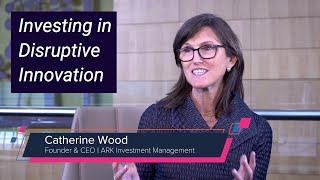
저자: CathieWood · 외국인
요약 보기
캐시 우드는 지수 투자의 한계를 지적하고 혁신 기업 중심의 장기 투자를 강조하며, 특히 테슬라를 ARK 포트폴리오 내 가장 저평가된 최고 확신 종목으로 꼽았다. 출연자 소개: 캐시 우드는 1980년대 이후 40년 이상 금융업에 종사했으며, 파괴적 혁신 투자에만 집중하기 위해 ARK를 설립했다고 밝혔다. 공개 리서치 생태계 운영과 테슬라 모델 공개(GitHub)도 언급했다. 시장 구조 진단: 현재 금융 시장은 인덱스 투자와 단기 시계(다음 분기·다음 해) 중심으로 변했으며, 이를 5~10년 장기 시계로 확장하는 것이 목표라고 주장했다. 혁신 플랫폼: DNA 시퀀싱, 로보틱스, 에너지 저장, 인공지능, 블록체인 5개 플랜폼이 동시에 진행 중이며 각각 수조 달러 시가총액이 될 것이라고 전망했다. 중국 모바일 결제가 2014년 1조 달러에서 2018년 2조 6천억 달러 수준으로 4년간 약 26배 성장했다는 사례를 들었다. 테슬라: 가장 높은 확신을 가진 저평가 종목. 전기차 판매는 작년 약 140만 대에서 5년 내 2,600만 대로 증가할 것으로 봤다. 배터리 가격 하락으로 전기차 평균가가 2년 내 내연기관차보다 낮아지고, 5~6년 후 약 1.5만 달러 대 vs 2.5만 달러 대로 격차가 벌어진다고 전망했다. 자율주행이 2~3년 내 현실화되어 구독·서비스형 수익 모델로 전환되면 기존 자동차 애널리스트의 평가가 틀렸다고 주장했다. 인재 전략: 신세대 인재를 발탁해 책임을 주고, 유전체학·신경망 등 다학제 인력을 협업시키라는 조언을 제시했다. 투자 조언: S&P500, MSCI 월드 등 주요 지수는 혁신 플랫폼에 의해 파괴될 가치 함정(value trap)으로 보며, 지수 대신 혁신 기업 비중을 높이라고 권고했다. 자신은 지수에 투자 자산을 두지 않는다고 밝혔다. 리스크: 발언에 구체적 손실 리스크 언급은 없으며, 2019년 시점의 장기 전망이다.
다듬은 글
Welcome back to another episode of Exponential Africa. We are fortunate enough to be with Cathie Wood, co-founder and CEO of ARK Invest, at the Exponential Finance Summit in Cape Town, to talk about investing in disruptive innovation. Cathie, welcome to the show.
I'm delighted to be here. It's a great conference in a beautiful city.
Can you explain why you started ARK?
I started ARK for two reasons. The first was to focus only on disruptive innovation. I saw a big void in that space, because of the move toward index-based investing and because many large asset managers look for innovation in the private space. But to scale exponentially, you have to be in the public space. That's one reason. The second was to open up our research. We have an open research ecosystem. We've now reached the point where we post models, like our Tesla model, on GitHub so that we can collaborate with people who may think differently or know more than we do about certain things. It's pretty interesting.
That's amazing. I read a lot of your work before meeting you. I've been following all of your research for about two years, and it has been really helpful and valuable for us, even in South Africa and Africa.
Fantastic. How have things changed since you started your career in finance and managing all these different funds until today?
I started more than 40 years ago in this business, and now we're a little bit back to the future. What we're doing is back to the future. In the early days we did real research, looking far into the future. Today there's a lot of index-based investing with very short time horizons, with analysts looking at next quarter or next year, but not five or ten years out. So what we're trying to do is extend the time horizon, to help people understand how many opportunities there are to capture exponential growth.
So it's accelerating, and you're seeing this across all these different industries.
Absolutely. We see five innovation platforms evolving at the same time. To find multiple innovation platforms emerging together, you have to go back to the late 1800s and early 1900s, to the telephone, electricity, and the internal combustion engine, which transformed the world. Today we have five: DNA sequencing, robotics, energy storage, artificial intelligence, and blockchain technology. Between then and now we haven't had multiple platforms at once. Each of these is going to be worth multiple trillions of dollars in stock market capitalization in the years ahead. I think economies are going to grow at scales we can't really understand.
Yes, we can't. In a presentation here this morning I showed that mobile payments in China went from about one trillion dollars in 2014 to about 26 trillion dollars in 2018, up 26 times in four years. We're going to see a lot more exponential growth like that, some of it starting in emerging markets and China, as they put in place infrastructure, in this case financial infrastructure, that wasn't there before. Now we can do it with technology. You just carry a bank in your pocket.
Incredible. You talk a lot about Tesla in your research. Why do you say Tesla is undervalued?
Tesla is our highest-conviction holding and the most undervalued company in our portfolio. With the exception of some of the genomics companies, we believe that's because the traditional world is very siloed, and analysts can only follow one thing. In this case, auto analysts follow Tesla. But Tesla is a technology company, not an auto company. Auto analysts are very uncomfortable with technology. It moves too fast, and their world is very mature.
We believe Tesla is going to be the reason electric vehicle sales go from 1.4 million units globally last year to what we think will be 26 million in 2023, five years from now. The reason is that battery pack and system technology costs are falling. In two years, we believe the average electric vehicle will be cheaper than the average gas-powered car, and prices will keep falling. In five or six years we see 15,000 US dollars as the average price for an electric vehicle, while a gas-powered vehicle will still be at 25,000 to 26,000 dollars.
That's the first reason. The second is that we think auto analysts are getting this wrong, because they don't believe in autonomous vehicles, certainly not in the next two to three years. We believe Tesla is well on its way to delivering an autonomous vehicle, and that autonomous vehicles will change cars from a one-and-done purchase, where you pay upfront and there's no more business except services, into a recurring revenue model like ride-sharing. That's a completely different model from the auto model. Recurring revenue models, transportation as a service, and software as a service are hugely profitable. Auto companies are not. Auto analysts aren't even following this the way they should. Tesla has a very software-centric, high-margin model, while auto companies have a very hardware-centric, very low-margin model. So it's night and day.
What advice would you give entrepreneurs looking to start the next Tesla?
What has worked for me is hiring talent that has one foot in the new world and buys into the mission and the dream. That's critical. Then give them a lot of responsibility and make them accountable. These people are usually very young, coming out of schools that teach the leading edge of technology. Let them use their energy and excitement to take the company to levels it would not reach without them.
The other thing about bringing in the right talent is that it must be multidisciplinary. You can't have a siloed view of the world. If you listened to this morning's presentation, the world is becoming more collaborative and cooperative. You need multidisciplinary people. You need a genomics analyst who knows the brain to work with the neural network specialist who understands neural networks, because they can help each other. Harness their energy, harness their knowledge, and let their creativity go.
What advice can you give investors who are looking to invest in this space?
One thing to avoid is the indexes. In the US, that's the S&P 500, and globally it's the MSCI World. Those indexes are populated today with what we believe will be value traps, because they will be disrupted by all of the platforms I just mentioned. So don't put all your eggs in the index world. In fact, I have no eggs there. I want to be in the innovation world, which portfolios out there don't represent well. I don't think I'm supposed to be selling our funds, but that's all we do, and that's why I founded ARK. We know the ground is shifting underneath us. Everybody knows that, and they know they're not positioned correctly to capitalize on it. So that's what we've tried to do at ARK.
Thank you so much. This was so interesting, and we could be talking for days. Thanks for your time. This was a fantastic talk on what to invest in and which new technologies to look at. I hope you enjoyed the show. Make sure to tune in, subscribe to Exponential Africa, and keep smiling.
Comments 0