저자: NitinSood · 외국인
요약 보기
이 영상은 Peter Lynch의 『One up on Wall Street』 내용을 바탕으로 한 투자 원칙 강의로, 특정 종목이나 자산의 가격 방향에 대한 예측은 없다. 핵심 원칙: 10개 종목 중 6개만 잘 되어도 충분히 수익을 낼 수 있으므로, 종목 선별과 분산이 중요하다. 자금 우선순위: 주식 투자 전에 집을 마련하고, 생활비·자녀 교육 등 예정된 지출과 비상자금을 먼저 확보해야 한다. 여유 자금이 아니면 투자하지 말라는 취지다. 개인 역량: 투자 성공의 가장 큰 요인은 개인의 자질이며, 다양한 투자 서적을 읽고 얻은 내용을 자신의 투자 시스템에 반영하는 것이 중요하다. 시장 심리: 사람들이 시장 하락기에는 주식 얘기를 멈추고, 상승기에 종목 팁을 쏟아낼 때가 경계 신호가 될 수 있다는 관찰을 제시한다. 매수 타이밍: 종목 팁을 듣고 즉시 매수하기보다 기업의 실적을 몇 년간 확인한 뒤 천천히 비중을 늘리는 것이 바람직하다는 조언이다. 예로 HDFC의 연 18% 성장을 든다. 투자 모델 구축: 자신만의 투자 모델을 만들고, 재무제표 항목의 의미를 이해하며, 과거 데이터로 백테스트해야 한다는 주장이다. 제품 영향도: 특정 제품의 뉴스가 있어도 회사 전체 매출·이익에서 차지하는 비중을 봐야 한다. Pampers(P&G)는 비중이 작았고 Hanes의 Leg's는 비중이 커서 의미가 있었다는 사례를 든다. 대형주: 대형주도 급락 후 회복 여지가 있으며, 질 좋은 대형주를 적정 시점에 보유하는 전략이 가능하다는 견해다. PER 해석: PER은 단독으로 의미가 적고, 기업의 과거 범위·업종 평균·성장률(PEG<1)과 함께 봐야 한다. 현금을 차감한 PER도 참고할 수 있다. 맥도날드 사례처럼 고PER은 주가 급락 위험이 있다는 경고도 포함된다. 매수 적기: 빠르게 성장하는 소·중형주가 우선이며, 대형주는 PER이 낮은 구간에 있고 주가가 수년간 정체된 상태에서 사업 구조 개선·해외 매출 성장 등 긍정 신호가 나타날 때가 적기라는 관점이다. 리스크: 영상은 특정 종목 추천이나 시장 방향 예측을 하지 않으며, 일반적인 투자 원칙을 설명한다.
다듬은 글
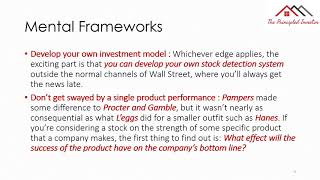
hi friends this is the thing this presentation is about investment insights that I learned from one up on Wall Street by Peter Lynch one of the insights that Peter Lynch propagates is there if you invest in ten companies in six of them were to do very well the remaining four could either go to zero or not do so well and that's fine as long as six of ten five ten of your companies doing create you're gonna do pretty well as investor one example so if you invest in ten good companies based on your stock selection system and six of them were to go five acts in a given space of time you made 300 bucks on on the investment of $60 the remaining 40 don't matter that much you go to zero they go down 50% they stay where they are any of the situations I can't change the fact that he made three acts on the overall 100 roll investment already so so that's a very important thing to know there you already you already narrowed down the stock selection to ten stocks that you prioritize on the top of the deck and then six of them were to do very well that that's all you got to do the is what prioritization which very few people talked about in the stock market everybody talks about going selling your house and going into the market Peter Lynch to the contrary say it's there you need to own a house first you need to evaluate what they're going to need this money for something that's coming up some emergencies some contingency some predictable needs like your kids education etc and you know save some that money aside and not not do speculation or trading or investing with that money the third one is the largest of the decisions of the priorities which is personal qualities and you know developing those personal qualities gonna guarantee your success in the stock market and you read reread and keep reading different writings on investing this is a there's an ocean of books available and you've got to read a lot and more important than just reading is they taking a pause after every reading making sure that whatever we learned whatever is meaningful from that book you add that to your stock system stock investing system with a stock selection where this talk you know when to sell the stock or it's about how much to allocate which talk etc keep building your system as you read otherwise there's no point of reading without application of those learnings into real life the next one is to understand human behavior and you know you get a sense from how people behave in your social settings at work when you discuss investing with a group of people who understand this you start seeing that most people who who don't have a general sense of don't have a stock selection system haven't done enough reading don't have much experience in spent time in the market you start seeing their they stop talking about the market when the market is doing bad they talk a lot about all the stock tips that they heard about all the news that I hear about when the market is doing very well so you get a sense when to get into the market if everybody stocks stops talking about you know stocks and shares that's the time to Karen the third inside of this page is bar reacting versus predicting don't be in a hurry to get into a stock on Peter Lynch said that people hear about a tip and the breathless to make that investment as soon as they get in front of a computer or the phone they will make that investment while they'd spend all the time in the world selecting a refrigerator looking at all the features or different models etc they won't spend more than a few seconds putting their life savings into a stock based on a stock tip so no need to be in that zone and it's often okay to let a company show its results on his financial statements you know let the products of the company succeed for a couple of years it's fine to wait that long mostl companies if you look at the Indian market HDFC has been growing at 18 percent for a number of years so if you'd spend a few years in the beginning to let HDFC prove itself and that get it then get into the market slowly increasing your position you're still done extremely well so no need to be in that hurry breathless in Varanasi the next sites are about developing your own investment model I think it's very important the the writers and speakers and you talk about the concept of border conviction doesn't help the market crashes you get shaken out of the market you have to develop your own conviction you have to understand the rationale behind each ratio each line item in the financial statements and what it means you're a backtest your model to make sure you understand if it applied this model that you've developed five years ago or ten years ago where wherever you have been financially and how these stocks have done if this was the model you you you were to follow the practice is really important the second insight talks about the whether a single product is meaningful if you read a news about a product orally where does it mean that you should just jump into the stock and buyer the answer is no it's very important to look at the bigger picture and what that product really means as a as a percentage to the top and bottom line of the company's financial statements the example used by Peter Lynch's pampers for Procter & Gamble in legs for Hanes pampers as a percentage was extremely small couldn't make a dent in the universe of pocket and Gamble legs on the other hand was a large proportion of the the sales in the bottom line for for hence I think most important question is what is the product mean to the bottom line the company which has a large share is doing extremely well sales are rapidly rising a great reason to get into the stock the next set of about big companies have small moves and that's really really insightful a lot of people spend a large amount of their investing lives investing in blue chips and large companies nothing bad with there nothing wrong with that but as the third bullet on this slide talks about you can expect for her to quadruple in two years and that that's just an example you can change the name and for any big company's name there and the same thing is going to apply to them unless there's been a big crash in this talk or in the market in general and then the stock recovers after their their reasons for the for the market for you do we feel that the market overreacted etcetera so when you know there's something that went wrong in stock crash fifty percent you think you you confident there the reason is or big enough companies you know has the ability to recover from the a particular concern creates reason to get in into a large company in good quality company and and ride the wave back to the same to the price where we started falling from the next set of inside one of the most talked about ratios called the price earning ratio in isolation price earnings ratios in my experience doesn't mean anything it has to be looked at in terms of the stalks the company's own history in terms of how high and how low the peas have been historically for that company it has to look there in the context of the industry that the company operates in what's a fair p/e in that particular industry was a high P in that industry IT companies for example or former companies would have a different p then let's say public sector banks etcetera so the perspective is really important when looking at p i-- in isolation it it just becomes misleading and the other two aspects about p which are worth mentioning in this discussion is look at in the context of the growth so that's called PE G and many investors argue their PG ratio less than one is great the likelihood of you making a lot of money in those companies which qualify your stock selection system plus have a PE g less than one is it just increases the probability the other thing about PE ratios is it's sometimes worth as a secondary parameter to look at P net of cash on the books of the company so that gives you the right perspective as to how much you're paying for the for the business and you know the third bullet in this page Peter Lynch talks about how a name like McDonald's was overpriced as the P of 50 and you know when it corrected back from 75 to 25 dollars P came down to more realistic number of 13 and that's what happens in the market so it's important not to pay a very high PE for instruction and so we share in this slide talk about a P of 500 for a company where analysts were you know something their chest and saying the P deserves to be at a thousand and which basically means that you make back your money in thousand years we should ridiculous and then you know there was news about bankruptcy of this company so that that's how these stories turn out to be so one thing that it should completely know about P's is never going to companies with the abnormally high B's you stay away from those companies the talks about you know when when getting into large companies what should be the kind of circumstances when you decide to go into a large company normally you should look for fast growers small and mid-cap kind of companies fantastic products and a growing at a rapid pace you know that's where you you know I'll encourage you to be but in case of a circumstance where a company company is near its low p/e range and the stock hasn't done much in the last two three years and they've been a lot of improvement in the business model in the product range in the distribution campaigns in the marketing campaigns of the company that divested in ventures which have not proven to be profitable they've come with different variants which are picking up rapidly in the market in terms of the growth rate the international sales are going up double-digit percentages they have you know taking more control of their distribution channels etc you know all of these circumstances indicative of a brighter future better performance in the coming years and that's that's probably the environment in which you should be getting into large companies and not when they're doing extremely well and all the results have been created prices go on up to X that that's not a great time to get into big companies in companies that was the last set of insights for this section I'll come back soon with the part 2 of this video with much more so say State Union thank you very much
Comments 0