저자: 미상 · 외국인
요약 보기
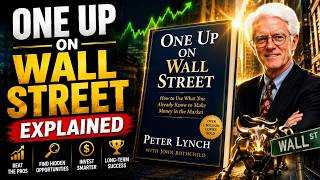
피터 린치의 'One Up On Wall Street' 핵심 개념을 설명하는 교육 영상. 개인투자자는 기관에 비해 관료주의 제약이 없어 구조적 이점이 있다고 주장. 기업을 저성장·안정·고성장·경기순환·턴어라운드·자산주 6개로 분류하고, 10배 상승주(텐배거)는 흔히 지루한 업종에서 나온다고 설명. 핫 산업, 뜬소문주, 무분별한 다각화는 피해야 한다고 권고. 2~3년 내 필요한 자금은 주식에 투자하지 말라는 점을 강조.
다듬은 글
Welcome to the explainer. Listen, today we are opening up the ultimate underdogs playbook. If you've ever looked at the stock market and felt like it's just this totally rigged game where only the insiders win, well, this explainer is going to completely flip your perspective. We're diving straight into the brilliant strategies from Peter Lynch's classic OneUp on Wall Street.
And we're going to prove to you that everyday retail investors actually have a massive structural advantage over Wall Street professionals. So, let me ask you a question right off the bat. Who really holds the ultimate power in the stock market? Take a second to think about it. You're probably picturing a room full of guys in tailored suits staring at multiple monitors backed by supercomputers and IV League degrees, right?
But despite what the financial media might lead you to believe, the answer isn't those professional fund managers. The answer is actually you. And the reason why is surprisingly simple. It really all comes down to this. Professional fund managers are completely buried in red tape. They have strict mandates.
They have to justify every single trade to a committee and they have to navigate just endless bureaucracy to make a move. But the everyday investor, you have absolute freedom, incredible agility and absolutely zero institutional limitations holding you back. So here is our playbook for today's explainer.
First, the individual advantage. Two, the six categories of stocks. Three, spotting a tenbagger. Four, toxic stocks to avoid. And finally, number five, a pre-investment checklist. All right, section one, the individual investor advantage. This right here is the foundational premise of Peter Lynch's entire philosophy.
The harsh reality of Wall Street is that the pros are boxed in. Think about it. If a mutual fund manager buys a completely unknown, boring stock and it crashes, they get the blame and they might even get fired. But if they buy a massive famous company and it crashes, they just shrug and say, "Well, you know, the whole market is down." They are literally terrified of being contrarian.
But as an individual investor, you need zero boss approvals. You don't have to write up some mandatory research report. You have the total freedom to quietly buy undiscovered gems without needing to justify it to anyone. Moving on to section two, the six categories of stocks. There are thousands of publicly traded companies out there and treating them all like they're exactly the same is a massive mistake.
To filter them out, Peter Lynch categorized all companies into six distinct buckets. Slow growers, stalwarts, fast growers, cyclicals, turnarounds, and asset plays. Let's quickly break down exactly what each of these means so you know where you should be focusing your attention. First up, we've got our slow growers and stalwarts.
These are your large mature companies. Slow growers grow steadily alongside the economy, usually about 2 to 5% a year. Stalwarts grow just a little bit faster, maybe 10 to 15%. Think of your massive consumer goods giants here. You know, the companies making your soap, your toothpaste, your soft drinks.
These are safe, highly reliable dividend payers. Your money is highly unlikely to just vanish overnight with these guys. They're basically the steady anchors of a portfolio. But right here is where it gets incredibly exciting, the fast growers. These are smaller early stage companies that have the potential for explosive exponential returns.
We are not just talking about gaining a few percentages here. These are the exact stocks where everyday investors can make absolutely life-changing money. Think of a small regional restaurant chain that's rapidly expanding nationwide, very much mirroring Lynch's own fascination with places like Dunkin Donuts back in the day.
This is really where the magic happens. Now, I do have to give you a word of caution regarding our next category, cyclical. These are companies whose revenue and stock prices aggressively ride the waves of the economic business cycle. The automobile industry is a perfect example of this. I've got to warn you, these are incredibly dangerous for beginners.
Why? Because newcomers almost always buy at the absolute peak of a bull market when the company looks fantastic and then they panic sell when the cycle inevitably drops. Finally, we have turnarounds and asset plays. Turnarounds are beaten down companies fighting for their very survival. Asset plays are companies sitting on massive, totally unrecognized assets like excess cash or prime real estate.
Now, these require a really sharp eye. Turnarounds can completely collapse into bankruptcy if they don't get the support they need. But asset plays, they hide immense value that the broader market is simply completely ignoring. Okay, section three, spotting a 10bagger. This is all about hunting down those elusive fast growers we were just talking about.
It's honestly the most exciting part of the entire playbook. So, what exactly is a 10bagger? Well, in Peter Lynch's world, a 10bagger is a stock that doesn't just go up a few%. It's a stock that actually multiplies your initial investment by 10. 10x your money. Imagine turning $1,000 into $10,000. That is the ultimate goal for the everyday investor.
But here is the secret Wall Street definitely doesn't broadcast. Boring is beautiful. I mean it. While everyone else is out there chasing flashy tech names with fancy buzzwords like green energy or AI in their titles, unloved, totally dull businesses are secretly where the biggest fortunes are hiding.
We are talking about waste management, water treatment, or hey, a company manufacturing white glue. Because they're boring, they get ignored. And because they're ignored, you can buy them at an incredible price. When you are looking at these unloved companies, look for focused, niche products that generate recurring revenue.
You want products people have to buy over and over again. And perhaps most importantly, look for insider buying. When company promoters and executives are taking their own hard-earned money and investing it into their own stock, that is a massive sign of confidence that the business isn't going anywhere.
Which brings us to section four, toxic stocks to avoid. Spotting winners is only half the battle, right? Think of this section as your financial survival guide. Here are the four most common toxic pitfalls that will just destroy everyday portfolios. You've got the hot industry, the next big thing hype, whisper stocks, which by the way are essentially just baseless rumors passed between friends, and a really destructive corporate habit called diversification.
Let's run through these quickly. The absolute most crucial point here is to avoid the hot industry. Why? Well, because hot industries attract brutal, cut-throat competition, and competition destroys profit margins. Furthermore, anytime a broker or an analyst labels a stock the next Amazon or the next Google, you should honestly just turn around and walk away.
It is almost always a hype-driven trap designed to take your money. And then there's this brilliantly coined term, diversification. This happens when a highly successful, highly profitable company completely loses its focus and foolishly acquires an unrelated business. Just imagine a really successful food company suddenly deciding to buy a toy manufacturer.
Make sense? No. Instead of returning their excess cash to you as a nice dividend, these companies waste it on confusing unrelated ventures, ultimately destroying their own value. Stay far away from these companies. And finally, section five, the pre-investment checklist. It is time to prepare you to actually apply all this knowledge in the real world.
Before you buy a single share of anything, you absolutely must ask yourself this direct lifestyle focused question. Do I actually need this money in the next 2 to 3 years? Seriously, look at your upcoming expenses, look at your emergency fund, look at your life plans. This is the absolute most critical filter for any investor out there.
Let me be perfectly clear on this. If the answer to that question is yes, do not invest that money in the stock market. The short-term market is completely unpredictable. It can drop significantly for reasons literally nobody sees coming. True investing requires a timeline of a decade or more to let the power of compounding and business growth actually work in your favor.
So, I want to wrap up this explainer with a provocative thought for you to chew on. Look around your own home today. What simple, boring products are you and your family already using every single day? As Peter Lynch famously taught us, just by observing shoppers at the local mall or his wife buying panty hoes, your next great 10bagger investment doesn't require some massive Wall Street algorithm to find.
It is highly likely sitting right there in your kitchen pantry or your living room just waiting to be noticed by you. Keep your eyes open, trust your own observations, and remember your advantage. Thanks for joining me on this explainer and hey, happy hunting.


Comments 0