원문 보기
Welcome back to Rich by Design. I am Vel. In the late 1990s, a young investor stood up at a Berkshire Hathaway shareholder meeting and asked Charlie Munger what advice he would give to someone trying to build wealth from scratch. Munger gave an answer that shocked everyone in the room. He did not advise a secret action.
He did not propose a complex options strategy. He said, "The first $100,000 is hard work, but you have to do it. Even if it means walking everywhere and not eating anything that wasn't bought with a coupon. Find a way to get to $100,000." Why was one of the greatest investors in human history so obsessed with this number?
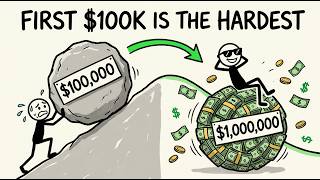
Because from zero to $100,000, your money hardly works for you. You do 100% of the hard work with your own blood , sweat, and discipline. It feels painfully slow. It's like pushing a two-ton boulder up a vertical cliff. And because most people don't understand the math of this stage, 90% give up midway through.
Today we'll look at why overcoming your first $100,000 completely changes the rules of the money game and how the law of compound interest will do the rest of the work for you. Let's look at the cold, hard math of why accumulating that first $ 100,000 feels like torture . Let's say you save $10,000 each year and invest it in an S&P 500 index fund with an average return of 7%, adjusted for inflation .
You save $10,000 in the first year . Your profit for the entire 12 months is only $700. You could make that in two weekends delivering groceries. This feels completely insignificant. By year three, you've contributed $30,000 of your hard- earned money, and your portfolio has only grown by $4,400 in interest.
By year five, you have deposited $50,000, and the total interest accrued is barely $11,000. Notice what is happening here. Almost 80% of your portfolio is direct deductions from your salary. Your money doesn't help you much. It takes a grueling 7.8 years of continuous savings just to reach the $100,000 mark.
This is what I call the "valley of disappointment." This is the moment when people look at their friends who drive new cars and ask, "Why am I eating home-cooked food and driving a 10-year-old car for $700 in interest?" They give up right before the miracle happens. Now look what happens once you hit the $100,000 mark.
The laws of physics are reversed . It took almost eight years to go from zero to 100,000. It only takes 5.1 years to go from $100,000 to $200,000 by saving the same $10,000 per year. You just saved for three whole years without a single penny left over in savings. Why? Because your $100,000 now generates $7,000 in annual income on its own.
Your capital suddenly starts working like a full-time employee at minimum wage , 24 hours a day, seven days a week, without lunch breaks or weekends. It only takes 3.7 years to get from 200,000 to 300,000 . And when you reach $500,000, your annual income from investments alone will exceed your initial contributions.
From this point on, compound interest does over 80% of the work. Reaching 1 million is no longer a question of " if," it's simply a mathematical inevitability over time. This brings us to the main reason why 90% of professionals never break the $100,000 mark: the popular 50-30-20 budgeting rule. Financial influencers like to advise spending 50% on needs, 30% on wants, and saving 20%.
Here's the inconvenient truth. In today's inflationary environment, the 50-30-20 rule is designed to keep you " comfortably middle class" for 45 years. Spending 30% of your net income on desires before you have $100,000 is like trying to fill a bucket with a huge hole in the bottom. When your net worth is less than six figures, you are in an accumulation sprint.
You can't afford the luxury of spending a third of your salary on status symbols, expensive dinners, and lifestyle improvements . At Rich by Design, we teach aggressive sprint strategies. Limit your spending, cut your discretionary spending to 20%, and put 40–50% of your income straight into the compound interest machine until you have the first $100,000 in your account.
You only need to sprint once. Once the " snowball" has rolled, you can relax for the rest of your life. What does it really take to cross the finish line in less than 5 years? It all comes down to three uncompromising sacrifices. Victim number one: get rid of the automotive status trap. The average monthly car payment today exceeds $700.
If you invest that $700 in an index fund for 7 years, instead of giving it to a dealer, you will reach your first $ 100,000 just because of this one habit. Drive a reliable car and let outsiders think whatever they want. Victim number two: Say no to dinners for the sake of social approval. I'm not saying you should never have dinner with friends, but spending $200 every Friday on drinks and appetizers to impress your coworkers is burning through the very start-up capital that could buy you a lifetime of freedom.
Victim number three: stop raising your standard of living when you get a promotion at work. When your boss gives you a $10,000 raise , pretend it didn't happen. Set a limit for your expenses and direct 100% of this allowance towards capitalization. If your lifestyle is not expanding, your path to freedom is greatly shortened.
Here's your clear, four-step plan to reach your first 100,000, starting this month. Step one: Create a $5,000 money fortress. Never invest without a “safety shield” in case of emergencies. This will save you from having to sell stocks when unexpected events happen in life. Step two: automate investing in index funds.
Choose a low-cost broad market index fund. Don't waste time picking individual stocks or trying to guess market movements. Step three: First pay for your freedom. Set up an automatic transfer that will withdraw your investment capital from your account within 60 minutes of receiving your paycheck. Step four: Focus on the goal, not the noise.
Stop checking stock prices every day. Focus solely on pushing that “ boulder” to 100,000. Remember Charlie Munger’s words: “The first 100,000 is hard work, but you have to do it.” Once you cross that line, your money will start working harder for you than you do. If this analysis was helpful, click the subscribe button for new issues on the psychology of money from Rich by Design.
Write a comment below. At what stage are you now on your way to your first 100,000? I read every message and respond to them. I am Vel. Be disciplined, stay calm, and build your well-being from within.
Comments 0