저자: JamieDimon · 외국인
요약 보기
Dimon은 AI 투자 붐과 미국·유럽의 정부 부채 증가가 금리와 신용스프레드를 밀어올릴 수 있다고 경고했다. AI 자본지출은 올해 약 7000억 달러, 내년 약 1조 달러로 전망되며 전력 공급, 소송, 사이버 위협 등이 리스크로 꼽혔다. 정부 차입은 전 세계적 현상이고 미국 부채/GDP는 50%에서 100%로 늘었다. 중국은 미국채 보유를 약 1.2조에서 7000억 달러로 줄였다. 다만 기업·소비자 부채는 과도하지 않고 AI는 장기적으로 큰 가치를 만든다고 봤다. 금리·인플레이션 방향에 대해서는 명확한 예측을 피했다.
다듬은 글
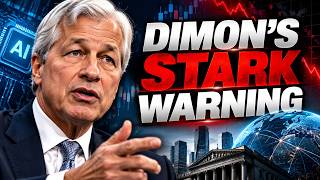
CEO J.P. Morgan Jamie Dimon just issued a stark warning about the global economy, and investors should heed it. As artificial intelligence attracts huge investments , public debt grows, and borrowing costs threaten to rise further, are financial markets underestimating future risks? Dimon's latest comments show why the next major market shock could come from an unexpected direction.
Let's take a look at Jamie Dimon's latest interview and what he says about the risks facing global markets. It's always nice to chat here. That's Jamie Dimon, of course, chairman and CEO of J.P. Morgan. This is the 14th J.P. Technology Summit. Morgan here in London, bringing together PE, VC and of course your technology investment team.
Jamie, thank you for your time. This is an environment, as Danny and the team in New York have said, where the Nasdaq is potentially setting a third consecutive record. Technology stocks are rising rapidly. We are getting news about fundraising from OpenAI. Investors are still willing to put money in, and yet we see the cost of capital rising.
We see that CDS spreads are starting to widen in some AI companies. What leeway do you see, Jamie, for further funding of this AI? Nice to meet you, Danny. Thank you for inviting me here, friends. Let's start with the good news. Previously, there were 20 people at this conference. Now it's 2,000 investors and hundreds of companies from all over the world, and this is a very positive sign of the ability of technology to expand its geography.
It's not just Silicon Valley anymore. It's everywhere. So this is a very good sign. And many of these companies are real. They are going to invent things that will help humanity for hundreds of years. You know, debt financing is a short-term problem, and so, look, rates are going up, there's a demand for capital, but a lot of the government financing, in my opinion, was somewhat expected.
You know, if they go even higher, there will be credit risk. Will credit spreads increase? Yes, this creates risks for all companies. It changes the valuations, and then the markets open and close, you know. So there is no permanent state of affairs when it comes to markets. We all see this increased cost of capital.
So, putting that on top of the AI capital spending projections—700 billion this year, maybe a trillion next —that's your team's view. What do you think is the biggest potential risk to this forecast? Is this a physical construction? Is this monetization? Is this the cost of capital? Is this something else?
Well, I think you're right—it's all of the above. When we went through this with the internet, it eventually paid off, but there will be better models, better semiconductors, changes in schedules, and lawsuits over the construction of these data centers. Look, most of them will be built where people want them , not where they are against them.
They will be used. You know, artificial intelligence itself, in my opinion, creates a lot of value, so I'm not too worried, although you rightly pointed out that it requires a lot of borrowing. There are normal capital expenditures, and I don't know if the borrowings reach a trillion, because it's more of a liability, but there's a lot of borrowing.
And here the government is borrowing two trillion dollars again. And this is a global phenomenon, not just in the United States. Yes, there is a demand and supply for capital. If it was previously believed that there was an excess of savings, now this is not the case. And you know, that might even be a good thing.
If rates are rising, it is because there is a demand for capital that is being used productively. The problem is the government, it's consumption. This is a completely different thing. Of course, government spending can provoke inflation, so there may be a flip side to this. I would like to move on to that, but you mentioned AI policy.
What would be your advice to founders of cutting-edge labs and governments on how to address the policy issues of AI and mitigate these critical risks? Well, these are different questions . Yes. Data centers are built where they want to be, half of the new centers in America are in Texas and Virginia .
But you know, the people there don't want them. You will not win. There will be lawsuits, but there are many states with access to energy that will accept them. And, of course, any large company should be a responsible member of the community. I think many of those who are involved in this, they come to the city, they become part of the community, they help it gain rights, they take on the obligation not to raise electricity prices for consumers.
Just these kinds of things. This issue will be addressed, and artificial intelligence will have a huge positive impact. I truly believe it will cure many illnesses. It will help avoid road accidents and create new composite materials. He will make people's lives incredible. The downside, of course , is what you read about: agents, myths, and anything else that can cause problems.
And this is a completely valid concern. This is a real thing. I'm not going to get hysterical about whether this is an existential threat. We'll just roll up our sleeves and get to work to fix it. Banks have always had a system where we help each other. We also launched the Critical Infrastructure Alliance.
It starts with 50 companies. It starts in the USA. It covers six industries. Technology, financial services, water supply, transportation. Industries that the government defines as vital. But over time, it should expand to healthcare, pharmacy, and agriculture. Ultimately, every industry is critically important.
We also need to help smaller companies because they have different suppliers and different needs. So there is a lot of work. We just have to do it. AI has created vulnerabilities we didn't even know existed. We've been worried about cyber threats before. You have been thinking about cyber risks for a long time .
I know this. This is our biggest threat. Yes. Is this your biggest risk? Does AI make systemic cyber risks more likely? Oh yes. So I'm saying that myths or whatever you thought before... When I wrote the letter to the chairman of the board, I said: cyber risks are our biggest risk, and myths weren't even discussed yet.
I would say that after the myths appeared, the risk increased tenfold. I want to change the subject. Let's look across the ocean, to France. What do you think about the bond sell-off? There is a slight pullback today. French debt yields fell slightly. What do you think about what you have seen in recent weeks in France, and are you concerned about the risk of contagion for other eurozone countries?
Yes, maybe a little. I'm not going to talk about France specifically. This is a warning to governments, okay? We can't borrow and spend endlessly, and this has been going on for a very long time . If you look at the accumulation of debt in the world, it was smaller in Europe. I mean, you reached the limit at one time, but in America, debt has gone from 50% of GDP to 100 %.
You know, countries all over the world are borrowing money, and I think we shouldn't be complacent. The lesson is that there will come a point when the market will demand more and more, and this will eventually affect corporate debt and credit spreads, as it usually does. But I've always said that it's best to resolve such issues before they become a crisis.
If a crisis occurs, we will work with it. It's just going to be a much less pleasant path. OK. Some argue that in France we are far from avoiding a crisis, given the current political situation. Although Le Pen has already provided details of her budget today. Are you watching for signs of credit market contagion?
Is this the same transmission mechanism we should be watching for? Well, I think so. I believe that all businesses should prepare for different outcomes. I think it's a mistake to say, " Here's my forecast, I 'll run my business accordingly," because you need to be prepared for a wider range of events.
It's intellectually useful to think about this. You may consider the probability of some events to be less or more than I do, but I see the risk in persistent inflation and continued rate hikes. Therefore, it is important for corporations, regardless of their level of debt load, to be prepared for higher credit spreads when they have to refinance or borrow money.
So at JP Morgan we have to be ready for this. So, if credit spreads widen and rates rise, we are not in danger. We built our model to continue serving customers. We don't bet on such things. We serve customers under any circumstances. Regarding the US: virtually full employment, growth above 2%, fiscal expansion , deficit—what, 6%?
You have record borrowings. How is this resolved—ultimately , through financial repression? Should it all ultimately come down to this or inflation? Yes, I do, we don't know yet. I mean, what you said is good news. You know, and here's some more good news. Corporate debt is not too high. Consumer debt is not too high.
This is public debt. Public debt does fuel inflation a little . It also fuels corporate profits, so I don't know how this will all be resolved. It doesn't have to be financial repression. I just think rational things make things better. I have to emphasize this because it could be my next article. Good politics costs nothing.
I believe that the right policies in the US and Europe can increase growth by 1% and require no spending. These are permitting procedures, school education, and deregulation without creating additional risks. Rational climate policy, different immigration policies can stimulate growth. If done right, it will have a deflationary effect and provide greater development.
And in almost every country, this 1% increase will begin to reduce the debt- to-GDP ratio. So, uh... I want to ask you about the Treasury bond markets. Ray Dalio says the Chinese and Japanese are becoming more cautious. They want to reduce their holdings of Treasury bonds. This potentially pushes long-term yields even higher.
Are the markets underestimating this? China's role, China's role in the Treasury bond markets? No, because, firstly, this is completely public information. So it's not something that is opaque. China has already reduced investments from 1.2 trillion to 700 billion. This happened , well, it's been going on for, I don't know, two years.
It's a little different with Japan, because they have problems with the yen and the dollar, and the question of how to finance growth. So they may act differently, but I will leave that to the Minister of Finance, let them deal with it themselves . But again, it's just supply and demand. The dollar is a commodity, and bonds are a commodity.
Interest rates are a commodity. There are many supply and demand problems. And, uh, that's why I'm not worried. But yes, maybe it will become a problem someday. Structurally higher inflation. Inflation will continue to rise, given supply chains, competition, capital spending , AI—we are moving towards a more inflationary world.
Well, I don't know yet. So look, here's my approach, because I don't like to make predictions about the future. There is a strong argument that some of these things will eventually reduce inflation and stimulate growth . And growth is good. Growth can be non-inflationary. And it doesn't necessarily have to be inflationary.
But there are signs that our actions are provoking inflation: spending, remilitarization, and, you know, migration policies, which are probably a little inflationary. So, you need to maintain a balance. I look at it from the perspective of what is the possibility and what is the probability. I believe the growth opportunity is higher than others think.
This is not guaranteed. It's just, you know, a probabilistic event. So, I know you don't want to predict the future . But markets are predicting one more Fed rate hike this year and more than two next year. Does that seem reasonable given what you're saying? You know, look, the markets, well, the markets, no matter what they say, they're always wrong too.
You know, the stock market was up 20%. The Fed makes forecasts—and they get them wrong, economists make forecasts, and they go from down to up, so in my opinion, it doesn't say anything. I think they are reacting to short-term data . And inflation can be influenced by long-term factors. Like oil prices, wars and, you know, global shortages and things like that .
So, everything is not so clear-cut. There are many forces at work here, and I don't spend much time guessing. Record second quarter for JP Morgan. Your team is also forecasting quite strong growth in the third quarter in terms of revenue. Tell me about the third You can't talk about the third The third quarter, yes.
Third quarter. But you see the momentum from the team. I can't talk about it . But when it comes to Europe, IPOs, mergers and acquisitions—it's all pretty good. You know, if we talk about the United States, there was probably a slight slowdown in September. But, as I've told your audience, the pipeline of deals opens and closes, especially with IPOs and debt obligations.
You know, a little bit, corporate debt—it's not quite the same. So far so good. But I will tell people again that “so far so good”—it’s good, and it may last a long time, or it may not. So I'm always prepared for the "maybe not" option. What is particularly interesting about Diamond's comments is the connection between three major forces: massive investment in AI, rising government borrowing, and potentially persistent inflation.
AI can create extraordinary long-term economic value, but financing this expansion becomes more difficult if interest rates and credit spreads rise at the same time. And there is another problem: public debt. If investors demand higher returns to finance growing deficits , the cost of borrowing could rise for the entire economy.
This does not guarantee a financial crisis, but it does suggest that investors should consider a broader range of economic outcomes rather than assuming that current favorable market conditions will last forever. This excerpt is presented for independent commentary, analysis, and educational purposes. This is Cryptonite. Be vigilant, be informed.


Comments 0