
저자: JensenHuang · 외국인
요약 보기
ServiceNow와 엔비디아가 자율형 에이전트 'Project Arc'를 발표. 젠슨 황은 서비스 산업(소프트웨어의 100배)과 물리 AI로 컴퓨트 수요가 계속 증가하며 2028년 상반기까지 컴퓨트 제약이 지속될 것이라 주장. 엔비디아 매출 성장 재가속, 하이퍼스케일러 자체칩 위협은 과소평가라고 강조. 영상 후반 채널 운영자는 Iron(IREN) 실적 전망(AI 클라우드 매출 상승, 비트코인 채굴 매출 감소, 매출 미달 가능성)과 목표가 100~150달러(2027년 상반기)를 언급.
다듬은 글
Moments ago, ServiceNow and NVIDIA announcing a new autonomous agent called Project Arc. It can code, think, and work with enterprise applications all on its own. Let's get out to John Fort. He is in Las Vegas. The both shares are fractionally lower, John, but with more in what does sound like a very big announcement.
It's all for sure, Kelly. Thank you. I am here with Bill McDermott and Jensen Huang. Hey guys, we're on. We're live. Um Bill, thanks for having me once again here at Knowledge. Jensen, always great to see you. Bill, I want to start with just the market temperature. I'm looking at this and ServiceNow is being priced like Microsoft on earnings, like Oracle on revenue, despite growing one and a half to two times faster than either one of them.
Yeah. But you made some projections today that maybe are going to catch the street's attention on some of that. Tell me about what gives you the confidence to say you're going to hit 30 billion plus sub revenue by 2030. When I came in in 2019, we were a three and a half billion dollar company. Now we add a ServiceNow every year.
This year we're projecting to be nearly a 16 billion company. Right now we have a 28 billion RPO. So, we're growing faster than any other enterprise software company at scale in the world ever ever happened. We yesterday said to the financial analysts we were going to double the company again, and we would do that by 2030.
And the company right now is really focused on a couple of things. One is agentic business. You know, we have to be the agentic front door. We work with great companies like NVIDIA, the great Jensen, the great NVIDIA. Uh we announced Project Arc. You'll hear about that today, I'm sure Jensen will have some thoughts on it.
But we want to manage the identities of the humans and the agents. We treat the agents just like the humans. So, the rules and rails can complement this great AI revolution. The enterprise is a pretty messy thing. So, we clarify it, we clean the mess up, and we make sure that the AI is secure. And I think that is a big breakthrough.
And we told that story yesterday and people really liked it. Jensen, tell me about I mean, this is at least the third time that I'm seeing you here at Knowledge. We're talking with an application software company. You've talked about this five-layer cake with energy, chips, you know, platform and applications at the top necessary to really make AI work.
Why is the application layer not just important, but long-term profitable, do you see? Why does that need to happen and why is why is ServiceNow one to watch for you? This is one of the greatest transformations for the software industry ever. For For the first time, service is software. Service Software is service.
And the service industry is 100 times larger than the software industry. And so now for the very first time, you're going to have human agents that are of course managed and supported by ServiceNow, augmented with AI agents that are going to be working autonomously, working with humans. And they're all going to need identity management, access control, network control, all of the things that companies do with respect to regulation and compliance and governance.
All of that has to be provisioned, whether you're human or an agent. And in the future, of course, out at the edge, robotic systems. These all of these autonomous systems, the time has now finally come. Now, of course, for our industry, for the rest of the five-layer cake, it's completely revolutionary because AI agentic AI needs to be processed in real time.
Unlike software of the past that's pre-recorded, you could put it in storage, retrieve it as you need it. Today's software needs to be processed completely in real time. The amount of computation necessary from generative AI 2 years ago to now agentic AI, it has gone up a thousand percent. Because the AI now has to read a lot more, use tools, reason, generate a lot of tokens.
Not only that, the amount of use has gone up orders of magnitude because now for the first time, AI is doing work. It's doing useful work, and the return on that investment for software companies, for agentic companies like ServiceNow, is completely accretive. And so that time has finally arrived. So in that context, Bill, tell me about Project Arc and the work with Nvidia.
How does Nvidia's stack actually enable that? What's the level of capability that's going to bring that you didn't have before? Well, we're so honored to work with Jensen and Nvidia, and I don't think anybody has been more responsible for the AI revolution than Jensen and Nvidia. So everything we do, and we started this together 7 years ago, has been built on Nvidia.
The Nvidia factory is absolutely the bedrock of ServiceNow's platform. And Project Arc takes it up to the edge of the enterprise. At the edge of the enterprise, we have humans and we have agents, and and obviously you see robots. And all of that integration, the rules and the rails, is taking place at that level.
So we warmly welcome open shell and the AI agents that come from OpenAI and Anthropic and Gemini. We think it's fantastic. But we also know that the enterprise needs to control it and make sure it's secure, so we can scale and bring all of that thought leadership and content to the enterprise. We are the action layer.
So, all of that compute power that NVIDIA brings you, now it comes to the edge. We manage the humans and the agents, and all of that is happening on a rules and rails basis with ServiceNow. This whole platform, John, is agentic. There's an agentic front door. We manage the identity of the agents and the humans for you, and we even manage the security of the IT and the OT, IoT, shadow IT, networks, devices.
All on one platform. And I would like to compliment NVIDIA because they're the best company out there. And to think that Jensen runs employee works from ServiceNow, the humans and the agents, is a testament that we're very proud of. But also, if you think about the complexity of the bill of materials that goes along with NVIDIA supercomputer, think about it.
That's a really complex thing. Configure, pricing, quoting for a company like NVIDIA's scale, done on ServiceNow, is a testament to the move we made in CRM. So, when Jensen calls us the operating system for the enterprise, everybody at ServiceNow is fired up to deliver service now. So, Jensen, on physical AI, I think a lot of times people think about these humanoid robots that we see, we hear about folding laundry, maybe the dogs running around, but there's a manufacturing component of this and a flexibility in manufacturing that it seems like is potentially transformative on a global basis.
How do you think about the nearer term economic opportunities, TAM expansion around physical AI in that context? Until now, until physical AI, the world's $50 trillion of industries that of industries that are associated with the physical world, the conference center we're in today, manufacturing plants, warehouse and logistics, all of the roads and cities around the world, none of that has been an exposure for IT, exposure for software.
But now we have agentic systems. Use this as an example. We now have agentic AI in the enterprise and it's going to be running in this open shell that Nvidia created and it's going to be accelerated on Nvidia's computing platform. It's going to be secure, it's going to be safe, it's going to be governed.
Well, you're going to do the same thing with robotic arms, AMR's running around the warehouse. The entire manufacturing line will be operated by robots, managed by more robots, and the entire factory is a robot. All of those all of that software are basically going to be physical AI agentic systems.
They're going to run in open shell, they're going to run on top of ServiceNow, and you're going to manage them just like employees. And so you could just see as you see it now, there's an operating system, there humans on it, there agentic software AI on it, there physical AI on it, all the way from the center of the enterprise all the way out to the edge of the enterprise, all running on one common fabric, ServiceNow.
Jensen, I know you got to run, Bill. We're going to talk more in a bit. We're now I'm going to toss it back to Kelly. Thank you once again for having me here here to learn. Bill McDermott, thank you. Jensen. Thank you, Bill. Congratulations. No, you are the best. No, John, thank you very much. No, John's the best.
Uh coming up & decent day throughout much of the market with the exception of a few of the mega cap tech names. Today Nvidia and ServiceNow announced an expanded partnership focused on bringing autonomous AI agents in enterprise workflows. ServiceNow is introducing project arc, a long running self-evolving autonomous desktop agent designed for knowledge workers including developers, IT teams, and administrators.
Project arc connects natively to the ServiceNow AI platform to bring governance, auditability, and workflow intelligence to every action the agent takes. It can complete complex multi-step tasks that traditional automation can't handle, but with the controls enterprises actually need to deploy AI at scale.
Project Arc uses NVIDIA Open Shell, an open-source secure runtime for deploying autonomous agents in sandbox policy-governed environments. The main takeaways for investors are that this announcement reinforces NVIDIA's full-stack enterprise AI strategy. We're about to se because long-running enterprise agents that use tools, access software, and complete multi-step workflows should meaningfully increase token generation, and that ultimately will increase compute demand.
And NVIDIA's full-stack system offers the best token output per watt and the lowest cost per token in the industry. Really quick, I want to remind you that Iron reports earnings this Thursday, May 7th. Please hear me well right now. I continue to be bullish on Iron for 2026 and most of 2027. I may be bullish longer than that, and I'll try to update my thoughts as time goes on.
That said, while I am bullish on Iron, we need to have realistic expectations ahead of this specific earnings report. I am expecting AI cloud revenue to be decently higher on a percentage basis. However, I'm also expecting Iron's Bitcoin mining revenue to be decently lower due to Iron reducing their Bitcoin mining operations as they transition data centers to AI cloud.
And also, because Bitcoin traded at notably lower prices during the quarter. Iron sells the Bitcoin they mine rather than holding it, and Bitcoin traded at notably lower prices during the quarter. Ultimately, I think we may have a situation where Iron's top-line revenue on this specific earnings report is lower than what market participants are expecting.
Remember, before Iron can install GPUs and bring them online, they have to first remove the ASICs that are used for Bitcoin mining. That means there's an in-between period in which Bitcoin mining revenue decreases and AI cloud revenue is not yet fully ramped. And so, for this specific earnings report, I am not expecting a notable increase in top-line revenue.
That's something to look forward to in future quarters. We should see Iron's AI cloud revenue ramp notably in the second half of calendar 2026 and into 2027. But for right now, we need to be patient and have realistic expectations. As for the earnings call, I want an update on Iron's build-out. I want an update on the transition of their existing data centers to AI cloud and any updates on customer demand and negotiations with prospective customers would be appreciated as well.
As long as the world is compute constrained and power constrained, Iron will most likely sell whatever capacity they can bring online. If Iron trades lower when they report earnings, but the buildout is still on track, don't freak out. I'm still expecting a share price in the range of 100 to 150 dollars per share sometime in the first half of calendar 2027 as long as there isn't a market downturn.
Iron meets their ARR targets on time a reason that price range is so wide is because we don't know what Iron will do with their 6 billion dollar ATM program. 6 billion dollars is a lot for Iron. Leadership have said that it's important to maintain balance sheet flexibility, but that there is no urgency to issue shares under the ATM.
So that's why the price range of 100 to 150 dollars per share is so wide. The point is, don't panic if Iron were to trade lower after earnings are released. I'm not expecting Iron to report strong results on this earnings report. What matters is that the buildout is still on track and that Iron is still on track to reach their ARR target of 3.7 billion dollars by the end of this year.
On Tuesday we learned that Iron has acquired for 625 million dollars. First off, let me say that I think this is a great move by Iron. In recent months, Iron has received a lot of flak about their software offering not being great compared to the competition. In SemiAnalysis recently found Iron service to be quote severely lacking.
You may remember that in SemiAnalysis GPU Cloud Cluster Max rating for April 2026, they listed Iron in the underperforming and not recommended sections. As I explained in previous videos, in this rating SemiAnalysis is ranking the cloud operators based on what they offer to end customers. So Microsoft Azure ranks in the gold tier, but Microsoft is a key customer of Iron.
You may be wondering, how does that make sense? Well, Microsoft offers the cloud experience to the end customer, even if that cloud experience is running on compute owned by Iron. Microsoft is still the one offering the service to the end customer and SemiAnalysis is ranking what is offered to the end customer.
And so Iron is a great option for large hyperscalers like Microsoft who want access to bare metal compute. Microsoft then runs their own software stack on top of that bare metal compute and Microsoft offers the cloud experience to the end customer. And Microsoft Azure ranks in the gold tier. However, while Iron is a great option for large hyperscalers, Iron's offering to enterprises was found to be severely lacking, according to Semianalysis.
And that's where Iron's acquisition of Mirantis comes into play. Mirantis will strengthen what Iron can deliver to enterprises. The acquisition is expected to support faster deployment and operation of workloads on Iron's existing GPU infrastructure. It will improve monitoring, performance visibility, and management of customer environments.
It adds technical support, service delivery, and enterprise operations expertise. And the acquisition expands Iron's ability to serve a broader range of customer requirements, including existing AI native customers and emerging enterprise AI workloads. Mirantis has experience serving over 1,500 enterprise customers globally, and Mirantis is a founding independent software vendor partner of the NVIDIA AI Cloud Ready initiative.
This acquisition addresses many of the key reasons why Iron ranked so poorly in Semianalysis ClusterMax rating. This will allow Iron to offer a better service to end customers. And it will also enable Iron to serve additional customers that they were previously unable to support. Remember how I said previously that Iron's software situation does not concern me, and Iron could just use the software offering from another company?
Well, there you go. Iron's software is not the reason why I'm invested in the company. That has very little to do with my thesis on Iron. Also, as a side note, Iron is paying for the acquisition with shares of Iron stock. That means they don't have to use cash that would have otherwise gone toward funding the build-out.
So, that's good. I don't like dilution, don't get me wrong, but I honestly think that this acquisition is the right move, and it should help Iron a lot in multiple key areas moving forward. Overall, I'm very happy with the acquisition. It addresses multiple key areas of concern that some investors had, including Iron's software offering and their ability to serve non-hyperscale clients.
I continue to be bullish on Iron in 2026 and most of 2027. I'll try to update my thoughts on Iron as time goes on. As a reminder, we have NVIDIA earnings on May 20th after market close. And then after that, . That keynote is of us in the United State. Now, I want to briefly mention Cerebras since they're getting ready to IPO.
And I'll also mention custom ASICs from the hyperscalers as well. This is not zero-sum. There's plenty of room in this market for multiple chip makers to succeed as there is such strong demand. I keep saying this because I'm completely serious. For now, there's enough room for all of them. I want you to think about this for a moment.
Right now, the world is compute constrained in the face of very strong AI demand. On their earnings calls, each of the hyperscalers spoke about not having enough compute to meet demand. For example, on Alphabet's earnings call, Alphabet CEO said, quote, "Obviously, we are compute constrained in the near term.
As an example, our cloud revenue would have been higher if we were able to meet the demand." And so, I'm not exaggerating when I say that these companies literally cannot get enough compute to meet the demand that they're seeing from their customers. Now, think about what that means. It means that for right now, there's plenty of room for multiple chip makers to all succeed simultaneously without reducing each other's sales.
There's simply not enough compute. And on top of that, the entire total addressable market is growing in the double-digits percentage annually. The pie is already large enough for all of them. And on top of that, the entire pie is growing in the double-digits percentage each year. And so, I don't want to diminish what Cerebras and Google and Amazon and all the other chip makers are doing.
Many of them do great work, and they have a clear runway of growth ahead of them. At the same time, we are not going to see any of these companies reduce Nvidia sales anytime soon. Again, there's already a severe shortage of compute. Demand is growing even stronger, and the pie is expanding. And so, at this point, any worries about Nvidia potentially losing market share are moot.
That's the wrong point to focus on given the rate at which the TAM is growing. If we eventually get to a point where the world is no longer compute constrained, then that's when it makes more sense to focus on competition and market share dynamics. Based on what I'm seeing currently, I think the world is likely that's probably around the time that physical AI will really start taking off at scale.
And so, there's a very real possibility that we may be compute constrained even beyond that point. So, when you hear about custom accelerators from the hyperscalers and other chip makers posing a competitive threat to Nvidia, Here's the main thing you need to remember. For right now, while the world is compute constrained, this is not the time to focus on changes in market share.
It's largely irrelevant at this current moment, given the growth rate of the total addressable market and the compute constrained environment we see throughout the industry. If we eventually get to a point where the world is no longer compute constrained, then that is when conversations about competition and market share dynamics are relevant.
For now, it is very much irrelevant. I do not expec in 2026, 2027, or 2028. Additionally, while the major hyperscalers currently represent about 60% of Nvidia's data center revenue, Jensen believes that will change once physical AI really starts taking off. At that point, Jensen believes that non-hyperscale customers will represent 70% of Nvidia's data center revenue, and the major hyperscalers will only represent 30% of data center revenue.
And so, as time goes on, Nvidia will become less dependent upon the hyperscalers as customers. Ultimately, developers decide which platforms to build on. Today, the vast majority of developers want to build on Nvidia's platform. Nvidia brings customers to the hyperscalers. Therefore, we should expect the hyperscalers to continue purchasing large quantities of Nvidia systems for the foreseeable future.
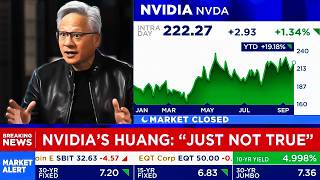
Unfortunately, many market participants do not understand this, which is why we saw Nvidia trade lower after hyperscale earnings, even though each of the hyperscale companies spoke about not having enough compute. I'm getting tired of the ridiculous, ill-informed, zero-sum narratives that have repeatedly resulted in Nvidia trading lower in recent months.
The good news is that Nvidia's revenue growth is reaccelerating, and the stock is trading at a cheap valuation on forward earnings. And so, I do think it's only a matter of time before market participants wake up. In the meantime, market participants are wondering how long the world will be compute constrained.
When will there be a return on investment? What Nvidia's market share will be moving forward given rising competition? And they struggle to know how to properly value Nvidia as they try to balance Nvidia's already massive market cap with the company's very strong future growth prospects. As I said, , but maybe longer than that.
The leading AI labs are starting to see very strong return on investment with revenue surging in just the past few months due to the soon, that should help market participants finally realize that there's a clear ROI on AI investments. The market will soon realize that the growth rate of the total addressable market, in combination with the shortage of compute, renders the conversation about competitive market share dynamics irrelevant as long as the world is compute constrained.
And finally, despite market participants struggle to properly value Nvidia, they will eventually have to come to grips with the fact that Nvidia's revenue growth is re- accelerating. The TAM is growing, new growth vectors are ahead that are in addition to Nvidia's already existent business, and numbers will ultimately have to move highe.
When they reported earnings, each of the four major hyperscale companies either raised or reiterated their CapEx guidance. All of them spoke about being supply constrained and not having enough compute to satisfy demand. And each of them spoke about the importance of agentic AI as it relates to their businesses.
As I've said in recent videos, most market participants truly do not realize what is happening right now with this inference inflection, and they do not understand gentic AI is is is the main reason why we've seen GPU spot pricing move higher in recent months, including spot pricing for older generation GPUs like the H100.
The proliferation of agentic AI is just getting started, and this should be a very notable trend over the next couple of years. And I want you to notice this. Agentic AI is not simply a short-term fad. It is a fundamental shift in how work will be completed moving forward. With agents, ith all working systems in a major way.
. And this is has a lot for about 2 to sort of the timeline that we're currently looking at. Agentic AI's rapid adoption and the proliferation of agentic AI is when . When you look at the situation from that perspective, it's very . In the short term, we need to be prepared for some potential volatility as the situation in the Middle East unfolds. At the same time, .



Comments 0