저자: 미상 · 외국인
요약 보기
레이 달리오의 올웨더 포트폴리오를 소개. 성장/인플레이션 조합 4가지 경제 국면에 대비해 주식30%·장기국채40%·중기채15%·원자재7.5%·금7.5%로 구성하고, 리스크 패리티 개념과 유럽 상장 ETF 4종 예시를 제시. 1990~2025년 연환산 수익률 7.37%(S&P500 10.36%), 변동성 7.45%(S&P 500은 약 15% 수준으로 언급) 등 백테스트 수치를 근거로 제시.
다듬은 글
You want a bulletproof portfolio that doesn't need to be tinkered with on a weekly basis, yet sits on its own like a cactus on a windowsill, one that works not only when the going gets tough , but also when the world is heading into financial hell. I have good news. This is an existing strategy and it even has its own name.
An all-weather portfolio, or in Hungarian, a portfolio prepared for all weathers. Its developer is none other than Ray Dalio. The guy is not a small-time player. He founded the giant firm Bridgewer Assass, which manages over $160 billion in assets. Of course, he didn't work on it alone, he had an army of experience and decades behind him .
The goal was quite simple, but ambitious. To create a strategy that works in any economic environment. Whether it's growth, recession, inflation or deflation. Whatever comes. In this video, I will not only tell you what this strategy is about, but I will also show you how you can easily map it using four LTFs without any particular complexity.
Let's see what problem this strategy solves. The idea for the Allvedő portfolio starts from a very simple question. What if we moved away from the classic portfolio model? Traditionally, especially in the USA, the so-called 6040 model was used, meaning 60% bonds, 40% stocks. They expect returns from stocks, and they try to reduce volatility with bonds .
For Rayio and his team, this structure didn't make sense because, while stocks provide long-term growth , they are much more volatile. And during a crisis, if 60% of your portfolio consists of risky assets, you could suffer serious losses. That's why Dio and his team rethought the strategy from the ground up , with a completely different logic.
And this is where the true all-weather concept comes into play , or as I like to call it, a portfolio that adapts to any economic climate, because instead of looking at which asset generally performs well, Dio identified the possible economic environments and built a portfolio that tries them all, or rather, tries to survive them all.
Dio identified potential economic environments and built a portfolio that could survive each one. Ray, who more than likely sees economic models in his dreams , thought that instead of guessing where the market was going, let's look at what economic environments existed. According to him, the entire global economy revolves around two main engines: growth and inflation.
And these are like two cats, sometimes jumping together, sometimes running in opposite directions , and sometimes just lying there and doing nothing. So, their combination ultimately results in four different economic seasons, or if you prefer, four different financial weather fronts. Front weather front.
The first such climate is growth with high inflation, that is, when the economy is booming, but everything is getting more expensive. Such was the case, for example, with the post-Covid recovery or the wave of price increases following the Russian-Ukrainian war . This is not a period of saving with coupons , but rather one when commodities, stocks, and inflation-linked bonds take the prime.
These assets are able to swim with the price increase, while previously, as we have seen, others drowned in it. The second option is not so fun. This is a recession with low or falling inflation. Here the economy hits the brakes, people spend less and prices slow down or even fall. A typical example of this is the 2008 crisis.
In this environment, everyone flees the financial storm to the safest havens. These are usually long-term government bonds, which behave like a stable sailboat in a stormy sea. The third scenario is even more utopian. This is economic growth without inflation. It's rare, like a Hungarian small cap closing in the red on the first day of the year, but it did happen, for example, in the early 80s.
In such cases, stocks usually lead the field, but a small medium-term bond is also useful to prevent the portfolio from losing its pulse too much. And finally, there's the fourth, which investors only mention in whispers. This is stagflation, that is, economic stagnation combined with high inflation.
It's like when you have a cold and an upset stomach at the same time , you can't move forward and you feel worse and worse. Such was the case, for example, with the oil crisis of the 1970s. This is when stocks and bonds suffer, but gold and some commodities have proven that they can still show strength.
Before we get into how you can build this portfolio step by step, there is a very important principle you need to understand. Otherwise, this will be just another Excel spreadsheet among many. So listen, Raidio's approach is not about throwing together some 50-50% solution and then whatever happens, but about ensuring that each asset class contributes the same amount of risk to the entire portfolio.
This is called risk parity. And no, this is not, this is not some elite financial board game. That's some pretty clever math behind the stability . The point is, the goal is not to have everything have the same weight in your portfolio, but to bring in the same amount of volatility, i.e. swings. Because what's the point of putting 30% in gold?
But it barely moves, while 20% of the stocks are already tugging at the portfolio like an overexcited child tugging at its mother's hand in front of a piece of gummy candy. Dalia. So they say it makes sense to have your portfolio prepared for all four economic environments and not rely on luck to decide which one comes along.
Since we cannot know when the economic dice will roll, the best strategy is to build in a balanced way and not bet on any one scenario. Of course, this is just theory, practice is sometimes a little more stubborn, because it is true that there are four types of economic weather , but they do not occur in equal proportions .
For example, stagflation, that terrifying little monster that brings you to sleep with stagnation and inflation at the same time. He has been a fairly rare guest since the 1980s . We've been hearing a lot about it again recently, but let's not put the whole house on it. He probably doesn't deserve a 25% chance per year across scenarios.
And it is precisely this gap between theory and reality that is one of the reasons why the Allweather portfolio usually contains much more bonds than we might initially think is healthy, because no matter how boring it may seem, when the economic storm clouds come, bonds are that certain stable umbrella that is always good to keep in your bag.
In a crisis, bonds are still the most effective tool against panic. So their weight seems too much, that's not a mistake, but Dio, after all, with conscious safety in mind, Dio finally came up with a simplified practical version, which instead has five main device classes. Each has their own role, like in a well-functioning orchestra.
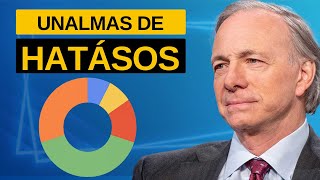
The lineup is as follows. 30% US stocks to create some momentum and growth. 40% long-term US government bonds, which hold the front during big drops . 15% medium-term bonds, which is the stable middle, 7.5% raw materials, so that inflation doesn't hit too hard. And finally 7.5% gold, because when everything else melts away, gold still shines.
So Dion himself admitted that this 30% stock seemed low at first, but insisted that since stocks are much more volatile than bonds, it would not be reasonable to give them the same weight. According to their calculations, even 30% represents the same amount of risk as bonds relative to their ratio .
What is truly remarkable is the weight of government bonds. Long- and medium-term government bonds together account for 55% of the portfolio, meaning more than half of the capital is in defensive assets. According to Dali, this is not a weakness, but rather what gives the strategy its strength in difficult times.
In addition, there are commodities and gold, which are very good hedges against inflation, because in an inflationary environment, both stocks and bonds can suffer, but these assets can balance out the losses, so to speak. And then comes the practice. How can this portfolio be built in real life? Because that's the question, because it's one thing to talk about stocks, bonds, and commodities, but where should we put our money specifically?
The good news is that you can now copy this strategy very easily using just four LTFs. These are all available in Europe, operate at low costs and follow exactly the tools that are in the Allweather portfolio. Furthermore, if you want to invest in LTFs , you can use any of the three brokers that I leave you here in the description.
They work with competitive fees, are well regulated, and believe it or not, they don't even want to scam you. Well, back to the portfolio. Let's start with the fund of funds, long- term bonds. This block makes up 40% of the portfolio, meaning it's the part that holds up even when the stock market hits the panic button.
For this purpose, a one-year ibonds ETF is a perfect choice. contains US Treasury bonds that mature in December 202. So you know exactly when your money will come back. This is not some weird derivative, this is physical replication, meaning you actually buy the bonds. It reinvests the returns, and the cost is almost indicative, 0.10% per year, and it is also USIT-rated, so you can move it tax-efficiently as a Hungarian investor.
You don't have to wave to NAV at every step . Then comes the motor block, i.e. stocks with 30% of the portfolio. Here, ISARE score S&P 500 UITS ETF USD is one of the most reliable instruments. It tracks the American S&P 500 index with full physical replication, meaning it actually buys the companies that form the backbone of the economy.
It reinvests the classes, and its cost is relatively low at 0.07%. Let's just say you can't see it even with a magnifying glass, so there's no need to worry about that. You can also solve the 15% for medium-term bonds with this ibons 2029 LTF if you don't want to overcomplicate things. The fund covers not only long-term but also medium-term maturities , since the so-called duration, i.e.
the average maturity, is approximately 3.6 years, which falls exactly into the zone that is not too short, but not too long, so you could say it falls into the right category for us. Then come the raw materials, the portfolios, but the 7.5% yield is even more impressive. The perfect choice for this is the Invesco Bloomberg Commodity Usits ETF Accumulated, which tracks the Bloomberg Commodity Index through futures contracts.
This index covers such a broad spectrum that it includes practically everything that can be dug, milked, or sown. energy, metals, agriculture and animal husbandry. The ETF works with synthetic replication, meaning it doesn't buy a specific bag of wheat or barrel of oil, but in terms of price movement it behaves as if it did.
It also returns profits here. And the annual cost is a friendly 0.19%. If there was a commodity market multivitamin, this would be the compact, versatile, and easy-to-use one. And speaking of protection, good old gold cannot be left out, the other 7.5% of the portfolio. This is where ISARS Physical Gold ETC comes in, which does not buy paper gold or promises, but 24-karat real physical gold stored in a safe, directly without derivatives .
Its annual cost is only 0.12% and it tracks the spot price almost exactly . In other words, if gold rises, it goes with it, like the shadow. And since it's a physical LTC, there's no counterparty risk, and you get the favorable tax treatment you're used to with an LTF winter. Simple, pure and timeless, just like gold itself.
With these four products, you already have your own Allweather portfolio. A complete, beautifully balanced construction that adapts to all climates. No broker exam required, dozens of winners. And the goal remains the same throughout, for each asset to do its job and maintain its place in the system, because if you let the portfolio fall apart, sooner or later one type will dominate, and you will lose the very thing that makes it all work.
the balance. Moreover, this annual rebalancing not only helps maintain order, but also a clever little trick that practically forces you to buy low and sell high. There's no prediction, no "I have to get in now" type of stomach cramps, just a simple correction. You watch the numbers, make a little adjustment and move on.
Of course, you have to do it wisely. Consider the costs and the tax environment, especially if you are not investing in places where you can repatriate assets tax-free. Now that the structure is clear and we know what specific assets this portfolio is made up of, the question everyone is asking themselves can come up .
Okay, this all sounds very good , but does it actually work? The answer is short. Yes, it works, it just depends on what you expect, because the Olvező portfolio was not created to beat the market every year , but to move forward with less risk and in a much more balanced way , even when it's raining or the economic wind is blowing.
If you just look at the price, it might seem a bit light at first, but if you also look at the price at which it brings this yield, then it's a completely different story. Between 1990 and 2025, the annualized return of the Allther portfolio was 7.37% . This is quite friendly in itself, but when you compare it to the S&P 500, which returned 10.36% annually over the same period, you may rightly have questions.
There's just a little twist here. The volatility of the Melting portfolio , i.e. the fluctuation of the exchange rate, was only 7.45% per year, while the SNP had a swing of 500.66%, or half as much. and the big falls were Olveder, with a maximum drop of -20.6% , while the SNP 500 fell by -43.7% on its worst day.
This is not just a difference, these are two separate feelings. And if all that weren't enough, there's the polar indicator, which measures how much return you get per unit of risk. Here, Allweather has a value of 0.65, while SNP 500 only has a value of 0.5. In other words, even if one brings more, the other is one and a half times better for you.
If I may say so, if your investment were a car, the Olved would be more of a stable hybrid SUV, and the S&P would be a sports car with slick tires that will do well until it starts to rain. So in summary, this is not the portfolio that will be the star of the bull market. But when the crash, inflation, crisis, or just an uncertain period comes, this strategy really shows why it's called all-weather . We'll see you again soon. Thank you for watching the video.
Comments 0