
원문 보기
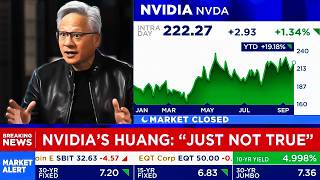
Right now where I stand, a few short months after GTCDC. One year after last GTC, right here where I stand, [clears throat] I see through 2027 at least $1 trillion. That's a big big number put on the demand for Nvidia's products. Shares of Nvidia closing up more than 1.5% among that after that keynote and they're up a third of a percent this morning.
For more let's bring in Joel Kulina ahead of media and technology trading at Wedbush Securities. A trillion dollars is a big deal and am I right in this about twice as much as what was anticipated? Yeah, good morning Contessa. Thanks for having me. Yeah, I mean it's a massive number and you and you saw the shares of Nvidia initially spiked.
I think it took 180 188 189 initially and then things sort of calmed down reverted. The problem with that number is that you know the street was already at around 968 billion for data center revenues with the buy side already thinking above a trillion for for that for those platforms as well. So it was sort of a sell the news type of headline initially then it got a lot of attention but then price action once again just kind of remained a little bit uh frustrating to say the least.
Okay, so previously Jensen Huang had talked about 500 billion through the end of 2026. The trillion dollar number is for 2027. It's That's a remarkable trajectory. What do investors want to hear from him in terms of the all right, show me the money? Yeah, it's it's been a really interesting stock. I mean it's we know the story is phenomenal.
They've sort of been the the linchpin the key leader for this AI revolution since early 23 but the stock just can't get any any momentum. It's been a been a huge laggard in alpha. You know I think since October 1st it's down 2% versus the SOX up 20% and almost the I think coming into this event the skeptics have continued to kind of focus around the debate around the spend trajectory.
What is the what is CapEx growth from hyperscalers look like moving forward? Memory prices going you know through the roof, increasing competition from from both ASIC custom chips or from TPUs I you know Alphabet, power constraints. So the bears you know surprisingly remain in firm control and Nvidia just sort of continues to spin its tires but you know another large cap semi like Broadcom is also pretty much flat since October 1st.
So it feels like it's more function of money going into other pockets of this trade whether it's an optical, memory, semi cap and despite Jensen sounding as bullish as ever really at every event. These these presentations and keynotes just aren't moving the needle on the stock. Okay, there were there were all these announcements.
There were announcements on Grok. There were announcements on gaming video gaming. There were I have to clarify because I cover gambling. Video gaming. There there were announcements here on on Nemo claw. Of these does any truly significantly move Nvidia in a different trajectory? Um the stuff on Grok and and CPU focus you know Jensen said it's a multi-billion opportunity moving forward.
Very very well flagged. I mean that's that's sort of the problem with these events as well. The leaks and and and the reports that we hear in in the weeks leading up to these sort of you know huge highlight events are becoming have become more and more accurate. So the wow factor just really isn't there for investors like it was you know going back I feel like you know three to five years but the the Nemo claw stuff is very interesting.
We know that open claw has kind of fueled this this a agentic AI kind of inflection over the past you know one or two months and basically it's an it's an ecosystem for agents to kind of you know work more efficiently within within the enterprise more more more obviously importantly with with security to use the tools, memory etc.
So I think the Nemo close claw stuff is very very interesting and look for bank shots on that whether it's named like Cloudflare, Digital Ocean. You know there are winners if even if Nvidia doesn't kind of rip on the back of these these announcements. what about Nvidia saying it's going to launch robotaxis with Uber?
Yeah, I mean again it sort of says that you know the frontiers are building out. You know they they had the the commentary with Uber, Lyft I believe you know they also you know released a press statement as well. That stock was up two to three percent last night. I think it's paired back a little little bit.
BYD was involved in the announcements as well. That's bullish in my opinion as as Nvidia's clearly building out their frontier of their chips into other kind of you know end markets and and I don't expect that trend to slow down any soon and and I think the number one takeaway from Nvidia yesterday is that the AI factory the build out is accelerating.
It's not slowing. There's obviously a lot of skeptics just given on where the stock can go from from institutional investors but the narrative is still pretty clean and intact. Nvidia CEO Jensen Huang taking center stage at the company's annual developer conference saying he expects purchase orders for the Blackwell and Aver Rubin platforms to reach $1 trillion.
Doing this right now is Chris Caso. He's Wolf Research senior analyst. Good morning to you. It was fascinating to watch so much of that that presentation yesterday. Some of it's gone viral various clips. Let's just talk though about the $1 trillion. Do you think that's a optimistic take or do you think that's almost a pessimistic version?
Well, we think that represents more of a a floor than a ceiling and they gave a a similar disclosure back in October where they talked about 500 billion for 25 and 26. So this trillion is 25 26 27 but what's important to note is it's only March 2026. So there's plenty of time to book additional business for 27 and and you know the next it it provides you know even as it stands today pretty healthy upside to where consensus estimates are for 27.
What is your sense I mean the other thing that's happened literally in the past week? You know last week Apple announced these new M5 chips and there's a whole group of people out there who think that so much of the AI universe is going to move to what they call the edge meaning effectively to laptops and and phones and other things using the actual chips there as opposed to the chips in the data centers.
And it depends on the task and you know certainly if you can outsource the inferencing to a laptop or a phone well then you know you the consumer paying for it as opposed to the the the the hyperscaler. But the problem is it's it's pretty limited on that and and one of the factors behind that is the decline of Moore's law and if you remember you know years ago every time you got a new phone or a new new PC it was much much more powerful and and now it's not and that's the reason why most of this compute capacity has to be in the cloud because that's where you get the scale and again the subsequent generations of Nvidia chips uh continue to to provide more performance unlike what happens on your PC or your phone.
What do you think of the competition? I mean increasingly obviously Google's making its own chips and some of those chips are going to be used by even their competitors. You have Amazon making chips now. I mean one of the big things we've talked about forever is trying to bring down the price of chips.
How quickly is that going to happen what does that mean to margin compression? Right. So for right now Nvidia has maintained you know guidance of mid-70s growth margins in the back half of the year. So so about the same. So so so far so good on that. But what I think is important is the other innovations that Nvidia bring to bear with which a lot of which they'll to be discussing this week at GTC.
One of them were recently for example is Grok which allows for low latency inference. You don't have to wait for your answer as quickly. So the cloud service provider can provide a higher tier of service. If you want your answer more quickly it's not $20 a month it's $100 a month and and something like Grok provides that.
So if even if you're doing your own chip whether it's Meta or Amazon or whomever now you've got to answer the question what's my low latency low latency strategy and that is where Nvidia has really shined and and brought their competitive advantage because they keep coming up with these things and move the ball forward and and that's really the key right?
As long as you're ahead of all your competitors you stay you know you you maintain your margins. Of their competitors is there one you like? Uh well we we we like Broadcom and Broadcom is the largest providing you know custom chips and and you know the big customer there is Google and and Google's TPU is the closest competitor to Nvidia and it's a very good chip.
But Meta's coming on as well and you saw there was some disclosures last week on on Meta's road map and and and that's part of Broadcom too and and they've already provided some some some pretty strong guidance on on 27 also. So I I don't think this is zero sum game. I think there's a lot of winners here.
To that let's get to your Nvidia stuff Jim. Jensen Huang holding court at GTC. Several announcements in yesterday's keynote including one AI chip forecast that was quite an eye-opener. Well, I think Right now where I stand, a few short months after GTCDC. One year after last GTC, right here where I stand, I see through 2027 at least $1 trillion.
[snorts] All right Jim, so let's put this in in some framing. He does extend the timeline and it's earnings visibility. What what should viewers understand about that line? All right, there was a bit of a miscommunication between Jensen and the uh directorial staff that that accompanied the big conference.
You know, this is the problem. That's a number from 2025 through 2027, so it wasn't really what I would call apples to apples. So, the stock spikes as people get all excited and then they realize, "Wait a second, he included 2025. It's not as big a deal." But, I would point out it is still a beat and raise, so to speak.
And if you look at that little moment where there's a little stick up. David, that's when people were confused and were taking numbers up in their heads. And then after that, they said, "Wait a second, maybe this isn't special." And then it became a yawn. David, how does this become a yawn? How much do people dislike this largest company on Earth that you get this amazing forecast and people were yawning it.
I mean, I Well, I I don't know that it should be a surprise, Jim, because we had the same response to those earnings that were also unbelievable earnings and guidance and margins that were amongst the strongest we've ever seen. And the stock trades at 21 times, right? I think that's the appropriate That's the multiple right now.
I think And that's where it is. I which leads to that question of, "Well, then what do they have to do to get this stock really moving or it you know, is it is it just now sort of broadly in line with the market, so to speak? By the way, to be fair, it is up more than the S&P over I think the last 6 months.
Well, we have two things that have to happen. We have to bust the Nvidia on we that I feel on Wall Street. The long knives are out, as I've told you. And then we have to start thinking about the new products that were announced, whether it be joint ventures with robotaxis or is is it the possibility that they have an inference king killer?
David, you know, the part of the problem is you've got these companies. You've got Google, which needs all the Nvidia product it can get. You have Amazon, needs all the product but they are themselves developing inference chips. I thought felt very clear that Jensen offered an inference alternative that is better, that is cheaper, that is going to be able to blunt what these other guys have.
Paul, right now people feel, "Wait a second, they don't need the real expensive Jensen chip. They can just go use what Google has." I think that that was what was blunted, but people didn't want to go there because there was there was a firehose of new product. I found myself scribbling. I mean, I was like, "I was just scribbling." And then but finally I just like, "You know what?
I give up. I give up." I mean, you know, an hour and a half in, I just said, "Ah, yeah, but I enough already." Jim, looking at the analyst commentary, trying to get back to the sort of trillion-dollar number, many of them seem to be quite positive in part because they said the figure doesn't include a lot of sort of what they call Ben Wright just says the new stuff.
And Stacy Rasgon, who's going to be a guest later in the show, also sort of saying the same thing in the sense of, you know, there's um things in the trillion that are not necessarily included that they expect will happen. So, how are you reading that? Well, I mean, on page 42 of my notes, I actually noted You're absolutely right, the Grok 3 LPU.
David, it's not in the numbers. The Grok So, isn't that the problem? The Grok 3 LPU. When you get that granular, most of the Wall Street money managers are saying, "Grok 3 LPU, was that like something from Disney? Grok?" Now, it turns out there's a whole lot from Disney was thrown in, too. We are We are stymied.
He's Okay, maybe Jensen is too smart and the rest of us were lobotomized. And they just don't get that he's offering new compute. He's offering premium premium inference. And what they're saying is, "Hmm." "Hmm." I was going over that. I mean, I saw analysts I was I saw analysts sleeping. I saw analysts, you know, they're like
They are It also does go to the point of how quickly they're moving. It was Christmas Eve when I reported on that Grok deal. Can't say the word acquisition because it wasn't officially an acquisition, but they immediately brought over the entire team basically of engineers and the CEO of Grok as well became an Nvidia employee.
And they were already now got a road map to a lot of of products that are going to benefit from the acceleration the accelerator chip that Grok has and therefore offer inference, I guess, cheaper and more efficiently, right? That's the whole story, isn't it, Jim? Okay, so I wish you were out here because it's almost as if nobody got that that was a huge acquisition and it was immediately turned into something that could be put in the numbers in 3 months.
I think if you had to talk about the most breaking news possible, it was Grok and how the Grok acquisition is now going to make it so that Nvidia is the inference king. And I mean, like I I left there thinking, "What do people think that the king of?" It was so disheartening. I was disheartened. Call it what it's worth.
I was disheartened. I thought it was breaking out. And I found myself thinking, "Wow, break out." They did throw a lot of information at us, Jim, yesterday. Although Goldman's takeaway is basically that all of it should help calm concerns about what they're calling peak CapEx in 2026. . I want to do a few things in this video.
First, I'm going to give some updates to what I shared in last night's video because we have some new information. I'm also going to cover some details from today's financial analyst Q&A. And then I want to recap what I said in last night's video about Jensen's keynote because I want to make sure we're all on the same page moving forward.
All right, so what's changed since last night's video? Nvidia's CFO, Colette Kress, said that the $1 revenue figure is just cumulative revenue from Blackwell and Rubin. It does not include [clears throat] any Grok chips, the new Grok LPX system, CPX, or CPU racks. Those other products are also part of data center revenue, but they are not included in the $1 figure that Jensen shared during his keynote.
Jensen provided more clarity on this topic during the financial analyst Q&A on Tuesday. Jensen told us that 100% of Nvidia's customers were to adopt Grok, then it would increase their CapEx by 25%, which would make the revenue figure $1.25 trillion rather than $1 trillion. And CPUs would probably add another 5% to the $1 trillion.
Also, this is important. Jensen told us that the $1 revenue figure does not include any Rubin Ultra revenue. That's interesting because we're expecting Rubin Ultra to launch in the second half of 2027, but Jensen did not include any early ramps of Rubin Ultra in the $1 revenue figure. And Jensen said in an interview today that there are still 21 months for Nvidia to book new business before the end of 2027.
Like I said in Monday night's video, there's plenty of time for Nvidia to gain new orders and fulfill those orders before the end of 2027. And so, I'm expecting a number to be notably higher than $1 and I think we make an update to that number on a future earnings call or at a future GTC event. We also learned during the financial analyst Q&A that Grok LPX will launch in the second half of this year, probably in Q3, and that Vera Rubin will ship first before Grok LPX.
So, that means we're on track for a launch of Vera Rubin either in Q3 or sooner. Jensen was asked about Nvidia's customers' return on investment and he said that AI startups like OpenAI and Anthropic are seeing their revenues increase by one or two billion dollars a week and he wishes that these companies were public so that the public could see what he sees.
This next point is very interesting. Jensen spoke about Nvidia's customer diversity and shared this graphic once again. He said that the 60% on the left represents the hyperscalers and the other 40% are the non-hyperscaler customers. And here's what's very interesting. Jensen says he expects both groups to grow at a similar rate for a few years until we get to physical AI.
At that point, he thinks the non-hyperscaler customer segment could grow at a faster rate than the hyperscaler customer segment. And eventually, non-hyperscaler customers could represent 70% of Nvidia's data center revenue. This is a big deal. Jensen is essentially telling us that Nvidia's customer mix will grow more diverse over time and that should reduce Nvidia's customer concentration risk by diversifying data center revenues beyond the major hyperscalers.
Nvidia's CFO also mentioned capital allocation and said that Nvidia has some commitments that they have to deliver on during the first half of this year. But after that, they expect to use 50% of their free cash flow for investor returns in the form of share repurchases and dividends. That is very positive news for long-term investors.
All right, now I want to recap what I shared in Monday night's video in case you missed it because Jensen covered a lot of important details during his keynote and I want to make sure we're all on the same page moving forward. that stood out to me. Jensen mentioned that there's been a surge in new AI-native companies and those companies will need a lot of compute.
Jensen mentioned that over the past few years, there have been multiple inflection points. First, there was the generative AI ChatGPT moment in 2023. Second, we had advanced reasoning models in 2024, which increased the amount of computation tremendously. And now more recently, there's been another major inflection, agenic AI, specifically agenic inference.
With agenic AI, the models are now able to solve problems and perform tasks. AI is now able to do productive work. Therefore, the inference inflection has arrived. In the last 2 years, computing demand has gone up 10,000 times and the amount of usage has gone up by about 100 times. Putting those two together, Jensen believes that computing demand has increased by 1 million times in the last 2 years.
This next point is very important for investors. Jensen mentioned the $500 figure that he shared at GTC back in October. And during his keynote, Jensen told us that he sees at least $1 trillion of cumulative revenue through 2027. That's cumulative revenue in 2025 through 2027. And that number is still growing.
Jensen told us that even then, Nvidia will still be short, meaning that he is certain that the computing demand will be much higher than what Nvidia can supply. In other words, Jensen does not see demand slowing down through 2027. He sees the opposite. Jensen reiterated that it's extremely important for customers to choose the correct architecture.
Nvidia is the absolute best on the market today and it isn't even close. If companies are constrained by power and space, then those companies must choose the absolute best architecture to maximize their revenues given those constraints. Jensen shared semi-analysis inference X performance data again, showing that Blackwell Ultra systems deliver up to 50x higher throughput, 35x lower cost.
Jensen also revealed a new Grok system consisting of eight new Grok LP30 chips, which are in volume production now. I'll have more to say about that in a moment. Jensen told us that Nvidia is selling a lot of CPUs standalone, and that alone will be a multi-billion dollar business for Nvidia. As a reminder, Meta and Nvidia announced an expanded partnership last month in which Meta will make significant standalone purchases of Nvidia CPUs.
Jensen also showed us Rubin Ultra, which features 144 GPUs in one NVLink domain. Jensen also told us that Rubin Ultra is currently in tapeout, which is good to hear. Jensen shared that Vera Rubin will increase throughput substantially compared to Grace Blackwell. Jensen compared the two platforms and showed that Vera Rubin can deliver roughly five times the revenue for customers compared to Grace Blackwell.
And Vera Rubin in combination with Nvidia's integration of Grok's ultra latency technology can deliver up to 10x higher revenues for Nvidia's customers compared to Blackwell. Make no mistake, Nvidia's customers will want to get Vera Rubin as quickly as they can because it directly drives greater revenues and lowers costs.
Jensen told us that Vera Rubin is in full production. And the Vera Rubin system now includes seven unique chips up from six chips previously after the addition of a new Grok chip to the Vera Rubin system. Jensen told us that Nvidia and Grok re-architected the way that inference is done, putting the work that makes sense for Rubin on Rubin and offloading the decode generation, the low latency, the bandwidth-limited part of the workload to Grok's chip.
Nvidia unified two very different processors, one for high throughput, Rubin, and one for low latency, Grok, creating the new Nvidia Grok 3 LPX system. The new Grok LP30 chip is in production being manufactured by Samsung and is expected to ship in the second half of this year, probably around Q3. Jensen told us that Nvidia's supply chain can manufacture thousands of Vera Rubin systems per week.
Essentially multiple gigawatts of AI factories per month. Jensen told us that in the future Nvidia is going to scale up with both copper and optical. With optical, Nvidia will be able to scale up Oberon to NVL576. Yes, we're now talking about 576 GPUs in an Oberon rack via optical scale up. And with the Kyber rack, Nvidia will scale up with both copper and co-packaged optics.
Jensen emphasized that copper is not going away. Nvidia and the AI ecosystem need a lot more capacity of both copper and optical. Jensen provided an updated product roadmap. I've already shared some of the details regarding Rubin and Rubin Ultra, but we also learned more about Nvidia's next architecture after Rubin Ultra, which is Fiman.
Fiman includes the new Rosa CPU, Bluefield 5, and the upcoming Grok LP40 chip. Jensen briefly mentioned that Nvidia is going to space and Nvidia is working with partners on a new computer named Vera Rubin Space One. Jensen also spoke about the incredible importance of Open Claw and how it has skyrocketed in usage doing a matter of weeks what took Linux 30 years to achieve.
Jensen explained that Open Claw is revolutionary. It basically allows anyone to create their own AI agents, and enterprises would benefit greatly from this. But if an enterprise were to integrate claws, those claws would have access to the company's private internal data, be able to execute code, and be able to communicate externally.
That creates a major security risk, and it's the reason why many enterprises have been hesitant to adopt Open Claw. But during his keynote, has worked with the world's best security and computing . Now Open Claw is enterprise ready. . As I've said in the past, large enterprises are the ideal customers for agentic AI because they can immediately start using it to drive productivity .
Jensen emphasized that every enterprise needs to have an agentic strategy. Every enterprise needs to have an Open Claw strategy. This technology is going to transform society, and it really is that important. Jensen reiterated that every single software company of the future will be agentic. Jensen also spoke about open-source models and emphasized that Nvidia is determined to be the leader in open source.
As I've said before, Nvidia being a leader in open-source models should lead to a very advantageous situation for Nvidia in which many popular AI applications are built on Nvidia's own models. Plus, open-source models drive greater consumption. Greater consumption leads to a greater need for compute.
And of course, Nvidia sells the compute. Jensen also mentioned sovereign AI. As a reminder, we learned from Nvidia's recent earnings that their sovereign AI business more than tripled in one year. This will be an important growth vertical for Nvidia moving forward. Jensen also announced a Nematron coalition to partner with Nvidia to advance open frontier models and make Nvidia Nematron 4 even more amazing.
Jensen also spoke about physical AI and announced four new partners for Nvidia's robotaxi-ready platform, BYD, Hyundai, Nissan, and Geely. This is in addition to Nvidia's previously announced partners, which include Mercedes-Benz, Toyota, and GM. Overall, I was very happy with Jensen's keynote. Nvidia's Blackwell and Rubin backlog grew by $500 billion just since last October.
Regardless of market participants' expectations, that's incredible. still think that this company has plenty of runway ahead of it. For now, forward earnings, even though Nvidia is likely going to grow earnings somewhere in the range of 60% to 70% over the next 12 months based on hyperscaler capex guidance and commentary from Nvidia leadership.
By comparison, the broader market is expected to grow earnings by roughly 1/4 that amount over the next 12 months. And yet, at the time I'm making this video, forward earnings. I think this i. Looking out further with a longer-term perspective, we need to remember that we are just at the beginning of agentic AI systems being adopted at scale. This is going to drastically increase the neeman after that in 2028. .



Comments 0