원문 보기
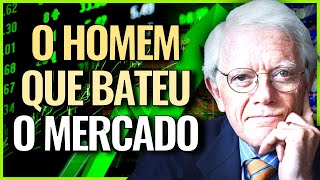
Peter Lynch, considered a Wall Street legend, is a source of inspiration for thousands of people, not only for his extraordinary successes but also for his personal journey. Born on January 19, 1944, in Newton, Massachusetts, USA, he became known for managing a fund that generated a 2,700 percent return for the investors he managed for 13 years.
Despite becoming a legend in the investment world, Peter's first contact with the capital market was quite unusual. Orphaned at the age of seven, he became a golf course carrier in Boston at the age of 10. There, he provided services to a number of magnates, and they constantly discussed the market and soul, topics that caught the attention of middle-class young people who wanted a more comfortable future.
Years later, Lynch pursued academic knowledge and obtained a scholarship to Boston College, where he studied business administration. Furthermore, he shares that his business vision was also shaped by the study of areas such as philosophy, psychology, and... While studying, he also worked, and even with a small salary, he began making his first investments in the stock market.
According to him, his first attack was buying shares of the airline Flying Tiger with an initial investment of $100. Shortly after, Lynch's investment multiplied more than ninefold, not because of his analytical skills, but because of the start of the Vietnam War and his two years of service in the American army.
This showed him that other adverse events can influence his investments. While serving in the army on American soil, Lynch also pursued a postgraduate degree in administration from the prestigious Othon School of Business, the University of Pennsylvania, considered a breeding ground for great names in the world market.
At the age of 25, Lynch had the great opportunity of his life when he was hired to work at Fidelity, a large investment company. This opportunity was opened by the company's president, who coincidentally frequented the golf club where Peter had worked as an assistant for eight years in 1966. Three years earlier, he had already done a summer internship at the company, and it was at this same company that he made his career, becoming the director of research.
In 1974, he became the fund manager of the Magallán Fund in 1977, a position that would make him world- renowned. Initially, he was responsible for a portfolio valued at $20 million, and under his command, the fund took advantage of the great rise in the American market from 1982 to 1987, which placed one million dollars in assets under his custody.
However, it was in 1987 that he faced the largest daily drop the American stock market had ever seen, 22.6 percent on October 19th of that year. Even so, he managed to adopt an investment strategy that allowed the fund to fully recover a little over 14 months later. Although seen as a long-term investor, he often used strategies of constant buying and selling of assets, even daily in some cases.
In this process, he sought stocks with great growth potential that were part of a plan that included stocks with the capacity to multiply the price by 5 to 50 times at the time of purchase, according to his method for identifying the six main categories of winning companies that could generate large returns.
Returns for the number one investor: Slow-growth companies are those that generally pay good dividends. However, investors who want to make money selling shares should analyze the percentage of net profit allocated to dividend payments. The lower this percentage, the greater the margin of safety for future appreciation of the company, and therefore more money will be reinvested in the business.
Number two: Reliable companies, according to him, are large companies that tend to continue for many years. To identify these stocks, it is necessary to analyze whether the price is in good proportion to the profit; whether the price of the company in question is similar to its market competitors. However, he warns that he does not look favorably upon these companies announcing investments in areas outside their main scope; that is, if there is too much diversification in this type of business, he does not take the risk.
Number three: Cyclical companies. According to him, there are companies that experience highs and lows, such as the automotive and construction industries. Therefore, it is important to historically identify when these companies tend to rise and when they tend to fall, analyzing the movement of the market in general, since these businesses are reflections of the economy as a whole.
Number 4: Fast-growing companies, according to Lynch, are important to check for companies that show consistent annual growth rates between 20 and 25 percent, especially when they frequently introduce products with great potential to leverage the business as a whole. He also points out that, according to his convictions, when companies that are already publicly traded show annual growth of 50 to 100 percent, there is something to be suspicious about.
Number 5: Companies in recovery. For Lynch, although risky, investing in companies that are attempting recovery can be interesting as long as they have a public plan for cost containment and a feasible plan for paying off debts to major creditors. Number 6: Companies with hidden assets. According to him, there are companies that cannot accurately account for the assets in their inventory, which may include real estate and other assets whose real value is actually higher than that considered by the company, such as properties in areas that have appreciated significantly but whose asset value has not been updated in the company's inventory through the Capital Market.
Even as an employee, Peter Lynch managed to achieve great success and amass a fortune. A millionaire since he was also a participant in the fund he managed, however, he warns those who want to follow in his footsteps as an investor in the market that the most important organ is the stomach, not the brain.
On the way to work, the amount of news you can hear is practically infinite; the question is, can you handle it? Despite all the success, in 1990 Peter Lynch surprised the market by saying he would be retiring from his executive career at only 45 years old to spend more time with his wife and three daughters.
In total, while he was in charge of a large fund, he accumulated 2,700 percent returns, delivering an accumulated net worth of 14 billion dollars. To be the successor, if someone invested $1,000 in a large fund on May 31, 1977, they would have $28,000 on May 31, 1990. 13 years later, when I leave, I share the lens in an interview with the Bible, and Lynch's performance was so frightening that, in total, he had an average annual return of 29.2 percent, almost double.
The appreciation of the S&P 500 index generated an average annual return of 15.8 percent during the period, numbers that caught the attention not only of people in the market but also of ordinary people, since at the time one in every hundred Americans was a shareholder in the Magellan fund. Another factor that led people to invest in the fund was the large number of advertisements on US television networks that showed Peter Lynch himself in his professorial style, a factor that also demonstrated the importance of establishing credibility with the market.
While he was in charge of the fund, Lynch was not afraid to expose himself to the public, despite the day-to-day running of the business and choosing to live a reasonably discreet life. Since then, he has continued as a member of the Fidelity board, which has helped train a large part of the company's investment analysts over the last 30 years.
Considered a generous figure, Lynch also became a philanthropist and author of books on investing, the most famous of which, known in Brazil as "The Peter Lynch Way of Investing," became a bestseller with over a million copies sold and presents... A series of tips and teachings from an investor who recounts part of his life and the pillars of his vision on investments.
According to him, one of the rules for a successful investor is to invest only in what you know, and to know, according to him, is to truly understand how the company works and what factors will influence its day-to-day operations. And nothing else. Use your specialized knowledge to identify stocks that you can analyze and study.
Then decide if it's worth buying them. If you don't understand the company's balance sheet, you probably shouldn't buy stocks, he told The Wall Street Journal. He even shared the important warning: People are cautious. When buying a house, a refrigerator, or a car, they research for hours to save $100 on an airline ticket, but they are capable of putting $5,000 or $10,000 into a crazy idea they heard on the bus, and that's gambling, not investing.
It's not research, it's pure speculation. One of Elite's great skills was his ability to predict crises and identify scenarios of great price distortion. According to him, before anything else, it's necessary to carefully analyze the relationship between the price and earnings of stocks, the so- called P/E ratio.
Even before the year 2000, he was one of the great [investors/successors]. The text discusses the questioning of the excessive valuation of internet companies, the so- called ".coms," which at the time accumulated prices and reflected 500 times their own profits. It points out a dysfunction that was later proven correct with the bursting of the financial bubble involving these companies, causing thousands of Americans to lose $100 million.
The author, Peter Lynch, now 78 years old, continues his philanthropic work, primarily focused on education. His estimated fortune of $450 million has already been donated to the Boston Collider Institute, where he graduated. He also donated $10 million to create a leadership academy bearing his name, focused on training school principals.
Furthermore, he makes other contributions through his Foundation, which invests in initiatives promoting health, culture, historical preservation, and even religion (as he is a declared Catholic). Because of all his achievements, Victor Lynch is a great source of inspiration for thousands of people, and his trajectory is yet another success story that deserves recognition.
This story will be told on our channel. And don't forget to check out our step-by-step entrepreneur insights channel; our content is in direct, to-the-point cuts to facilitate your learning, and the link is in the description of this video. Remember that we are producing various free content about entrepreneurship on our channel.
To continue receiving our free content, subscribe to our channel and activate the notification bell to receive our updates. We hope you enjoyed it. A big hug and see you soon!


Comments 0